
BİM shelves 150 stationery items at 2025 prices, how should small stationers respond?
BİM, the Turkish grocery chain, has put 150 stationery items on sale at their 2025 prices for the school season and added 49 new products to the category, with sales starting on Sunday, 23 August (Perakende.org, 24 August 2026). The range covers the basics on a school list: water bottles, pencils, erasers, paints, school bags, stitched and spiral notebooks, modelling dough, craft paper, glue, book-cover paper and cork boards.
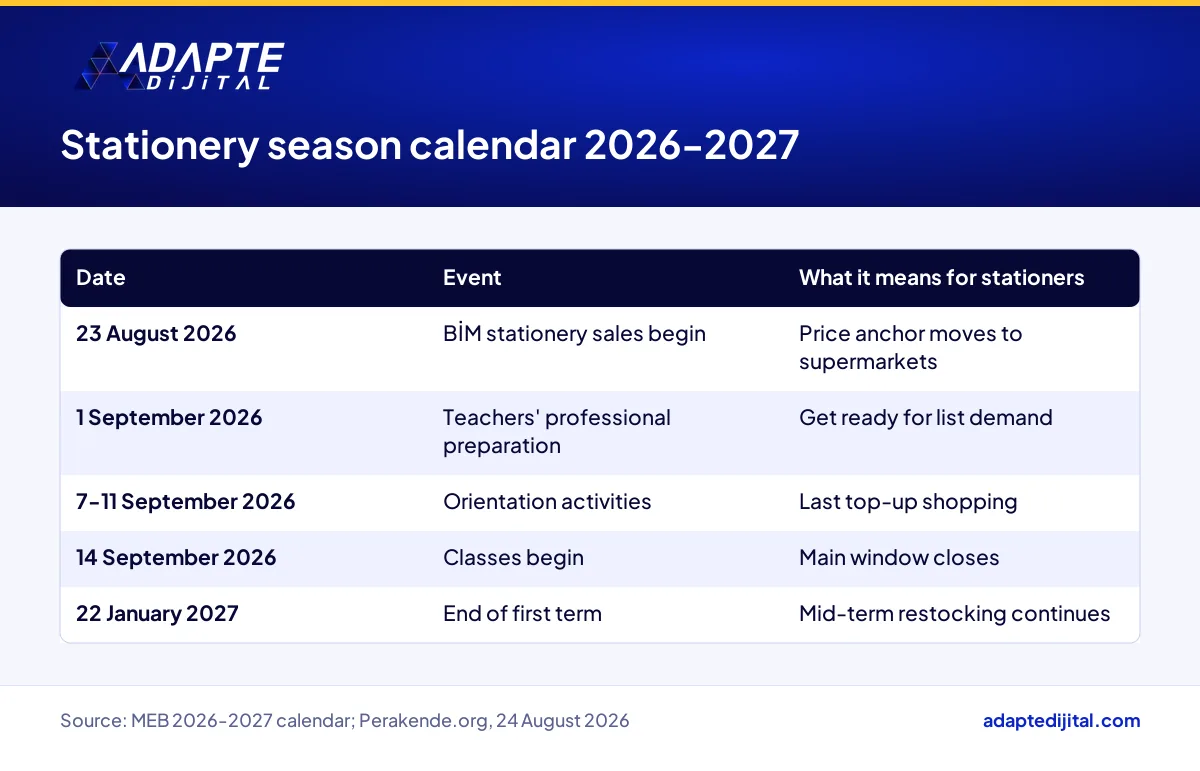
For the neighbourhood stationery shop, the meaning is simple: on the basic items, the chain store now sets the price anchor. Classes started on 14 September 2026, so in October 2026 what lies ahead is mid-term restocking and a selling period that runs to the end of the first term on 22 January 2027. In that period, selling the service a supermarket does not offer is a sounder bet than racing it on price.
Who does BİM’s 2025-priced stationery shelf affect, and how?
BU BÖLÜMÜN ÖZETİ
- Under pressure: the small shop living on basic items
- Less exposed: the shop that sells services and custom orders
- Indirectly hit: the wholesaler supplying stationery shops
It hits hardest the small stationery shop that makes most of its turnover from notebooks, pencils and paints. BİM had 14,851 stores in total at the end of the second quarter of 2026, after opening 275 new ones in that quarter (Bloomberg HT, 18 August 2026). That reach means many neighbourhood stationery shops across Türkiye in autumn 2026 have a shelf with the same prices just down the street.
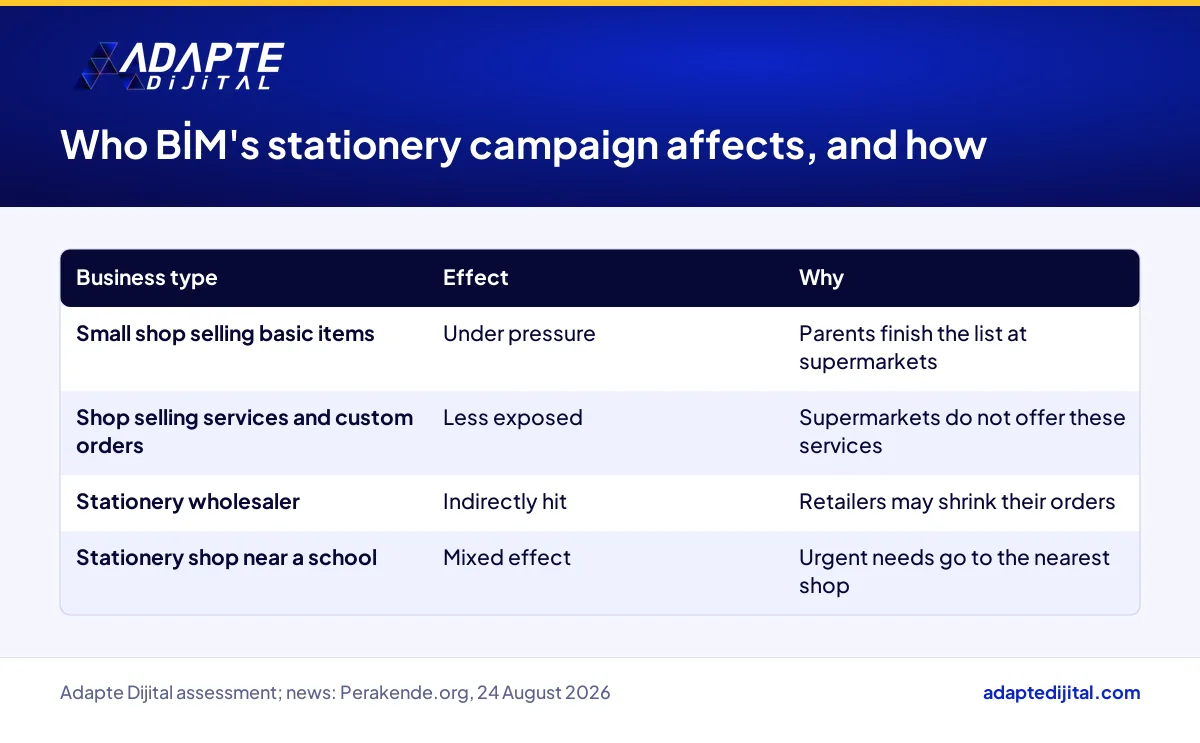
Under pressure: the small shop living on basic items
When parents finish the list at the supermarket, the till goes quiet. Average basket size drops, because customers only drop by for the one or two items they could not find elsewhere.
Less exposed: the shop that sells services and custom orders
Photocopying, printing, binding, ready-made packs built from the school list and name labels are things a supermarket shelf does not cover. A shop that earns from these lines keeps the price pressure confined to the basics.
Indirectly hit: the wholesaler supplying stationery shops
If retailers shrink their orders for basic items, the wholesaler’s season volume shrinks too. The conversation with your wholesaler this season is less about price and more about returns and the flexibility to order in smaller batches.
Should a stationery shop compete with BİM on price, or on something else?
No, matching prices across all the basic items would wipe out the margin of most neighbourhood shops. A chain buys at scale, while you buy in small quantities. So the right question is which products you keep close to the supermarket price and where you stand apart through service. BİM Trade President Umut Baba describes supporting customers’ budgets as one of the company’s priority responsibilities.
The most common mistake: putting the whole shelf on sale
The first reflex after hearing about the campaign is to cut every price tag. The result: turnover stays flat at the end of the season, the profit disappears and stock still sits in the back room. Limit discounts to your traffic-building items.
Which formula should a stationery shop use to check its margin this season?
Use a three-line calculation: unit contribution, break-even volume and each product group’s share of turnover. The report gives no product-level prices, so you will work it out with your own buying and selling figures. This is information for a decision, not pricing advice.
- Unit contribution = selling price minus purchase price (per item).
- Season contribution = unit contribution × units sold last season.
- New unit contribution if you match the supermarket = supermarket price minus purchase price.
- Units needed = season contribution ÷ new unit contribution.
- If the units needed exceed last season’s units, do not compete on price for that item.
Which weeks does Türkiye’s 2026 school calendar pack stationery sales into?
The main rush falls in the roughly three-week window between 23 August and 14 September. According to the 2026-2027 calendar from MEB, Türkiye’s Ministry of National Education, teachers start professional preparation on 1 September, orientation activities run from 7 to 11 September and classes begin on 14 September 2026. The first term ends on 22 January 2027.
What should change on a stationery shop’s digital side after BİM’s campaign?
A stationery shop’s digital job is to show up in “stationery shop near me” searches as open, stocked and offering services. While the supermarket talks price, you make speed, ready-made packs and services such as photocopying visible. Local visibility is the one area where the neighbourhood shop does not share a shelf with the supermarket.
What should a stationery shop owner do this week?
BU BÖLÜMÜN ÖZETİ
- Step 1: Split last season’s sales into three groups
- Step 2: Put what the supermarket does not stock at eye level
- Step 3: Put services on the till as their own line
Do a three-step job: split your sales, rearrange the shelf and put services on the till. Each step takes a few hours and runs on your own numbers. Pricing by a different unit than the item is another option; Migros’s pay-by-weight restaurant is an example of this in food service.
Step 1: Split last season’s sales into three groups
Sort your products into traffic builders, profit makers and slow sellers. Write down each group’s share of turnover as a percentage.
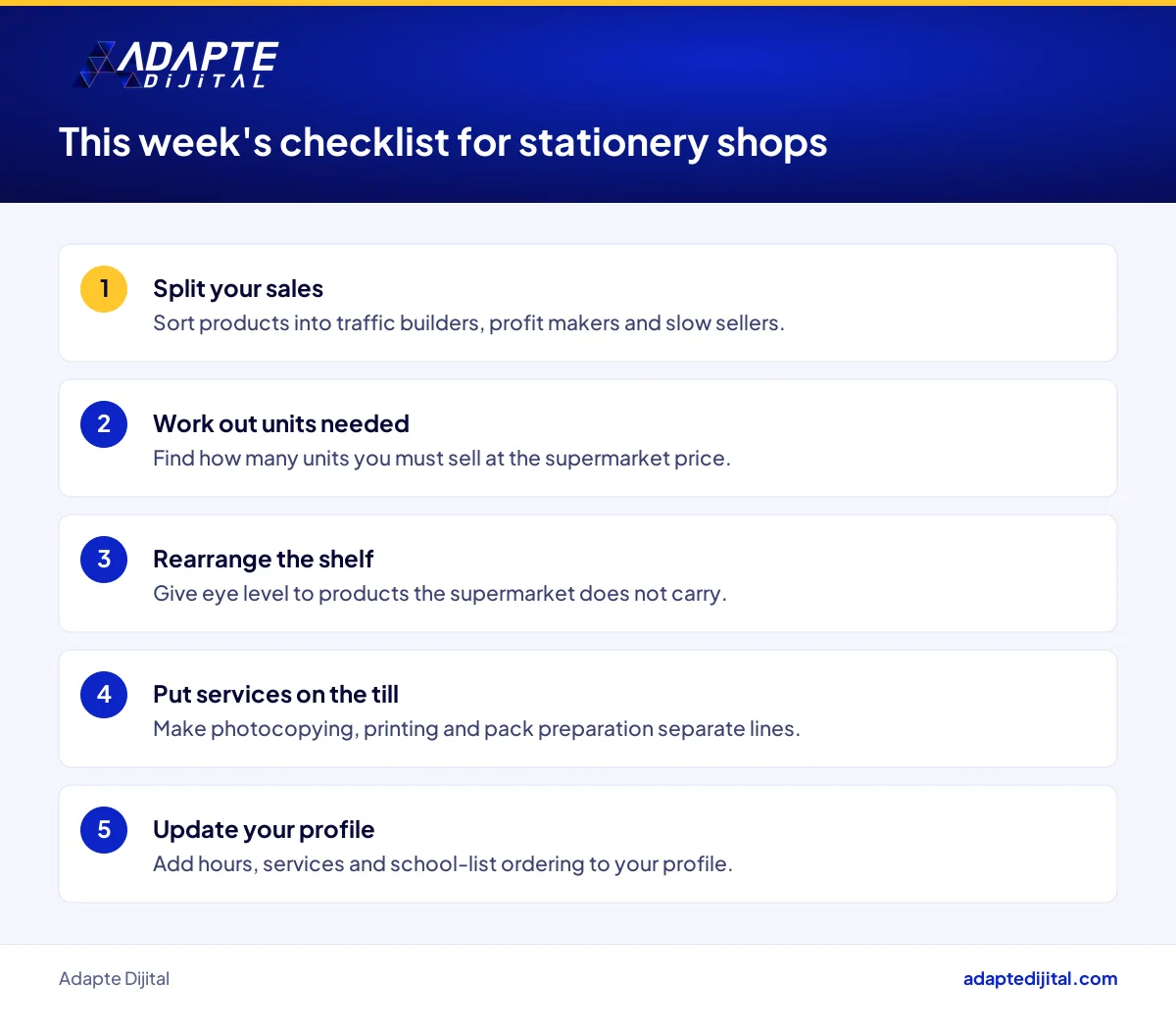
Step 2: Put what the supermarket does not stock at eye level
Move the items the supermarket also carries to your back shelves. Give eye level to art supplies, project materials and ready-made list packs. Hand your best shelf space to the products that leave a profit.
Step 3: Put services on the till as their own line
Make photocopying, printing, binding and pack preparation separate sales lines. That way you see each month how much of your turnover comes from services. We run local visibility and campaign planning for stationery and retail businesses as part of our digital marketing services.
Quick Summary
- BİM put 150 stationery items on sale at 2025 prices and added 49 new products (Perakende.org, 24 August 2026).
- Sales started on 23 August, and classes began on 14 September 2026 (Perakende.org; MEB).
- Matching supermarket prices on basic items wipes out a small shop’s margin.
- A units-needed calculation shows on which items you can safely match the price.
- Services, ready-made packs and local visibility are areas the supermarket does not enter.
Short Glossary
- Price anchor
- A price anchor is the term used to describe the first price a customer uses as a reference when judging a product.
- Unit contribution
- Unit contribution is the measure used to describe what is left of a product’s selling price after the purchase price is deducted.
- Break-even volume
- Break-even volume is the threshold used to describe how many units must be sold to cover fixed costs.
Frequently Asked Questions
Next Step
If you would like to review your shop’s sales data and local visibility together, fill in our consult your expert form.
Sources: Perakende.org, 24 August 2026 · Ministry of National Education (MEB), 2026-2027 school year calendar · Bloomberg HT, 18 August 2026
Updated: October 2026
Sık Sorulan Sorular
Every product you drop to the supermarket price earns you less per unit. To keep the same profit, you have to sell many more units of it. If your foot traffic cannot carry that volume, the discount grows your loss, not your turnover.
You can match on a handful of items that bring people through the door and whose price everyone knows. Small-ticket items such as pencils and erasers suit this role. The rest of the shelf sells on service, range and speed.
Take the purchase price from your latest invoice and subtract it from the shelf price. What is left is the money that item leaves in the till.
Divide your monthly fixed costs by your average unit contribution. The result is the number of units you need to sell to close the month without a loss.
Rank last season’s sales by SKU, the stock-keeping unit that identifies each product. The top group brings in traffic, and the bottom group just takes up shelf space. Fill the space of the slow sellers with services or with a range the supermarket does not carry.
List shopping ends before school opens. Demand after the first day of class comes from missing items or things a teacher asks for later. That demand is small but urgent, and it goes to the nearest shop.
Used-up notebooks, lost pencils, and card and glue for project homework sell all term long. This shopping is far less price-sensitive than list shopping. The customer wants the item tonight and does not go hunting for a supermarket promotion.
Start collecting your sales data from the end of the first term. When MEB announces next year’s calendar, calculate your window from there. Our retail page, where we interpret retail news for you, helps you turn those dates into a plan.
Opening hours, phone number, a list of services and recent photos should all be complete. School-list packing and printing should appear as separate lines in the services section. Customers see what to expect before they walk to your door, so they do not turn back at it.
Set up a flow where parents send a photo of the list on WhatsApp, and you pack the order and give them a pick-up time. A supermarket does not offer this convenience. Those photos also show you which items were requested.
Your district name combined with “stationery”, “photocopy”, “school list” and “binding” should appear in natural sentences in your profile description. We also look at growth and location choices for local retailers through Onur Market’s new store in Maslak.
The report gives no product-level prices or discount rates. It only states that the items are sold at their 2025 prices.
No. Demand for used-up notebooks, lost pencils and project materials continues until the end of the first term on 22 January 2027.
Not across the whole shelf. You can match on a few items that bring customers in, and standing apart through service and range is safer for the rest.