
Migros opens a pay-by-weight restaurant at Viaport, does gram pricing suit a small eatery?
Migros has opened “GurmeMutfak Gramla”, a restaurant priced by weight instead of fixed portions, inside its 5M Migros store at Viaport, a shopping mall in Istanbul, in partnership with CRC Kurumsal (Perakende Türkiye, 12 August 2026). The menu offers hot dishes, a salad bar, bowls and world cuisine, along with vegetarian and gluten-free options.
Here’s something most people don’t know: the restaurant is not on the mall’s food court floor but inside the grocery store itself. For a small restaurant or café owner, the question is simple but important: would selling by weight instead of by portion work for my kitchen and my till?
How does pay-by-weight pricing work at Migros’s GurmeMutfak Gramla?
Customers fill their own plates, the plate is weighed, and the bill follows the weight. There are no fixed portions. The technical name is “weight-based pricing”; in everyday words it means “pay for what you take”. The report gives no price per gram or per kilogram, so no price comparison is possible.
What does Migros aim to gain from weight-based pricing, for itself and its customers?
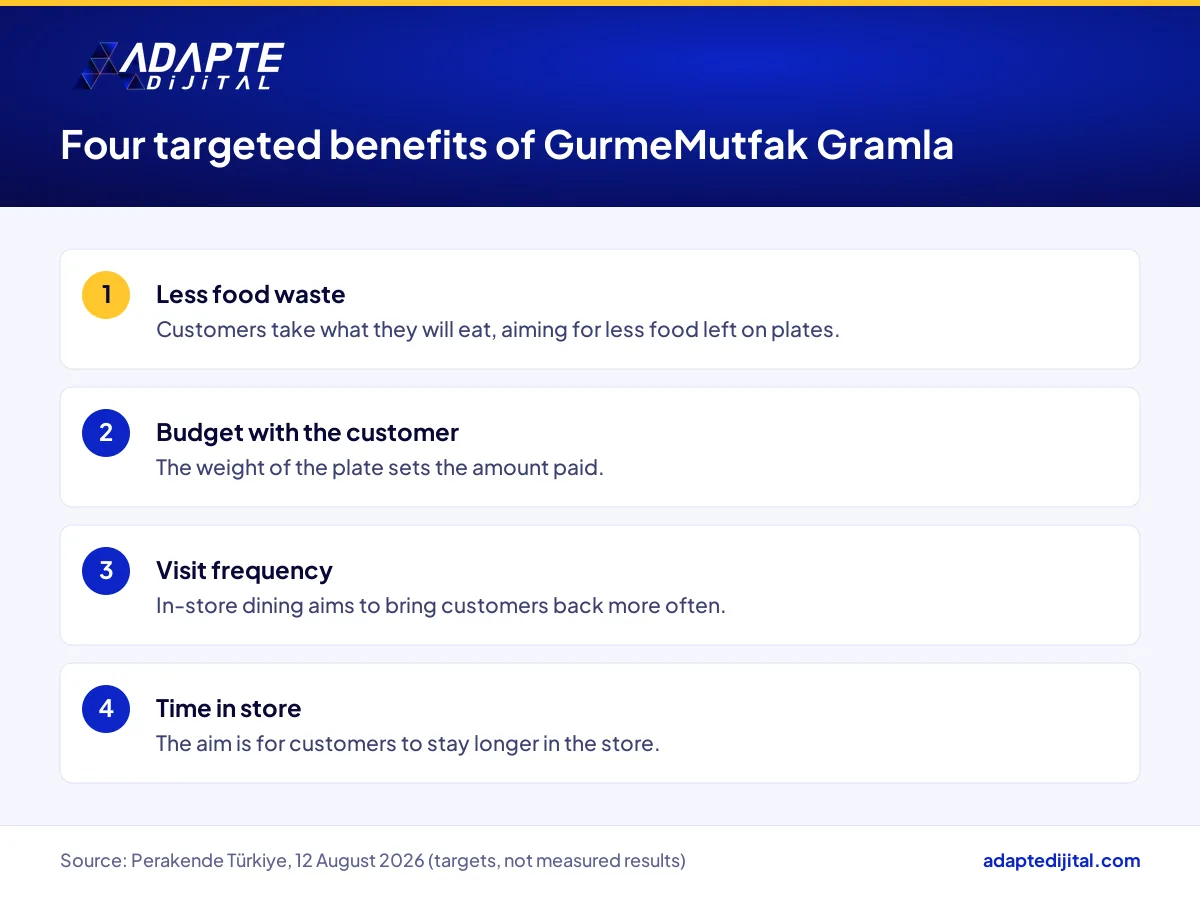
It aims for four things: less food waste, a budget in the customer’s hands, more frequent visits and longer time spent in the store. The report presents these as goals; no measured waste or visit data has been published. Cüneyt Taşpek, Deputy General Manager for Sales at Migros, says consumers are looking for a personalised experience in eating out as well.
Who does a pay-by-weight restaurant inside a grocery store affect, and how?
BU BÖLÜMÜN ÖZETİ
- Under pressure: the mall restaurant with a fixed lunch menu
- Seeing an opening: the café selling salads and bowls
- Indirectly affected: contract caterers and ready-meal suppliers
It matters most to small lunch restaurants in Istanbul’s AVMs, the Turkish term for shopping malls, in autumn 2026. An office worker who finds a fast plate with a budget of their own choosing inside the supermarket can eat without going up to the food court. For a café selling salads and bowls, the model is both a competitor and a source of ideas.
Under pressure: the mall restaurant with a fixed lunch menu
A single-price lunch menu can turn away the customer who only wants a little. If the same building has an option priced by the scale, that customer drifts there. A restaurant relying on table turnover sees that drift at the till first.
Seeing an opening: the café selling salads and bowls
A café whose ingredients already sit in an open counter can try the same setup with a scale quite easily. Customers already choose by looking at their plate; the scale only changes how the price is set.
Indirectly affected: contract caterers and ready-meal suppliers
If in-store dining grows, stores that do not want to build a kitchen will turn to ready-meal supply. We follow shifts like this alongside the retail agenda on our retail page.
Does pay-by-weight pricing suit a small restaurant or café?
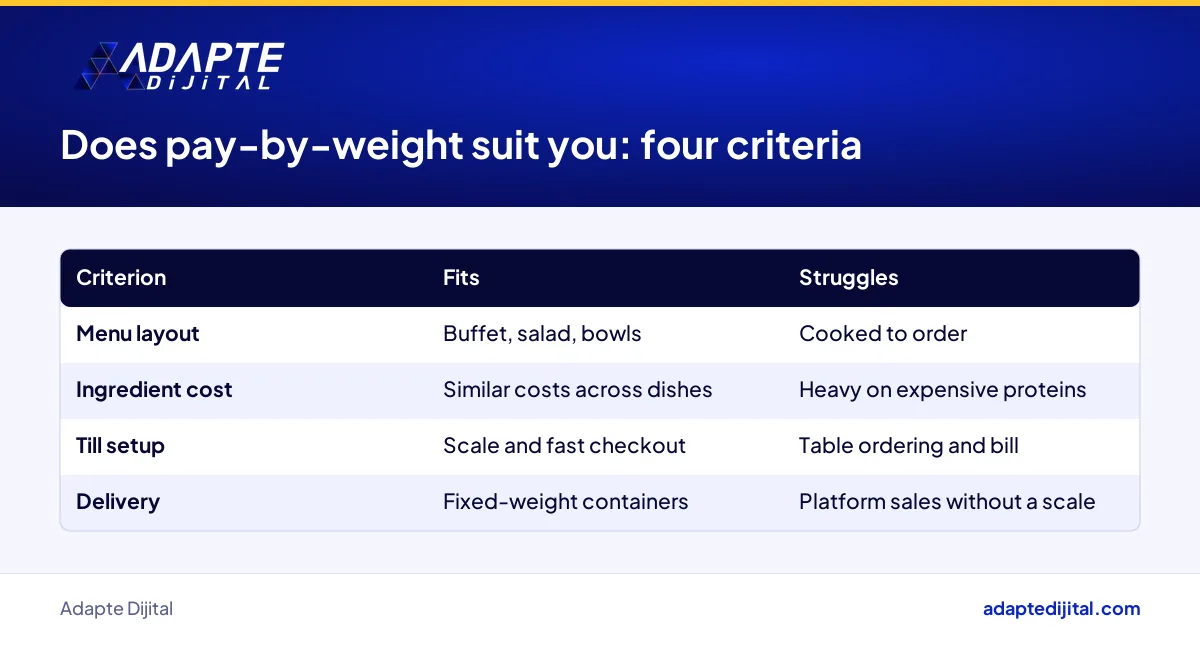
It can, if your menu is made of dishes displayed on an open counter with similar costs. It is harder in a kitchen that cooks to order and leans on expensive proteins. The decision rests on three criteria: menu layout, the spread of ingredient costs and how your till works.
How should a pay-by-weight restaurant show its menu and prices online?
The digital job of a business selling by weight is to answer “how much will I pay” before the customer reaches the door. The price per gram and a sample plate should be written the same way on your business profile, your menu page and delivery platforms. Data from the scale and the till also becomes raw material for menu decisions.
What should a food business owner do this week to test pay-by-weight pricing?
BU BÖLÜMÜN ÖZETİ
- Weigh your current portions
- Start with a single station
- Write the price in one sentence
Set up a small trial without changing the whole kitchen. First find out how many grams your current plates really weigh, then sell by weight at a single station. Let your own scale’s data make the call, not a hunch.
Weigh your current portions
For one week, weigh the plates that leave the kitchen and what comes back on them. That shows how many grams you really serve when you sell by portion. You build your price per gram on that number.
Start with a single station
Move the salad or bowl counter to the scale and keep main dishes priced by portion. Running both side by side shows where your average basket is heading.
Write the price in one sentence
Use the same sentence on the counter, on your profile and on your website: the price per gram and an average plate. We set up digital menus, data and local visibility for food businesses as part of our digital consulting work.
Now you know: pay-by-weight is not a price tag but a way of running a kitchen. The Migros trial makes the model visible; whether it fits your kitchen is something only your own scale can tell you.
Quick Summary
- Migros opened the pay-by-weight restaurant “GurmeMutfak Gramla” in its 5M store at Viaport (Perakende Türkiye, 12 August 2026).
- Benefits for waste, budget, visit frequency and time in store were announced as targets, not measured results.
- Migros says it has 3,784 stores in 81 provinces, and the restaurant is in just one of them (Migros corporate website).
- Pay-by-weight fits open-counter menus such as buffets, salads and bowls more easily.
- The safest route for a small business is to trial a scale at a single station.
Short Glossary
- Weight-based pricing
- Weight-based pricing is the method used to charge for food by its weighed amount instead of by portion.
- Food cost percentage
- Food cost percentage is the ratio used to show what share of the selling price goes on ingredients.
- Table turnover
- Table turnover is the indicator used to measure how many times a table serves new customers in a given period.
Frequently Asked Questions
Next Step
If you would like to assess together whether your menu suits pay-by-weight pricing, fill in our consult your expert form.
Sources: Perakende Türkiye, 12 August 2026 · Migros corporate website (migroskurumsal.com)
Updated: October 2026
Sık Sorulan Sorular
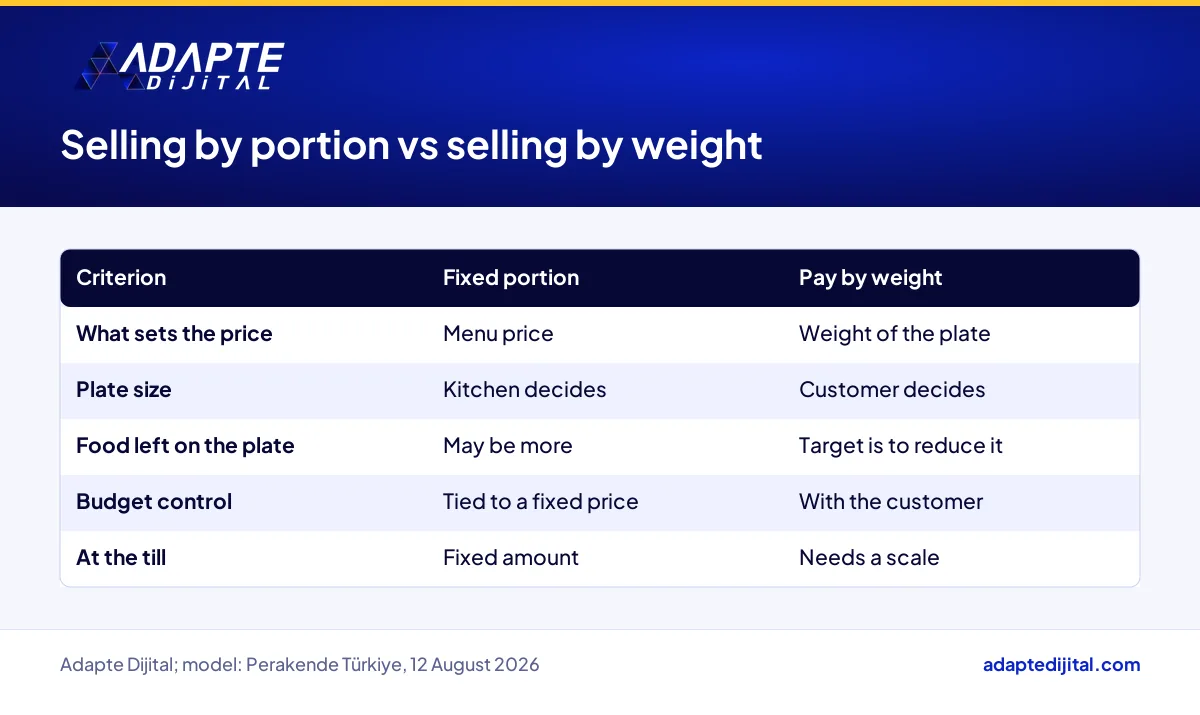
The weight of the plate sets the price. The kitchen no longer thinks in terms of “how many ladles make a portion”; the customer becomes the chef of their own plate. The scale works like a referee who never takes sides: a light plate means a light receipt.
The report lists hot dishes, a salad bar, bowls and world cuisine. Vegetarian and gluten-free options mean that customers with different dietary needs can build their own plate from the same counter.
The report says the concept opened as a partnership between Migros and CRC Kurumsal. Whether CRC Kurumsal runs the restaurant or supplies it is not clear. So we make no assumption about who handles the day-to-day operation.
The logic goes like this: if customers take only what they will eat, less food is left on the plate. On the kitchen side, how much food from the counter is left over at the end of the day is a separate question. Without measuring both, nobody can say waste went down.
With portion pricing, the menu price is fixed, so a light eater pays the same as a big eater. With pay-by-weight, customers do the maths in their heads while filling the plate. That makes the price visible, but it also brings the risk of a surprise at the till.
A lesser-known comparison shows the scale of the test. According to the Migros corporate website, the company serves customers with 3,784 stores and more than 77,000 employees across all 81 provinces of Türkiye; the restaurant sits in just one of those stores. The report mentions no plan to roll it out further, so it is fairer to read Viaport as a test site for now.
Buffets, salad bars and bowls, where customers make their own choices, work well. A dish cooked to order does not fit, because the kitchen decides what goes on the scale.
Divide the ingredient cost of a tray of food by its sellable weight. Then divide that unit cost by your target food cost percentage to reach a price per gram. Food cost percentage simply shows how much of the selling price goes on ingredients.
Selling an expensive ingredient at the same price per gram as a cheap one eats into your profit. If you use one price, price the expensive protein separately or serve it in a small dish on the counter.
Rules on measuring instruments and price display apply when you sell by weight. Verify with the official source; this is not legal or financial advice.
State your price per 100 grams or per kilogram clearly on your business profile and website. A vague price is a reason for someone who found you in search to give up.
Delivery platforms have no scale, so for delivery you need to sell fixed-weight containers. The same kitchen can work by weight in the dining room and by portion for delivery.
Every receipt records the plate’s weight and the time. That data shows which plates get bigger at which hours; we look at how menu data turns into decisions through Doyuyo’s menu rankings. For the question of where that data lives, Pazarama’s move to Google Cloud is a useful example.
The report does not share a price per gram or per kilogram. You need to check the current price at the store.
Yes, if the menu sits on an open counter and the dishes cost roughly the same to make. Starting with a single station lowers the risk.
Not definitely. Migros presents lower waste as a target; to see the result in your own business, you need to weigh plate leftovers and what remains at the end of the day.