
Coffee Factory passed 45 stores in 10 provinces, is franchising or central control safer?
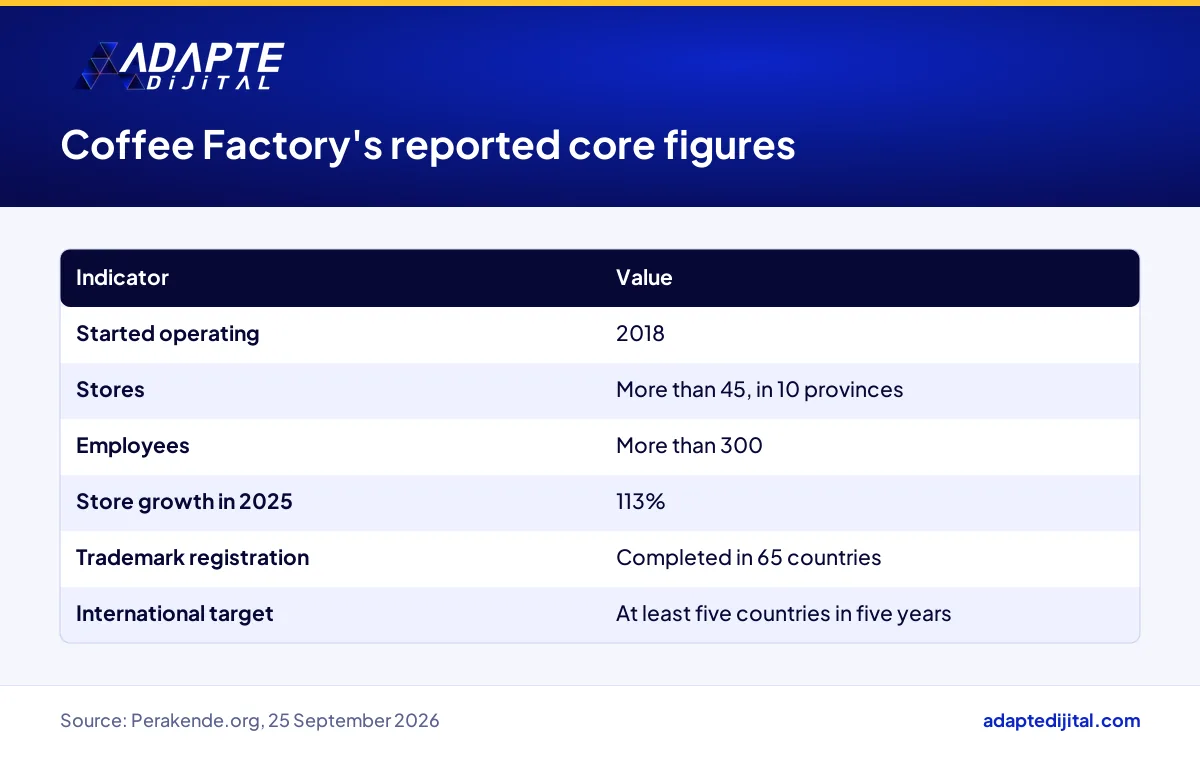
Coffee Factory has passed 45 stores across 10 Turkish provinces and, while it keeps growing through franchising, aims to raise the share of company-run stores (Perakende.org, 25 September 2026). The brand started operating in 2018, employs more than 300 people, grew its store count by 113 percent in 2025 and is opening new locations in Istanbul. The story also says its trademark registration is complete in 65 countries and that the target is to be active in at least five countries within five years.
If you are building a café chain or thinking about buying a franchise, here is what this means for you: even a fast-growing brand wants to pull control back to the center. Franchising brings speed, company-run stores hold quality, and the balance between them becomes a question of cost and oversight. The decision is yours, and the right question is which model fits your ability to inspect.
What is behind Coffee Factory’s growth past 45 stores in 10 provinces?
Three things: a fast rise in store numbers, a goal to grow the share of company-run stores and preparation for going abroad. General Manager Batuhan Şahin says in the story that the company does not see growth “only as increasing the number of stores”. That line describes growth built around control more than count. In the Turkish café chain market in autumn 2026, that emphasis stands out.
Franchise or central control: which is safer for a café chain like Coffee Factory?
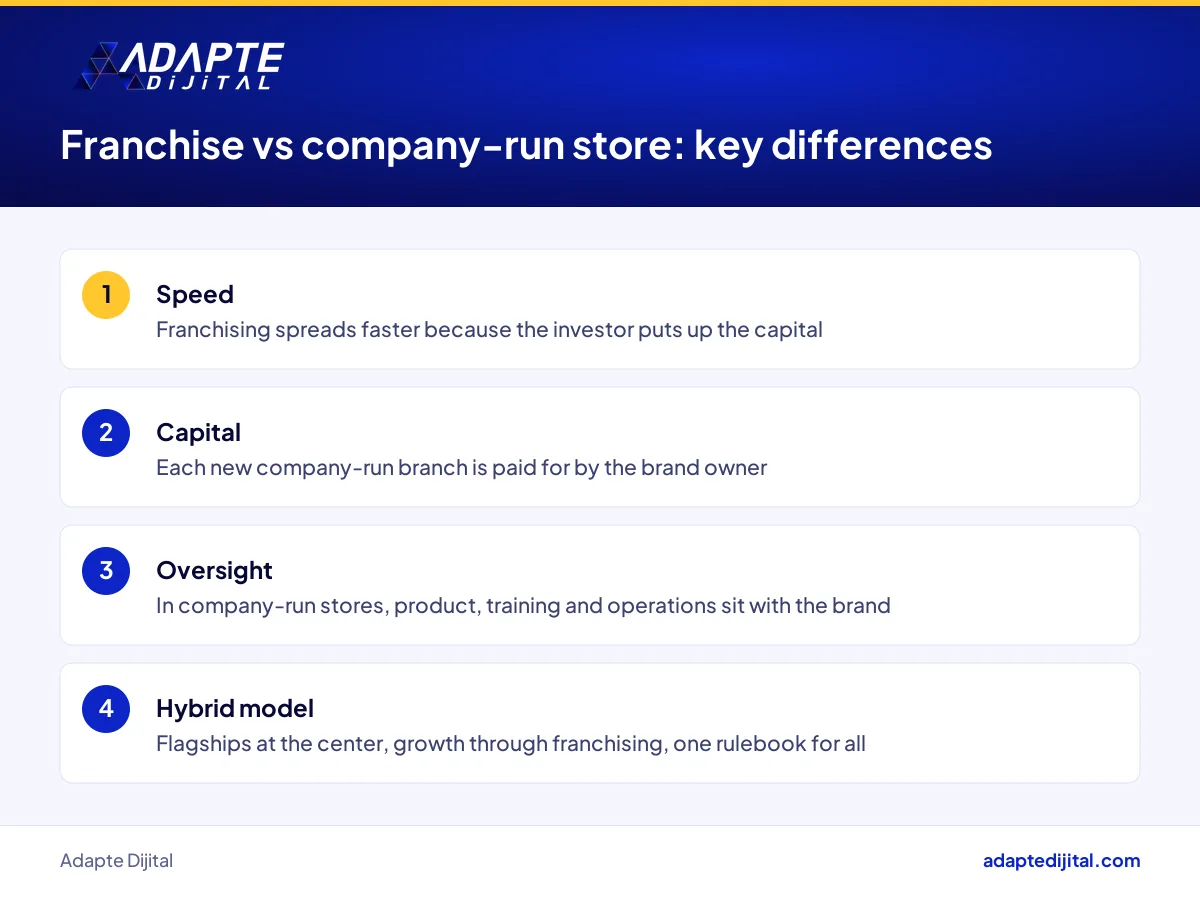
Neither is safe on its own; the safe choice is mixing the two to match your ability to inspect. Franchising spreads fast because the investor puts up the capital. A company-run store spreads slowly but keeps quality in your hands. Coffee Factory’s goal reads like shifting that mix toward company-run stores.
How much does a Coffee Factory café franchise cost?
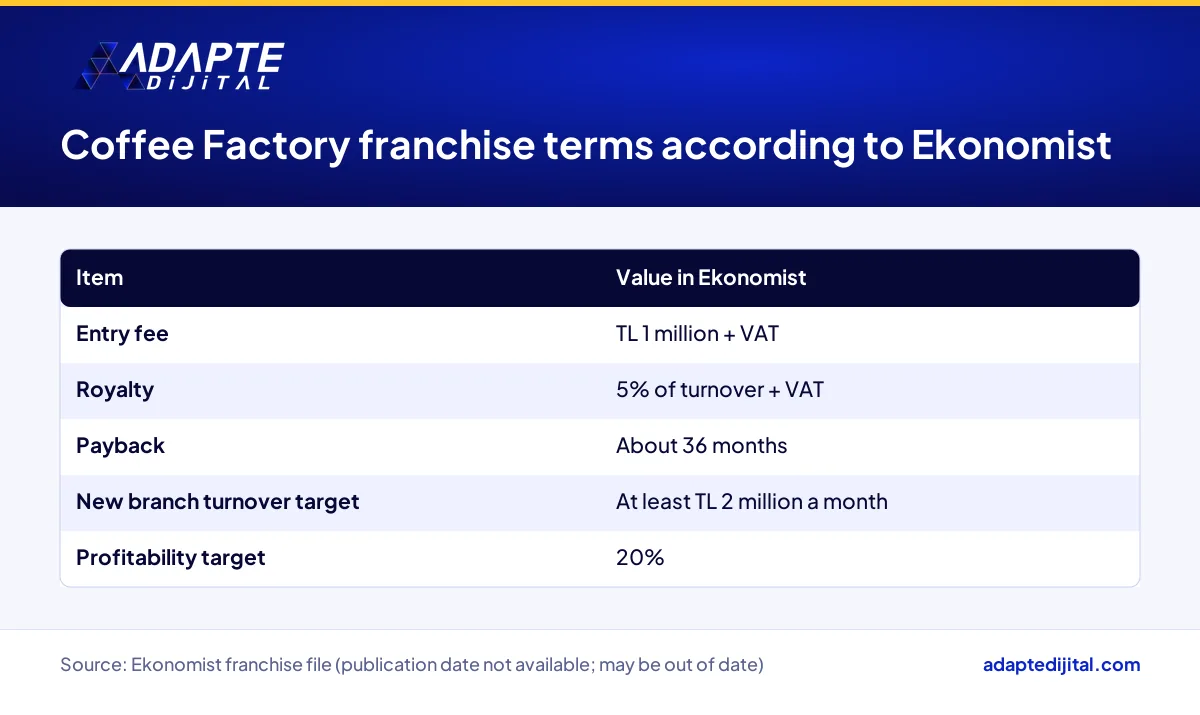
According to Ekonomist’s franchise file on Coffee Factory, the entry fee is TL 1 million plus VAT, the royalty is 5 percent of turnover plus VAT and payback takes about 36 months. The same file says a new branch targets at least TL 2 million in monthly turnover and 20 percent profitability. The file’s publication date could not be confirmed, so these figures may be out of date. When you get an offer, confirm the numbers with the brand in writing.
Who does Coffee Factory’s growth model affect, and how?
Franchise investors, independent neighborhood coffee shops and café landlords feel it most directly. Investors may face tighter inspection. The independent shop may compete with a chain running a standard menu on the same street. Landlords may see more chain cafés in their tenant mix.
How should a café chain like Coffee Factory set up digital oversight and visibility?
In three places: map profiles, shared inspection data and protecting the brand name in search. As a chain grows, every branch carries its own digital face. If those faces are not managed from the center, customers see different hours, different menus and different photos at each branch. Central oversight has to work online too.
What should a business owner considering a Coffee Factory-style franchise do this week?
BU BÖLÜMÜN ÖZETİ
- Ask for the draft contract and the operations manual
- Spend a day in one branch
- Build the numbers with your own figures
Do three things this week: ask for the draft contract, spend a full day in one branch and rebuild the numbers with figures from your own street. None of this requires a signature. But all three belong before you sign.
Ask for the draft contract and the operations manual
See the royalty, territorial protection, termination and transfer clauses in the draft. If there is an operations manual, it tells you what inspections actually measure. In a system without one, inspection depends on the inspector’s mood that day.
Spend a day in one branch
Sit in a branch from opening to closing. Note when the queue grows, when customers turn around at the door and at what hour the average basket rises. One day of watching tells you more than any table in a pitch deck.
Build the numbers with your own figures
Write down rent, staff, entry fee and royalty for your own location. Keep your turnover estimate conservative and work out the payback period yourself. We work through growth and digital oversight decisions like these with businesses as part of our digital consulting work.
We look at what a local food tie-in does for a brand through Nutella Café’s pairing with Ankara simit. For other developments, see our retail page, where we interpret the retail agenda for you.
The desk’s advice: if you can measure inspection on a screen rather than on paper, grow through franchising; if you cannot, write your standard in company-run stores first.
Quick Summary
- Coffee Factory has more than 45 stores in 10 provinces and more than 300 employees (Perakende.org, 25 September 2026).
- The brand grew its store count by 113 percent in 2025; the base figure was not disclosed (Perakende.org).
- It aims to raise the share of company-run stores and tighten central oversight while franchising continues.
- Trademark registration is complete in 65 countries, and the goal is to be active in at least five countries within five years (Perakende.org).
- According to Ekonomist, the entry fee is TL 1 million plus VAT and the royalty is 5 percent of turnover plus VAT; the figures may be out of date.
Short Glossary
- Royalty
- A royalty is the recurring fee, usually tied to turnover, used to pay a brand for the right to operate under its name in a franchise.
- Company-run store
- A company-run store is the branch model used when the brand owner operates a location directly rather than through a franchisee.
- Operations manual
- An operations manual is the written rulebook used to apply the same standard in every branch of a chain.
Frequently Asked Questions
Next Step
If you want to review your growth model and digital oversight setup together, fill in the consult your expert form.
Sources: Perakende.org, 25 September 2026 · Ekonomist, Coffee Factory franchise file (publication date not available) · Ekonomist, the franchise race among coffee chains · TÜRKPATENT trademark page
Updated: October 2026
Sık Sorulan Sorular
Look, 113 percent growth is a strong number, but the story does not give the store count at the end of 2024. Reading a growth rate without its base is misleading. The split between franchised and company-run stores is not given in numbers either. We have a direction, not a ratio.
According to the story, the brand aims to raise the share of company-run stores while it keeps franchising. That is a wish to keep the standard for product, training and daily operations in its own hands. Every growing chain hits the same question at some point: does every store serve the same coffee with the same taste?
The story says registration is complete in 65 countries and that work is under way in Germany, the UK, Iraq and Azerbaijan. It is not clear which system the registration used, or whether the work in those four countries means openings or talks. You can see how trademark protection works before going abroad on the TÜRKPATENT trademark page, Türkiye’s patent and trademark office. Verify with the official source; this is not legal or financial advice.
In a franchise, the investor takes on the rent, the fit-out and the staff. The brand owner provides know-how, product and the name. That is why store numbers can rise in a short time. The price: in each shop, you are not the one making the calls.
In a company-run store, barista training, recipes and the till routine are directly yours. Customer complaints come to you, and you fix them. But every new shop is paid for out of your own pocket; when the capital runs out, growth stops.
The system we suggest: flagship stores at the center, growth through franchising, one rulebook for everyone. Company-run stores define the standard and double as training sites. Franchised stores carry that standard through measurable rules. Inspection then scores both sides against the same checklist.
The entry fee is paid once; the royalty comes out of turnover every month. Because it is calculated on turnover rather than profit, the payment continues even in a bad month. In the month the till goes quiet, that line is still on the table. Build your budget around that fact.
The payback period is an estimate that depends on hitting the turnover target. Rent, location and staff costs vary from city to city. The real question: is the turnover in that spreadsheet possible on your street? Test it with your own eyes before you invest.
What the contract says in that case is the most important clause. A franchise contract is like a marriage: you read the separation clause before the wedding. Go through termination, transfer and territorial protection with a lawyer. This is not investment advice.
Stronger central oversight can mean less freedom over product, training and daily operations. That is not a loss; it is a trade. As long as the brand keeps its quality, the investor’s store is protected too, but the feeling of “my own shop” shrinks.
According to Ekonomist, chains are growing fast through franchising; the same file lists more than 240 stores for Gloria Jean’s and a target of 250 stores by the end of 2026 for Coffy. A chain arrives on your street with a known name and standard prices. The independent shop stands apart by knowing customers by name, roasting its own beans and keeping local ties.
Café landlords, equipment and coffee bean suppliers and businesses that train café staff are touched indirectly. A chain that tightens central control also wants uniform products from suppliers. For a supplier, that means a large customer with strict rules.
Anyone who reads branch reviews often notices the same pattern: customer complaints pile up most there, but head office is often the last to see them. Ownership of the profiles should sit at the center, and the right to reply at the branch.
Coffee Factory says every store is inspected regularly. An inspection that stays on paper only records that day. Kept in a shared digital list, it makes differences between branches visible. Let’s say one branch keeps getting its morning delivery late; the screen shows it in week one, not week three.
We could not reach a website that can be confirmed as Coffee Factory’s official site. As a chain grows, different pages carrying its name can appear. When the official site, verified social accounts and branch pages link to each other, customers end up in the right place. We look at the digital loyalty side separately through Praticar’s digital rental experience.
According to Perakende.org on 25 September 2026, the brand has more than 45 stores in 10 provinces of Türkiye. The split between franchised and company-run stores was not given in numbers.
According to Ekonomist’s franchise file, the entry fee is TL 1 million plus VAT and the royalty is 5 percent of turnover plus VAT. The file’s date is unclear, so confirm current terms with the brand in writing.
If your standard is not written down, it is safer to set the rules in company-run stores first. Growing through franchising after inspection becomes measurable lowers the risk.