
Migros publishes pesticide results in its app, how can smaller grocers prove food safety?
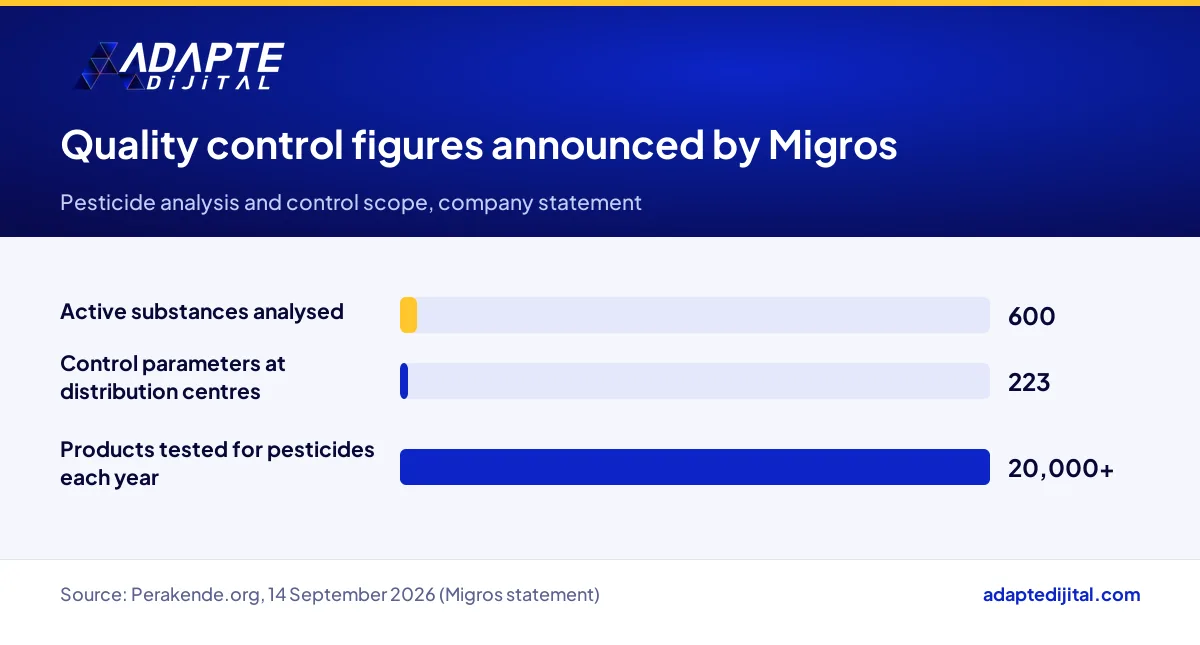
Supermarket chain Migros now publishes pesticide test results for its fruit and vegetables in Migros Sanal Market, its online grocery store, inside each product’s “product description” tab (Perakende.org, 14 September 2026). According to the company, more than 20,000 products a year go through pesticide analysis in accredited laboratories, and its laboratory in Kocayatak, Antalya, screens for 600 different active substances.
For you, it means food safety is moving from a promise made at the shelf to information a shopper reads on the product page. In autumn 2026, any grocer, greengrocer or deli selling food online in Türkiye faces the same question: how do you show that kind of trust without a laboratory network, and with which documents?
Where and how does Migros show its pesticide results in Sanal Market?
The results sit in the “product description” tab of fruit and vegetable listings in Migros Sanal Market. The shopper sees the analysis on the same page where they add tomatoes to the basket. The news does not say which products or batches the results cover, or whether in-store shoppers can see them through a QR code or similar.
Why would a grocery chain like Migros put pesticide data on the product page?
Because online, the shopper cannot touch or smell the produce. All they have is a photo, a price and a description. According to 2026 data from TÜİK, Türkiye’s statistics institute, the share of people ordering online has reached 60%; at that scale, trust information on the product page becomes part of the basket decision.
How does the food transparency race affect grocers, greengrocers and online food sellers?
The winner is the business that knows its suppliers and keeps its paperwork in order. The one under pressure is the seller who buys produce from whichever wholesale market stall is cheapest that morning and can show no records at all. Producers feel it indirectly, as retailers start asking for documents.
Without a laboratory, what data can a small grocer use to prove food safety?
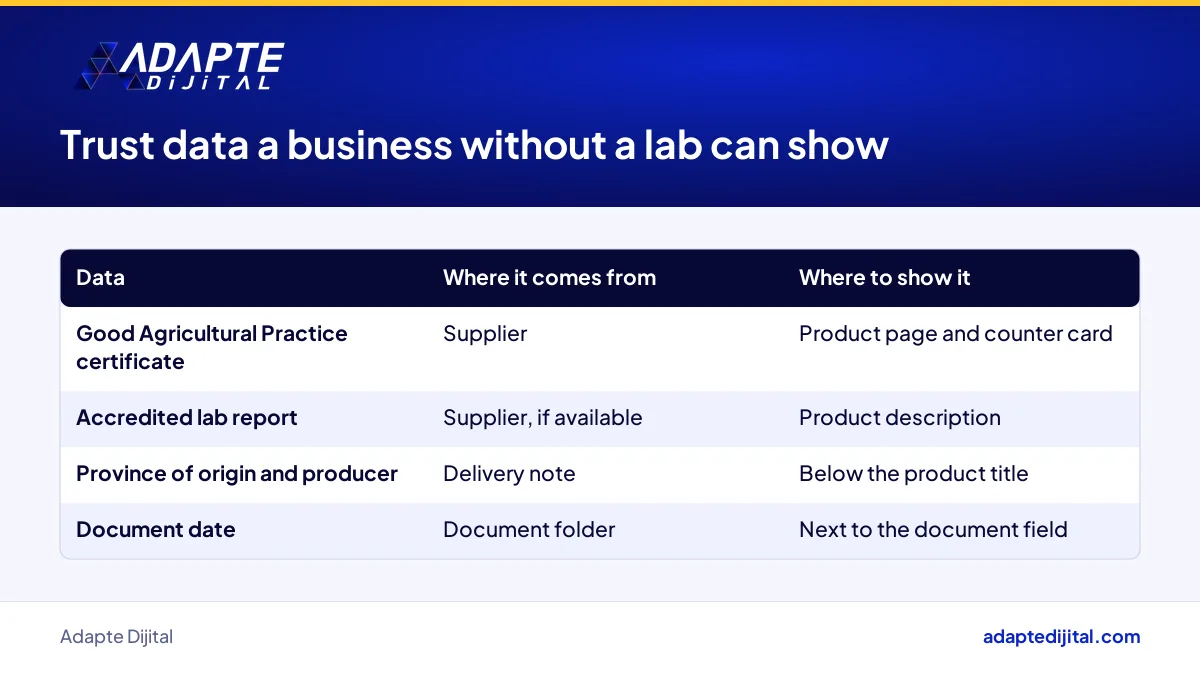
The documents you already have. Your supplier’s Good Agricultural Practice certificate, the region and producer the item comes from, any analysis report your supplier got from an accredited lab, and the delivery date are all concrete data a small business can show.
Let’s say you run a corner market, and this morning’s tomatoes arrive from the wholesale market. Next to the till there is a small card on the counter: the supplier’s name, the province the produce comes from, a copy of the Good Agricultural Practice certificate and its expiry date. The shopper reads the card, then checks their phone and sees the same information on your product page. Here is the quiet part: the card does its job just by being there, before anyone reads the fine print.
How should an online food seller present transparency information on the product page?
Put it close to the buy button, keep it short, and date it. Do what Migros does and place it inside the product description rather than burying it in a separate PDF. A shopper should see the document’s name, date and owner in two seconds; anyone who wants detail should reach the full document in one click.
What should a grocer or greengrocer do this week to show food safety?
BU BÖLÜMÜN ÖZETİ
- Monday: set up your document folder
- Wednesday: start with your best sellers
- Friday: match the counter and the screen
Three tasks are enough: collect supplier documents, add a document field to the pages of your five best-selling fruit and vegetable items, and place a card at the counter showing the same information. None of it needs a lab.
Monday: set up your document folder
Ask every supplier for their Good Agricultural Practice certificate and any analysis report. File what arrives in a digital folder by product name and list the expiry dates in one spreadsheet.
Wednesday: start with your best sellers
Pick the five items that contribute most to your average basket value and add the document field to their pages. A routine that starts small is one that lasts.
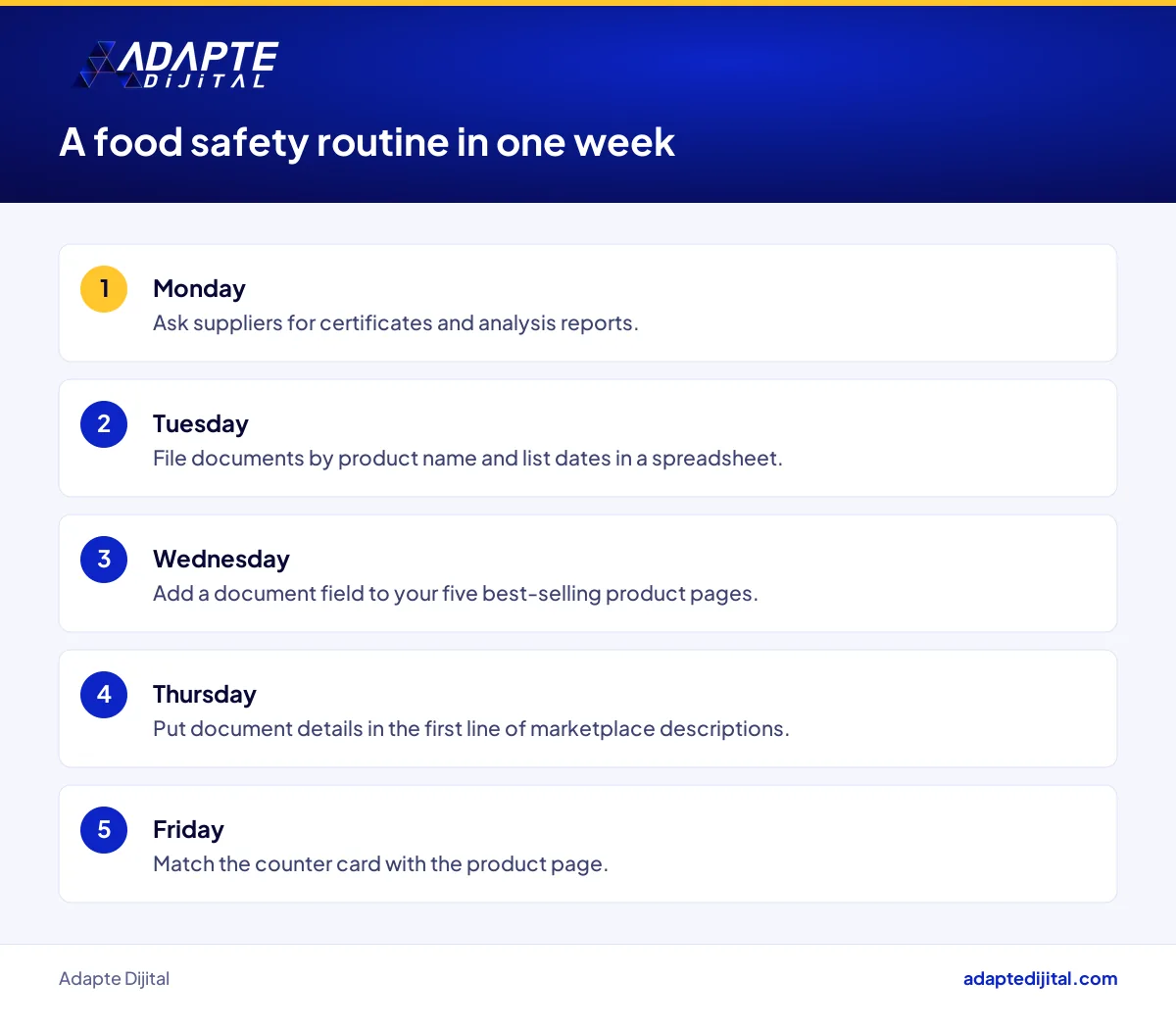
Friday: match the counter and the screen
Make sure the card in the shop and the information on your site say the same thing. We talk about why standards matter for businesses thinking of growing through franchising in Terra Pizza’s 250th restaurant. One principle carries all of it: show the proof where the decision happens.
Quick Summary
- Migros publishes fruit and vegetable pesticide results in the product description tab of Sanal Market (Perakende.org, 14 September 2026).
- According to the company, more than 20,000 products a year go through pesticide analysis in accredited laboratories (Perakende.org).
- In Greenpeace’s 1 September 2026 scorecard Migros scored 20 out of 100 and received a D, but the two events are not linked (Greenpeace Türkiye).
- A small grocer can show trust with supplier documents and traceability information instead of its own lab.
- Product pages should show the document name, date and supplier in one standard template.
Short Glossary
- Pesticide residue
- Pesticide residue is the term used to describe the part of an agricultural spray that remains on produce after harvest.
- Good Agricultural Practice
- Good Agricultural Practice is the certification scheme used to document that produce is grown under environmental, health and traceability rules.
- Traceability
- Traceability is the concept used to show, through records, every stage a product passes through from field to shelf.
Frequently Asked Questions
Next Step
If you want to plan which documents to show on your product pages, and in what order, fill in our consult your expert form.
Sources: Perakende.org, 14 September 2026 · Greenpeace Türkiye pesticide scorecard, 1 September 2026 · TÜİK 2026 data (as reported by CNBC-e) · Ministry of Agriculture and Forestry · Our retail page, where we interpret the retail agenda for you
Updated: October 2026
Sık Sorulan Sorular
According to Migros, around 3.8 million food and non-food products a year go through quality control. Its distribution centres check 223 different parameters. The analyses use laboratories accredited by TÜRKAK, Türkiye’s national accreditation body.
The company says 75% of its domestic produce comes from Good Agricultural Practice (İyi Tarım) certified production. The news does not make clear whether that share is measured by item count or by tonnage. Read it as a direction of travel, not a product-level guarantee.
Ekmel Baydur, Executive Board Member for Marketing at Migros Group, puts it this way: “We put the trust our customers place in us at the centre of our work.” According to Baydur, Migros was the first organisation in Türkiye to start pesticide analysis, heavy metal analysis and traceable product programmes. That is a company claim.
On 1 September 2026, Greenpeace Türkiye published a “pesticide scorecard” for A101, BİM, CarrefourSA, Migros and ŞOK. Migros scored 20 out of 100 and received a D; only ŞOK managed a C. The Migros announcement does not refer to that report, so it would be wrong to draw a cause-and-effect line between the two.
Of the 20 tomato samples analysed in the same report, 3 did not comply with regulations and 14 contained PFAS pesticides. Only 1 sample showed no residue at all. Greenpeace’s demands include full supply chain transparency and a cap of 3 pesticides per product.
A shopper sees analysis information on a big chain’s product page, then walks into the greengrocer down the street. They ask the same question at the counter: “Has this been sprayed?” If the only answer is “it’s clean, trust me”, the customer walks out; trust is built on records, not words.
A boutique site selling organic or village produce already sells on a “clean food” promise. If the product page stays empty, shoppers abandon the basket and the stock just sits there.
A small producer with a Good Agricultural Practice certificate or a lab report has a way to stand apart from rivals selling the same item on the same marketplace. Putting the document in the product description creates a difference without cutting the price.
Ask for the Good Agricultural Practice certificate, any accredited lab analysis report, and traceability information for the product. One documented source per product group is a sensible first target.
For pesticide residue limits and food inspection rules, the official source is the Ministry of Agriculture and Forestry. If you plan to write a claim such as “residue-free” about your produce, base it on a document. Verify with the official source; this is not legal or financial advice.
Producer or supplier name, province of origin, document type, document date and last update date. A consistent template reads cleanly for shoppers and search engines.
Searches such as “Good Agricultural Practice tomatoes” or “certified village produce” can favour a business that states this clearly on its product pages. Adding photos of documented produce to your Google Business Profile is another place to show the same proof. We handle this as part of our e-commerce consulting, together with how your product pages are built.
Put the document information in the first line and the marketing sentence after it. We discuss a similar niche positioning question through FİLE Market’s gluten-free Harras range.
For your obligations, rely on official announcements from the Ministry of Agriculture and Forestry. Even without running tests, you can build trust by showing your supplier’s documents.
Only if you have a document that proves it. An unsupported claim puts both customer trust and your business at risk; write the document type and date next to the claim.
The news only mentions the product description tab in Migros Sanal Market. It does not say whether the results can be seen in store through a QR code or similar.