
Güçlü Gross opens its 10th branch in Yozgat, how does a local grocery chain grow?
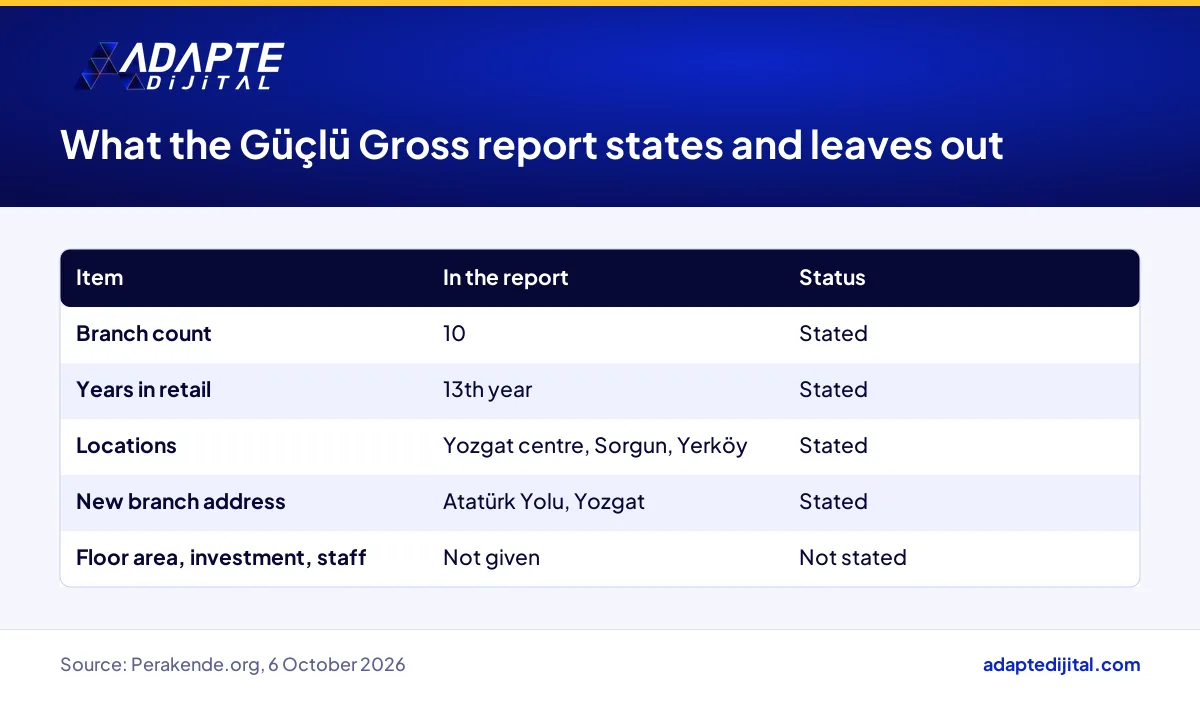
Güçlü Gross, a grocery chain operating in the central Anatolian province of Yozgat, has opened its tenth branch on Atatürk Yolu in the city of Yozgat; the chain is in its 13th year in retail and trades in Yozgat city centre, Sorgun and Yerköy (Perakende.org, 6 October 2026). The report gives no floor area, investment, headcount or turnover. What it does give is a branch count and three places where a local chain has grown inside one province.
Here is what it means for you: national discount chains keep opening in every district, yet a local grocer does not have to stop growing. Every new branch, though, is its own project, from the trading licence and shelf layout to Google visibility and the supplier negotiation.
What does Güçlü Gross’s tenth branch say about how a local grocery chain grows?
It says three things: slow growth, a tight map, and an owner who puts price and customer satisfaction first. The chain reaches 10 branches in 13 years and concentrates them in Yozgat city centre, Sorgun and Yerköy rather than spreading out. For a food retailer in central Türkiye in autumn 2026, growth here comes from density, not speed. If you would rather grow through franchisees than open branches yourself, our piece asking whether your business is ready to franchise covers the other road.
Which steps does a local grocery chain follow to open a new branch?
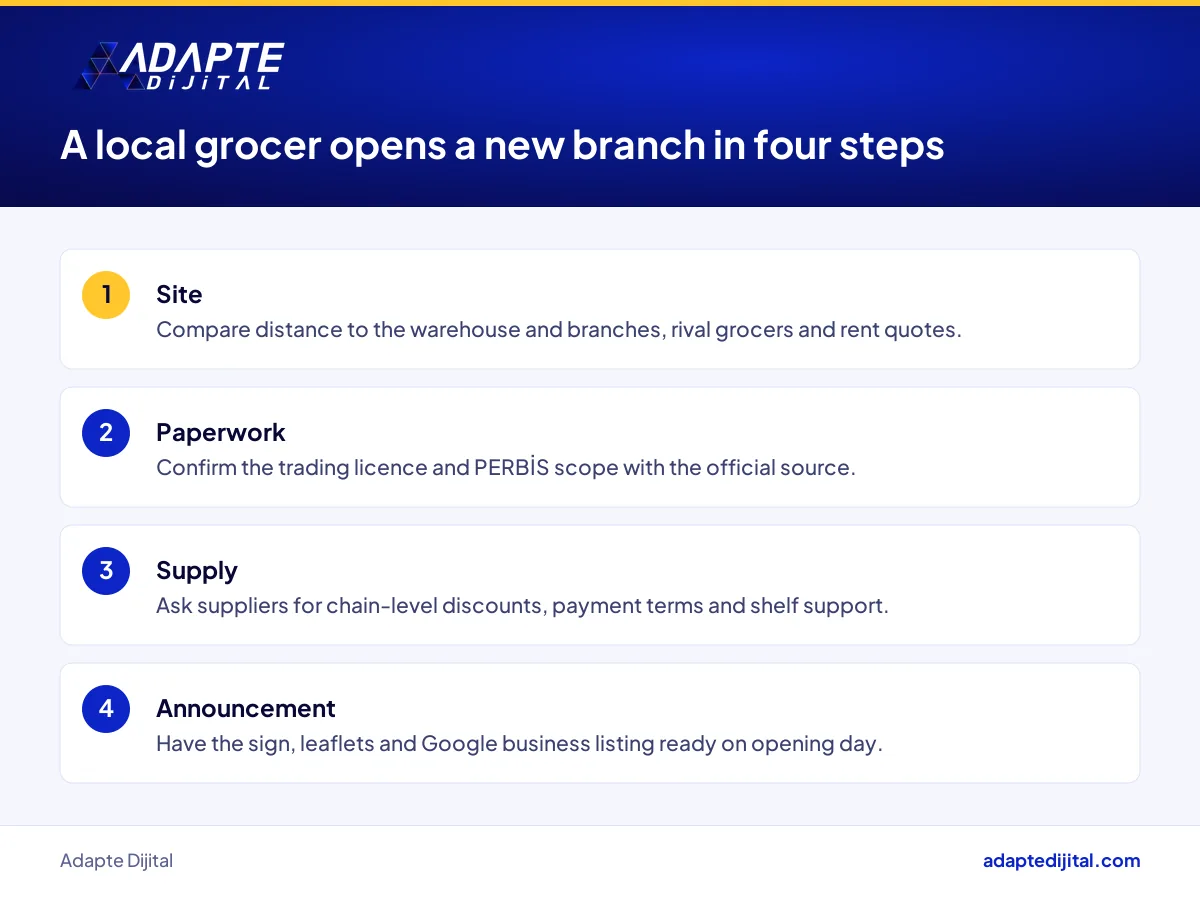
Four steps: choose the site, complete the paperwork, scale up supply and announce the opening locally. Time and cost vary by province and building, and the report gives no figures. So get your own quotes and ask your own municipality how long each step takes.
How does a local grocer position itself against national discount chains?
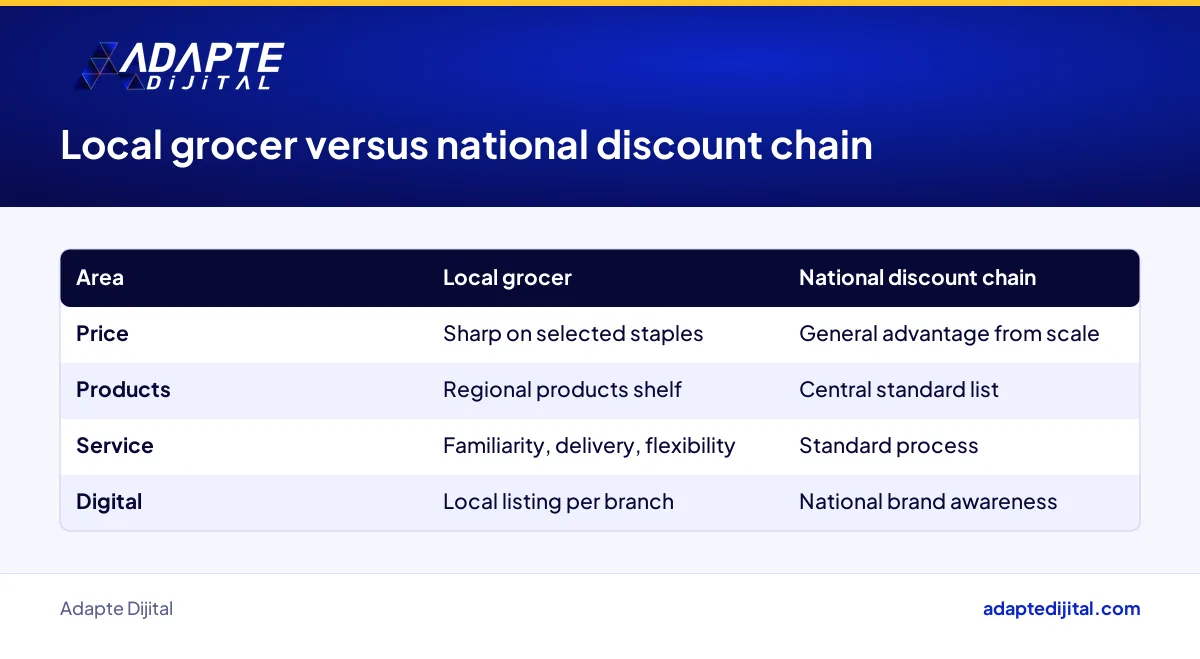
Not by matching every price, but by pricing sharply on selected items and standing out on service. A national chain’s strength is scale and standardisation. A local grocer’s strength is familiarity, flexibility and regional products, and Güçlü Gross’s stress on price and satisfaction points to holding both together.
How does a local grocery chain become visible online?
By registering every branch on Google as its own business, with the right map pin and opening hours. A customer who types “grocery near me” looks at the first three results on the map. If a ten-branch chain does not have ten separate, accurate listings, that search goes to the national chain.
Who does Güçlü Gross’s growth in Yozgat affect, and how?
It affects three groups differently. Local producers and wholesalers gain another outlet. Single-shop corner stores and small grocers on the same streets face tougher competition. National discount chains see an established, well-known rival grow denser in the province.
What should a grocery owner planning a new branch do this week?
Finish four jobs this week. Check how your existing branches appear on the map, get a rent quote for the candidate address, ask the municipality how long the licence takes, and compare the prices of your best sellers with the rival chain. Those four facts turn the new-branch decision from a guess into a calculation.
What belongs on the checklist?
- The licence application and a check on whether PERBİS applies to you.
- The route between the warehouse and the new branch.
- Chain-level quotes from suppliers.
- A Google listing for the new branch.
- An announcement plan for opening week.
Write a responsible person and a date next to every line.
Quick Summary
- Güçlü Gross opened its tenth branch on Atatürk Yolu in Yozgat (Perakende.org, 6 October 2026).
- The chain is in its 13th year in retail and trades in Yozgat city centre, Sorgun and Yerköy (Perakende.org).
- The new branch’s floor area, investment and staff numbers are not in the report.
- A local chain can position itself against national discounters with sharp prices on selected items, regional products and service.
- A separate Google business listing for each branch is the foundation of local search visibility.
Short Glossary
- Clustering
- Clustering is the retail strategy used to concentrate branches in a tight area so they can share a warehouse and logistics.
- SKU
- SKU, or stock keeping unit, is the code used to track each product variant on the shelf separately.
- PERBİS
- PERBİS is the Retail Information System used by Türkiye’s Ministry of Trade to keep records on retail businesses.
Frequently Asked Questions
Next Step
If you want to look at your new-branch plan and your branches’ digital visibility together, fill in the consult your expert form and we will get back to you.
Sources: Perakende.org, “Güçlü Gross Yozgat’ta 10. şubesini açtı” (Güçlü Gross opens its 10th branch in Yozgat), 6 October 2026 · Ministry of Trade, Retail Information System (PERBİS)
Updated: October 2026
Sık Sorulan Sorular
When branches sit close together, one warehouse, one small fleet and one supplier route can serve several stores at once. A product that is just gathering dust on one shelf can be moved to a nearby branch, which keeps stock turnover healthy.
Yusuf Güçlü, the businessman who owns Güçlü Gross, keeps it short at the opening: “Today we opened our tenth branch.” The report says he highlights price and customer satisfaction. Officials, business people, customers and guests attend; no names are given.
The new branch’s floor area, product range, number of staff and investment amount are not in the report. Nor does it say how the ten branches split across the districts. The steps below describe what a grocer on a similar path would do, not Güçlü Gross’s internal workings.
Yes, start with the area around the branches you already run. Note whether the same warehouse can feed it, how often the van can call, and whether a discount rival is already on the street. Get at least two separate quotes for rent and fit-out.
The basic document is the workplace opening and operating licence issued by the municipality. Depending on your size, registration in the Ministry of Trade’s Retail Information System (PERBİS) may also come up. Check which records apply to you with the official source; this is not legal or financial advice.
As the branch count rises, the conversation with suppliers changes. Volume discounts, payment terms and shelf support come back to the table. Ask for quotes at chain level, not branch by branch, and keep a separate SKU list for each store.
In the first week, every customer who walks in from the neighbourhood counts. Leaflets, the streets around the mosque and the school, local radio and the Google business listing should all be ready on the same day. A common mistake is hanging the sign on opening day and forgetting the branch on the map; a customer looking for directions cannot find you and walks away.
Bread, milk, eggs and cooking oil, the products whose price customers know by heart. A shop that looks expensive on these loses trust, even when its average basket is high. On the rest of the shelves you can protect your margin.
A national chain’s central list does not take every province’s cheese, bulgur or butter. A grocer who works with local producers holds products nobody else stocks. That shelf brings people in regardless of price.
At the till, on delivery and when something goes wrong. Let’s say a cashier knows your name, a shop boy drops your phone order at the door in the evening, and the manager swaps a spoiled product without questions. Those are the things a standardised chain struggles to offer.
One profile per branch, with its own phone number and its own photo set. Opening hours need updating for religious holidays and special days. Reviews should be answered by one voice from head office, not by each branch manager, so the tone stays consistent.
Even a simple site puts the branch list, this week’s offers and contact details in one place. A separate page for each branch helps the name surface when people search with a district name. Online ordering is optional; accurate information is not.
Weekly offers, newly arrived regional products and opening announcements. With an ad budget, target only a few kilometres around the branches. Province-wide ads are money down the drain.
Small producers of regional food, milk and flour suppliers, local hauliers and sign makers. A new branch adds one more door to the trade that circulates inside the province.
The single-shop corner store within walking distance of the new branch. If that shop cannot compete on price and the till is not ringing, it has to lean on what the chain does not offer: late hours, a tab for regulars or home delivery. For a shop left alone on a street with a weak tenant mix, that difference is vital.
Food suppliers sitting on surplus stock, and retailers whose branch count is rising. Our piece on what selling surplus food stock earns looks at the shrinkage problem that grows as branches multiply.
Once the branch count grows, digital visibility is no longer a side job. We set up business listings, branch pages and local ad structures as part of our digital consulting work. Our retail page gathers similar news in one place.
A second branch is worth calculating if your current shop makes a steady profit, you can negotiate terms and discounts with suppliers, and the new address can be fed from the same warehouse. Get your own quotes for rent and your municipality’s timeline for the licence.
Review your prices on the staples whose price customers know by heart, strengthen your regional products shelf and put forward services the chain does not offer, such as home delivery.
Yes. A separate business listing with each branch’s own address, phone number and opening hours lets a customer searching for a nearby grocery find you on the map.