
Arkın Obdan explains the EU’s €3 e-commerce duty, how can exporters protect their prices?
Since 1 July 2026, the European Union no longer exempts e-commerce parcels worth €150 or less from customs duty and charges a flat €3 per item instead; Arkın Obdan, General Manager of Obdan Sistem and Chairman of the Board at Servex, explains that a €2 handling fee set by the European Commission on 21 September 2026 will sit on top of that duty (Perakende.org, 28 September 2026).
If you ship low-value, high-volume parcels from Türkiye to EU customers, the meaning is simple: fixed charges are growing relative to the price of your product. According to Obdan, part of the cost may reach the shelf price, but not in the same way for every product or company. The exporters who protect their prices are the ones who clean up their product data and review their sales model now.
What does the EU’s €3 customs duty change in a Turkish e-exporter’s basket?
It changes the fixed cost of every basket. Before 1 July 2026, a consignment under €150 paid no customs duty; now every item carries a flat €3 duty. The duty does not replace VAT, it comes on top of it. Selling through IOSS, the special arrangements or standard import VAT does not change that.
On what timeline do the EU’s €3 duty and €2 handling fee apply together?
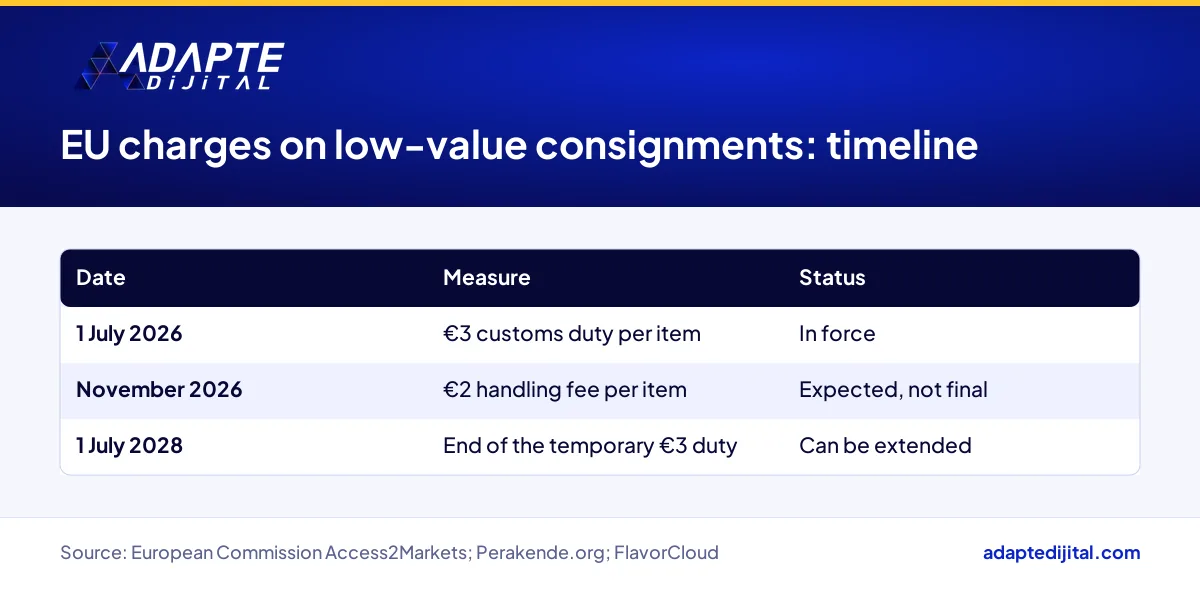
Three dates: 1 July 2026 started the €3 duty, November 2026 is the expected start of the €2 EU customs handling fee, and 1 July 2028 is the planned end of the temporary duty. The middle date is not final, so keep your plan flexible.
Which e-exporters do the new EU charges hurt, and which gain room?
They hurt the seller who ships cheap products one at a time, because a fixed load approaching €5 per item eats a low unit price. A seller with a high average basket and few lines feels it less. A company that can hold stock inside the EU gets breathing space.
How do EU customs charges show up in an e-exporter’s marketplace listings, ads and product data?
In three places: product page data, checkout price and the basket your ads target. According to Obdan, missing data can cause delays and disrupt delivery plans. The tariff code, origin and value in your online store are now the raw material of the customs declaration. If the data is wrong, the parcel sits at customs and the customer waits.
How can an e-exporter calculate the cost of the EU charges to protect product prices?
BU BÖLÜMÜN ÖZETİ
- Step 1: Export the last 30 days of orders line by line
- Step 2: Rank categories by fixed load ratio
- The most common mistake: calculating per parcel
Treat the fixed load per basket as its own cost line. The formula: declaration lines times €3, plus items times €2 once the handling fee starts. Divide that by the basket value and you have your fixed load ratio. Track it by category and set prices from the ratio, not from a guess.
Step 1: Export the last 30 days of orders line by line
For each order, count the items and the distinct tariff codes. Do not change a single price before you know your own average.
Step 2: Rank categories by fixed load ratio
Flag the three categories with the highest ratio. Each has three options: raise the price, switch to set selling or pull back from the EU market. As Obdan notes, the pass-through is not the same for every product, so decide category by category.
The most common mistake: calculating per parcel
A “€3 per parcel” price sheet understates every multi-item basket. The till looks busy, then the margin comes up short at month end. Always calculate on lines and items.
What steps should an e-commerce business selling to the EU take this week?
BU BÖLÜMÜN ÖZETİ
- Days 1-2: Audit your SKU data
- Day 3: Ask your carrier and customs broker about declaration type
- Days 4-5: Prepare the model decision
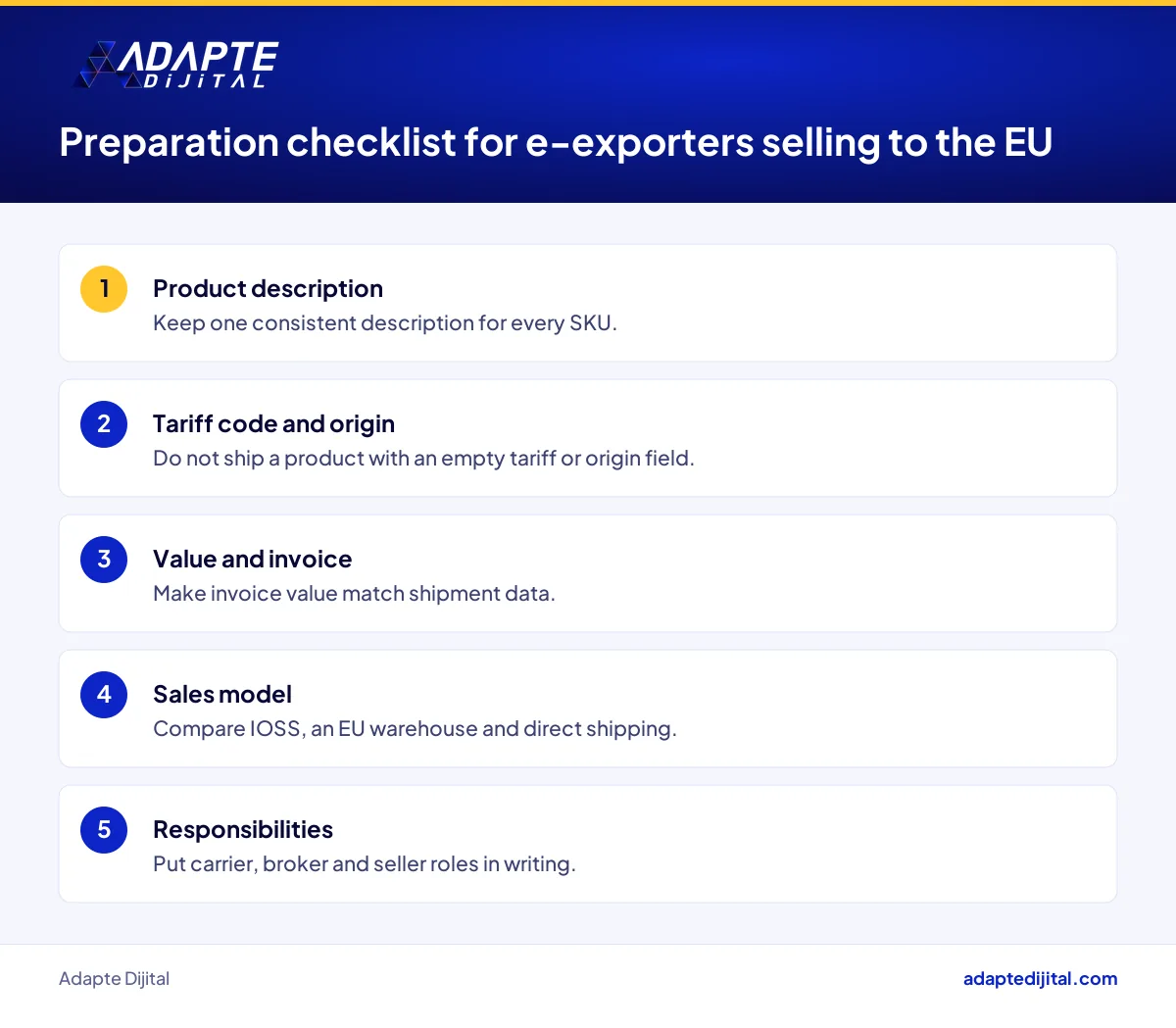
Clean your data, put responsibilities in writing and review your sales model. Obdan’s recommendations cover the same ground: accurate description, tariff classification, origin, value, invoice and shipment data; a fresh look at sales and delivery models, IOSS included; and clear responsibilities.
For the rule itself, read the European Commission’s Access2Markets notice.
Days 1-2: Audit your SKU data
Start with your best sellers and work down by revenue. Check that description, tariff code, origin and value are filled in and consistent for each one. Do not ship a product with an empty field to the EU.
Day 3: Ask your carrier and customs broker about declaration type
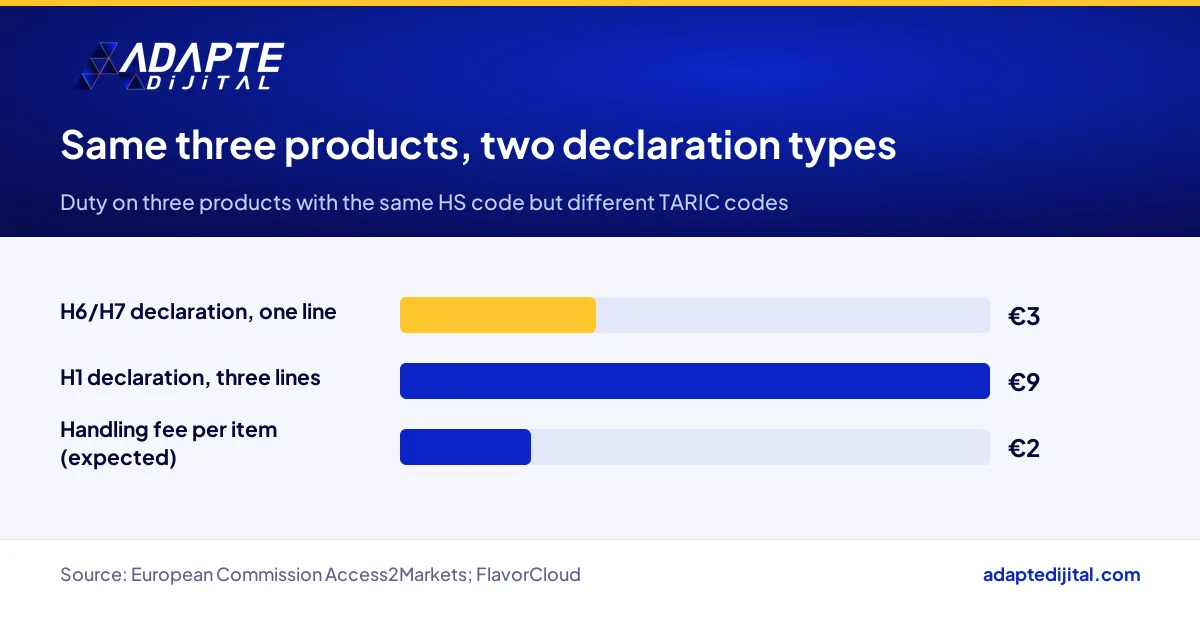
Ask which declaration type your shipments use. The gap between €3 and €9 in the Commission’s example comes from exactly this question. Get the answer in writing.
Days 4-5: Prepare the model decision
Put IOSS, an EU warehouse and direct shipping side by side, each with its fixed load ratio. We build this comparison with clients in our foreign trade consultancy work. For the wider picture, our retail page reads the Turkish retail agenda for you.
Retroactive risk checks are on the social media agenda too; see how music copyright audits can affect your Reels. Looking for growth funding? See the investment figures shared at the Bacacı summit.
Your Monday template, in one line per order: declaration lines × €3 + items × €2 (once the fee starts) = fixed load; fixed load ÷ basket value = fixed load ratio. Fill it in for your top three categories first.
Quick Summary
- Since 1 July 2026, the EU charges €3 per item on e-commerce consignments of €150 or less (European Commission).
- For now the duty works per declaration line, so the same three products can pay €3 or €9 (European Commission).
- The Commission set a €2 handling fee on 21 September 2026, with a start expected in November (Perakende.org).
- According to Obdan, the two measures are not alternatives and will apply together.
- The way to protect prices is to calculate the fixed load ratio by category and fix your product data.
Short Glossary
- IOSS
- IOSS is the EU’s Import One-Stop Shop, the scheme used to collect import VAT at the point of sale on low-value goods and declare it in one place.
- Declaration line
- A declaration line is the entry on a customs declaration used to list goods of the same tariff and origin group as a separate item.
- Fixed load ratio
- Fixed load ratio is the cost indicator used to compare duty and handling fees with basket value, found by dividing the charges by the basket total.
Frequently Asked Questions
Next Step
If you want to work out the fixed load ratio of your EU catalogue together, fill in the consult your expert form.
Sources: Perakende.org, 28 September 2026 · European Commission Access2Markets notice, 30 June 2026 · FlavorCloud, 24 September 2026 · RSM Belgium
Updated: October 2026
Sık Sorulan Sorular
As a rule, goods in the same tariff and origin group count as one item. According to the European Commission, IT limits mean the duty applies per declaration line for now. A cost sheet built per parcel will undercount.
In the Commission’s example, three products share an HS code but have different TARIC codes. On an H6 or H7 declaration they sit on one line and pay €3; on an H1 declaration they split into three lines and pay €9.
The €3 duty covers low-value consignments of €150 or less. The €2 handling fee expected in November has no value threshold; according to FlavorCloud, orders above €150 are covered as well. B2B imports fall outside that fee.
The interview says “November”; FlavorCloud expects 1 November 2026. Until the Commission’s delegated regulation appears in the EU Official Journal, the date is not final. Verify with the official source; this is not legal or financial advice.
No. Obdan is clear on this: the two measures are not alternatives and will apply together once their conditions are met. The Commission has also confirmed that national fees in France, Romania and Italy should stop once the EU-level fee begins.
The planned end is 1 July 2028, but the duty is tied to the EU Customs Data Hub and can be extended if the hub is delayed. Do not build long-term pricing on the assumption of relief in 2028.
The small exporter living on single-item marketplace orders. One item per basket, one line per item, so the duty lands straight on unit cost. The customer walks away at checkout when the delivered price tops a local competitor’s.
A brand that uses, or is big enough to use, a warehouse inside the EU. RSM Belgium expects a trend toward holding stock in the EU and serving B2C customers from there. France started applying the €3 duty early, in March 2026.
Customs brokers, carriers and fulfilment providers. How a consignment is declared and how accurate its data is now shape the client’s margin.
Because declaration lines come from the product description and the tariff classification. Every SKU needs a consistent tariff code, origin and description. In Türkiye that code is the GTİP, the national HS-based tariff number. If one product appears under two names, it lands on two lines and pays twice.
Campaigns aimed at single-item, low-value baskets now leave less profit behind. Put bundles, product sets and a free-shipping threshold first, because they raise the average basket value. Measure contribution margin after fixed charges, not revenue.
A surprise fee on delivery means an abandoned basket or a return, and according to FlavorCloud the €2 fee is not refunded on returns. Showing prices with charges included reduces that loss.
No, it applies per item, not per parcel. According to the European Commission it is calculated per declaration line for now, so a multi-item parcel can pay €3 more than once.
The European Commission set the fee on 21 September 2026, and it is expected to start in November 2026. The date is not final until the delegated regulation is published, so verify with the official source.
There is no single answer for every product. First calculate the fixed load ratio by category, then compare a price change, set selling and an EU warehouse for the categories with the highest ratio.