
How to test a business idea: what a demand test is, and 3 ways that don’t risk rent
Most people don’t know this: the answer to how to test a business idea starts in search, not in a shop. You measure demand in three layers before you spend big. Are people searching for it, do they click when they see you, and do they message you to ask the price? That three-layer check is called a demand test.
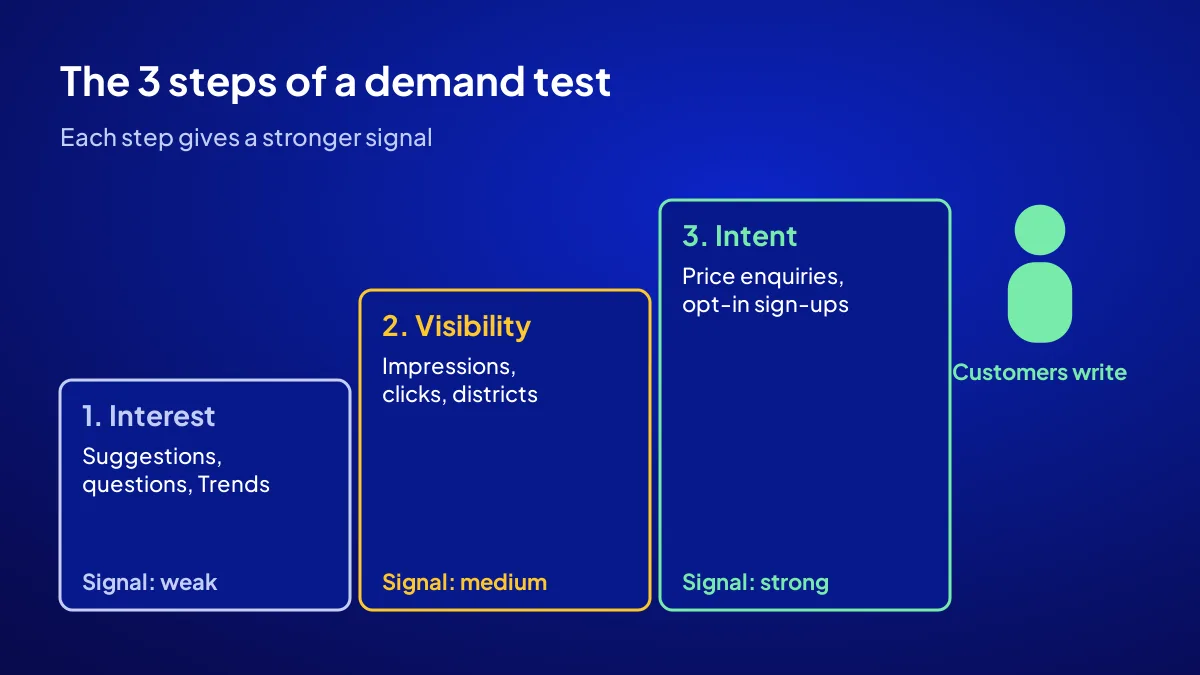
Interest, visibility and intent are measured in order, and each layer gives a stronger signal than the one before. In 2026 you don’t need to sign a lease for this. A domain, a small website and a WhatsApp line are enough to collect the first 30 days of data.
What does a demand test measure, and what doesn’t it?
A demand test measures whether anyone will pay for your business before you spend big. It does not guarantee sales or predict next year’s turnover. It answers three things: is anyone searching, is anyone choosing you, is anyone writing to you. It moves the decision from guesswork to numbers.
Interest, visibility, intent
Interest is people searching for the topic. Visibility is you showing up when they do. Intent is them picking up the phone after finding you, the moment a customer reaches for their wallet.
Testing versus guessing
A guess says “nothing like this round here, it’s bound to work.” A test checks that against 30 days of numbers, and the gap is often a year of rent.
Why is 100 on Google Trends not 100 people?
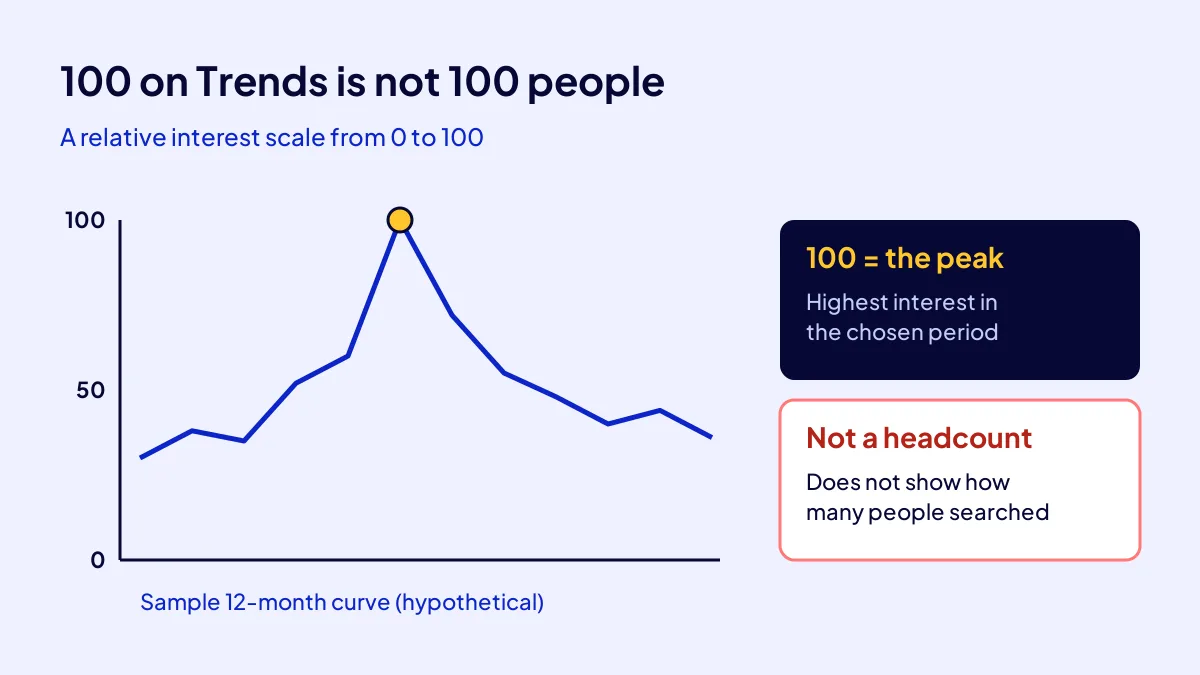
Google Trends does not show absolute search counts. According to Google’s help page, each data point is divided by total searches in that region and period, then scaled from 0 to 100. So 100 is the peak moment of interest in your chosen period. It says nothing about how many people searched.
Think of a thermometer
A Trends chart works like a thermometer. It tells you the temperature is rising or falling, not how many people are in the room. A “coffee shop” line hitting 100 does not mean a thousand coffee drinkers are queuing on your street.
Google says so openly
Google states on its help page that Trends is not a scientific poll and only reflects interest in search. Use it as a first filter. The final decision needs other numbers.
Route one: read the interest in search
The first route costs nothing: look at the interest in search. Type your business into Google and note the autocomplete suggestions, the “People also ask” questions and the Trends curve. Together they show the words people use, in about an afternoon.
The limit of this route
This route shows interest in the topic, not in you. So you move to route two.
Route two: measure visibility with a small online storefront
The second route is to open your business online with a small storefront and count how many people see you. You set up a website, articles that answer questions about your trade, and a Google Business Profile. Search Console gives you impressions and clicks, GA4 tells you which district visitors come from. Now you count interest in you, not interest in general.
Why one page isn’t enough
A one-page site is like a one-word shop sign: it answers few questions and appears in few searches. We explain the whole setup in open online before you open a shop.
Route three: collect messages and early interest
The third route measures the strongest signal: people writing to you. Messages on your WhatsApp Business line such as “how much is it”, “when do you open”, “do you come to the house” are intent itself. Log them in one list and count them by topic and neighbourhood. One message tells you more than a hundred impressions.
If you’re collecting early interest
If you can’t sell yet, ask “shall we let you know when we open?” and save the number with permission. That list is your first customers on opening day.
At what threshold does a test say “open”?
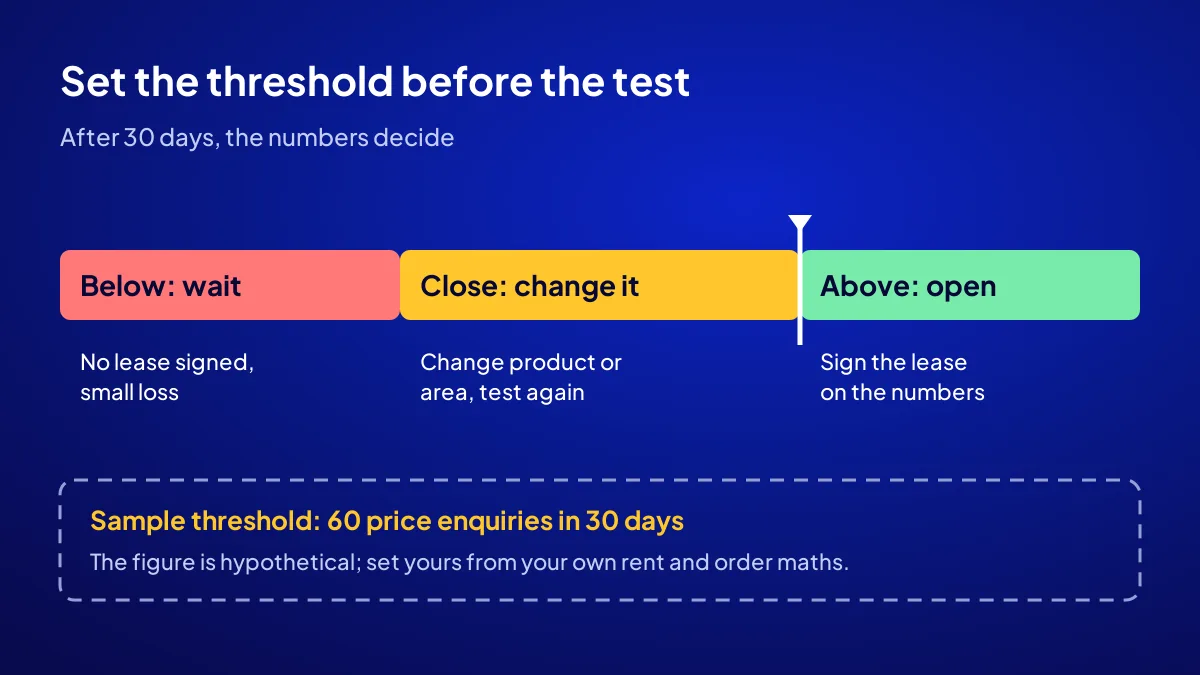
You set the threshold before the test starts, not after. Work out how many customers a month would cover the shop’s rent, and write down the number of messages the test must deliver. Above the line, you open; close to it, you change the product or area and measure again. Below it, the loss stays small because no lease was signed.
| Route | What it measures | Cost | Time | Signal strength |
|---|---|---|---|---|
| Interest in search | Whether the topic is searched | Free | An afternoon | Weak |
| Online storefront | Your impressions, clicks, districts | Setup fee | 30 days | Medium |
| Messages and early interest | People asking prices or waiting for news | Comes with the storefront | 30 days | Strong |
Say you’re starting a home cake workshop
Say you’re planning a home cake workshop in Esenyurt, Istanbul, and by your maths 60 orders a month cover your costs. You write the threshold up front: “at least 60 price enquiries in 30 days.” With 70 messages you carry on; with 20, you change the product or area. The figures are hypothetical, so swap in your own.
The most common mix-up
Likes and followers are not demand. A hundred hearts on Instagram is a weaker signal than one person asking the price. We cover which accounts are actually worth opening in which accounts should I open.
Where does someone without a shop start the test?
BU BÖLÜMÜN ÖZETİ
- How the campaign sets up routes two and three
- The next question after the test
- Now you know
Someone without a shop starts online, and that is an advantage, not a gap. You can appear on Google with a service area and no public address. Every month without rent is a month of testing on the house. Numbers first, location later.
How the campaign sets up routes two and three
Adapte’s Start a Business Online campaign builds routes two and three for you: domain, website, 108 articles across 6 keyword groups, Business Profile, WhatsApp Business and GA4 plus Search Console. The price is TRY 36,000 + VAT, upfront and fixed, or TRY 43,200 with 20 percent VAT; check the current rate on your invoice. Applications are open until 1 November 2026, and the setup schedule is given in writing once the project plan is approved. See the Start a Business Online campaign page for details.
The next question after the test
The next question is usually “shop first or website first?” We compare the first 6 months across three scenarios in shop first or website first. If customers don’t come in after opening, see why a new shop gets no customers.
Now you know
100 on Trends is a peak, not a crowd. Being seen and being clicked are different things. The most valuable number is how many people write to you, and you set its threshold in advance.
Quick Summary
- A demand test measures interest, visibility and intent, in that order.
- Google Trends shows relative interest from 0 to 100, not people.
- Route one is free: suggestions, questions and the Trends curve.
- Route two is a small online storefront: impressions, clicks, districts.
- Route three is strongest: price enquiries and permission-based sign-ups.
- Set the threshold first; with no lease signed, any loss stays small.
Short Glossary
Demand test: A demand test is a method used to check whether a business idea has paying customers before big spending.
Click-through rate: Click-through rate is the ratio used to show what share of people who see you in search results click.
Trends index: The Trends index is the scale used to show a topic’s relative search interest in a period and region from 0 to 100.
Next Step
You can do route one yourself tonight. If you want routes two and three set up for you, apply to the Start a Business Online campaign.
Frequently Asked Questions
Source: Google Trends Help — FAQ about Google Trends data
Sık Sorulan Sorular
One layer misleads. A popular topic does not mean customers in your neighbourhood. A page with plenty of clicks and no messages is just window shoppers walking past.
It shows season and direction. You see at a glance which months seasonal trades like air-conditioning repair or school transport peak. That curve helps you choose your opening month.
Type the customer’s problem, not your trade. Try “birthday cake order” rather than “patisserie”, “bridal hair at home” rather than “hairdresser”. Customers search for their problem, not your shop sign.
Impressions are how often your site appears in search results. Click-through rate is the share of those viewers who click. Think of how many of a hundred passers-by actually step inside the shop.
Open a simple sheet: date, neighbourhood, product, price asked. By the week’s end the top product and busiest area stand out. Most shops with an empty till start this sheet after opening; you start it before.
Yes. A demand test is done before the shop anyway. In the Start a Business Online campaign, without a shop you appear on Google with a service area.
Checking interest in search takes an afternoon. The storefront and message layers need at least 30 days of data.
No. Trends shows a topic’s share of total searches, scaled from 0 to 100. It does not say how many people searched.
Updated: October 2026