
Why is a new website not showing on Google? Start with 108 articles, not 10 pages
Say you are opening a boutique patisserie in Esenyurt, Istanbul, and your website is ready: home, about us, products, gallery, contact. Ten pages in total. The short answer to why a new website is not showing on Google: those ten pages answer almost none of the questions customers actually search. And Google does not show a page that answers nothing to the person asking.
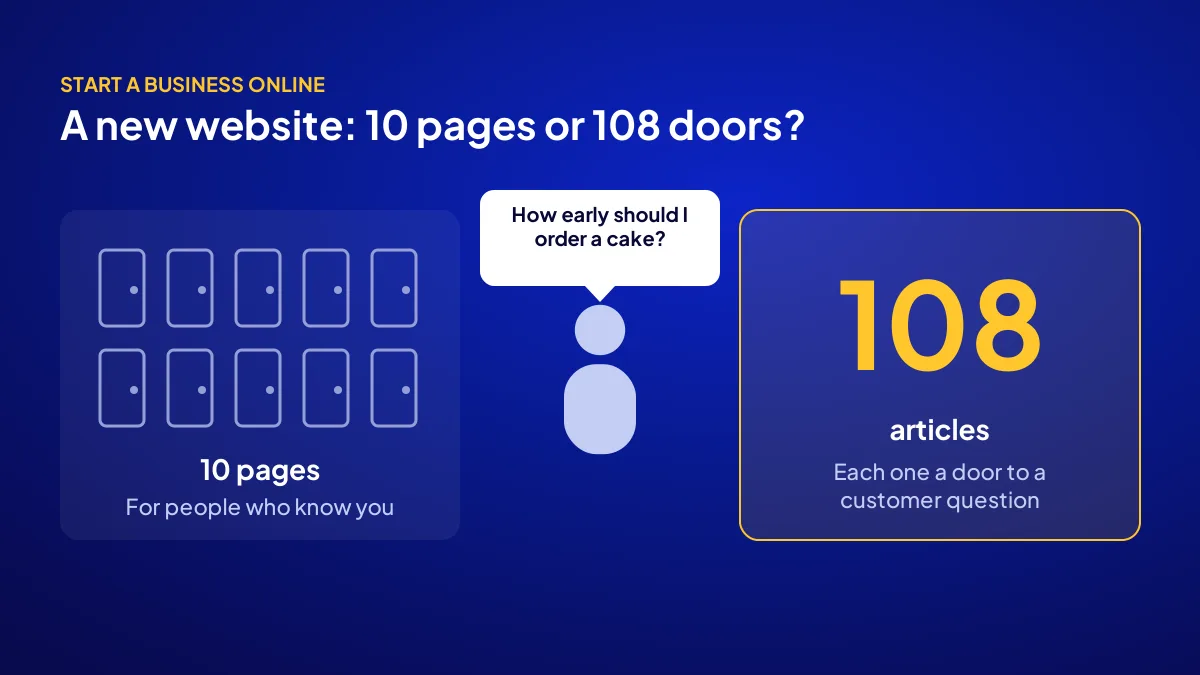
Nobody searches for “patisserie about us”. They search “how many people does a birthday cake serve”, “where to find gluten-free cake”, “same-day cake in Esenyurt”. Every question is a door into your site. A ten-page site opens ten doors; a site that starts with 108 articles opens 108. That is why the number 108 sits at the heart of the Start a Business Online campaign.
Which customer question does a ten-page site answer?
Usually none. Company pages are for people who already know your name: they show your address, phone number and product photos. A new business, though, has no one who knows its name yet. People who do not know you type a need into Google and expect a page that explains that need. If you do not have that page, someone else does.
Company pages are for people who know you
An “about us” page is like the licence in a shop window. Necessary, reassuring, but it pulls nobody inside. When customers are not coming through the door, the problem is not the licence but the road outside.
Customers search questions, not names
A new business’s first customer looks for a solution, not a brand. Someone asking “how many days ahead should I order a cake” meets the owner of the page that answers. If your site does not give that answer, the meeting never happens.
How does Google find a new website?
Google discovers new pages through links and sitemaps. According to the Google Search Central guide, pages are found by following links from a known page to a new one, or through a submitted sitemap. The same guide says Google does not guarantee it will crawl, index or serve a page, even one that follows its guidelines. Publishing, in other words, is not the same as being seen.
Links and sitemaps
When articles link to one another, Google can walk from one page to the next. A sitemap submitted in Search Console hands over the list of pages directly. On a ten-page site the walk is short; with 108 articles a network forms.
No guarantee, but preparation
Nobody can tell you “you will be first in month one”, and anyone who does is wrong. What you can do is prepare, from the start, as many right answers as Google can find, understand and show.
Why does a long question rise faster than a short keyword?
Because long, intent-rich questions have fewer competitors and a clear meaning. In Adapte’s own Search Console data for the three months from 14 June to 13 September 2026, the Turkish query “how to open a dental supply store” sits at an average position of 2.5, with 219 impressions and 11 clicks. The short, crowded query “digital agency” has 478 impressions but stays at an average position of 66, with zero clicks.
Short keywords are crowded
Thousands of long-established sites compete for “patisserie”. A new site takes a long time to stand out in that crowd. For a question like “egg-free birthday cake in Esenyurt”, you face only a handful of pages.
Being seen is not the same as being clicked
In the same data the whole site has 142,296 impressions and 1,699 clicks over three months, a click-through rate of about 1.2 percent. An impression is walking past the window. A click is stepping inside. What gets people inside is a page that answers their exact question.
Where does the number 108 come from?
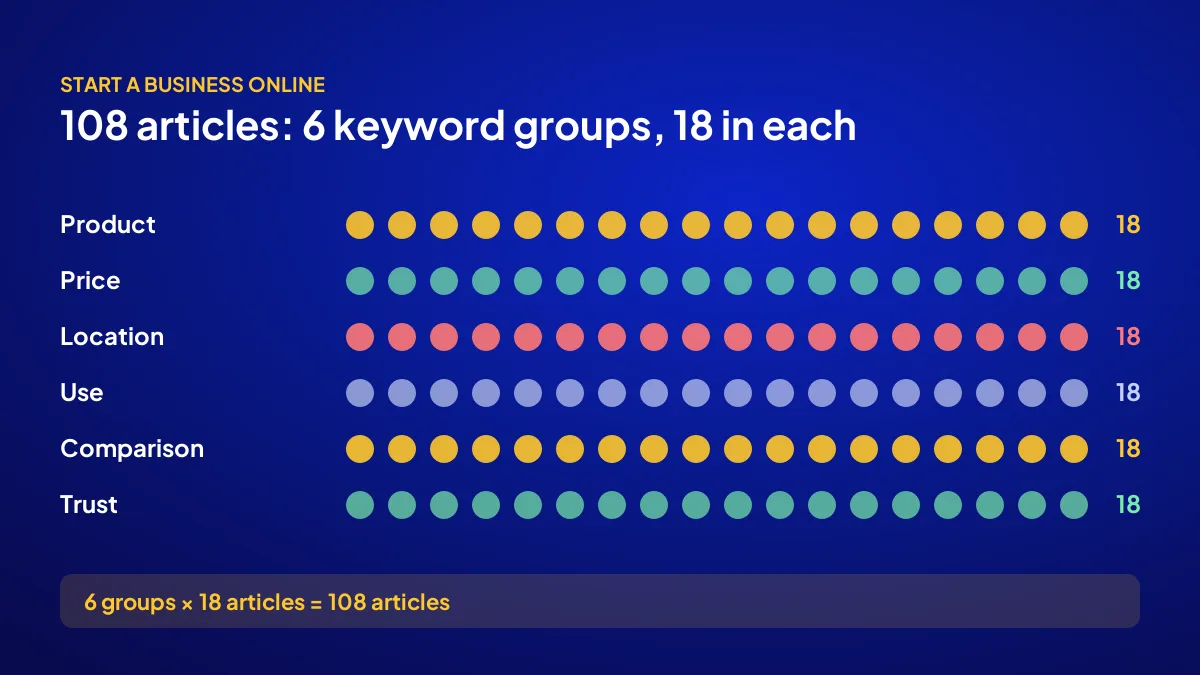
108 means 18 articles in each of six keyword groups. A keyword group is the cluster of questions customers ask around the same need. Each group covers one side of your business: product, price, location, use, comparison and trust. Together, the six groups cover most of the questions a new business will be asked.
Six groups, six customer intents
One group meets people asking about price, one meets those searching “near me”, one meets those asking “how do I choose”. Once groups are separated, articles stop stealing each other’s keywords. Each article owns its own question.
Eighteen articles per group
Adapte’s content method builds sets of 18: it maps who is searching a topic and along which nine question axes, then distributes articles accordingly. Eighteen articles cover a group in depth rather than on the surface. That also signals to Google that the site knows the topic.
Who writes the 108 articles, and how?
The 108 articles are written by Adapte’s writing team. They are prepared across six keyword groups and shaped to suit AI-powered search as well. Each follows the writing standard we call FORM-97: a clear answer in the first paragraph, question-style headings and sourced information. You tell us about your business; the writing team turns that knowledge into answers to customer questions.
You bring the knowledge, the team writes
You know which cake needs how many days’ notice. Spreading that knowledge across 108 different questions is a separate job. The order in which the campaign setup runs is laid out step by step in how the Start a Business Online campaign works.
Writing that suits AI search
Customers now ask AI assistants as well as Google. Short, clear, sourced answers are readable by those tools too. There is no guarantee of being recommended, but a site that cannot be read has no chance at all.
Are 108 articles enough on their own?
No, because articles stand on a foundation. The domain, hosting, Search Console, Google Business Profile and internal links are that foundation. The Start a Business Online campaign delivers the 108 articles together with that foundation, for a fixed TRY 36,000 + VAT; the setup schedule is given in writing once the project plan is approved. The domain is registered in your name.
Domain and technical foundation
If the address the articles hang on is poorly chosen, the effort scatters. How to choose a short, memorable name is covered in how to choose a business domain. The general order of building a site is in the how is a website built guide.
Allow for patience
Articles do not bring traffic on the day they go live. Google needs time to find, read and rank them. If the till is not turning over yet, look less at first-month numbers and more at which questions you appear for.
What do 108 questions look like for the patisserie?
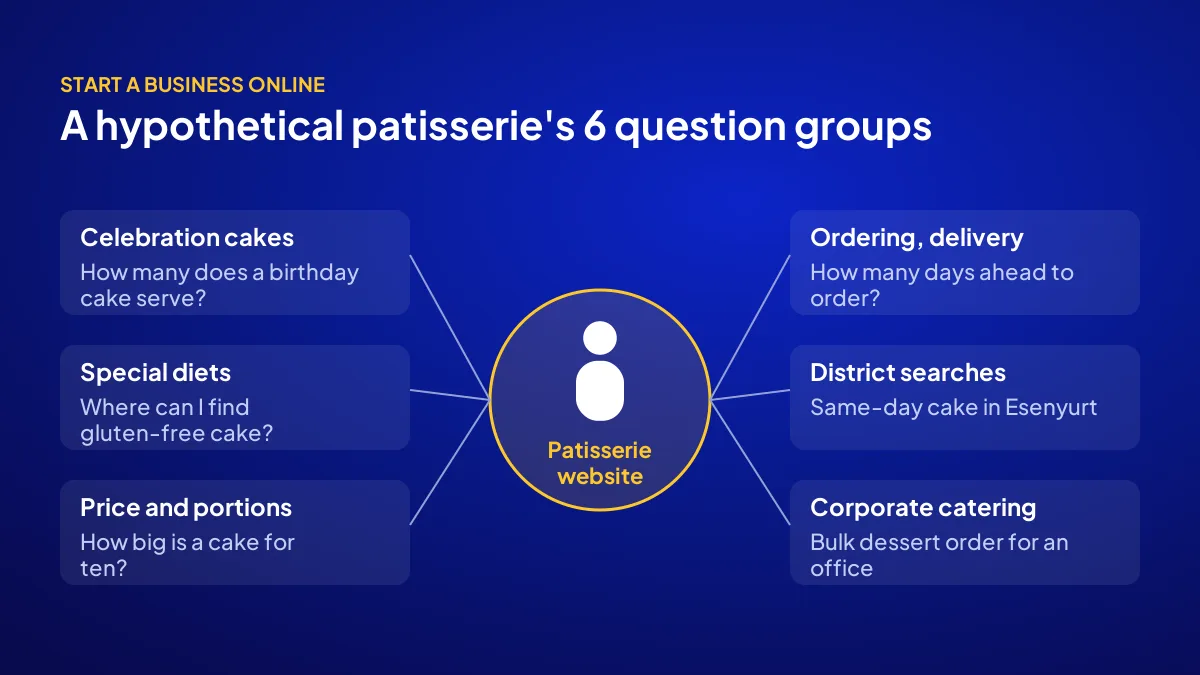
Back to the patisserie in Esenyurt. Its six groups could be: birthday and celebration cakes, special-diet products, price and portions, ordering and delivery, district searches, and corporate catering. Each group holds 18 questions, and each question becomes an article. The site then answers the neighbourhood’s questions even before the patisserie opens.
Three sample questions from one group
The price and portions group holds questions such as “how many kilos is a cake for ten people”, “what makes cake prices vary” and “whole cake or by the slice”. None of them is a question an “about us” page can answer.
One principle
A site is as visible as the questions it answers. The full logic of opening online before opening a shop is in open online before you open a shop.
Quick Summary
- A ten-page company site rarely answers customer questions.
- Google finds new pages through links and sitemaps and does not guarantee visibility.
- Long, intent-rich questions can rise faster than short keywords.
- 108 articles means 18 articles in each of six keyword groups.
- Adapte’s writing team writes them to the FORM-97 standard.
- Articles work on a foundation of domain, Search Console and internal links.
Short Glossary
Keyword group: A keyword group is the cluster used to plan search queries around the same customer need together.
Indexing: Indexing is the process Google uses to make a crawled page eligible to appear in search results.
Sitemap: A sitemap is the file used to tell Google about all the pages on a site in one list.
Next Step
If you want your site to open with 108 doors instead of ten, apply for the Start a Business Online campaign and let us set your six keyword groups together.
Frequently Asked Questions
Source: Google Search Central — In-depth guide to how Google Search works
Sık Sorulan Sorular
The 108 articles are written by Adapte’s writing team. They are prepared across six keyword groups and shaped to suit AI-powered search as well.
There is no fixed time. Google does not guarantee it will crawl or show a page, even one that follows its guidelines. Sitemaps, internal links and many answer-led articles make the process easier.
The domain is registered in the client’s name. The campaign includes the domain and one year of hosting.
Updated: October 2026