
Turkey e-commerce volume in numbers: how big is the market of the site you buy?
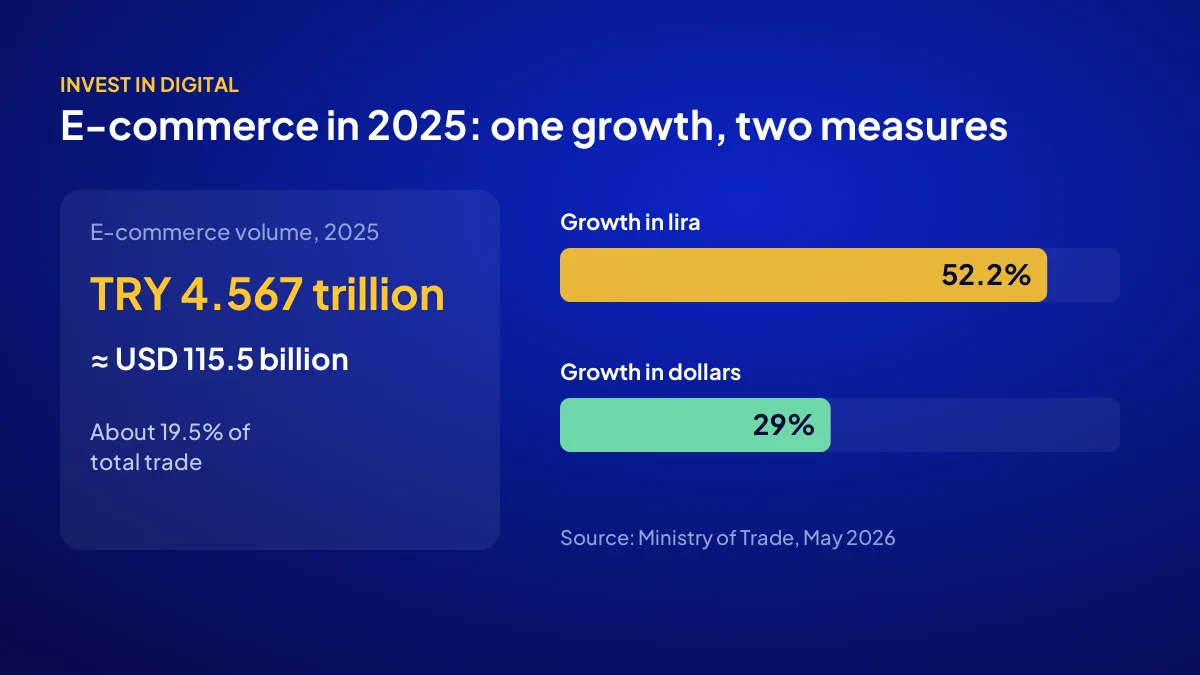
Turkey’s e-commerce volume reaches TRY 4.567 trillion in 2025. According to data the Ministry of Trade announced on 12 May 2026, that is a 52.2 percent rise on the previous year. In dollar terms it is about USD 115.5 billion, with 29 percent growth. E-commerce makes up about 19.5 percent of total trade.
For someone looking at an e-commerce site to take over, these figures describe the size of the market, not the site’s share of it. A big market means a wide door, but who walks through it is written in the site’s own data. Below we open the ministry data heading by heading and put a one-line comment under each figure.
How large was e-commerce in 2025 and how fast did it grow?
According to the ministry, e-commerce volume in 2025 is TRY 4.567 trillion, up 52.2 percent. That growth puts the 2024 volume at roughly TRY 3 trillion. In dollar terms the volume is about USD 115.5 billion, up 29 percent. E-commerce is reported at 6.9 percent of national income.
| Indicator (2025) | Value | One-line comment |
|---|---|---|
| E-commerce volume | TRY 4.567 trillion | No longer a side channel, but one of the main ones. |
| Growth in TRY | 52.2% | Part of the figure is price inflation. |
| Volume and growth in USD | USD 115.5 billion, 29% | A measure closer to real growth. |
| Share of total trade | 19.5% | Roughly one in five lira of trade turns on a screen. |
| Share of national income | 6.9% | A measurable weight in the economy. |
What does the retail side look like?
Sales to end consumers, retail e-commerce, rise to TRY 2.457 trillion in 2025, up 51.8 percent. According to the ministry, general e-commerce sees about 6 billion transactions and retail about 2 billion. Retail holds more than half of total volume.
A rough average per transaction
Divide retail volume by the number of transactions and you get a rough average of about TRY 1,200 per transaction. This is our rough sum from two rounded figures, not an official basket average. It helps to set the order average of the site you are buying next to it.
Quick commerce is its own lane
Quick commerce, delivered to the door within a short time, reaches TRY 388 billion and grows 55.6 percent. About 70 percent of it comes from food. The corner shop’s shelf is moving onto the screen.
How many businesses sell online?
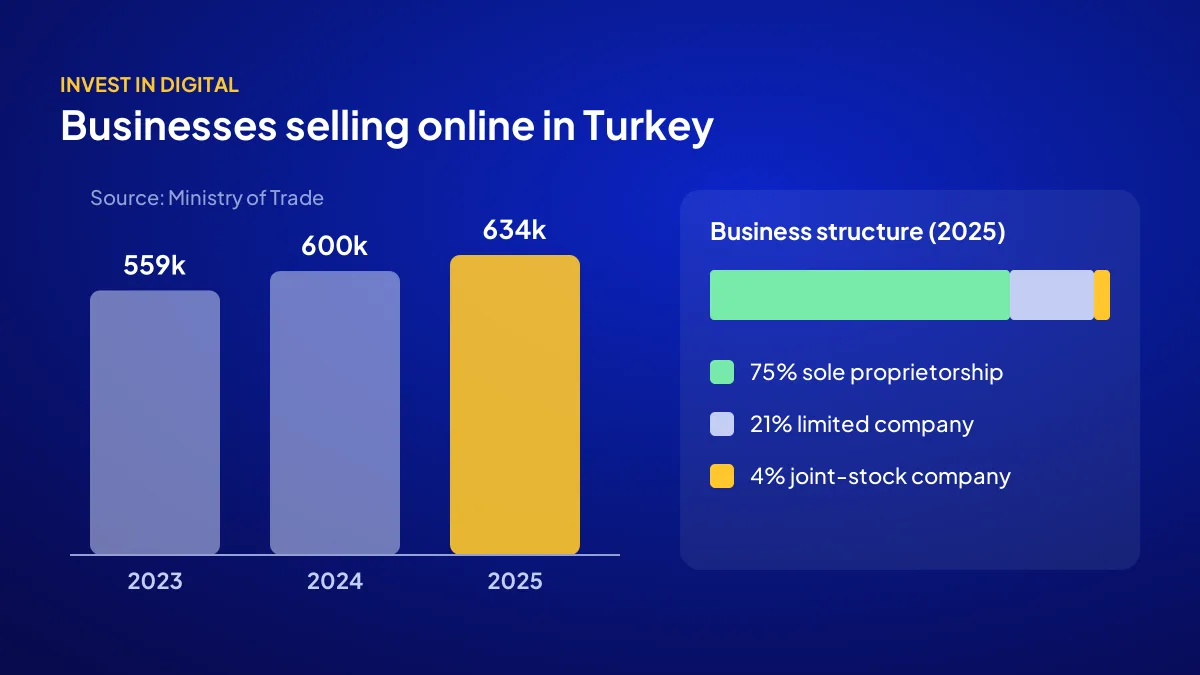
The number of businesses doing e-commerce is 559,000 in 2023, 600,000 in 2024 and 634,000 in 2025. According to the ministry, 75 percent are sole proprietorships, 21 percent limited companies and 4 percent joint-stock companies. As the market grows, more people set up a stall.
Which sectors are businesses crowding into?
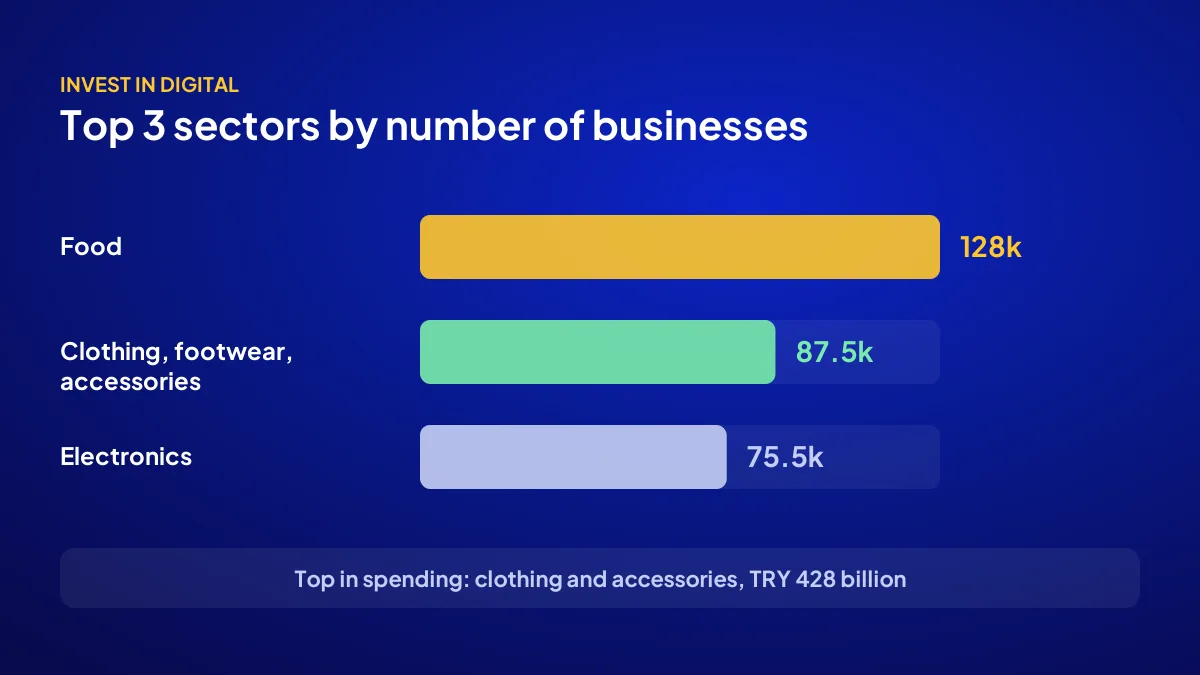
By number of businesses, the top three sectors are food, clothing-footwear-accessories and electronics. According to the ministry, there are 128,000 businesses in food, 87,500 in clothing and 75,500 in electronics. In spending, clothing and accessories lead with TRY 428 billion. A crowded sector means large demand and hard competition.
A takeover in a crowded sector
Taking over a site in food or clothing is like buying a shop in a busy bazaar. Plenty of customers, plenty of neighbouring shops too. Whether the site has its own loyal regulars decides everything here.
Less crowded niches
Outside the top three, sectors have fewer businesses. That can mean fewer rivals but narrower demand. The site’s Search Console data shows which one suits you.
How are habits and delivery changing?
Average cargo delivery time falls from 46 hours two years earlier to 42.2 hours. About 53 percent of shipments are delivered within 24-48 hours. Women account for 56 percent of spending volume and 75 percent of transactions. The highest spending tendency is in the 25-34 age group.
Delivery expectations are rising
Customers now expect a parcel within two days. Always ask about the carrier deal and delivery time of the site you are buying. Slow delivery wastes the work of a good page.
AI use is spreading
According to the ministry, 75 percent of e-commerce businesses use artificial intelligence. For product descriptions, customer messages and stock forecasts, the tools are now ordinary. List which tools are installed on the site you take over.
What do these figures mean for the site you take over?
These figures say the ground is wide and growing, but they reserve a share for no site. The value of the site you buy lies in its own traffic, its own orders and its own customers. Use market data as context and make the decision on the site’s data. This is not investment advice; decide according to your own situation.
Know what an asset for sale is
We explain that what you take over is a domain, a site, content and demand combined in what is a digital asset for sale. You can find what failing stores have in common in the why online stores fail guide.
Watch the next period
We discuss why trading digital assets may spread in the coming period in digital asset trading 2027. Buying a ready-made online business walks through a transfer from start to finish. To see installed e-commerce sites, visit the ASSETOR digital assets for sale page.
Quick Summary
- In 2025, e-commerce volume is TRY 4.567 trillion, up 52.2 percent in lira.
- In dollars, volume is USD 115.5 billion, up 29 percent.
- E-commerce is 19.5 percent of total trade and 6.9 percent of national income.
- 634,000 businesses do e-commerce, 75 percent of them sole proprietorships.
- By number of businesses, the top three sectors are food, clothing and electronics.
- Market size is context; decide on the site’s own data.
Short Glossary
E-commerce volume: E-commerce volume is the measure used to show the total value of all sales made online in a given period.
Retail e-commerce: Retail e-commerce is the concept used to separate online sales made to end consumers.
Quick commerce: Quick commerce is the term used to describe a sales model where orders reach the door within a very short time.
Next Step
If you have seen the market, the next step is to look at assets one by one. Browse the digital assets for sale on ASSETOR and read the cards of e-commerce sites next to these figures.
Frequently Asked Questions
Source: Ministry of Trade of Türkiye — E-commerce volume reached TRY 4.6 trillion in 2025 (in Turkish)
Sık Sorulan Sorular
Growth in lira carries price increases inside it. The 29 percent in dollars gives an idea closer to real growth. Make the same split when you read a site’s sales chart: did turnover rise, or the number of orders?
No. A growing market does not mean any single site will grow. ASSETOR gives no earnings guarantee on the assets it transfers; the ministry figure only shows how wide the ground is.
Three years add 75,000 businesses. That means more shutters opening for the same customer. Every newcomer has to build visibility from zero.
Three in four e-commerce businesses are sole proprietorships. The market is not a monopoly of big companies; it is also the small trader’s turf. The person deciding on a takeover often comes from this very group of small traders.
Women make three quarters of transactions, and the busiest age group is 25-34. Ask whether the language, images and payment options of the site speak to this buyer. If its visitor report has an age and gender breakdown, set it next to the ministry data. If they match, the site faces the right door; if not, the first job is fixing the shop window.
According to the Ministry of Trade, e-commerce volume in 2025 is TRY 4.567 trillion. Growth is 52.2 percent in lira and 29 percent in dollars.
You take over the domain, content, accounts and collected demand of an installed, working site. ASSETOR lists e-commerce sites, production businesses and service platforms.
Not necessarily. A growing market does not guarantee that a single site grows. ASSETOR gives no earnings guarantee; decide by looking at the site’s own data.
Updated: October 2026