
Digital asset trading: why will buying and selling sites spread towards 2027?
Say you want to start selling online in 2027, but you have no spare year to build a site. Digital asset trading steps in right here: instead of building from scratch, you take over a site that is set up, running and already generating demand. We expect this route to spread towards 2027, because three signals point the same way. Shopping keeps moving online, the rule load of building from zero is growing, and a site that generates demand carries value of its own.
One warning before we start. “Digital asset” makes most people think of crypto, but here we mean a business asset. Crypto assets are defined in Turkey’s Law No. 7518 and fall under the Capital Markets Board. A website for sale is a shop handed over with its domain, content and customer demand. There is no earnings guarantee either.
By digital asset, do we mean crypto?
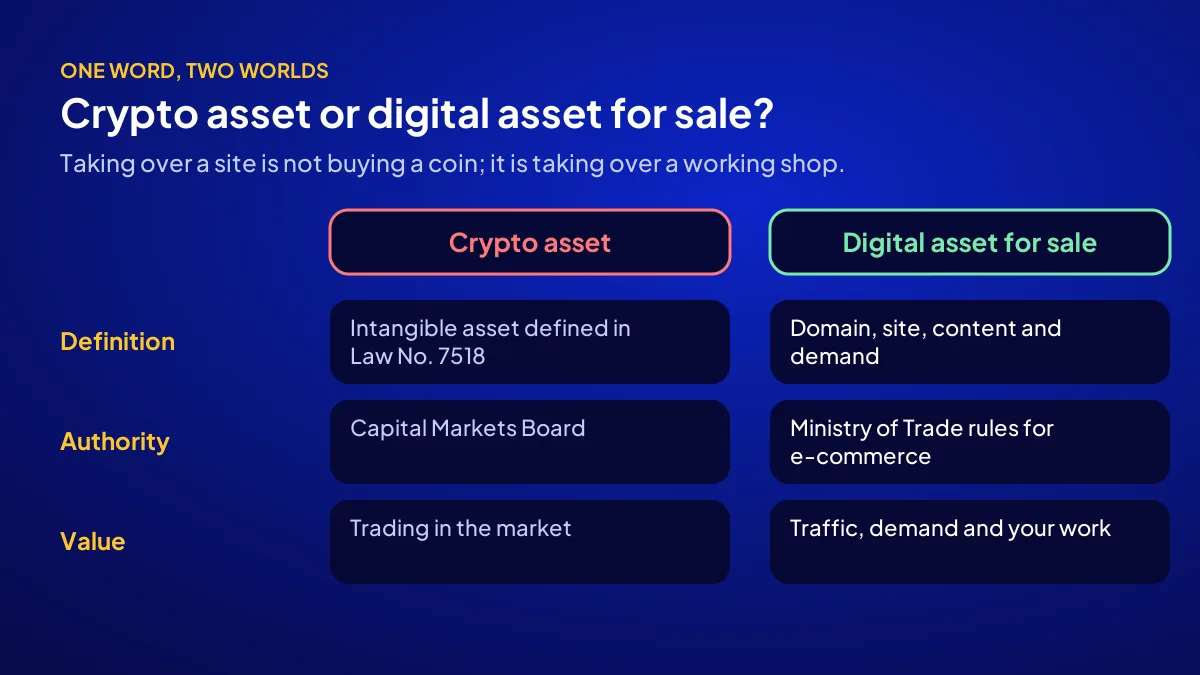
No. Here a digital asset means a working piece of a business on the internet: domain, site, content, visitors and demand. A crypto asset is a separate concept with its own legal definition. The two share a word, but what they give a buyer, who oversees them and their risks are different. The table puts them side by side.
| Feature | Crypto asset | Digital asset for sale (site) |
|---|---|---|
| Definition | Intangible asset defined in Law No. 7518 | Business asset made of domain, site, content and demand |
| Authority | Capital Markets Board (SPK) | Ministry of Trade rules if it sells online |
| What you get | A digital unit | A shop that receives visitors and collects orders or forms |
| What drives value | Trading in the market | Traffic, demand and how the business is run |
| Guarantee | None | None |
An unexpected finding
The law defines crypto assets as intangible assets created with “distributed ledger technology or a similar technology” that can represent value or rights. A website does not fit that definition. In short, the person who takes over a site is not buying a coin; they are lifting the shutters on a shop.
Why the distinction matters
A buyer who misses it looks at a site as an investment product and asks “how many times will it multiply?” The right question is “how will I run this shop?” What sets its value is not a market price but your work.
Reason one: shopping moves online and ready shops are in demand
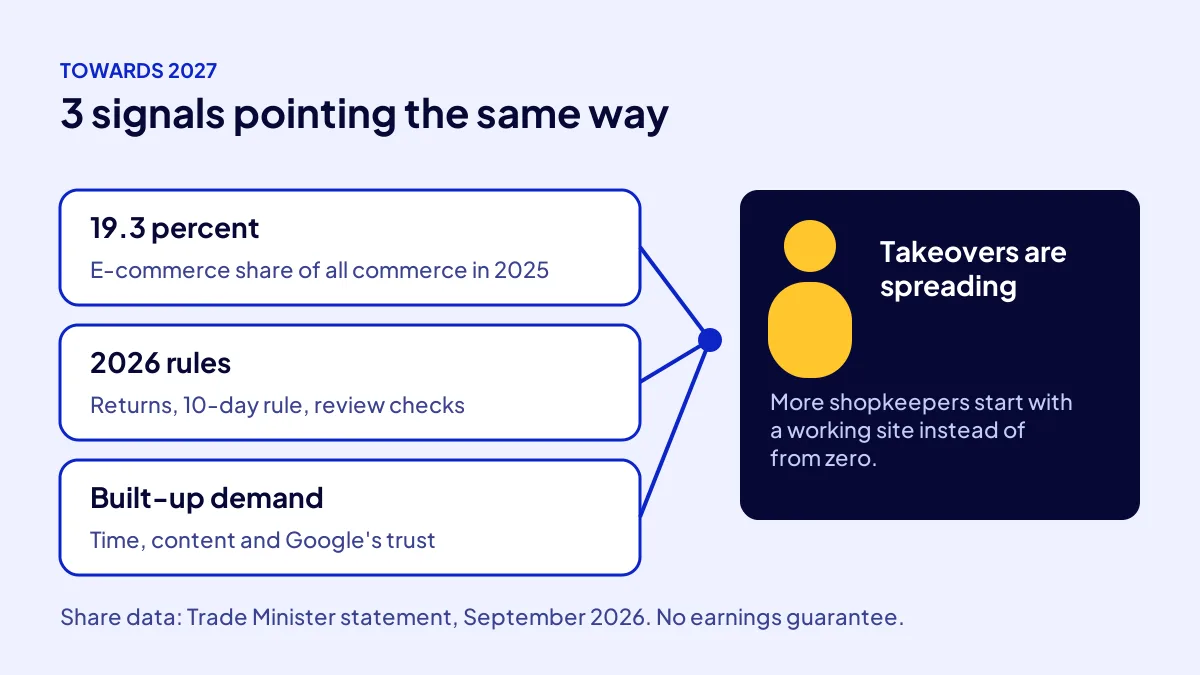
According to figures shared by Trade Minister Ömer Bolat in September 2026, e-commerce reached 19.3 percent of all commerce in Turkey in 2025. The same statement puts the number of businesses selling online at 634,000. Customers are online, and more shopkeepers are looking for a shop to meet them. Demand for established sites grows out of that gap.
Say you run a housewares shop
Say you run a housewares shop in Bahçelievler, Istanbul, and customers are not walking in like they used to. The people asking for the same products now search on their phones. Your question is no longer “should I go online?” but “how long will it take?”
Demand grows, the clock does not
As shopping moves online, more people want a new shop, yet the time a site needs to earn Google’s trust does not get shorter. The gap between the two feeds interest in ready-made sites.
Reason two: the rule load of building from zero is growing
In 2026 the rule list for a site selling online gets longer. Since 1 January 2026 the returns courier must be named in the pre-contract information. Since 1 August 2026 discounts use the lowest price of the previous 10 days, and reviews must be purchase-verified. Building all this from scratch means a lot of work before the first sale.
What comes ready on an established site
On a working site, contract pages, payments and the shipping flow have already been set up once. You still need to check they are up to date, but checking takes less time than building. Time is the most expensive item for someone starting from zero.
Inspection is a must
Being set up is not the same as being compliant. Before taking over, check the contract texts, price history and reviews one by one. If something is missing, raise it at the takeover table, not afterwards.
Reason three: a site that generates demand carries value on its own
An empty domain and a site that gets visitors, forms or orders every day are not the same thing. The second already holds time, content and Google’s trust. Once that build-up becomes something you can buy, wider trading follows. That is why marketplaces built for buying and selling websites have operated abroad for years.
Say you run a curtain workshop
Say you run a curtain workshop in Beylikdüzü, Istanbul. You have two roads: build a site and wait to appear in searches, or take over a site that already serves people looking for made-to-measure curtains. On the second road your phone may or may not ring on day one. But you start from existing demand, not from zero.
Who will sell, and who will buy?
Both sides of this market are familiar people. The seller is often someone who built and grew a site but is now moving to other work. The buyer is a shopkeeper who wants a ready business instead of starting from zero, an employee looking for side income, or an entrepreneur moving to a new city. What brings them together is time.
The seller’s side
The person who built the site holds two things: an asset that reflects their work, and time they can no longer give. Selling keeps that work from going to waste.
The buyer’s side
We describe which profiles suit a ready-made online business, from side-income seekers to growing firms, in six scenes in who should buy an online business.
Which risks grow as the market spreads?
BU BÖLÜMÜN ÖZETİ
- Ask where the numbers come from
- Do not trust earnings promises
- Where to look
- One principle
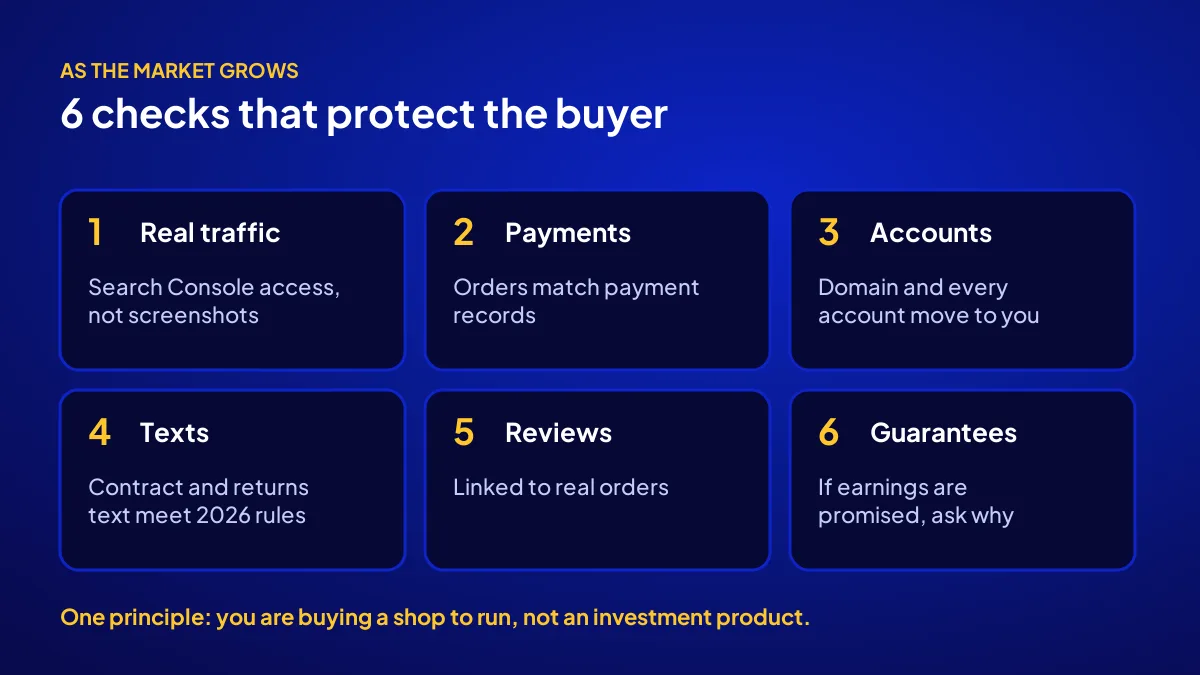
When a market grows, bad goods multiply too. Inflated visitor numbers, accounts handed over incompletely and “sure profit” promises are the three most common traps. So as trading spreads, inspection matters more. A process with clear rules protects both buyer and seller.
- Is traffic shown through Search Console access rather than screenshots?
- Do the orders match payment records?
- Will the domain and every account be handed over to you?
- Do contract and returns texts follow the 2026 rules?
- Are reviews linked to real orders?
- If the seller promises earnings, why?
Ask where the numbers come from
Ask for Search Console and Analytics access, and match orders against payment records. To learn how to tell whether a shop really makes money, see is my store profitable.
Do not trust earnings promises
An honest seller does not guarantee earnings. ASSETOR gives no earnings guarantee either: the asset is handed over set up, running and generating demand. The rest depends on your business, the market and your work.
Where to look
ASSETOR groups assets into three tiers: Silver with 6 assets (TRY 60,000), Gold with 2 assets (TRY 90,000) and Platinum with 6 assets (TRY 180,000). The process runs as inspect, choose, take over. See the list on the ASSETOR digital assets page. The overall maths is in buying a ready-made online business.
One principle
When you buy a digital asset, you are not buying an investment product but a shop you will run. Decide based on your own situation.
Quick Summary
- Here, a digital asset means a working business asset, not crypto.
- Crypto assets are defined in Law No. 7518; a website does not fit that definition.
- E-commerce reached 19.3 percent of all commerce in Turkey in 2025.
- 2026 rules make building from scratch heavier.
- A demand-generating site carries built-up time and trust.
- There is no earnings guarantee; never take over without inspecting.
Short Glossary
Digital asset: A digital asset is the name used for a business asset that hands over a domain, site, content and demand together.
Crypto asset: A crypto asset is the legal term used for units created with distributed ledger technology that represent value or rights.
Organic traffic: Organic traffic is the term used to measure visitors who reach a site from search results without paid ads.
Next Step
If you would rather be in this market than watch it, browse the digital assets for sale on ASSETOR and pick the tier that fits you.
Frequently Asked Questions
Source: Capital Markets Board (SPK) — Announcement on Crypto Asset Service Providers
Sık Sorulan Sorular
We explain in detail why a demand-generating site sells for far more than an empty domain in why demand-generating sites cost more.
No, no earnings guarantee is given. The asset is handed over set up, running and generating demand. Sales after the takeover depend on your business, the market and your work.
No. Crypto assets are defined in Law No. 7518 and fall under the Capital Markets Board. A digital asset for sale is a business asset made of a domain, site, content and demand.
On ASSETOR, prices are fixed by tier: Silver TRY 60,000, Gold TRY 90,000, Platinum TRY 180,000. Which tier suits you depends on the type of asset and your goal.
Updated: October 2026