
Why are ready-made websites expensive? 6 layers between an empty domain and demand
Why are ready-made websites expensive? The short answer: an empty domain is only a name, while a site that collects demand is that name plus months of work, content, Google history and real customer requests stacked on top. You can register an empty domain today. You cannot register demand today; you can only take it over.
The price gap comes from these layers. On ASSETOR, demand-generating assets sell in three tiers: TRY 60,000, TRY 90,000 and TRY 180,000. To understand the gap, you have to open the layers one by one.
What is actually inside the price of a ready-made site?
In a ready-made site, the domain is the cheapest part. The real value sits in what has built up on top of it and cannot easily be recreated: content, Google history, incoming demand and the measurement data that proves it. You are not paying for a sign but for a shop with customers walking past. How many walk past is what sets the price.
The name is cheap, the road is not
Say you are an air-conditioning installer and repairer in Avcılar, Istanbul. Buying a domain with your district and “AC service” in it takes one afternoon. Getting someone who searches “my AC is leaking water” to land on it takes months.
What you pay for is time itself
With a site that collects demand, you buy the fact that someone has already spent those months. Most of the price is the value of the months you will not have to wait.
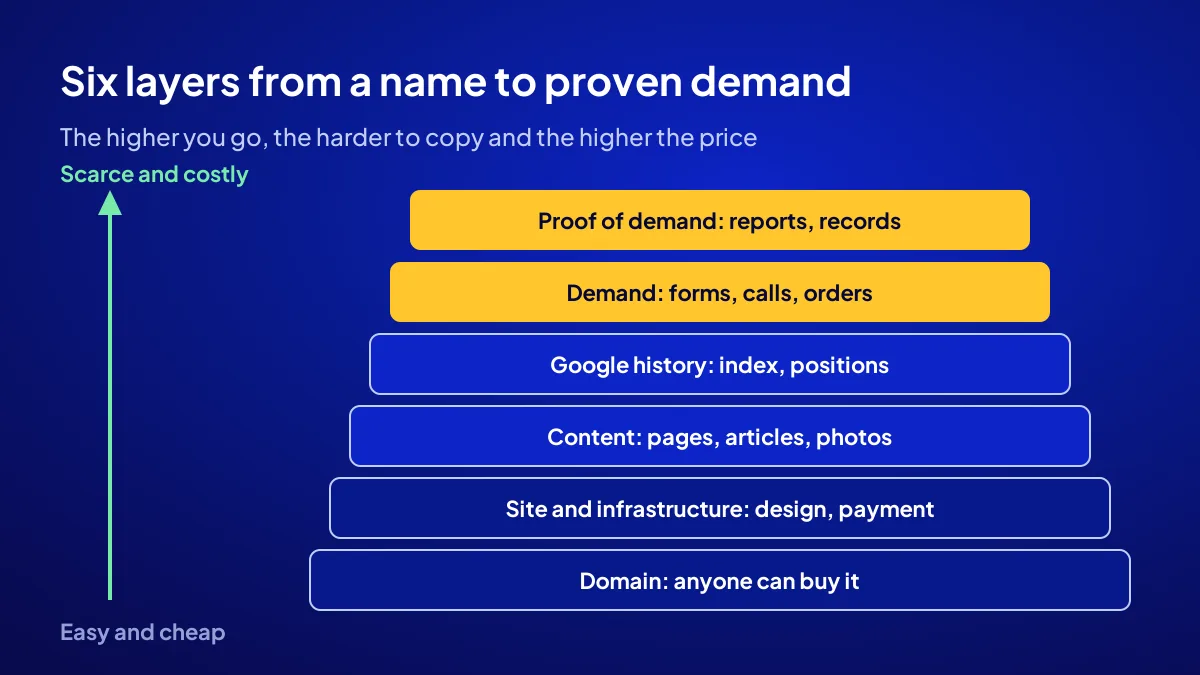
Which 6 layers separate an empty domain from a site that collects demand?
Six layers sit between an empty domain and a site that collects demand, and each adds to the price. The domain at the bottom is the part anyone can buy. Moving up, the layers become both more valuable and harder to copy. The top two, demand and its proof, are what really set the price.
- Proof of demand: Search Console and Analytics history, form records. The layer that shows demand is real.
- Demand: incoming calls, forms, orders. Customers coming to the door on their own.
- Google history: indexed pages, positions earned on specific queries.
- Content: product pages, articles that answer questions, photos.
- Site and infrastructure: design, payment, forms and tracking setup.
- Domain: the site’s address. The only layer anyone can buy.
Say you are torn between two listings: what is each one selling?
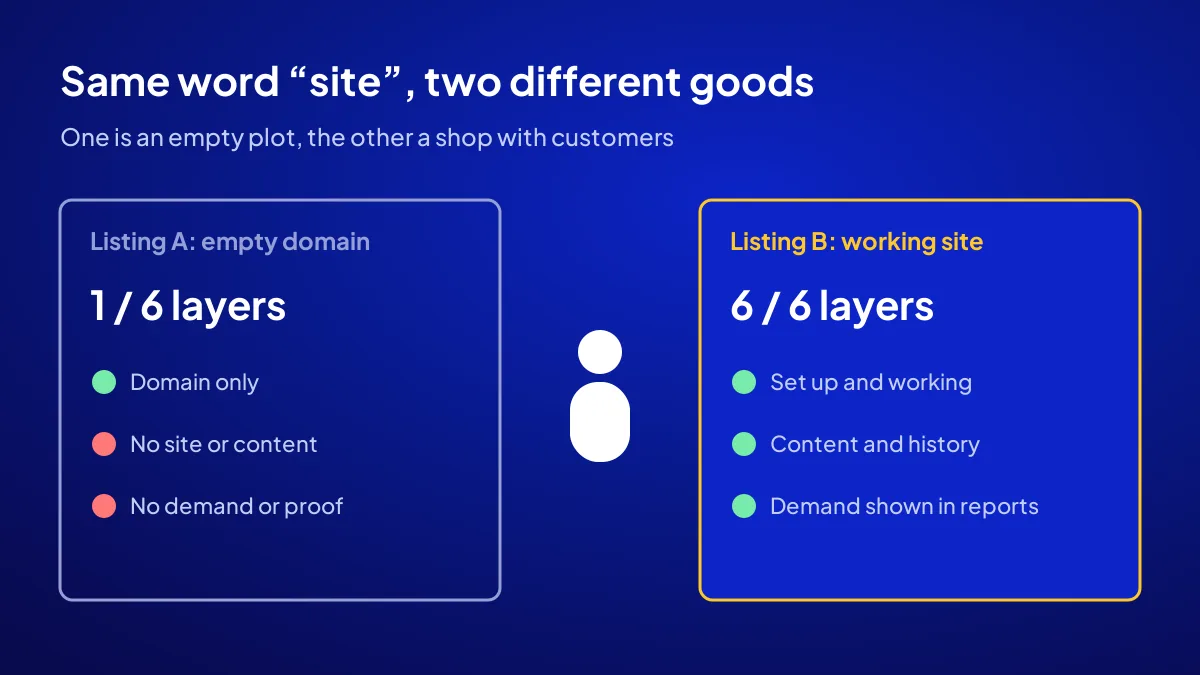
Two listings sit in front of you. One sells only a domain, and it is cheap. The other has a similar domain plus a working site, content and monthly incoming requests, and it costs far more. Both are sold as a “site”, but one is an empty plot and the other is a shop with paying tenants. The comparison table shows the gap layer by layer.
| Layer | Empty domain listing | Demand-generating site listing |
|---|---|---|
| Domain | Yes | Yes |
| Site and infrastructure | No, you build it | Set up and working |
| Content | No | Yes, published |
| Google history | No | Indexed pages |
| Incoming demand | No | Yes, measurable |
| Proof of demand | No | Shown with reports and records |
The hidden bill of the cheap listing
The installer who buys the empty domain has to build the five missing layers alone. Part of that is paid in money, most of it in time. Buy cheap, pay twice, as the saying goes, and here the second payment is months of waiting.
The one question for the expensive listing
With the expensive listing you ask one thing: is the demand real, and where does it come from? The answer to that question is what justifies the price, not how pretty the design is.
The surprising finding: you can copy the design, not the demand
You can copy the look of a demand-generating site in a week. But you cannot copy its traffic. Demand is tied to the history that address has built up over months. Most of the price sits not in the visible part but in this history that cannot be moved.
The visible part is cheap
Themes, logos and page layouts are easy to find on the market today. A buyer who judges the price by the design is usually looking at the wrong thing.
The invisible part is the real goods
Which queries bring impressions, which page brings forms, which month orders peak. This information does not show on screen; it shows in reports. That is what you are really buying.
What does the price depend on at ASSETOR?
At ASSETOR, the price depends on the asset’s tier, and there are three: Platinum with 6 assets at TRY 180,000, Gold with 2 assets at TRY 90,000, and Silver with 6 assets at TRY 60,000. The assets are e-commerce sites, production businesses and service platforms. All of them are set up, working and already collecting demand. You can see the current list on the ASSETOR digital assets for sale page.
A price is not a promise of earnings
A higher tier does not mean a higher guaranteed income. ASSETOR makes no promise of earnings. The price pays for the layers you take over; your result depends on how you run them.
Is the price fair: how do you verify demand before taking over?
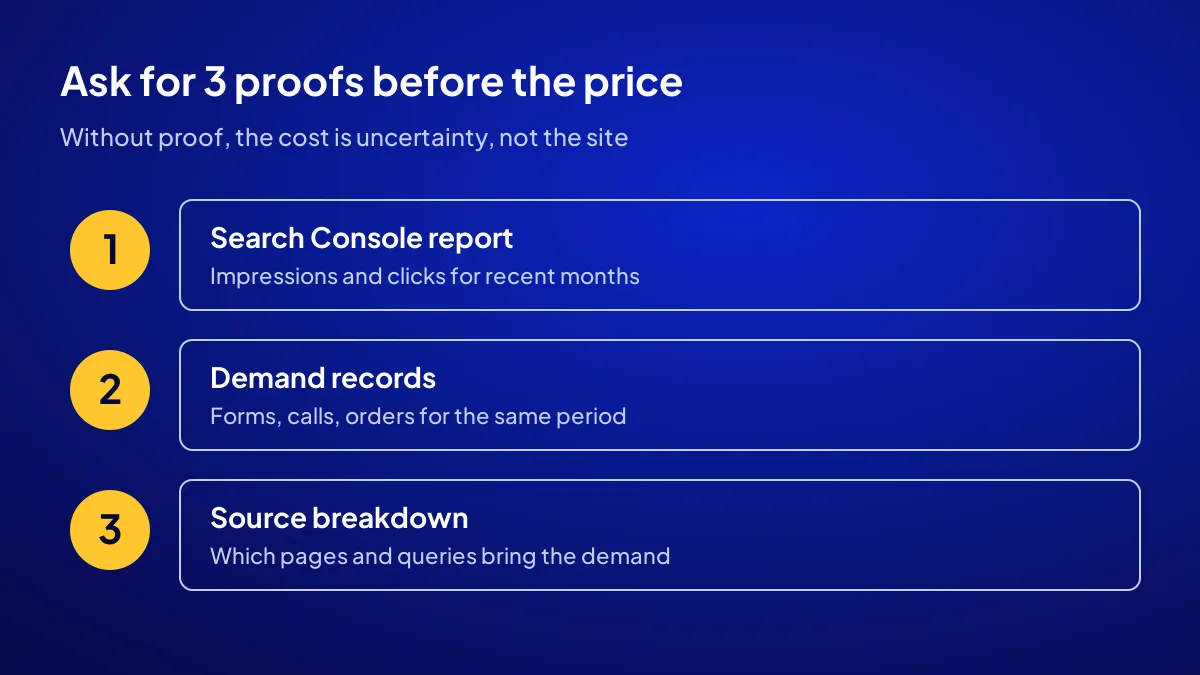
You judge whether the price is fair by looking at the proof of demand. Ask the seller for measurement reports, form or order records and the queries that bring impressions. If the numbers line up, the price matches the layers. Without proof, the expensive thing is not the site but the uncertainty. We cover the general way to tell whether a site really works in how do I know my website works.
- A Search Console impressions and clicks report for recent months.
- Form, call or order records for the same period.
- A breakdown of which pages and queries the demand comes from.
Translate the number into your business
Once you have seen the proof, one question remains: what is this demand worth in your business? The same number of forms means one thing for an AC installer and another for a bedding workshop. Think about it with your own average order value, then go back to the price.
One principle
The price of a ready-made site means as much as the demand you can see proof of. Look at the proof first, then the price. The full framework is in the guide to buying a ready-made online business.
Quick Summary
- An empty domain is a name; a demand-generating site is six layers on top of it.
- The domain is the cheapest layer; demand and its proof are the most expensive.
- Design can be copied; demand and Google history cannot.
- At ASSETOR, price depends on tier: TRY 60,000, 90,000 and 180,000.
- A price is not a promise of earnings; no earnings guarantee is given.
- Ask for proof of demand before looking at the price.
Short Glossary
Domain: A domain is the name used to give a website its address on the internet.
Impression: An impression is the measure used to count how many times a page appears in Google search results.
Proof of demand: Proof of demand is the set of reports and records used to show that a site really collects customer requests.
Next Step
If you want to start with an asset whose layers are already built, browse the digital assets for sale on ASSETOR and compare the tiers.
Sık Sorulan Sorular
Anyone can buy a domain. In Turkey, “.tr” domains are allocated through TRABİS via authorised registrars. Applying is open and quick, so there is no scarcity in this layer.
Content can be written in a few months, but Google history and demand cannot be written; they are waited for. What is scarce is always expensive. The price of a demand-generating site is the price of that scarcity.
We explain the logic behind the names in Platinum, Gold, Silver asset tiers. To weigh the three prices item by item, see ready-made website prices.
If a report is missing, ask which period is missing and why. Tracking may have been set up later; that is not a flaw, but you need to know which period you are weighing the price against. An unanswered question is a reason to walk away, not to haggle. Do not put down a deposit before all the proof is on the table.
An empty domain is only a name. A demand-generating site adds infrastructure, content, Google history, incoming demand and proof of that demand on top of the domain. The price gap comes from these layers and the time it takes to build them.
The price depends on the asset’s tier: Platinum TRY 180,000, Gold TRY 90,000, Silver TRY 60,000. The assets are e-commerce sites, production businesses and service platforms.
No. ASSETOR makes no promise of earnings. The price pays for the layers you take over; the result depends on how you run the asset.
Updated: October 2026