
Medical Technical Service Licences and Authorisation: What You Need
A medical technical service calls for the standard workplace documents: a lease, the building’s occupancy permit, a tax certificate, chamber registration, the workplace opening licence and a social security declaration. The real question sits beyond those: which devices you will work on, and under whose authority.
There are two positions in this branch. Being a service authorised by a manufacturer is one thing; working as an independent service is another. The document load and the business model differ. Below I set out what each one asks.
Step 1: Decide which position you will hold
An authorised service is one a manufacturer or importer has authorised for its own devices. Authorisation comes by contract; in return you receive training, original parts and technical documentation.
An independent service works without a brand tie. It is more flexible, but it cannot touch devices under warranty, and on some devices its access to parts and software is limited.
Duration: authorisation talks take weeks. Needed: technical capacity and staff competence.
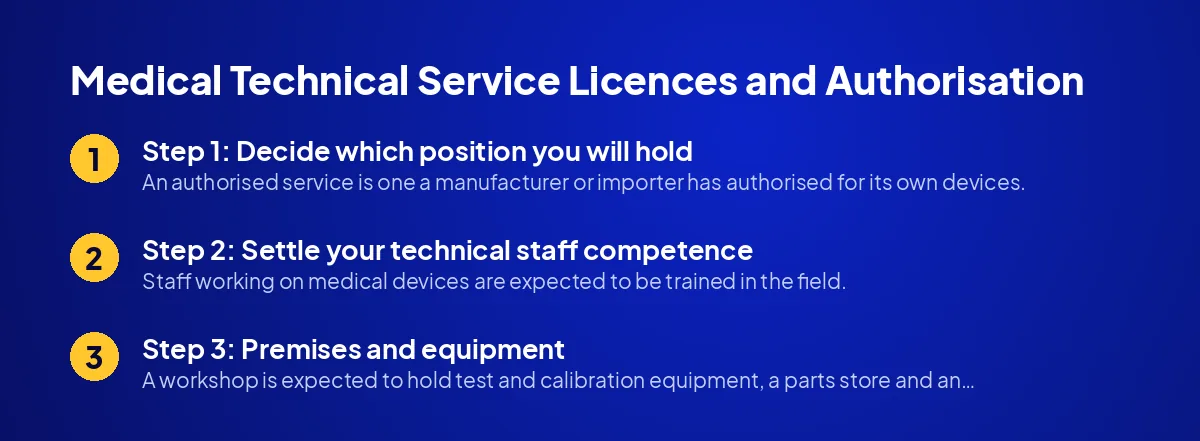
Step 2: Settle your technical staff competence
Staff working on medical devices are expected to be trained in the field. A technician or engineer schooled in biomedical work is this business’s core.
Common mistake: the “I will find a craftsman who knows electronics” approach. A wrong intervention on a medical device touches patient safety, and that is not the same as repairing an ordinary appliance.
Duration: days if the person is ready. Needed: training certificates and an employment contract.
Step 3: Premises and equipment
A workshop is expected to hold test and calibration equipment, a parts store and an arrangement keeping faulty and repaired devices apart. Electrical safety test instruments are the basic investment here.
Duration: weeks to set up. Needed: test equipment, shelving and partitioning.
Step 4: Workplace registrations
Lease, stamp duty, commencement notice, tax certificate and chamber registration. A company structure is common in this branch, because hospitals and corporate customers generally work with companies.
Duration: one to two weeks. Needed: the standard incorporation paperwork.
Step 5: If you will sell devices as well
If you will sell devices or spare parts alongside the service, the medical device sales centre framework comes into play: a sales centre authorisation certificate, Product Tracking System (ÜTS) registration and a responsible manager.
Common mistake: saying “I am a service, I do not sell” and then selling spare parts. A part can fall within the device scope too; check it group by group.
Duration: weeks. Needed: the sales centre application paperwork.
Step 6: Municipal licence and opening
The workplace opening and operating licence is obtained. The licence class is assessed according to the nature of the workshop; in some cases a non-sanitary establishment classification comes up.
Duration: one to three weeks. Needed: the other documents completed.
Service records: the unseen backbone
Every intervention must be recorded. That serves the customer relationship, your legal protection and your knowledge of the device.
What a service form should carry
- The device’s make, model and serial number
- The reported fault and the diagnosis
- The work done and the parts replaced
- Whether the part used was original or equivalent
- Test and calibration results
- Date of return and the person receiving it
The fourth item is the one that starts arguments. If you use equivalent parts, say so from the outset and write it on the form; learning it afterwards costs you trust.
Working with hospitals and corporate customers
Most income in this branch comes from the corporate side. Hospitals and clinics sign periodic maintenance agreements; those bring steady income and their own paperwork.
In a periodic maintenance agreement
Which devices fall in scope, how often maintenance occurs, the response time and whether a replacement device is provided should all be written into the contract. When you commit to a response time, write the time you can keep.
Calibration reports
A corporate customer will ask for a report on your calibration and use it in its own audits. Set your reporting up properly at the start and that relationship runs smoothly.
Spare parts supply keeps the service standing
A service’s speed equals the speed it finds parts. Without the part in hand the device waits, the customer waits, and that wait comes out of your reputation.
Two channels
As an authorised service you reach original parts through the manufacturer; time and price are largely fixed. As an independent service you turn to equivalent parts and the second-hand market; prices are flexible there but the reliability of the source varies.
Critical parts stock
Holding the frequently failing parts in stock shortens service times noticeably. Your service records tell you which parts fail often; by the end of six months that list forms itself.
Tie the parts record to the device record as well: which part went into which device, and where it came from. That record earns its keep the moment something goes wrong.
Checklist
Before you start: authorised or independent, who the technical staff are, the budget for test equipment.
At incorporation: lease, stamp duty, tax certificate, chamber registration, company paperwork.
Before you begin work: workshop partitioning, test equipment installed, service form system, municipal licence.
If you will sell too: sales centre authorisation certificate, Product Tracking System registration, responsible manager.
For the general order see the business licence roadmap, for the device sales side our medical supply shop article, and for capital bands our medical sector page.
Pricing: parts or labour?
BU BÖLÜMÜN ÖZETİ
- Separate the two items
- Call-out and diagnosis charges
- The contracted maintenance model
Service income has two components, and managing them separately makes the profit visible.
Separate the two items
A part is a commercial item carrying a set margin. Labour is a service charge, by the hour or by the job. Merging the two into one figure leaves you blind to which one earns.
Call-out and diagnosis charges
Travelling to the device and identifying the fault is labour. Offering that free turns into a straight loss when no fault is found. Stating the diagnosis charge up front clarifies expectations and cuts wasted journeys.
The contracted maintenance model
- An annual maintenance contract brings steady income
- It makes fault frequency predictable in advance
- Corporate customers prefer this model because they can budget for it
- For you, planned work is more productive than unplanned work
Moving to a contracted model means knowing fault frequency first; your first year’s records give that figure.
Which device group should you specialise in?
A service that tries to repair every device is fast enough at none of them. In this work specialisation lifts both speed and margin.
Two things settle it: which device group is dense in your area, and how many authorised services already cover it. A dense group with few services beats a broad but crowded field.
Holding parts stock also gets easier in the group you specialise in; the same parts keep turning. That shortens response times, and response time is the item corporate customers watch most closely.
In Short
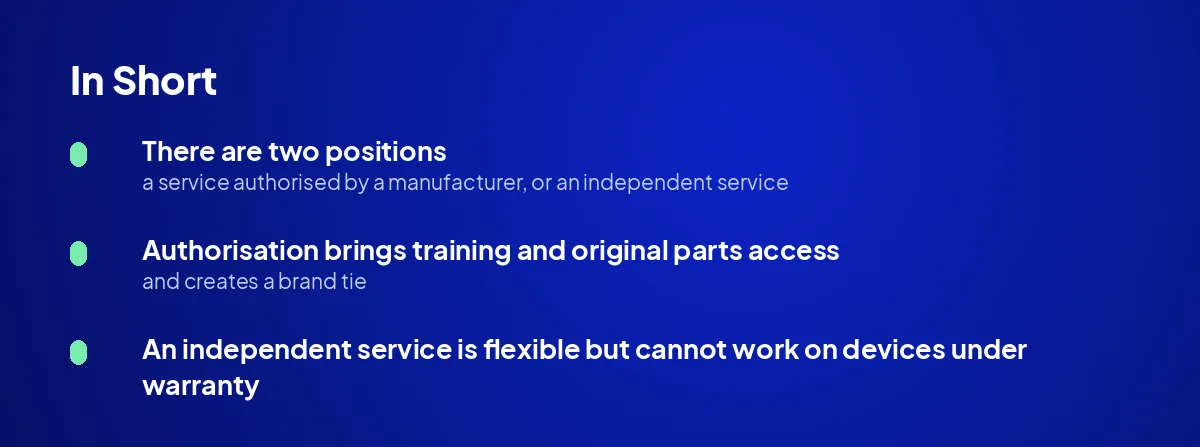
- There are two positions: a service authorised by a manufacturer, or an independent service
- Authorisation brings training and original parts access, and creates a brand tie
- An independent service is flexible but cannot work on devices under warranty
- Technical staff are expected to be trained in the field
- The workshop needs test equipment and separation of faulty from repaired
- If you will sell spare parts, the sales centre framework comes into play
- Every intervention needs a service form; equivalent parts must be written on it
- In corporate maintenance agreements, commit only to a response time you can keep
- Service speed equals parts-finding speed; stock the parts that fail often
- Price parts and labour separately; state the diagnosis charge up front
- Specialisation lifts speed and margin: pick a dense group with few services
For a neighbouring branch see our respiratory device sales article as well.
Quick Glossary
Authorised service: a service authorised by contract with the manufacturer, with access to original parts and documentation. Calibration: the adjustment and documenting of a device’s measurement accuracy. Equivalent part: a non-original part offering the same function. Periodic maintenance: planned maintenance carried out at set intervals.
Next Step
Let’s map out your service set-up and your authorisation plan together: consultation request form.
Frequently Asked Questions
Updated: September 2026
Sık Sorulan Sorular
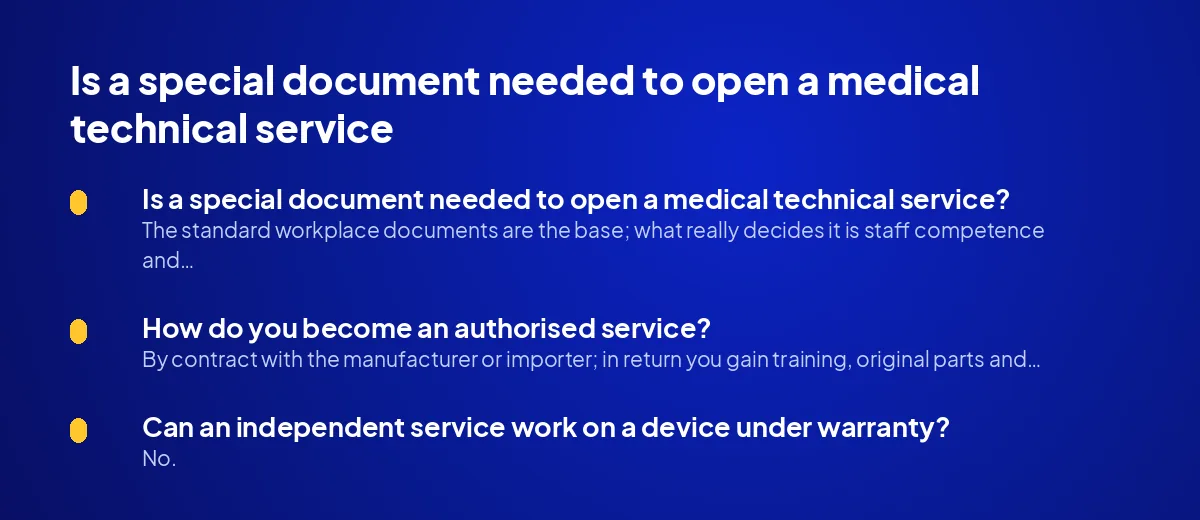
The standard workplace documents are the base; what really decides it is staff competence and manufacturer authorisation.
By contract with the manufacturer or importer; in return you gain training, original parts and technical documentation.
No. Intervening on a device under warranty voids it; that work goes to the authorised service.
A technician or engineer schooled in biomedical work is the core of this business.
A part can fall within the device scope; if you will sell, check the sales centre framework.
Device details, the diagnosis, the work done, whether the part used was original or equivalent, test results and the return record.
You may use them, but tell the customer from the outset and write it on the form; learning it afterwards costs trust.
The devices in scope, maintenance frequency, response time and any replacement device condition should be in writing.
It is assessed by the nature of the workshop; in some cases a non-sanitary establishment classification comes up.