
Unsafe Product List: What the Ministry of Trade’s Findings Mean for Baby Brands
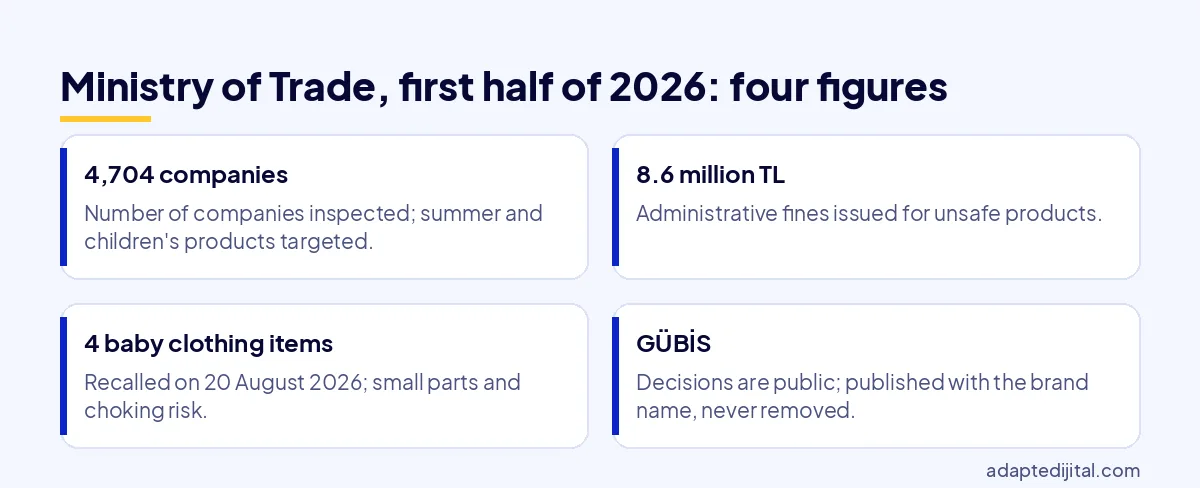
In the first six months of 2026 the Ministry of Trade inspected 4,704 companies, issued 8.6 million lira in administrative fines for products found unsafe, and declared children’s furniture, clothing, footwear and toys a priority inspection area. On 20 August 2026 four baby clothing items were recalled because small accessories came away easily, creating a choking and injury risk. The decisions are published openly on the Unsafe Product Information System (GÜBİS).
For a new baby brand this news means three things: baby products are a priority inspection area, a product found unsafe is published together with the brand name, and that listing is never deleted. This article gives the development first, then what it means for you, and finally the steps that protect you. The source is the Ministry’s own statement; the commentary sits in its own section.
What happened?
The Ministry announced the results of market surveillance carried out under its zero-tolerance principle for unsafe products: 4,704 companies inspected, sales bans, recalls and risk warnings applied to non-compliant products, and 8.6 million lira in fines in total. Summer products and children’s products were among the targeted inspection headings. In August, four baby clothing items joined the list with a recall decision.
Official source
The full statement is the Ministry of Trade market surveillance announcement; the recalled products and the grounds for each are published on GÜBİS (guvensizurun.ticaret.gov.tr).
The baby clothing decision
All four items share the same grounds: a small part that can come away. Buttons, beads, appliqués; decoration to a mother, a choking risk to an inspector. The decision is dated 20 August 2026 and was announced by the Ministry’s press office.
What it means for you: how does a new brand end up on the list?
BU BÖLÜMÜN ÖZETİ
- Small parts
- Label and composition
- Accessories and toys
A new baby brand usually ends up on the list by one of three routes: small parts and choking risk, missing label or composition information, and accessories without a conformity certificate. All three can be prevented at the design or production stage; none can be corrected at the sales stage. The list prints the brand name, not the manufacturer’s.
Small parts
Every decorative part attached to baby textiles is subject to a pull test. If the part comes away, the product is unsafe; the beauty of the design is no defence. A brand starting with textiles has this test done before production.
Label and composition
If fibre composition, care instructions, or manufacturer and importer details are missing, the product counts as non-compliant. On the cosmetics side the notification and ingredient list do the same job; that is covered in the article on dermatologically tested and hypoallergenic.
Accessories and toys
Dummies, teethers and toys cannot be placed on the market without a conformity certificate. This is the group with the toughest inspections; if a brand starts here, the laboratory comes before the designer.
The set-up order, with the document steps in place, is in the nine-step guide to starting a baby care brand.
What does a listed brand lose?
BU BÖLÜMÜN ÖZETİ
- Pharmacy and store
- Mother and search
- The new brand’s disadvantage
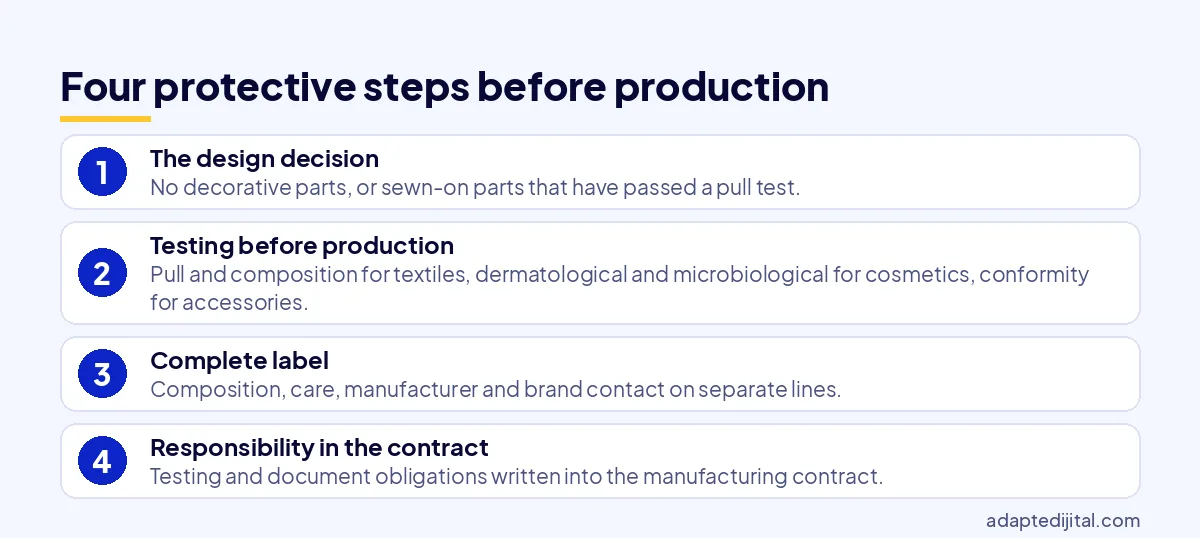
More than the fine: pharmacists and stores check the list, a mother typing the brand name into a search engine finds the listing, and that listing stays there for years. A new brand builds its reputation from zero; a name that appears on the list starts below zero. The loss is not financial, it is the loss of a channel.
Pharmacy and store
More and more buyers search the brand name in the system before making a stocking decision. Nobody meets a brand that appears on the list; often there is not even a chance to explain.
Mother and search
If a recall notice sits among the first results for the brand name, the product page never gets opened. That visibility cannot be papered over with advertising; advertising just shows the notice to more people.
The new brand’s disadvantage
A big brand carries a recall on ten years of reputation; a new brand meets its first headline with no reputation at all. The same decision leads to two different outcomes for two brands. That is why the inspection threshold for a new brand is higher than for a big one, not lower.
How to protect yourself: four steps before production
BU BÖLÜMÜN ÖZETİ
- The design decision
- Testing before production
- The contract with the manufacturer
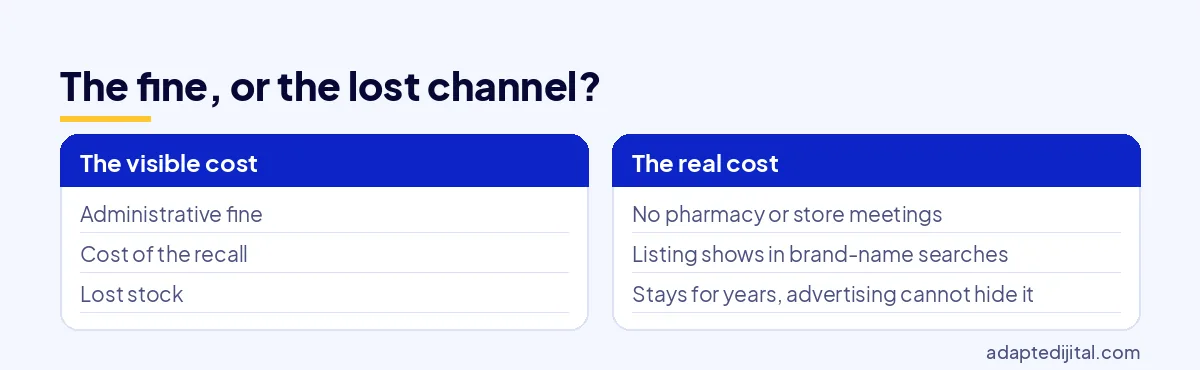
Protection begins in production, not in sales: no small parts in the design, pull and composition tests before production, complete information on the label, a conformity certificate for accessories. All four are the brand owner’s responsibility, not the manufacturer’s; with contract manufacturing the responsibility still sits with the brand.
The design decision
Do not add decorative parts, or use parts that are sewn on and have passed a pull test. The safety rule is given to the designer before production, not after.
Testing before production
Pull and composition tests for textiles, dermatological and microbiological tests for cosmetics, conformity tests for accessories. Reports are issued in the brand’s name and kept in the file; what gets discussed at the pharmacist’s counter is shown in the pharmacy shelf case.
The contract with the manufacturer
Responsibility for testing and documents is written into the contract; if it is not, the brand is left as the sole named party. Choosing a manufacturer, with the contract clauses, is in the article on how to choose a contract manufacturer.
Are inspections getting more frequent?
The Ministry’s statement says inspections concentrated on summer products and children’s products; 4,704 companies in the first six months is a wider targeted inspection area than in earlier periods. For a new brand the direction is clear: baby products are inspected as a priority, not by chance. A brand that plans for that ends up on the shelf, not on the list.
The sector picture
For the sector comparison and general framework see the baby brand sector guide; for pattern and labelling rules on the underwear side see the underwear brand guide.
The consultant’s role
A consultant does not issue documents; a consultant sets the order of the documents, their place in the contract and their counterpart on the label. The scope is on the brand consultancy page and the order in the pillar article.
Summary and what to do today
BU BÖLÜMÜN ÖZETİ
- One check
- Watch the list regularly
- The next article
Baby products are a priority inspection area, unsafe products are published with the brand name, and the listing is never removed. The one thing to do today: compare your product against the grounds given on GÜBİS; small parts, label, composition, conformity. If even one item is in doubt, production stops, not sales.
One check
Pick up the box or the product: is there a part that can come away, is the label complete, is the report in the brand’s name? Three questions, three minutes. If any answer is uncertain, uncertain counts as no; the inspector counts it the same way.
Watch the list regularly
GÜBİS is worth reading not only for your own products but for competitors’ too. Which product was recalled on which grounds; the list is a free risk map for you, and it is updated every month.
The next article
To see the set-up from start to finish, the nine-step guide; to find your stage, the hub article on which consulting comes first.
Frequently Asked Questions
Quick Summary
- First half of 2026: 4,704 companies inspected, 8.6 million lira in fines, children’s products a priority area.
- 20 August 2026: four baby clothing items recalled over small-part risk.
- The list is published with the brand name and never removed; the loss is not the fine but the channel.
- A new brand ends up on the list by three routes: small parts, an incomplete label, uncertified accessories.
- Protection comes before production, in four steps: design, testing, label, contract.
Short Glossary
- GÜBİS: the Unsafe Product Information System on which the Ministry of Trade publishes unsafe products with brand and grounds
- Recall: the decision to withdraw a product found unsafe from the market; it can be applied together with a sales ban and a risk warning
- Pull test: a safety test that measures whether a part on a textile product comes away under a given force
- Party placing on the market: the party that offers the product for sale under its own brand and carries the legal responsibility
Next Step
To read your product against the GÜBİS grounds together, write to us via the consult your expert form; the scope is on the brand consultancy page. Next article: how to start a baby care brand in nine steps.
Updated: October 2026
Sık Sorulan Sorular
The Ministry’s wording is plain: zero tolerance for unsafe products. In practice that means a product found unsafe gets a sales ban and a recall, not a warning. For a new brand the first mistake can be the last.
The Unsafe Product Information System (GÜBİS), where the Ministry of Trade publishes openly the products found unsafe through market surveillance, with brand, model and grounds.
They sit in the risk group because of small parts, choking risk and skin contact; in the first half of 2026 the Ministry declared children’s clothing, furniture, footwear and toys a targeted inspection area.
Whoever places the product on the market under their own brand, that is the brand owner. The manufacturer can share responsibility by contract, but the list prints the brand name.