
Why a Baby Care Brand Cannot Get onto the Pharmacy Shelf in Year One: A Case
A baby care brand is kept off the pharmacy shelf not by a bad product but by an incomplete file. The pharmacist does not try the product but reads the file: is there a notification, a test report, a named contact if something goes wrong, a return arrangement. If one of the four is blank, the shelf conversation never starts, however good the product.
This article follows a real brand through twelve pharmacy meetings; no names, just reasons. Four reasons for no, each with the pharmacist’s sentence and the brand’s fix. It ends with one principle: a baby brand enters the pharmacy with a file, not a product.
Say you launch with three products and nobody will stock them
Say you are a mother turned founder launching three products: shampoo, oil, nappy rash cream. The manufacturer is good, the packaging clean, the price below the market. You visit twelve pharmacies and all twelve politely say no. Look, the problem here is not the product; at the pharmacist’s counter it is never even opened.
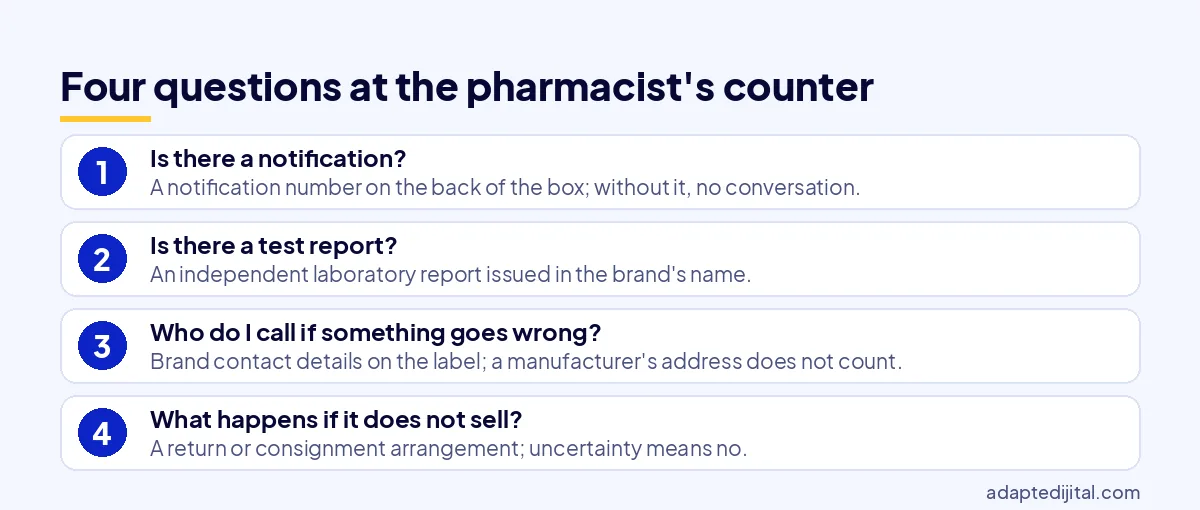
What the brand sees
The founder goes home and changes the packaging: new colour, new typeface, more natural look. The second round brings twelve more noes, because the pharmacist turns the box over and asks the same question. Packaging does not answer it.
The unexpected finding
Not one of the twelve pharmacists asks about price. The founder keeps it low and thinks that is an advantage; for the pharmacist a low price signals doubt, not trust. A cheap baby product does not look good on a pharmacy shelf.
What goes into that file is unpacked in the article on dermatologically tested and hypoallergenic.
Reason one: there is a product, but no file
The pharmacist asks for three documents: the TİTCK (Turkish Medicines and Medical Devices Agency) product notification, independent laboratory test reports and batch-level traceability. In this case the notification is filed, but the report stays with the manufacturer; the founder holds only the product. For the pharmacist, a document not in your hand does not exist.
The pharmacist’s sentence
Bring the report and we will take a look. That is not a promise, it is a door; the brand that opens it with a report gets onto the shelf, the brand that tries packaging does not.
The fix
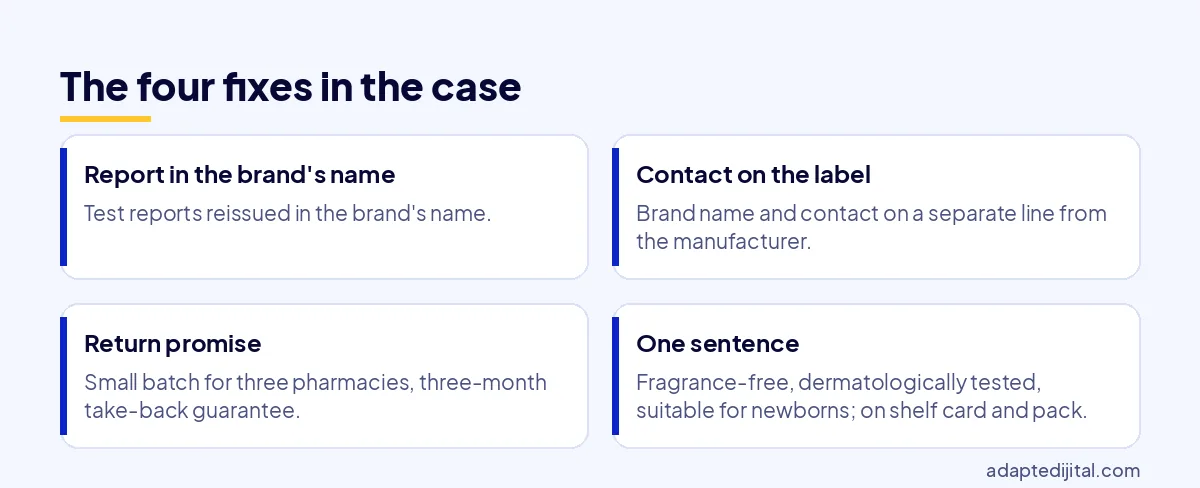
The brand has the manufacturing contract rewritten; test reports are reissued in the brand’s name and the batch number appears on every box. It takes two months, the most valuable two of the first year. The contract side is covered in the article on choosing a contract manufacturer.
Reason two: nobody knows who to call
If a mother complains, the pharmacist wants to know who to call. Here the box carries the manufacturer’s address but not the founder’s number; for the pharmacist the named contact is whoever sells the brand, not the factory. A product with no clear contact stays off the shelf, because the responsibility lands on the pharmacist next to it.
The fix
The label is reprinted: brand name, brand contact and manufacturer details on separate lines. Now the pharmacist sees who to call. This small change brings the first yes in the third round.
Beyond the label
A named contact is also response speed. The founder commits to calling back within an hour; beating a big brand’s call centre is the small brand’s only advantage.
Reason three: returns and turnover were never discussed
A pharmacy shelf is rented space, and the pharmacist will not fill it with a product that does not sell. Here the founder never raises returns; the pharmacist, unsure what to do with three unsold boxes, says no from the start. Sell it, and send back what does not sell: that sentence is the key to the shelf.
The pharmacist’s sums
The pharmacist looks at turnover: how long will this sit here? For an unknown brand the answer is uncertain, and uncertainty means no. A consignment start and a three-month return guarantee change the sums.
The fix
A small batch for the first three pharmacies, a take-back promise and a shelf card. Once turnover is visible, the second batch comes on normal terms. The channel comparison is tabled in the article on pharmacy, baby store or your own site.
Reason four: there is no recommendation sentence
The pharmacist does not sell a product but recommends it, and needs a sentence to do so. Here the founder talks for twenty minutes and the pharmacist cannot find one sentence in it. With nothing to say to the mother, the product sits on the shelf unsold; and what does not sell is not there for the next batch.
The fix
The founder writes one sentence per product and puts it on the shelf card. The pharmacist now sells the sentence, not the product. The same sentence repeats on the product page and pack; consistency is what trust is made of.
The mother’s side
Why mothers move from big brands to small ones is a separate case in the article on why parents switch to small baby brands; both end in the same place: a sentence and a document.
Where is the case today?
The brand is on the shelf in four of the twelve pharmacies, the second batch has come on normal terms, and the founder now walks into meetings with a file, not a box. The price is now mid-market rather than below it; the pharmacist finds that more trustworthy. The product never changed; the file, label, return promise and single sentence did.
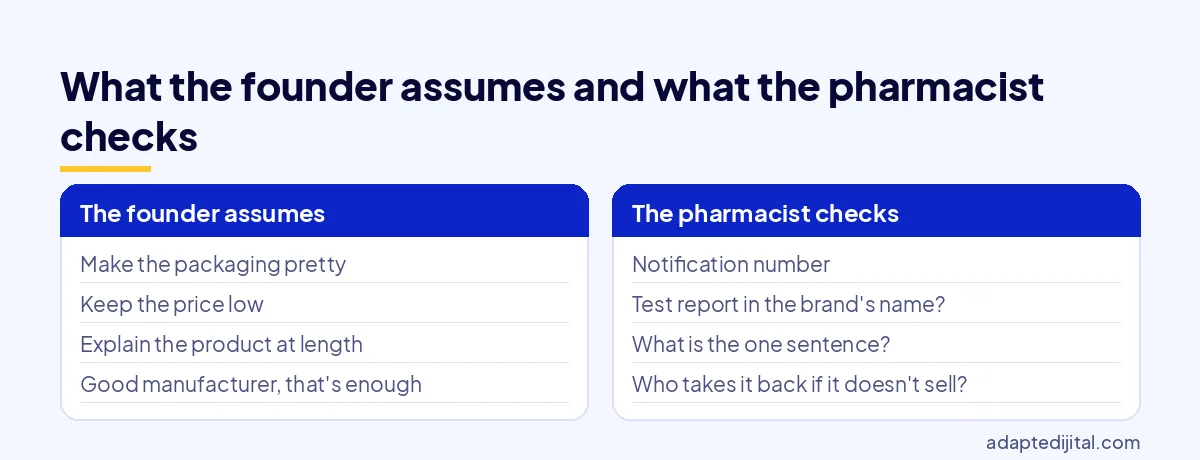
The cost in time
The four fixes took four months; done from day one they would have taken four weeks. That gap is a third of a first year. Putting things in order is what the pillar article does from the start.
The single principle
A baby brand enters the pharmacy with a file, not a product. The file is four things: documents, a named contact, a return promise and a single sentence. Check those four before you change the product; with all four in place the product gets discussed, with one missing it stays on the counter unopened.
To do today
Pick up your box, turn it over and look at it through the pharmacist’s eyes. Notification, report, contact, sentence: can you see all four?
The next step
To find your stage, go to the article on which consulting comes first; to put the budget in order, use the consult your expert form.
Frequently Asked Questions
Quick Summary
- The pharmacist reads the file, not the product: notification, test report, named contact, returns.
- Twelve meetings, twelve noes; the product was never opened, the file was incomplete.
- Four fixes: report in the brand’s name, contact on the label, a return promise, one recommendation sentence.
- A low price on a pharmacy shelf is a sign of doubt, not of trust.
- The single principle: a baby brand enters the pharmacy with a file, not a product.
Short Glossary
- Consignment: a shelf arrangement in which the product is paid for as it sells and unsold stock is returned
- Turnover: how quickly a product sells through on the shelf
- Recommendation sentence: the short line from the file with which the pharmacist describes the product to a mother in one breath
- Named contact: the responsible party shown on the label, the one to call with questions and complaints
Next Step
To read your box through a pharmacist’s eyes together, write to us via the consult your expert form; the scope is on the brand consultancy page. Next article: what the unsafe product list means for baby brands.
Updated: October 2026
Sık Sorulan Sorular
The pharmacist picks up the box, turns it over and looks for the notification number. Then one question: is there a test report? Until the answer comes the box sits there and the pharmacist turns to the next customer. The product is never discussed.
In contract manufacturing the manufacturer usually prepares the label with its own details. The founder sees nothing odd in that; the pharmacist looks for the brand on the label, cannot find it and does not trust it. A label that does not say whose product it is belongs to nobody.
The sentence comes from the file, not the product: fragrance-free, dermatologically tested, suitable for newborns. Three phrases the pharmacist remembers and passes to the mother word for word. A twenty-minute pitch does not become a sentence; a file does.
The specialist provides the document, the consultant the order; here brand consultancy built the file, the label and the sentence independently of the manufacturer. For regulation TİTCK is the official source; for the wider cosmetics route see the cosmetics brand guide.
With a product notification, independent test reports, batch traceability, a named contact and a return arrangement; the pharmacist assesses the file, not the product.
Rarely as the first question; a low price on a pharmacy shelf reads as doubt rather than trust. A mid-market price and a complete file are found more trustworthy.
As a small batch, with a take-back promise and a shelf card; once turnover is visible, the second batch comes on normal terms.