
Why Mothers Switch from Big Brands to Small Baby Brands: Four Reasons, One Case
Mothers switch from a big brand to a small baby brand for four reasons: understanding the ingredient list, reaching a real person when something goes wrong, the pharmacist recommending that brand, and reading another mother’s review. Price is not among the four; the small brand is usually dearer, and the mother buys it knowing that. The switch starts with trust, not with the product.
This article tells, in the present tense, a switch that begins in a mothers’ group: who, why, in what order. The finding is unexpected; what starts the switch is not the small brand’s advertising but a message the big brand leaves unanswered. Four reasons, one case, a single principle at the end.
Say you are in a mothers’ group and someone asks a question
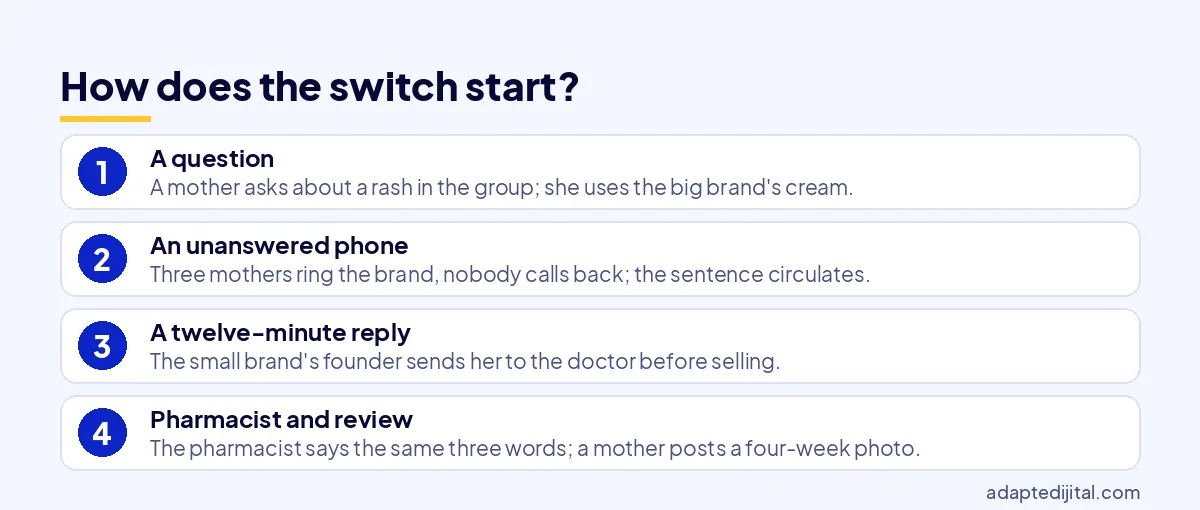
Say you are in a neighbourhood mothers’ group of two hundred. One mother writes that her baby has a rash in the nappy area and asks about the big-brand cream she uses. The group splits in two: those who use the same product without any problem, and those who had the same problem and rang the brand. The ones who rang share one sentence: I could not reach anyone.
The unexpected finding
Nobody in the group says the product is bad; everybody says they could not get through. The switch begins not at the moment of the rash but at the moment the phone goes unanswered. Now ask yourself: how many minutes does the small brand take to return that call?
Reason one: understanding what is inside
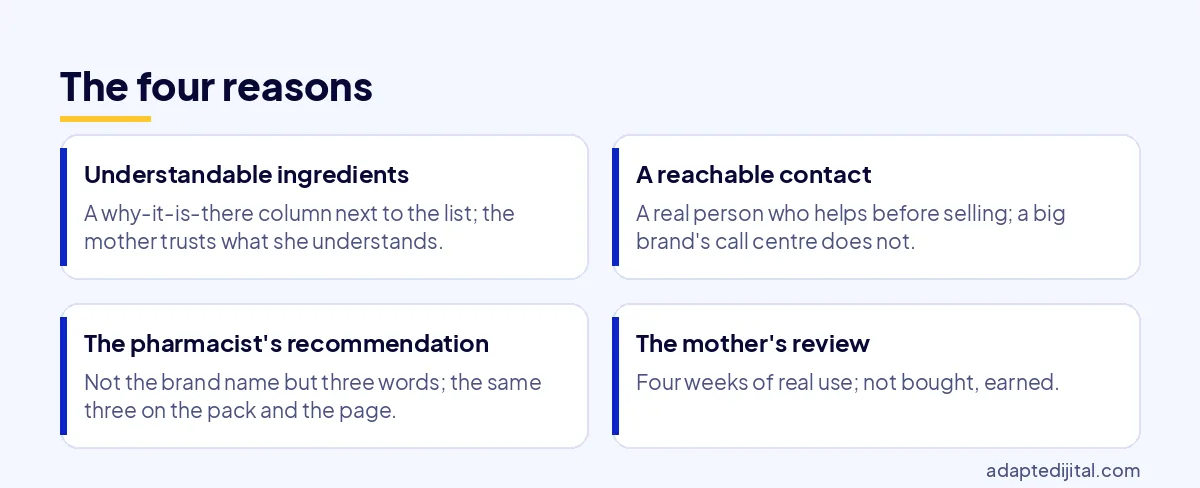
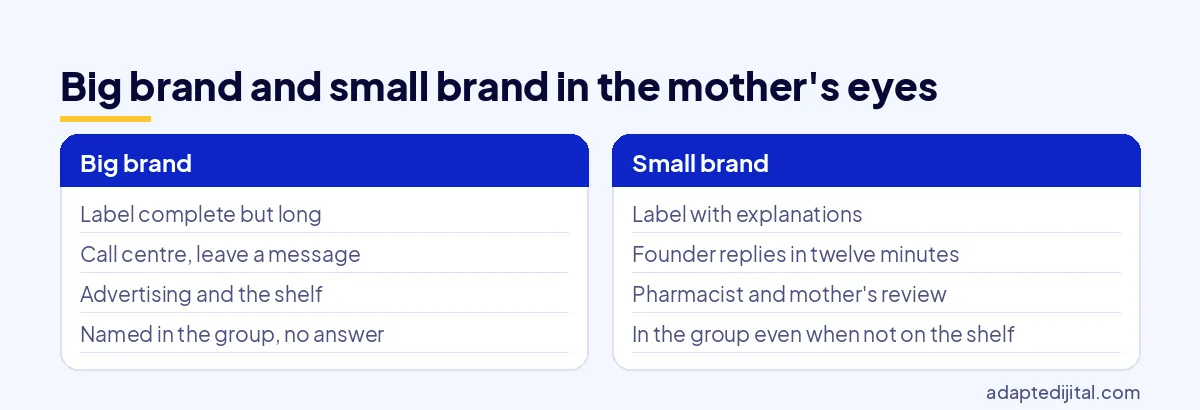
The mother now reads labels and wants to understand them. The big brand’s label is complete but long; the small brand gives the same list with a short explanation: this preservative is for this, this oil is for that. The mother finds a product she understands safer than one she does not, even when the safety is identical.
The principle for you
Writing the ingredient list is not enough; it has to be explained. The explanation is written once and read thousands of times.
Reason two: reaching a real person
The mother in the case messages the small brand and gets a reply from the founder in twelve minutes. The reply is not a sale; it says see the paediatrician first, stop the product, and we will send the ingredient list. The mother does not buy that day; she buys two weeks later and writes to the group. That is the second reason: someone to talk to, who helps before selling.
There is a risk too
If the founder replies in twelve minutes, she also has to reply to forty messages a day. That does not scale; but in the first two years it need not scale, it needs to build trust.
Reasons three and four: the pharmacist and the mother’s review
Two things make the switch permanent: the neighbourhood pharmacist recommending the same small brand, and another mother writing her review after four weeks of use. The pharmacist makes the trust institutional; the mother’s review makes it personal. When the two combine, the big brand quietly leaves the group.
The pharmacist link
Recommending the product, the pharmacist does not say the brand’s name but its three words: fragrance-free, tested, suitable for newborns. The mother repeats those three words in the group. The same three words on the packaging and the page are no coincidence; in the method built around the mother’s trust we build exactly this chain.
The mother’s review link
Four weeks later, a mother posts a photo: no rash. That single message does more than a month of advertising, and it costs nothing. A real review is not bought; it is earned.
Why does the switch become permanent?
Because the four reasons feed each other: an understandable ingredient list prompts a question, a person answers it, the pharmacist says the same words, the mother’s review closes the loop. The big brand is in none of these links; its links are advertising and the shelf. The small brand is in the group even when it is not on the shelf.
Whatever stage you are at
The loop does not care what stage the brand is at; a brand not yet founded and one already on the shelf build the same four links. To find your stage, see the hub article; there you will see which of the four links is missing.
The case today
In the group, the small brand is now known not by its name but by its three words; new mothers get the recommendation without asking. The brand is in two pharmacies in that neighbourhood; its site carries the second purchase. We gave the channel order in the comparison of three channels.
The single principle
The mother is not switching to a brand; she is switching to an answer. The small brand’s advantage is not being small but being able to answer: in the ingredients, on the phone, in the pharmacy, in the group. A brand that answers in those four places sells dearer than the big brand and stays. A small brand that cannot answer simply stays small.
To do today
Go to your product page and add a why-it-is-there column next to the ingredient list. Then look at your phone: how many minutes did you take to reply to the last mother?
Next step
For the sector picture, the baby brand sector guide; the general order is in the pillar article, the scope on the brand consultancy page, the first step consult your expert. On the inspection side the rule is the same: the Ministry of Trade lists the unsafe product, not the brand that does not answer; the mother forgives neither.
Frequently Asked Questions
Quick Summary
- The switch starts with trust, not the product; in the case, the starting point is an unanswered phone call.
- Reason one: an understandable ingredient list; reason two: a contact who helps before selling.
- Reasons three and four: the pharmacist saying the same three words, and a mother’s review after four weeks.
- Price is not a reason; the mother pays more for a product when she knows what she is buying.
- The single principle: the mother switches to an answer, not to a brand.
Short Glossary
- Mothers’ group: a community of mothers from the same neighbourhood or circle, gathered in a messaging app, where product recommendations circulate
- Contact: the real person who represents the brand and can be reached with a problem or a question
- Three words: the short recommendation sentence the brand repeats identically via the pharmacist, the packaging and the page
- Why-it-is-there column: the column next to the ingredient list that briefly explains what each ingredient does
Next Step
To build the ingredient explanations, the reply routine and the pharmacist’s sentence together, write to us through the consult your expert form; the scope is on the brand consultancy page. Next article: six things people get wrong about baby brands.
Updated: October 2026
Sık Sorulan Sorular
Three mothers ring the brand’s customer line on the same day; one leaves a message, and no reply comes. That sentence starts circulating in the group. The product is still the same product, but from now on it is the brand that does not answer.
It puts a why-it-is-there column next to the ingredient list on the product page. Ten lines, ten explanations. We explained the terms in the article on dermatologically tested and hypoallergenic; the small brand does this on every product page.
Like a person whose question has been answered. Understanding the label gives the mother a sense of control; control turns into trust, and trust into a repeat purchase.
The big brand’s call centre solves product problems, not people’s questions. The small brand’s founder answers the person, and no budget closes that gap. The pharmacist asks the same question in the pharmacy shelf case.
The sentence she writes to the group is this: she did not sell to me, she sent me to the doctor. That sentence outlives the brand’s name; two weeks later, buying the product, she repeats it.
The small brand is dearer, and the mother says so openly in the group: it is expensive, but I know what I am buying. Knowing is worth more than price. That sentence is a baby brand’s pricing strategy.
Here is what we saw: the small brand’s site has no advertising, it has explanations; no campaigns, it has answers. The mother notices this and says so. The size of the market is in the article on the baby care market in numbers; this case is the person inside those numbers.
For four reasons: understanding the ingredient list, reaching a real person when there is a problem, the pharmacist recommending the same brand, and real reviews from other mothers. Price is not a reason.
Yes, and it usually does; the mother accepts paying more for a product when she knows what she is buying.
By explaining the ingredients, replying quickly and without selling, using the same three words as the pharmacist, and earning real reviews.