
Baby Care Market in Numbers: 6 Data Points to Check Before Starting a Baby Brand
In 2025, 895,374 babies were born in Turkey and the total fertility rate fell to 1.42; those two figures are the first data anyone starting a baby brand should look at. The number of babies born is falling, but spending per baby is rising; the global baby care products market was measured at $107.6 billion in 2024 and is expected to grow by 4.3% a year to 2034. The market is not shrinking; the buyer profile is changing.
This article gives six sourced figures in order, puts a one-sentence reading under each, and shows how the numbers connect to the baby brand decision. The data comes from TÜİK (Turkish Statistical Institute), the Ministry of Trade and international market reports; the reading is ours, the figures are theirs. There is not a single number here without a source.
How many babies are born in Turkey?
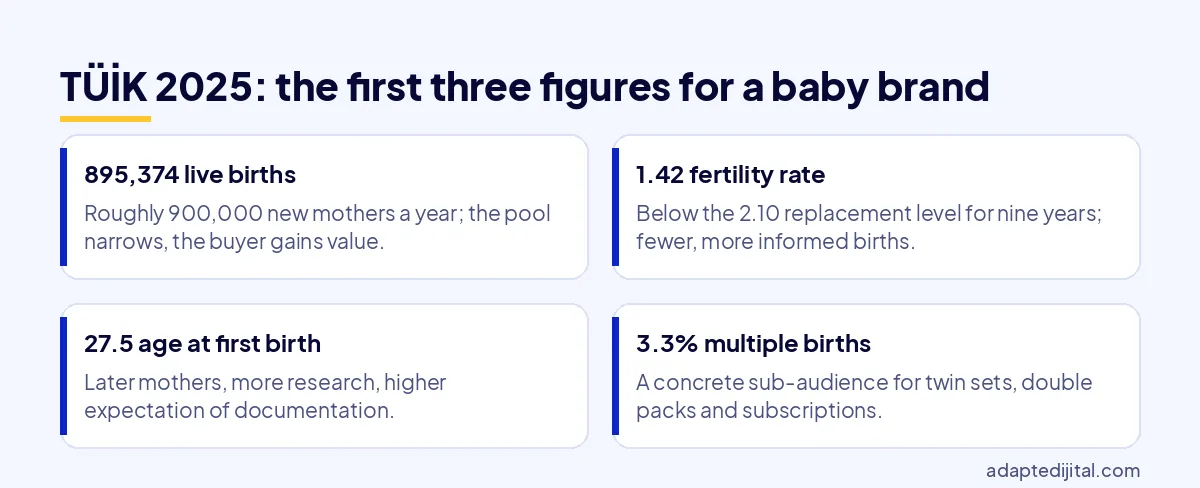
According to TÜİK, 895,374 babies were born alive in 2025; 51.4% of them boys and 48.6% girls. The crude birth rate dropped to 10.4 per thousand, from 20.3 per thousand in 2001. In other words, the birth rate has almost halved in twenty-five years. For a baby brand this means the number of buyers shrinks every year, but each buyer becomes more valuable.
What it means for a brand
In a narrowing pool, mass marketing gets more expensive and recommendation gets cheaper. Fewer babies, more information, a higher rate of label reading; so a documented brand has the advantage and a cheap brand has the disadvantage.
How the birth calendar affects the launch date is handled separately in the article on when a baby brand should launch.
Why does the fertility rate affect the brand decision?
BU BÖLÜMÜN ÖZETİ
- Provincial differences
- The one-sentence reading
- Multiple births
The total fertility rate was 1.42 children in 2025; it was 2.38 in 2001 and has been below the population replacement level of 2.10 for nine years. The mother’s average age at first birth rose to 27.5. Later, fewer and more informed births; that trio describes the baby brand’s buyer: higher income, more research, and not a lower price tolerance but a lower risk tolerance.
Provincial differences
Şanlıurfa has the highest fertility at 3.15 and Bartın the lowest at 1.09; İzmir is at 1.10 and Ankara at 1.11. The number of provinces below 2.10 rose from 57 in 2017 to 76 in 2025. A regional channel plan is not made without looking at this map.
The one-sentence reading
As the mother’s age rises, label reading rises; for a baby brand, documentation, an open ingredient list and expert recommendation are not marketing tools but the ticket to entry.
Multiple births
The multiple birth rate is 3.3%. It looks small, but it is a concrete sub-audience for twin product sets, double packs and subscription models.
How big is the global baby care market?
BU BÖLÜMÜN ÖZETİ
- The source of the figure
- What it means for Turkey
- The age slice
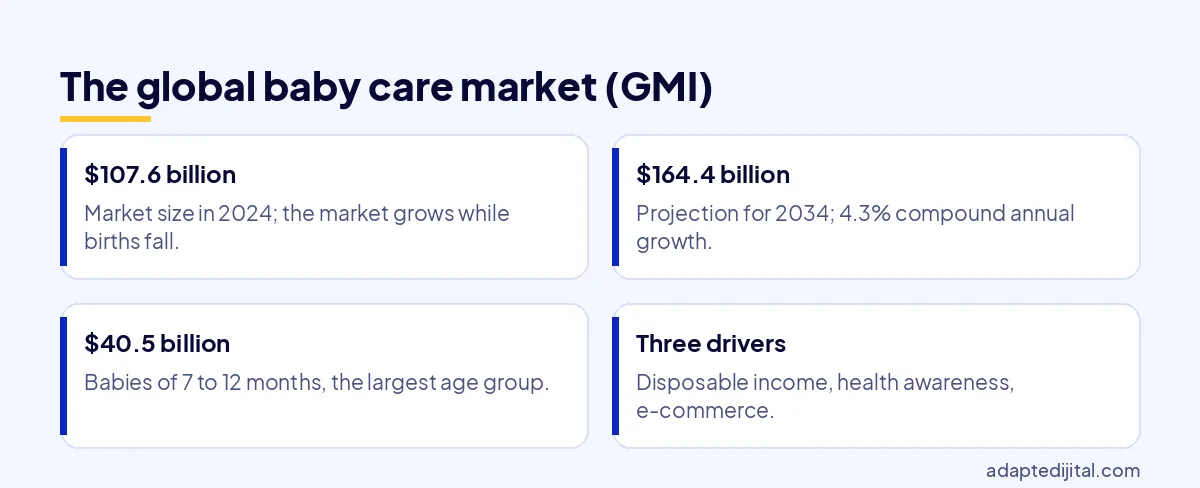
According to the Global Market Insights report, the global baby care products market stood at $107.6 billion in 2024; $164.4 billion is projected for 2034, with a compound annual growth rate of 4.3%. By age group, babies of 7 to 12 months are the largest slice at $40.5 billion. The growth drivers are disposable income, health awareness and e-commerce.
The source of the figure
For the report, see GMI Baby Care Products Market. Reports are estimates; they are read as a sense of direction, not copied straight into a business plan.
What it means for Turkey
A market growing while births fall says one thing: spending per baby is rising. The share of premium and documented products is climbing; the cheap shelf is narrowing. That is exactly where the small brand’s space is.
The age slice
The 7 to 12 month slice being the largest shows the weight of weaning and crawling-stage products; in care products, a product built for this period is a point of differentiation.
Why mothers move from big brands to small ones is opened up with a case in the article on why parents switch to small baby brands.
What figure does market surveillance give?
In the first six months of 2026 the Ministry of Trade inspected 4,704 companies and issued 8.6 million lira in administrative fines for unsafe products; children’s furniture, clothing, footwear and toys were priority inspection areas. On 20 August 2026 four items of baby clothing were recalled for choking risk because small accessories could come loose. The figures tell a new brand one thing: baby products are inspected, and the inspection is published openly.
Source
For the Ministry’s statement, see Ministry of Trade first-half 2026 market surveillance; unsafe products are published on the GÜBİS system.
The one-sentence reading
The fine may look small; the real cost is the brand’s name appearing on the unsafe product list, and that list is never wiped.
We read the list from a brand owner’s seat in the article on what the unsafe product list means for baby brands.
What do six figures say in a single table?
Put the six figures side by side and a single picture emerges: buyers are decreasing, spending per buyer is increasing, the mother’s age and level of information are rising, inspection is getting tougher. In this picture the winning brand is not the cheap one but the documented one; not the fast one but the trusted one. The table is below, with the reading next to each row.
Table
| Data | Figure | Source | What it means for a brand |
|---|---|---|---|
| Live births 2025 | 895,374 | TÜİK | A buyer pool of roughly 900,000 mothers a year |
| Total fertility rate | 1.42 | TÜİK | Fewer, more informed births; label reading rising |
| Mother’s age at first birth | 27.5 | TÜİK | Later mothers, higher expectation of documentation |
| Global market 2024 | $107.6 billion | GMI | Spending per baby is rising |
| Annual growth 2025–2034 | 4.3% | GMI | Share of premium and documented products climbing |
| Companies inspected, H1 2026 | 4,704 | Ministry of Trade | Baby products a priority inspection area |
How to use it
This table goes into an investor presentation or a pharmacist meeting as a single page. The figures are quoted with their source and the reading stays in its own column; a brand that mixes the two loses trust.
How do you get from the data to a baby brand decision?
BU BÖLÜMÜN ÖZETİ
- Documented product
- Recommendation channel
- Repeat purchase
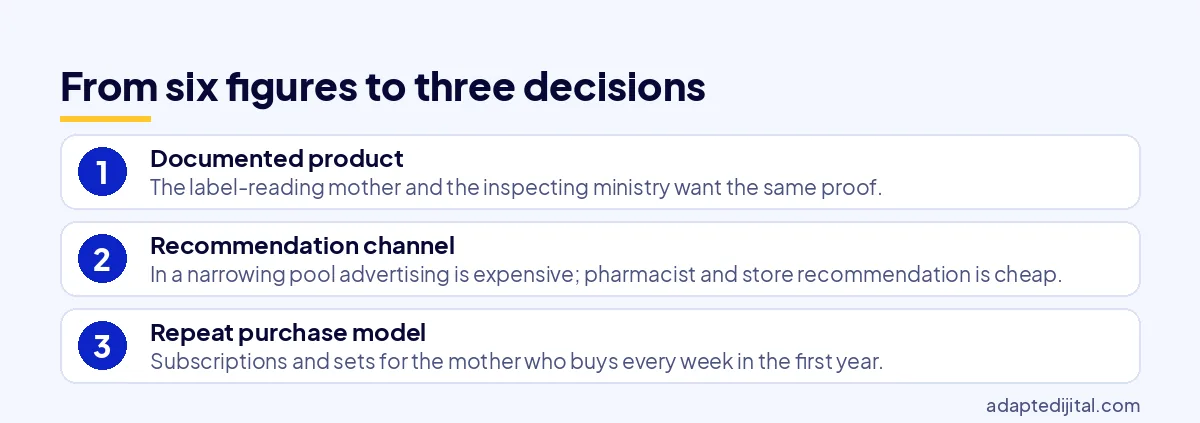
Data does not take the decision; it shows the direction of it. Three directions come out of the six figures: a documented product, a recommendation channel and a repeat purchase model. Those three fill in the set-up decisions in the order of the pillar article, and match the channel and budget decisions with the stage questions in the hub article.
Documented product
The label-reading mother and the inspecting ministry want the same thing: proof. Testing, notification and batch records are part of the cost of the product.
Recommendation channel
In a narrowing pool advertising is expensive and recommendation is cheap; the pharmacist and the baby store come forward as the first channel. For the sector comparison, see the baby brand sector guide.
Repeat purchase
900,000 new mothers a year, buying every week in the first year; a subscription and set model catches that rhythm. For the scope, see brand consultancy.
Frequently Asked Questions
Quick Summary
- 895,374 babies were born in 2025; at 1.42 the fertility rate is below replacement level.
- The mother’s age at first birth is 27.5: later, more informed, a higher expectation of documentation.
- The global market is $107.6 billion and growing 4.3% a year; spending per baby is rising.
- The Ministry of Trade inspected 4,704 companies in the first half of 2026; baby products are a priority area.
- The data points in three directions: documented product, recommendation channel, repeat purchase model.
Short Glossary
- Total fertility rate: the average number of children a woman would have over her childbearing years; 2.10 is the level at which a population replaces itself
- Crude birth rate: the number of live births per thousand people in a year
- Compound annual growth: the rate showing by what average percentage a market grows each year between given years
- Market surveillance: the inspection by the state of products already on the market for safety and compliance
Next Step
To adapt this table to your own product group, write to us through the consult your expert form; the scope is on the brand consultancy page. The next article is why a baby care brand cannot get onto the pharmacy shelf.
Updated: October 2026
Sık Sorulan Sorular
Roughly 900,000 new babies a year means roughly 900,000 new mothers. Every mother buys care products, textiles and accessories in the first year; the market renews itself every year, but the total pool is narrowing. Source: TÜİK Birth Statistics, 2025.
According to TÜİK, 895,374 live births; a total fertility rate of 1.42 children and a crude birth rate of 10.4 per thousand.
The global market was $107.6 billion in 2024, with 4.3% annual growth projected to 2034. If the market grows while births fall, spending per baby is rising.
Yes. The Ministry of Trade inspected 4,704 companies in the first half of 2026; products found unsafe are published openly through the GÜBİS system.