
When Should a Baby Brand Launch? Season, Document Timeline and the Pharmacy Calendar

A baby products brand launches in the week where three calendars overlap: the week the document file is complete, the week the product group enters its season, and the week the channel opens its orders. The document calendar is the longest and is counted backwards; the season changes with the product group; pharmacies and baby stores open orders to their own rhythm. A launch made without all three ends up without documents, out of season, or without a shelf.
This article opens the three calendars one at a time, then lays them on top of each other. The answer is a method, not a month; the month comes out of the product group. Worked overlap weeks for four product groups are at the end.
First calendar: the document timeline is counted backwards
For a baby care product the document timeline is at least twelve weeks: formula and samples four weeks, stability and microbiological tests four to six weeks, dermatological test and product notification two to four weeks. This period cannot be shortened, only run in parallel. Before a launch date is set, these twelve weeks are counted backwards; if the date is closer than that, what has been planned is not a launch but a hope.
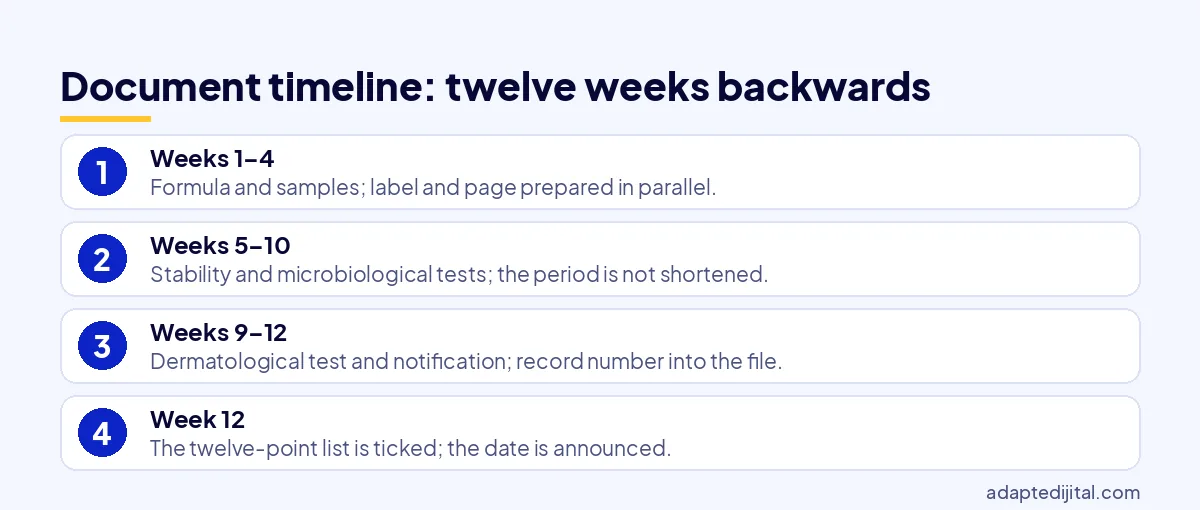
Running things in parallel
Label design, the product page and the shelf card do not wait for test results; they are prepared while the tests run, and the figures are added at the end. The twelve points that must be finished in the same week are in the launch checklist.
Textiles and accessories
The document timeline is shorter but not zero: fabric test report, detachable-parts check and mandatory labelling take six to eight weeks. The grounds for ruling a product unsafe are in the article on the unsafe product list.
Second calendar: the season depends on the product group
There is no single season for baby products; the product group sets it. Nappy-area and skin care peak twice, in summer and in winter dryness; sun products sell from May to August; textiles in the autumn and spring transitions; gifts and accessories at the year end. Births do not swing much across the year, but shopping does.
Product group and peak period
| Product group | Peak period | Entry week for launch |
|---|---|---|
| Skin and nappy-area care | June–August and December–February | Early May or early November |
| Sun and summer products | May–August | Mid-April |
| Baby textiles | September–October and March–April | Mid-August or mid-February |
| Gift sets, accessories, bundles | November–December | Early October |
Third calendar: the pharmacy and store ordering period
BU BÖLÜMÜN ÖZETİ
- The right week at the pharmacy
- The right week at the baby store
- On your own site
The pharmacy ordering calendar is weekly and runs through the wholesaler; the moment to decide on a new product is the weeks when the pharmacist is not busy, outside the flu season. The baby store opens orders two months before the season: August and February for textiles, October for gifts. A brand that does not know the channel’s calendar knocks with the right product in the wrong week.
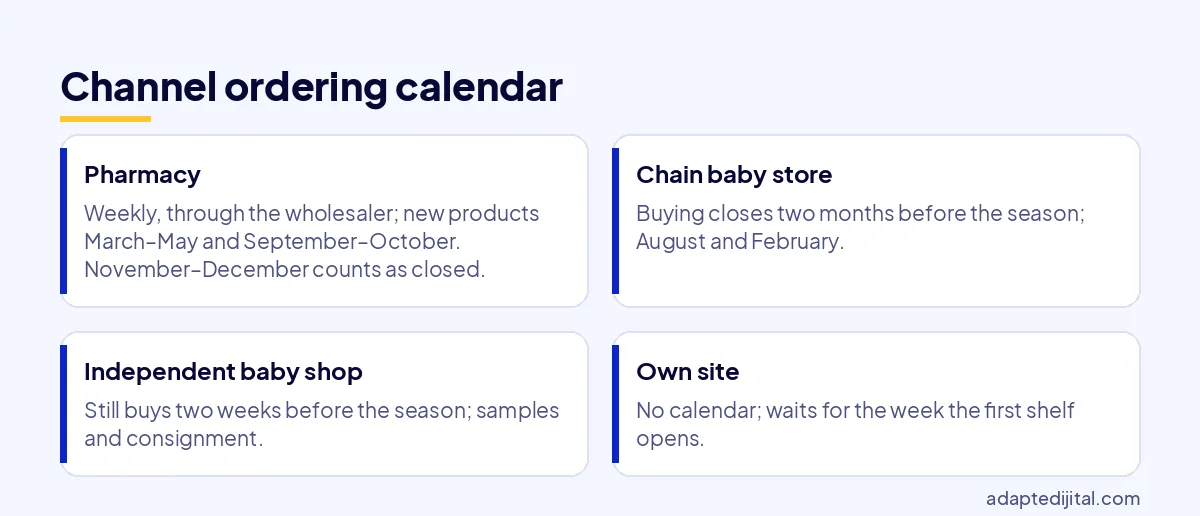
The right week at the pharmacy
The worst time to show a pharmacist a new product is November and December; the flu and cold rush pushes any shelf conversation aside. The best windows are March to May and September to October. The first conversation with a pharmacist is in the pharmacy shelf case.
The right week at the baby store
A chain store’s buying closes two months before the season; an independent baby shop still buys two weeks before it. The entry week changes with the channel; the comparison is in the article on three channels.
On your own site
A website has no calendar; a launch can happen any day. But a launch on the site makes no echo without a shelf; the site is the second channel and waits for the first shelf to open.
Three calendars on top of each other: the overlap week
BU BÖLÜMÜN ÖZETİ
- Example: skin care, pharmacy
- Example: textiles, independent shop
- Example: gift set, chain store
The method: open a one-year table, mark the week the documents finish, mark the product group’s entry week, mark the channel’s ordering week. The first week where all three overlap is launch week. If there is no overlap, the document calendar stays fixed and the season moves to the next peak; documents are never sacrificed for a season.
Example: skin care, pharmacy
Documents twelve weeks; entry for the summer peak early May; pharmacy window March to May. Overlap: late April to early May. The documents must have started in early February. If not, the launch moves to early November, because the second peak is winter dryness.
Example: textiles, independent shop
Documents six to eight weeks; entry for autumn mid-August; the independent shop buys up to two weeks before the season. Overlap: mid-August to early September. Start by mid-June.
Example: gift set, chain store
Documents eight weeks; entry early October; chain store buying closes in August. No overlap: next year for the chain, this October for the independent shop. The channel changes, the date does not.
What do early and late launches cost?
An early launch means a product without documents, with two outcomes: the shelf does not open, or it opens and closes at the first complaint. A late launch means missing the season, and the stock waits for the next peak; waiting stock eats its own shelf life. The cost they share is trust: a pharmacist does not easily take an undocumented product again, nor a shop an end-of-season one.
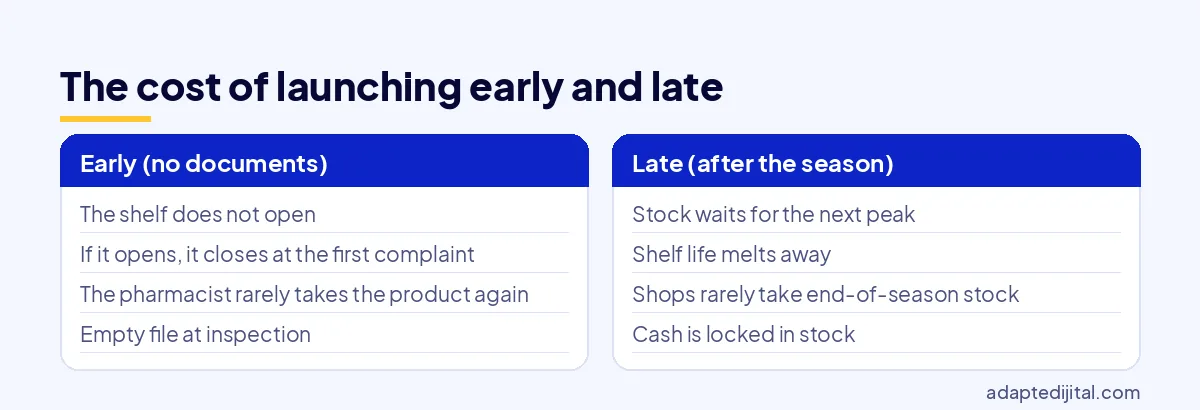
The shelf-life sum
A baby care product has a limited shelf life; stock that waits six months reaches the pharmacy with six months less, and the pharmacist reads that. A late launch does not lose the stock, it loses the stock’s life. The first-batch threshold is in the cost article.
How do you build the calendar today?
Answer three questions today: how many weeks until my document file is complete, which is my product group’s next entry week, and when does my first channel open its orders? Write the three answers in one table; the overlap week is your launch date, and before that date is announced, the twelve-point list is ticked. Building the calendar together is brand consultancy work.
Know the inspection calendar too
The Ministry of Trade inspects for unsafe products all year and announces results periodically; launch week is independent of that calendar, but the file must be ready every week. The announcements are on the Ministry of Trade website.
Next step
The overall order is in the pillar article, your stage in the hub article, the industry picture in the baby brand industry guide. For the calendar, consult your expert.
Frequently Asked Questions
Quick Summary
- The launch happens where three calendars overlap: documents, season, channel ordering.
- The document timeline is at least twelve weeks for a care product; counted backwards, never shortened.
- The season depends on the product group: skin care two peaks, textiles the transition months, gifts the year end.
- No new product goes to a pharmacy in November–December; the chain store closes two months before the season.
- If there is no overlap, the documents stay fixed and the channel or the date changes.
Short Glossary
- Overlap week: the first week in which the document finish, the season entry and the channel ordering period are all suitable at the same time
- Entry week: the week by which the product needs to be on the shelf, ahead of the peak period
- Stability test: the test that shows the product does not deteriorate physically or chemically over its shelf life
- Ordering period: the calendar window in which the pharmacy wholesaler or the store’s buyer accepts new products
Next Step
To lay the three calendars on top of each other for your own product group, write through the consult your expert form; the scope is on the brand consultancy page. The next article is baby products brands towards 2027.
Updated: October 2026
Sık Sorulan Sorular
A stability test measures what the product does over time; there are methods that accelerate time, but none that resets the clock. The dermatological test is run on volunteers, and the laboratory sets the timing. The terms are explained in the article on dermatological testing and hypoallergenic.
Birth statistics show the monthly distribution, and there is no sharp peak within the year; weather and shopping habits make the season, not births. For monthly and annual birth figures, TÜİK (Turkish Statistical Institute) is the official source; use the table there rather than a quoted number. The size of the market is in the article on the baby care market in numbers.
If the document calendar does not fit, change the channel rather than the date: an independent shop instead of a chain, a small start on your own site instead of the pharmacy. Then the full channel at the next peak.
There is no single month; early May or early November for skin care, mid-August or mid-February for textiles, early October for gifts. The week overlapping the document calendar is chosen.
At least twelve weeks for a baby care product; six to eight for textiles and accessories. It cannot be shortened, only run in parallel.
No. The documents stay fixed; the channel shrinks or the launch moves to the next peak.