
Pharmacy, Baby Store or Own Site? Three Sales Channels for a Baby Brand Compared
The comparison of three channels for a baby brand comes down to one sentence: a care product earns trust in the pharmacy, textiles find shelf space in the baby store, and both win repeat purchases on the brand’s own site. The pharmacy is the slowest channel to enter and the one that gives most trust; the baby store is the fastest to enter and the lowest on margin; the brand’s own site has the highest margin and the most expensive traffic. There is no winner, only an order that depends on the product group.
This article compares the three channels on six criteria, gives the table and adds a which-suits-whom row. It ends with a reasoned decision: one main channel in the first year, the second in the second year. No advertising language, just criteria.
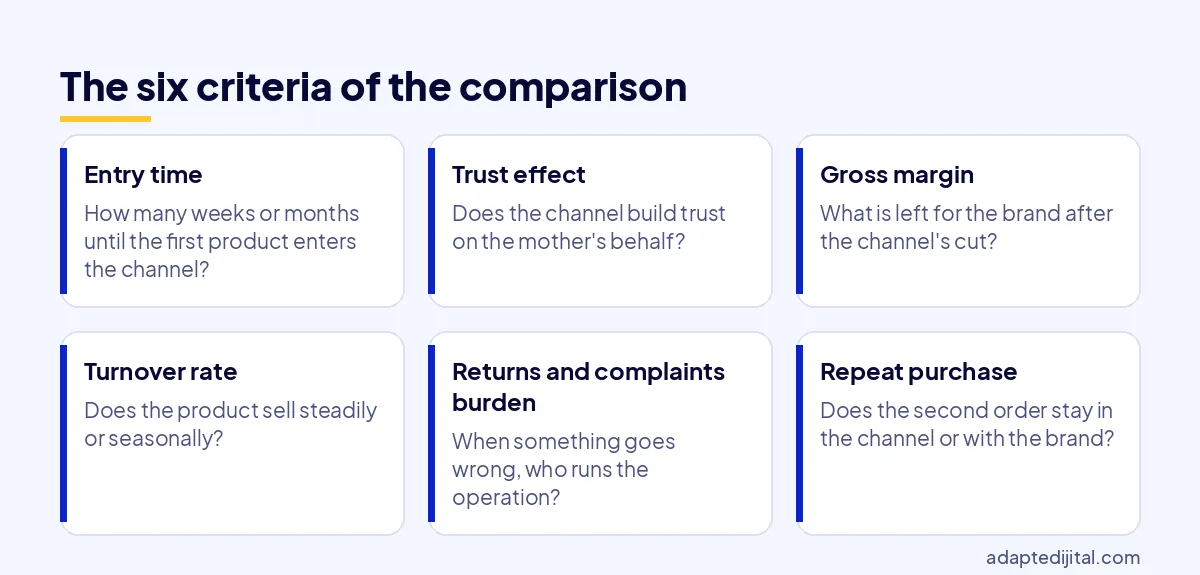
Which six criteria are used for the comparison?
Entry time, trust effect, gross margin, turnover rate, returns and complaints burden, and the repeat purchase set-up. These six shape a baby brand’s first two years; price and visibility are deliberately left out, because both are the brand’s decision, not the channel’s. Each channel is rated low, medium or high on each criterion.
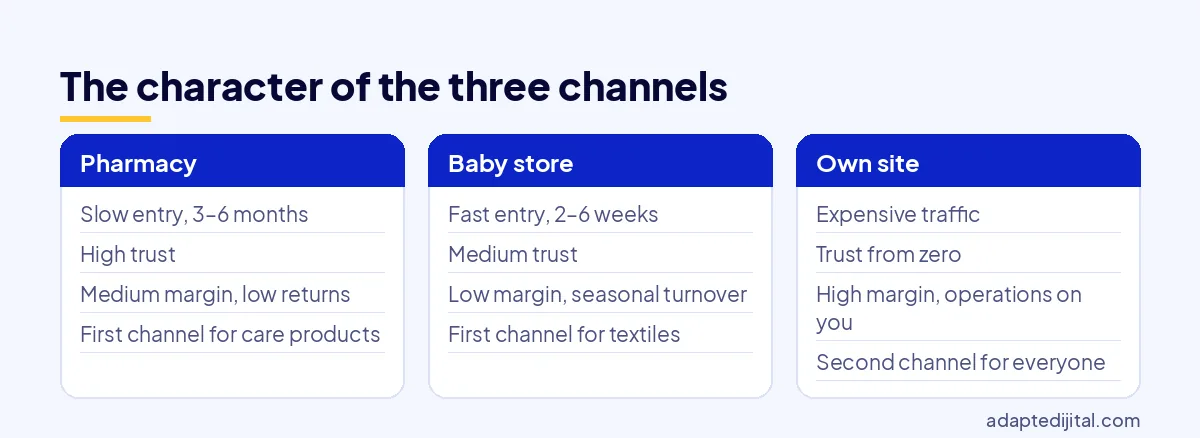
Pharmacy: slow entry, high trust
The pharmacy is the strongest channel for a care product: the pharmacist’s recommendation builds trust in one step and shelf turnover is steady. The price is slow entry; the file, the samples, the returns promise and the round of meetings can stretch to six months. Margin is medium, the returns burden low, and repeat purchase stays tied to the pharmacy.
Pros
Trust is highest, returns lowest, turnover steady. The pharmacist sells with one sentence; the mother comes back to the same pharmacy. We told the case in the article on the pharmacy shelf.
Cons
Entry is slow, the file is mandatory, volume per outlet is small. Fifty pharmacies mean fifty separate meetings; the operational load grows with the brand.
Baby store: fast shelf, thin margin
The baby store is the natural shelf for textiles and accessories; decisions are quick, the conversation is about season and size range, and the buyer looks at turnover. The price is a thin margin: the store asks for a high share and opens the door to an unknown brand only on consignment. Trust is medium, returns medium, and repeat purchase stays in the store’s hands.
Pros
Entry is fast, volume at a single outlet is high, ideal for seasonal products. You enter a chain store with a file and an independent baby shop with samples.
Cons
Margin is low, shelf space is contested, and the store sells the product rather than the brand. The mother remembers the store, not the brand, so repeat purchase stays in the store. That is why a brand on a store shelf prints its site and its one sentence on the pack; the shelf introduces, the site keeps.
Own site: high margin, expensive traffic
The brand’s own site has the highest margin and the hardest trust to build; a mother does not place a first order on the site of a brand she has never heard of, but she does when she arrives on a recommendation. The price is traffic cost: advertising, content and time. Repeat purchase and subscription are built only here, which is why it is every brand’s second channel, not the first.
Pros
Margin is highest, the data is yours, subscriptions and bundles are possible. The second order from a mother who came on a recommendation goes through here.
Cons
Initial traffic is expensive, trust starts from zero, and returns and shipping operations sit with you. Setting it up is a separate job under e-commerce consulting.
The comparison table and which suits whom
The table gives the six criteria for the three channels; the last row answers the question of which suits whom. There is no total score, because the weight of each criterion changes with the product group: trust weighs most for a care product, turnover for textiles, and repeat purchase for both.
The table
| Criterion | Pharmacy | Baby store | Own site |
|---|---|---|---|
| Entry time | Slow (3–6 months) | Fast (2–6 weeks) | Medium (site + traffic) |
| Trust effect | High | Medium | Starts low |
| Gross margin | Medium | Low | High |
| Turnover rate | Steady | Seasonal | Variable |
| Returns and complaints burden | Low | Medium | High (on you) |
| Repeat purchase | Tied to the pharmacy | Tied to the store | With the brand, by subscription |
| Who it suits | Care product, complete file | Textiles and accessories, seasonal | Second channel for everyone |
The decision: one channel in year one, a second in year two
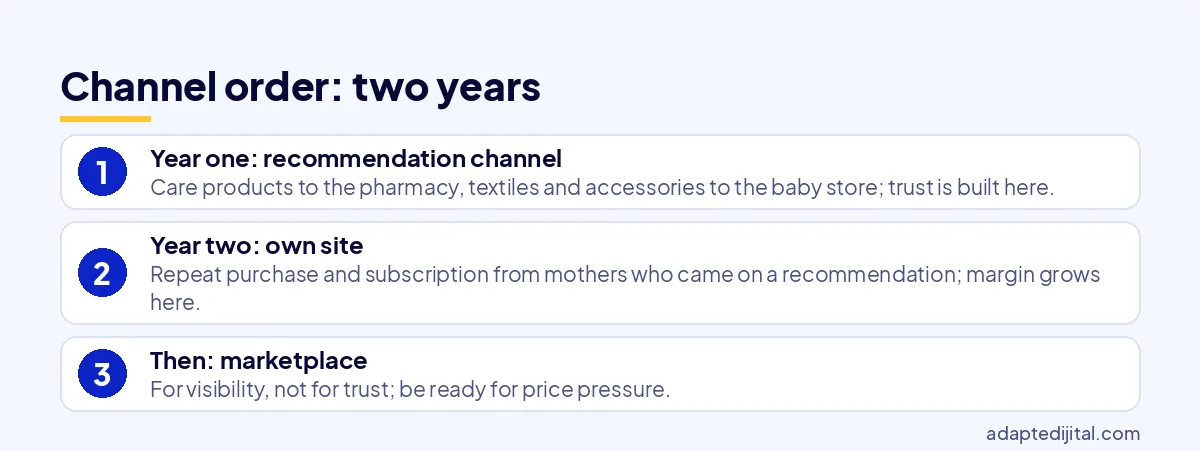
The winner is declared by product group: the pharmacy for a care product, the baby store for textiles and accessories, and in both cases the brand’s own site in year two. The reasoning is simple; the first channel builds trust, the second turns trust into repeat purchase. A brand that enters all three channels at once stays half-finished in all three and carries the returns burden from three places.
The external measure
Whatever the channel, the product safety rule is the same; for the inspection framework, the Ministry of Trade and GÜBİS records apply regardless of channel.
Frequently Asked Questions
Quick Summary
- Six criteria: entry time, trust, margin, turnover rate, returns burden, repeat purchase.
- Pharmacy: slow entry, high trust; the first channel for a care product.
- Baby store: fast shelf, thin margin; the first channel for textiles and accessories.
- Own site: high margin, expensive traffic; the second channel for everyone.
- Decision: one main channel in year one, the brand’s own site in year two; the marketplace fourth.
Short Glossary
- Gross margin: the share left to the brand after product cost and the channel’s cut are deducted from the selling price
- Turnover rate: a measure of how quickly a product sells off the shelf
- Consignment: a shelf arrangement in which the product is paid for as it sells and unsold stock is returned
- Recommendation channel: a point of sale, such as a pharmacist, midwife or store assistant, that builds trust on the mother’s behalf
Next Step
To build the channel order for your product group together, write to us through the consult your expert form; the scope is on the brand consultancy page. Next article: the cost of starting a baby care brand.
Updated: October 2026
Sık Sorulan Sorular
Price is set independently of the channel; the channel carries the price, it does not decide it. A brand that changes its price by channel becomes three different brands in three channels and loses the mother’s trust.
Visibility is bought with budget; it is an outcome, not a criterion. The budget line items are in the article on start-up cost.
At the launch stage; set-up is about product and documents, launch is about channel. Find your stage with the four questions in the hub article; a brand that picks its channel during set-up ends up bending the product to fit the channel.
A brand starting with a care product, with a complete document file and the patience for a slow first year. For textiles and accessories the pharmacy is the second channel, not the first.
A brand starting with textiles or accessories, with a seasonal calendar and production capacity ready. For a care product the store shelf comes second.
A brand that has opened its first shelf in a recommendation channel and needs a site for repeat purchases. A brand that starts with the site tries to buy trust with advertising; that is expensive and fragile.
The marketplace is the fourth option: highest visibility, highest price pressure, lowest trust. For a baby brand the marketplace comes after the brand’s own site; for the Trendyol side see real profit after commission on Trendyol.
A mother who reaches the site without a recommendation looks for trust and does not find it; a mother who comes from a recommendation channel already trusts the site. This order cuts the advertising budget in half.
The only exception is a founder with a ready community: a pharmacist with a following or a patient base, or a founder who runs a mothers’ group. The community stands in for the recommendation channel and the site can be the first channel; but the exception is limited by the size of the community.
The channel decision comes from the product group and the buyer card, not from preference; brand consultancy gives that match as a table in the method built around the mother’s trust. The general order is in the pillar article, the sector picture in the baby brand sector guide.
It depends on the product group: the pharmacy for a care product, the baby store for textiles and accessories; the brand’s own site is the second channel for every brand.
It can, but it is expensive; the first order on an unknown brand’s site does not come without a recommendation. First a recommendation channel, then the site.
Visibility is high, price pressure high, trust low; the marketplace is considered as the fourth option, after the brand’s own site.