
Baby Care Brand Launch Checklist: 12 Points on Documents, Labels, Packaging, Page
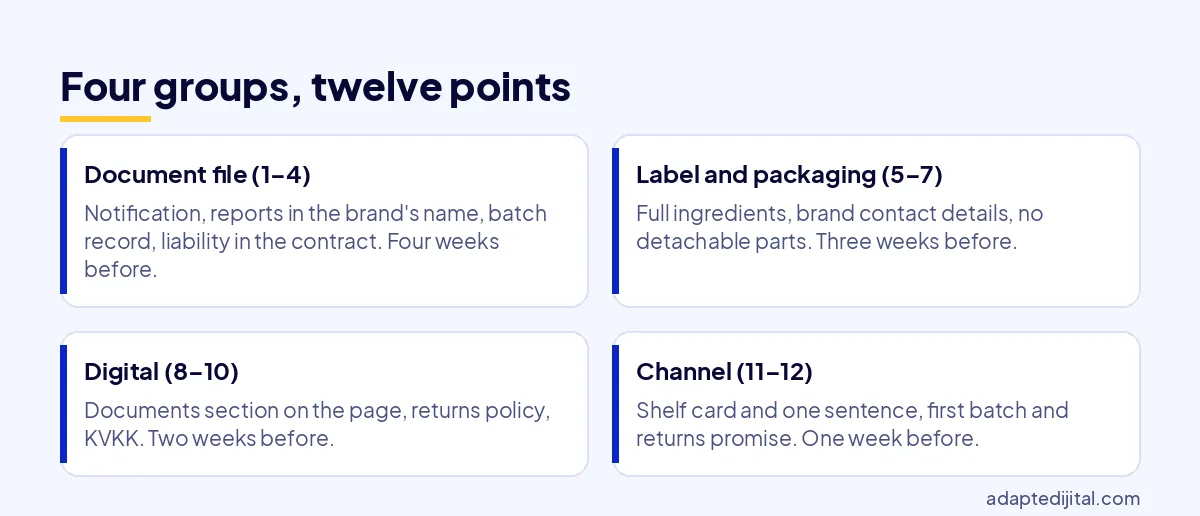
Before a baby product launches, twelve points are ticked: four on documents, three on label and packaging, three digital, two on channel. If even one is missing, the launch is postponed; the date changes, not the product. The list is written for a baby care product; in textiles the document points change, the order does not.
This guide gives each point in a single line, says who ticks it and what happens if it is missing. The list is repeated in printable form at the end. Launch day is spent with a list, not with excitement.
Group 1: the document file (four points)
BU BÖLÜMÜN ÖZETİ
- Points 1–2
- Points 3–4
- Common mistake
Product notification record, test reports in the brand’s name, batch record, and a liability clause in the contract manufacturing agreement. All four are paperwork, and none can be finished on launch morning; they must be complete four weeks before. The pharmacist and the inspector look at these four points and nothing else.
Points 1–2
The notification is complete and its number is in the file; the dermatological, microbiological and stability reports are issued in the brand’s name. Who ticks it: the brand owner and the responsible technical person. If missing: the launch slips four weeks, because that is how long the reports take.
Points 3–4
Every batch has a number, a date and a quality control record; the manufacturing contract says who is responsible for testing and documents. Who ticks it: the brand owner. If missing: at the first complaint, nobody knows who to call. The contract clauses are in the article on choosing a contract manufacturer.
Common mistake
Treating a report that sits in the manufacturer’s drawer as done, or planning to file the notification after launch. Both give the same result: product on the shelf, file empty. The cost of this mistake is in the pharmacy shelf case.
Group 2: label and packaging (three points)
BU BÖLÜMÜN ÖZETİ
- Points 5–6
- The claims rule
- Point 7
The label carries the full ingredient list and the preservative’s name, the brand’s contact details sit on a separate line from the manufacturer’s, and the packaging has no detachable parts and no leaks. These three points concern the first thing a mother holds in her hand; a label that does not match the notification is reprinted, and packaging with a loose part goes back to production.
Points 5–6
Full ingredient list, preservative named, claims small and evidence large; brand name and phone on the label, manufacturer details on a separate line. Who ticks it: the brand owner and the label designer. If missing: the label is reprinted. The terms are in the article on dermatologically tested and hypoallergenic.
The claims rule
Every claim on the label is tied to a report in the file: if it says dermatologically tested, the report exists; if it says fragrance-free, there is no perfume in the list. A claim that cannot be tied to anything comes off the label; a true sentence in small print beats an indefensible one in large print.
Point 7
No decorative part that can come off, no leaking cap, and a child-resistant closure where required. Who ticks it: the brand owner and the manufacturer’s quality control. If missing: the batch is held. The grounds for unsafe products are in the article on the unsafe product list.
Group 3: digital (three points)
BU BÖLÜMÜN ÖZETİ
- Point 8
- Point 9
- Point 10
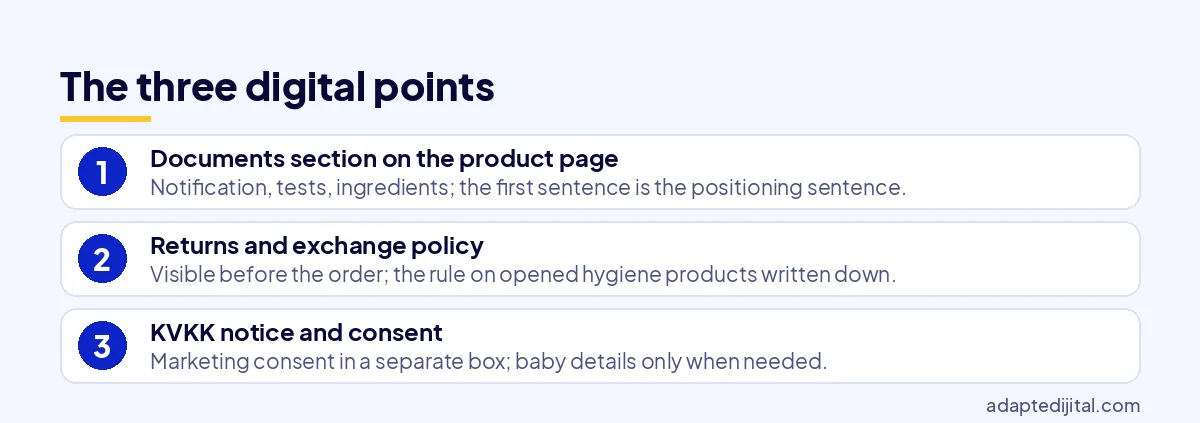
The product page has a documents section and a single positioning sentence, the returns and exchange policy is visible before the order, and the KVKK (Turkey’s personal data law) privacy notice and the marketing consent sit in separate boxes. These three points are what the mother sees on her phone; a product page without a documents section is a shop window, not a sales page.
Point 8
The product page has a section for the notification, the tests and the ingredients; its first sentence is the positioning sentence. Who ticks it: the brand owner and the site manager. If missing: the page does not go live. Building the site is the work of website consulting.
Point 9
The returns and exchange policy is visible on the product page and in the basket; for hygiene products, the rule on opened items is written down. Who ticks it: the brand owner. If missing: the first returns dispute becomes a public review.
Point 10
The privacy notice exists, marketing consent is a box separate from the order confirmation, and details such as the baby’s date of birth are requested only when needed. Who ticks it: the brand owner and legal support. If missing: the risk starts with the first form; the framework is in KVKK consultancy.
Group 4: channel (two points)
The shelf card and the single recommendation sentence for the first channel are ready, the first batch is sized to the channel’s capacity, and the promise to take back unsold stock is made. These two points decide whether the first shelf opens at all; a product without a shelf card sits there unsold, and one without a returns promise never reaches the shelf.
Point 11
Three words on the shelf card, one sentence for the pharmacist or retailer, and the brand’s contact details. Who ticks it: the brand owner. If missing: the first shelf meeting is postponed. Channel choice is in the comparison of three channels.
Point 12
The first batch does not exceed the three-month sales forecast; the promise to take back unsold stock is in writing. Who ticks it: the brand owner. If missing: stock locks up or the shelf never opens. The thresholds are in the cost article.
Who ticks the list, and when?
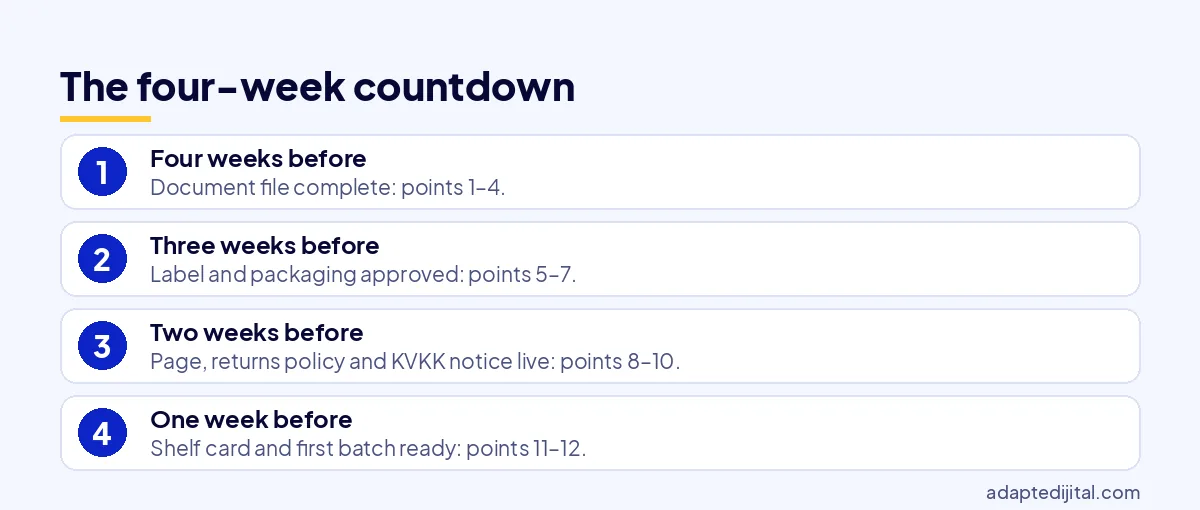
The brand owner ticks it and delegates it to nobody; the manufacturer and the site manager keep their own lists, but the twelve points have a single owner. Timing: documents are finished four weeks before launch, label and packaging three weeks before, digital two weeks before, channel one week before. On launch day there is no list, only a calendar.
The four-week countdown
- Four weeks before: document file complete (points 1–4)
- Three weeks before: label and packaging approved (points 5–7)
- Two weeks before: product page, returns policy and KVKK notice live (points 8–10)
- One week before: shelf card and first batch ready (points 11–12)
Common mistake
Trying to finish all four groups in the same week. Documents take four weeks, the label two, the page one; a launch that leaves everything to the last week slips two months. The timing decision is in the article on when a baby brand should launch.
The twelve points as a printable list
Print the list below and write next to each point who ticked it and when. The launch date is not announced until all twelve ticks are in place. The list is one page; the brand’s first year sits on it.
The list
- Product notification record and number in the file
- Test reports issued in the brand’s name
- Batch record and quality control record in place
- Document responsibility written into the manufacturing contract
- Full ingredient list and preservative name on the label, claims small
- Brand contact details on the label, manufacturer details on a separate line
- No detachable parts and no leaks in the packaging
- Documents section and positioning sentence on the product page
- Returns and exchange policy visible before the order
- KVKK privacy notice and separate marketing consent
- Shelf card and single recommendation sentence ready
- First batch within the three-month forecast, returns promise in writing
Frequently Asked Questions
Quick Summary
- Twelve points in four groups: documents (4), label and packaging (3), digital (3), channel (2).
- If one point is missing, the launch is postponed; the date changes, not the product.
- Documents finished four weeks before, label three, digital two, channel one.
- Reports in the brand’s name, brand contact on the label, no detachable parts in the packaging.
- The list has one owner: the brand owner.
Short Glossary
- Launch: the dated, planned moment when a product is offered for sale for the first time
- Shelf card: the card next to the product on a pharmacy or store shelf that carries the recommendation sentence
- Privacy notice: the mandatory text explaining to the user why and how their personal data is processed
- Countdown: the calendar that sets, counting back from launch, the week in which each group must be finished
Next Step
To place the twelve points on your own calendar, write to us through the consult your expert form; the scope is on the brand consultancy page. Next article: starting a baby products brand in Istanbul.
Updated: October 2026
Sık Sorulan Sorular
Building the list and placing it on a calendar is the work of brand consultancy; the general order is in the pillar article, your stage in the hub article. For the inspection framework, TİTCK (Turkish Medicines and Medical Devices Agency) is the official source; requirements change, so check the current version.
The notification record, test reports in the brand’s name, the batch record with its quality control record, and document responsibility in the manufacturing contract; all four are finished four weeks before launch.
The launch is postponed; the date changes, not the product. Depending on the point, the delay is one to four weeks.
The brand owner; the manufacturer and the site manager keep their own lists, but the twelve points have a single owner.