
6 Things People Get Wrong About Baby Brands: Natural Does Not Mean Safe
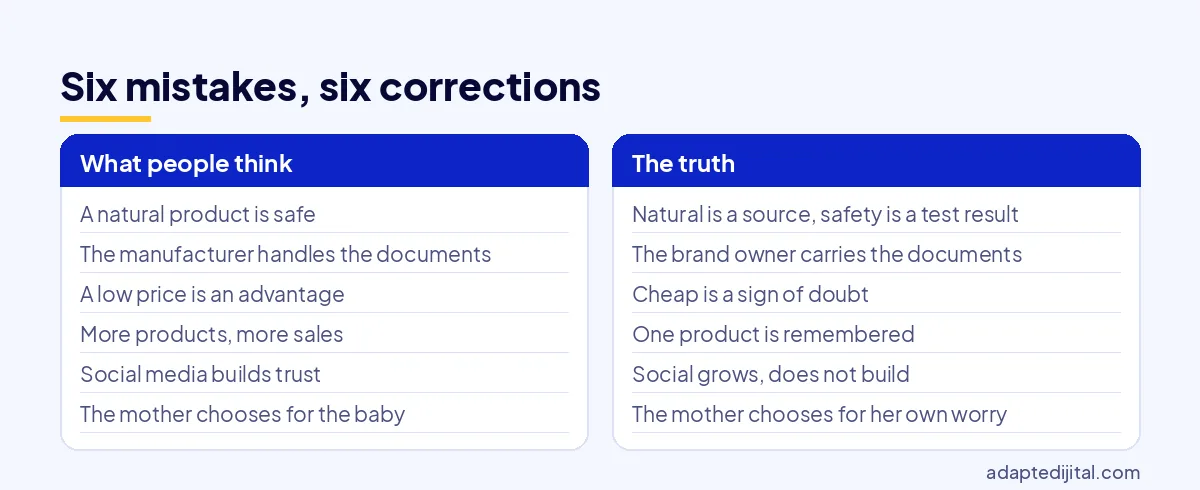
The six things people most often get wrong when starting a baby brand: a natural product is safe, the manufacturer handles the documents, a low price is an advantage, more products bring more sales, social media builds trust, and the mother chooses for her baby. All six sound right, and all six lose money in the first year. The correction sits under each one, short and reasoned.
You may not have known this: the word natural has no binding definition in cosmetics regulation, and some known allergens are plant-based; the most natural-looking ingredient can be the one that causes the most rashes. This article corrects the six mistakes one by one and says what each correction does to a brand decision. By the end, you will smile when you next hear one of the six.
Mistake 1: a natural product is safe
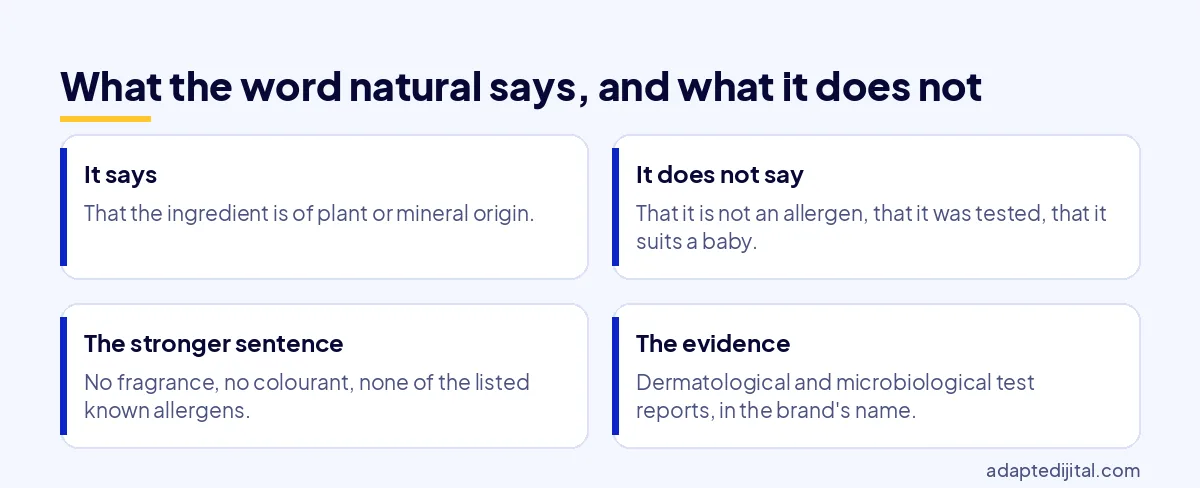
The truth is this: natural describes the source, safety is a test result, and the two are different things. Plant and essential oils can appear on the list of allergens cosmetics must declare; fragrance-free is a safer sentence than natural. The mother loves the word natural; the baby’s skin loves the report.
In plain words
A poisonous mushroom is natural too. Being natural tells you where something comes from, not what it does. In a baby product, the laboratory tells you what it does; the terms are in the article on dermatologically tested and hypoallergenic.
The brand decision
Instead of natural, write what the product does not contain: no fragrance, no colourant, none of the listed allergens. A concrete negative sentence beats an abstract positive one, and it can be defended in an inspection. The official framework is on the pages of TİTCK (Turkish Medicines and Medical Devices Agency).
Mistake 2: the contract manufacturer handles the documents
The truth is this: the manufacturer produces, and the party placing the product on the market, the brand owner, carries the documents. The notification, the test report, the label and being the named contact in an inspection are the brand’s job; the manufacturer helps under contract but does not take over the responsibility. Contract manufacturing hands over production, not the brand.
The brand decision
Five clauses in the contract: ownership of the formula, responsibility for documents, minimum quantity, acceptance criteria, price validity. If the five are not in writing, the brand that thinks its documents are handled stands alone at the inspection.
A comparison to make you smile
Leaving the documents to the manufacturer is like leaving the rent to your flatmate: well meant, but the lease is in your name.
Mistake 3: a low price is an advantage
BU BÖLÜMÜN ÖZETİ
- Little-known fact
- Through the pharmacist’s eyes
- The brand decision
The truth is this: in a baby product, a low price is a sign of doubt, not of trust. The mother pays more when she knows what she is buying, and the pharmacist questions a price below the market. A cheap baby product looks unsafe beside the big brand on the shelf; a mid-market price and a complete file is the stronger position.
Little-known fact
Price is not why mothers switch to small brands; the reasons are clear ingredients, a reachable contact, the pharmacist’s recommendation and a mother’s review. We told the case in the article on why mothers switch to small brands; the mother’s sentence is: expensive, but I know what I am buying.
Through the pharmacist’s eyes
When the pharmacist sees a price below the market, they ask two questions: was it tested, and where do the raw materials come from? The file answers both; the price answers neither. Cheap earns more questions and fewer shelves.
The brand decision
Build the price on unit economics, not by undercutting the competitor; the documents’ share sits inside the unit cost. The formula is in the cost article.
Mistake 4: more products bring more sales
The truth is this: more products bring more documents, more packaging, more stock and a scattered story; sales start from one product. A baby brand that opens with six products manages six test files, six labels and six shelf conversations, and nobody remembers any of them. One product is remembered; the second comes with sales data.
The brand decision
One hero product; let the mother remember it by three words and the pharmacist recommend it in one sentence. The second product is what the buyer of the first asks for, not the next catalogue item.
A comparison to make you smile
Opening with five products is like a first date with five topics of conversation: you cover them all, and none is remembered.
Mistake 5: social media builds trust
The truth is this: social media grows trust, it does not build it. In baby products, trust is built by the pharmacist, the documents and the mother’s review; social media shows the three to more people. Beautiful content from a brand without documents carries the doubt further, and for content involving babies and health claims the platform rules are strict.
The brand decision
First the shelf and the documents, then the content, which shows three things: the ingredient explanations, the pharmacist’s sentence and the mother’s review. For the digital media routine, see the digital media roadmap.
Mistake 6: the mother chooses the product for her baby
BU BÖLÜMÜN ÖZETİ
- Little-known fact
- The brand decision
- Now you know
The truth is this: the mother chooses the product for her own worry; the baby has no preference. The worry is this: buying the wrong thing and harming the baby. That is why the brand that reduces the worry wins, not the one that describes the benefits; documents, explanations and a contact exist for exactly this.
Little-known fact
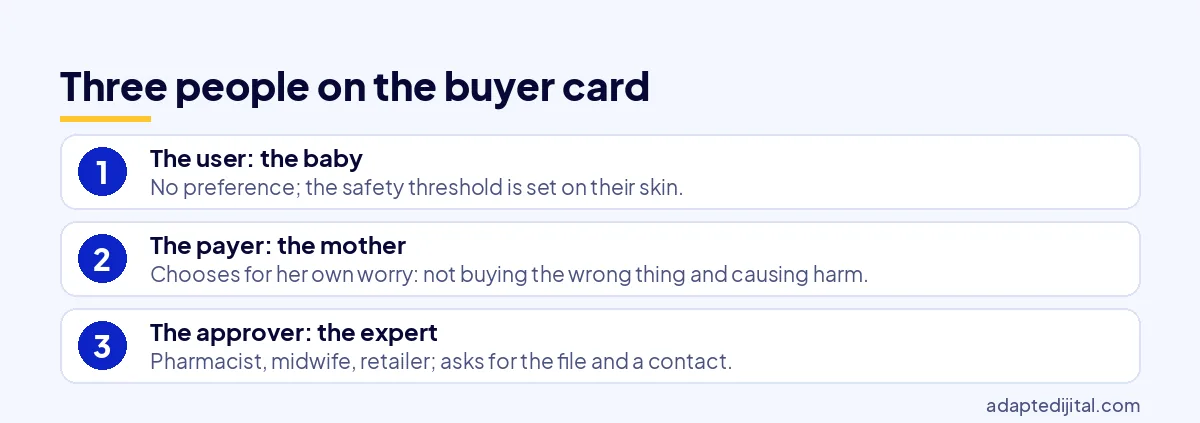
There are three people on the buyer card: the baby who uses it, the mother who pays, the expert who approves. The baby is on the list but does not decide; the mother’s worry and the expert’s approval do. We write this up as the buyer card in the method built around the mother’s trust.
The brand decision
The product page’s first sentence is not a benefit but an answer to the worry: fragrance-free, tested, suitable for newborns. The benefit is the second paragraph; the mother relaxes first, then reads.
Now you know
Natural is a source, safety a result; documents belong to the brand; cheap means doubt; one product is remembered; social grows, does not build; the mother chooses for her own worry. Six sentences, six decisions. The general order is in the pillar article, the scope on the brand consultancy page, the sector picture in the baby brand sector guide.
Frequently Asked Questions
Quick Summary
- Natural describes the source, safety is a test result; plant-based ingredients can be allergens.
- The brand carries the documents, not the manufacturer; five clauses go in the contract.
- A low price signals doubt in a baby product; the mother pays more when she knows what she is buying.
- One product is remembered; many products mean many documents and scattered stock.
- Social media grows trust, it does not build it; shelf and documents first.
- The mother chooses for her own worry; the first sentence answers it.
Short Glossary
- Natural ingredient: a raw material of plant or mineral origin; it says nothing about safety or allergens
- Party placing on the market: the party that sells the product under its own brand and carries the legal responsibility
- Hero product: the single product that carries the brand in its first year and that the mother and the expert remember
- Buyer card: the working document defining the user, the payer and the approver on one page
Next Step
To correct the six sentences in your own brand, write to us through the consult your expert form; the scope is on the brand consultancy page. Next article: when should a baby brand launch.
Updated: October 2026
Sık Sorulan Sorular
Because manufacturers naturally say we will handle it, and most mean it. But the report stays in the manufacturer’s file, and the pharmacist asks for yours. We saw the cost of that difference in the pharmacy shelf case; the contract clauses are in the article on choosing a contract manufacturer.
The inspector calls the brand on the label, not the manufacturer; so does the pharmacist. Both are shown a file in your name; if the name is not yours, the file does not exist.
When the manufacturer’s minimum quantity is high for a single product, the brand splits it across varieties: five products, a little of each. The result: five half-stocks. The minimum quantity is the third threshold in the cost article.
Because followers are visible and trust is not. A brand with a thousand followers and a pharmacy shelf is stronger than one with a hundred thousand and no shelf. The order is in the hub article: advertising and social belong to the sales stage.
Natural describes the source, safety is a test result; plant-based ingredients can be allergens. Documents show safety, not a word.
The brand owner who places the product on the market; the manufacturer helps under contract but does not take over responsibility.
No. In a baby product, a low price signals doubt; a mid-market price and a complete file is the stronger position.