
Genuine Leather, Faux Leather and Vegan Leather for a Bag Brand: How to Read the Label
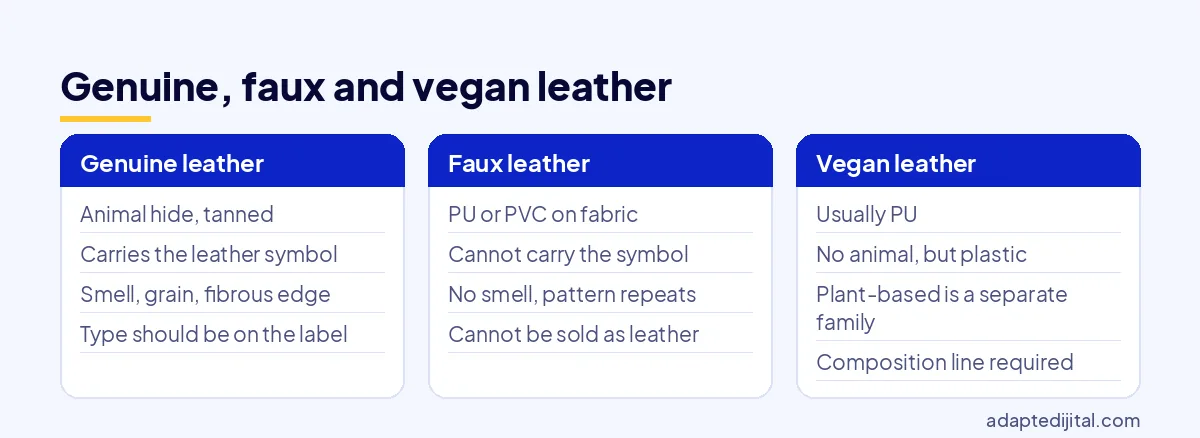
Genuine leather is animal hide, in three kinds: full-grain, corrected-grain and split. Faux leather is plastic on fabric, labelled PU or PVC. Vegan leather is usually the same plastic under a prettier name; plant-based materials are a separate, rarer family. The leather symbol goes only on real leather, and vegan is not a material name.
You smell leather, look at its grain and touch its edge; that takes three seconds. This article explains five terms plainly and ends with the three-second test box.
What is genuine leather, and how many kinds are there?
BU BÖLÜMÜN ÖZETİ
- In everyday terms
- What it means for a brand
- The common mix-up
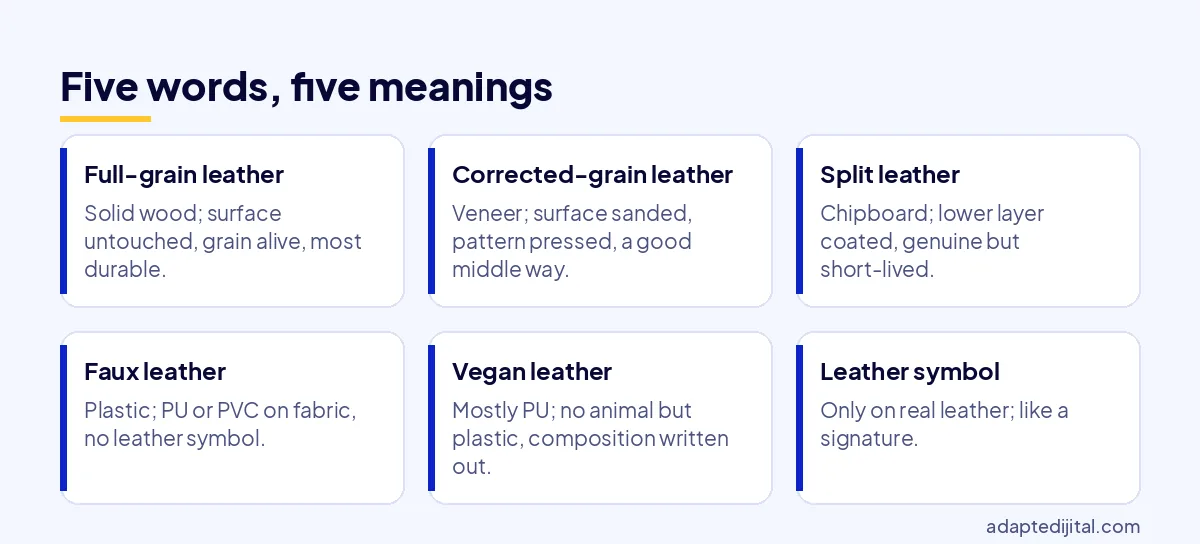
Genuine leather is tanned animal hide, but not one single thing. Top surface left as it is: full-grain. Marks sanded off and a pattern pressed on: corrected-grain. Lower layer separated and coated: split; all three are genuine, all three may carry the leather symbol, and the difference shows in durability, ageing and price.
In everyday terms
Think of a tree trunk. Solid wood, veneer and chipboard come from one tree but make different tables: full-grain, corrected-grain and split.
What it means for a brand
Your product group chooses the leather. A handbag carried for years wants full-grain or good corrected-grain; an entry cardholder can use split, if the label names it. Sourcing is settled in the article on choosing a workshop or contract manufacturer.
The common mix-up
Genuine leather is not always good. Split is genuine, yet it cracks quickly. Genuine states origin; type and tanning state quality.
What is faux leather, and how does it appear on a label?
BU BÖLÜMÜN ÖZETİ
- In everyday terms
- What the label says
- What it means for a brand
Faux leather is a plastic layer coated onto a textile base; polyurethane is labelled PU, polyvinyl chloride PVC. It looks like leather, does not smell like it, has no pores, and its coating peels over time. It is not a bad material: cheap, light, plenty of colours. What is bad is selling it as leather.
In everyday terms
Stone-pattern wallpaper looks like a stone wall from a distance, but it is not cold to the touch, and one day a corner lifts. PU is the same.
What the label says
The label names the material: PU leather, faux leather, synthetic leather. None may sit next to a leather symbol; the framework is in labelling rules and inspections for bag brands.
What it means for a brand
You can build a brand on faux leather, but not a leather brand. Write PU on the product page and never invite comparison with a leather bag; how a marketplace forces it is in own site, marketplace or boutique for a bag brand.
Is vegan leather plant-based?
BU BÖLÜMÜN ÖZETİ
- In everyday terms
- What goes on the label
- The sustainability question
Usually not. Most vegan leather bags in shop windows are PU coating; vegan says no animal was used, not what the material is. Plant-derived materials such as mushroom, pineapple leaf fibre, cactus and apple pomace exist, but most contain a plastic binder too. Vegan leather on the label and PU in the material line means a plastic bag.
In everyday terms
A sugar-free dessert still has sweetener. Vegan leather has no animal, but plastic; both must be written honestly.
What goes on the label
The material name: PU, or the plant-based material’s trade name with its composition. Vegan is free in marketing copy, not in the material line; more in six things people get wrong about bag brands.
The sustainability question
The measure is a certificate, not a word. For tannery-level environmental and chemical audits, Leather Working Group is the official source; it certifies tanneries, so ask your supplier.
What do the leather symbol and the label tell you?
BU BÖLÜMÜN ÖZETİ
- On a leather bag
- On a textile bag
- What it means for a brand
The leather symbol, the small mark shaped like a hide seen from above, is used only for real leather; it may not go on faux leather. On a textile bag a fibre label is compulsory, written in fibre names. Origin and manufacturer details sit on both. The label is a promise; the symbol is its signature.
On a leather bag
The symbol, the type where possible, manufacturer details, origin, care advice. Symbol without type: ask.
On a textile bag
Fibres by percentage and fibre name. The Turkish rule follows the EU regulation on textile fibre names; fibre name, not trade name.
What it means for a brand
The manufacturer supplies the label; the brand carries its accuracy. Symbol only on real leather, PU in a vegan product’s material line, fibres from the declaration: inspectors ask these first.
How do you do the three-second leather test?
BU BÖLÜMÜN ÖZETİ
- The box: three seconds
- When the test is not enough
- On your own product
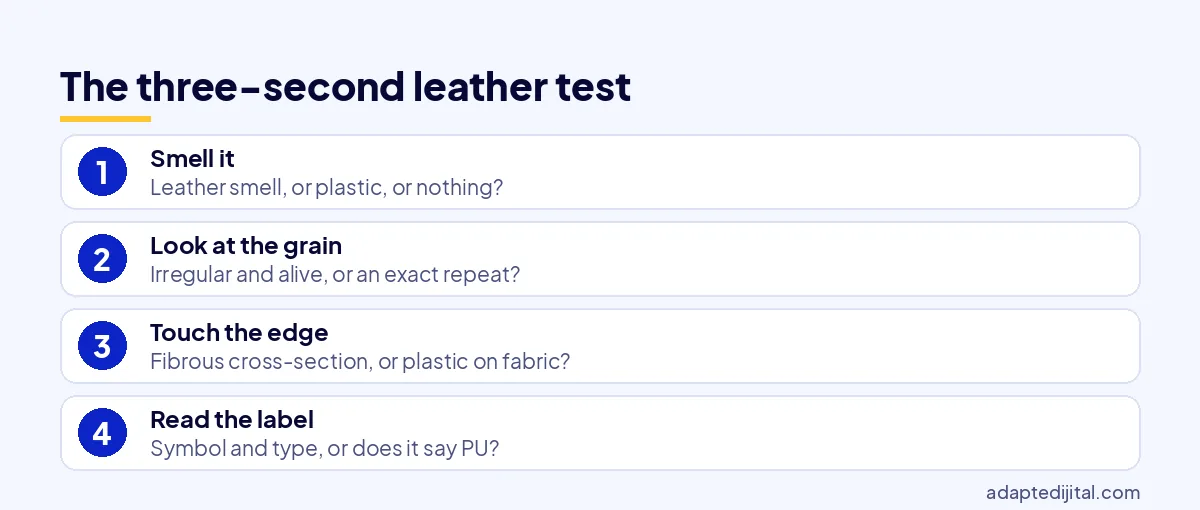
Smell, look, touch: real leather has a smell of its own, PU smells of plastic or nothing. Real leather shows irregular pores and small flaws; the PU pattern repeats identically. A cut edge of leather is fibrous and suede-like; PU shows fabric under a thin plastic layer. All three are done silently in a shop.
The box: three seconds
- Smell it: leather, plastic, or nothing?
- Look at the grain: irregular, or an exact repeat?
- Touch the edge: fibrous, or plastic on fabric?
When the test is not enough
Good corrected-grain and good PU can be confused; then the label speaks. The test raises the doubt, the label settles it.
On your own product
Test your own sample. A sample with no smell is either not leather or heavily finished; both questions go back to the workshop.
Why do edge paint and lining decide a bag’s fate?
Because a bag ages from its edges and its inside, not its surface. Edge paint seals the cut edge and withstands years of rubbing; applied thinly, it cracks in the first month. The lining takes the pen marks, key scratches and phone rubbing. These two details justify half the price, yet neither shows in a photograph.
In everyday terms
Nobody buys a shoe for its sole, yet the sole finishes the shoe. Edge paint is the sole of a bag.
What it means for a brand
Ask how many coats of edge paint the workshop applies and what the lining is; run a fingernail along the sample’s edge. Edge paint has its own line in the differentiation map in the pillar article on starting a bag brand.
Now you know this
Genuine leather has three kinds and not all are good; faux leather is PU or PVC and cannot be sold as leather; vegan leather is usually that same PU; the symbol goes only on real leather; edge paint and lining decide how long a bag lives. A founder who knows these five words writes the label correctly and reads a shop-window bag in three seconds.
To do today
Run the three-second test on three bags from your wardrobe, then read the labels. Where test and label agree, that workshop is a candidate.
Frequently Asked Questions
Quick Summary
- Genuine leather: full-grain, corrected-grain, split; not all the same quality.
- Faux leather is PU or PVC on fabric; no leather symbol.
- Vegan leather is usually PU; composition is written out.
- The leather symbol goes only on real leather; textiles need a fibre label.
- Three-second test: smell, grain, edge; the label settles doubt.
- Edge paint and lining decide how long a bag lives.
Short Glossary
- Full-grain leather: the most durable type, top surface unsanded
- Split leather: the coated lower layer of the hide; still genuine leather
- PU leather: polyurethane coated onto fabric; no leather symbol
- Edge paint: the layer sealing the leather’s cut edge
Next Step
To match your label to the workshop’s language, use the consult your expert form; the scope is on the brand consultancy page. Next: how to choose a workshop or contract manufacturer for bags.
Updated: October 2026
Sık Sorulan Sorular
Brand consultancy matches every label line to a document and a story. The sector picture is in the industry guide to starting a bag brand, your stage in the hub article on which consulting a bag brand needs; to read a label together, consult your expert.
Genuine leather is tanned animal hide. Faux leather is a PU or PVC coating on fabric and may not carry the leather symbol.
Usually not; most vegan leather is PU. Plant-derived materials are a separate family, and most contain a plastic binder too.
Smell, irregular grain, fibrous cut edge. If doubt remains, the label decides.