
6 Things People Get Wrong About Bag Brands: Vegan Leather Is Not Plant-Based
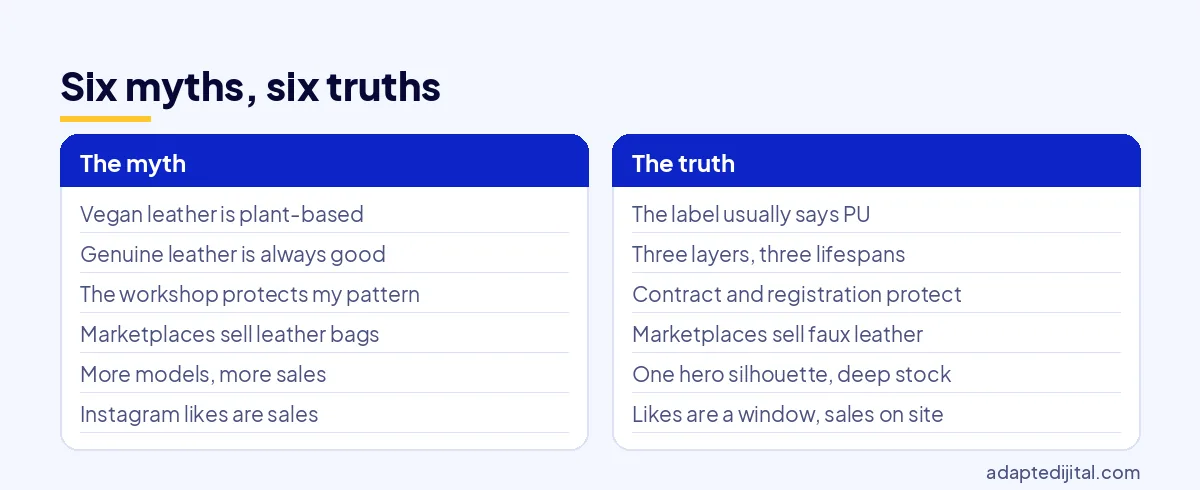
Six things people get wrong when starting a bag brand: vegan leather is plant-based, genuine leather is always good, the workshop protects my pattern, marketplaces sell leather bags, more models mean more sales, likes are sales. All six sound right, and all six lose money in the first collection.
You may not know this: a so-called vegan leather bag’s label usually says PU, meaning polyurethane, because vegan is not a material but a claim that no animal product is inside. Each myth below gets a correction and a brand decision.
Myth 1: vegan leather is plant-based
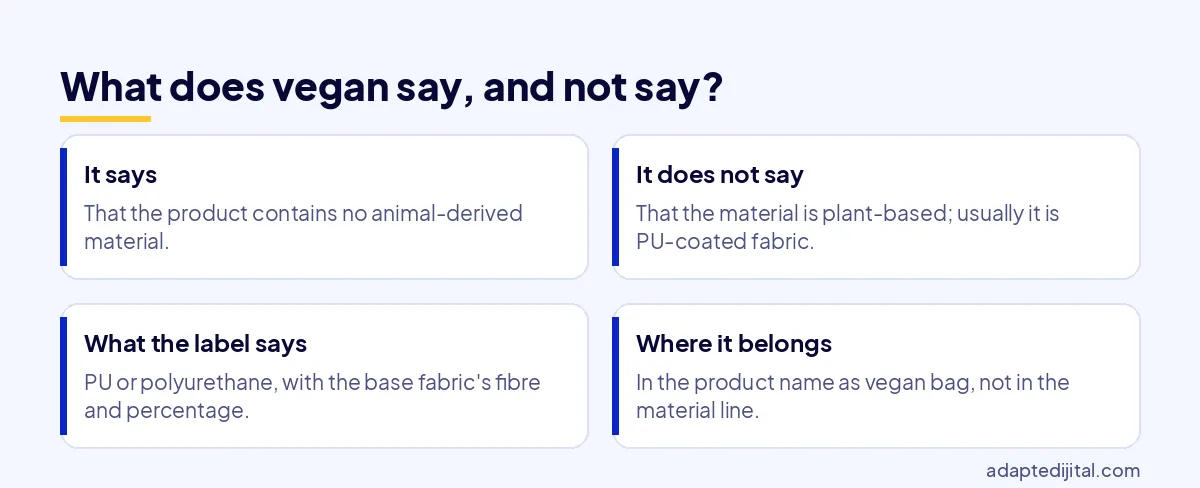
The truth: vegan leather is a claim, not a material, and most vegan leather bags are polyurethane-coated fabric with PU on the label. Plant-based materials such as mushroom, pineapple leaf fibre or cactus are a small, separate group, named as such on the label. Vegan says no animal product, not plant-based.
In everyday terms
Vegan leather is like a meat-free burger: no meat, but it does not say what is inside. In a bag it is usually plastic. Only real leather may be labelled leather; for misleading advertising, the Ministry of Trade is the official source.
Brand decision
Put vegan in the product name, not the material line: product name vegan bag, material PU-coated cotton or mushroom-based material, whichever applies. Separating the two keeps you at ease with inspectors; see labelling rules and inspections.
Myth 2: genuine leather is always good
The truth: genuine leather is a family name, and full-grain, corrected-grain and split share one symbol but have very different lifespans. Split is the hide’s lower layer, painted on top and sold as leather; its edges wear fast and it has no pores. Genuine leather on a label is a good sign, not a sufficient one.
Brand decision
Write the layer, not the family: full-grain calfskin, corrected-grain calfskin. Buyers start looking for layers and your price explains itself. What to ask in Tuzla is in the Istanbul local article.
A comparison to smile at
Trusting every genuine leather label is like assuming every 100 per cent fruit drink is freshly squeezed: the words are true, the contents differ.
Myth 3: the workshop protects my pattern
The truth: unless the contract makes the pattern yours, it stays on the workshop wall and can be cut again for another brand. No bad faith is needed; dozens of brands come out of one workshop. Protection comes from a pattern ownership clause and paying for the pattern, not from goodwill.
Brand decision
The pattern belongs to the brand, is used only for this order and is handed over when the relationship ends; three sentences, fee paid. Design registration for an original silhouette is the brand’s job, not the workshop’s.
A comparison to smile at
Leaving a pattern at a workshop without a contract is like giving your neighbour your cake recipe and then opening a bakery: the neighbour is nice, but the recipe travels.
Myth 4: marketplaces sell leather bags
The truth: marketplaces sell cheap faux leather bags, rank leather bags by price and squeeze the silhouette into a small square. Buyers meet the lowest price and thousands of similar squares, where good leather looks expensive and pointless. Edge paint, pores and a repair promise are invisible there.
Brand decision
Own site and concept stores for leather bags; marketplaces for wallets, cardholders and textile bags as entry products. The rule is in the own site, marketplace and boutique comparison; for store numbers, see Trendyol consulting.
Myth 5: more models mean more sales
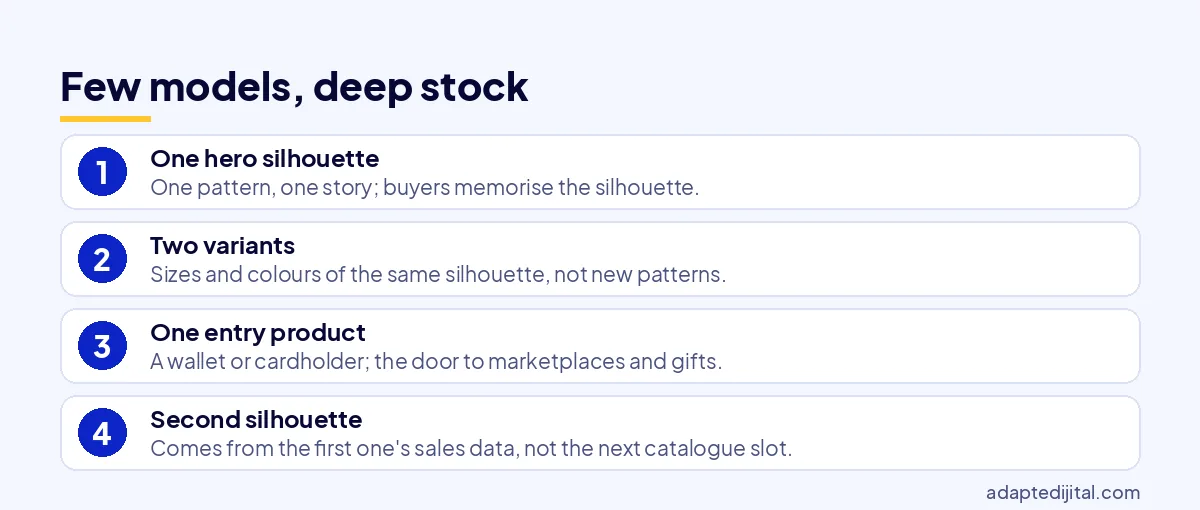
The truth: more models mean more patterns, samples, leather purchases, photos and a scattered story; sales start from one hero silhouette. A brand launching with twelve models makes a few of each, reorders none and never learns what sells. Few models, deep stock, a clear story; the second silhouette comes from the first one’s data.
Brand decision
One hero model, two variants, one entry product: a capsule of four. Buyers memorise the silhouette and stock is replenished in time; see the photo-first method.
A comparison to smile at
Launching with twelve models is like serving a guest twelve soups: all go lukewarm, none is remembered.
Myth 6: Instagram likes are sales
BU BÖLÜMÜN ÖZETİ
- A little-known fact
- Brand decision
- Now you know
The truth: Instagram is a shop window, and a like is a passer-by turning their head. Sales happen on the site, in the boutique and through the repair promise. A brand with many likes and few sales is a lovely window with no door; until the path from window to site is built, the basket stays empty.
A little-known fact
The person who likes is often not the person who buys. The liker looks at the photo, the buyer at size, leather and the repair promise; see why people pay for small bag brands.
Brand decision
Instagram is the window, the site the shop: one path from each post to a product page showing size, leather layer and repair promise. See the digital media consulting guide.
Now you know
Vegan leather is usually PU; genuine leather has three layers; a contract protects the pattern; marketplaces sell faux leather; one hero silhouette is enough; likes are a window. The order is in the pillar article, your stage in the hub article, the scope in brand consultancy, the overview in the bag brand sector guide; talk to a consultant.
Frequently Asked Questions
Quick Summary
- Vegan leather is a claim, not a material; the label usually says PU.
- Genuine leather has three layers with one symbol and different lifespans.
- The contract protects the pattern, not the workshop.
- Marketplaces sell faux leather; leather bags belong on your own site and in concept stores.
- One hero silhouette with deep stock beats twelve thin models.
- Instagram is a window; sales happen on the site, in the boutique and through repair.
Short Glossary
- PU: polyurethane; the plastic coating behind most faux and vegan leather
- Split: the hide’s lower layer, painted and sold as leather, with a short life
- Pattern ownership: a clause making the pattern the brand’s property
- Shop window: where buyers discover a brand but do not buy
Next Step
To correct the six in your brand, talk to a consultant; the scope is on the brand consultancy page. Next up: when a bag brand should launch.
Updated: October 2026
Sık Sorulan Sorular
PU or polyurethane, with the base fabric’s fibre and percentage. For plant-based materials, ask for a content statement; most contain a polyurethane binder. See the genuine, faux and vegan leather article.
One symbol, one word, three layers. The tannery sells three layers at three prices, and the workshop will not say which it uses unless asked. A cheap genuine leather bag is usually split under thick paint.
Because workshops rightly say they never hand patterns on, and most keep their word. But craftsmen change and workshops change hands. The contract clauses are in the article on choosing a workshop or contract manufacturer.
Because marketplaces have traffic, and traffic is mistaken for sales. But it is the traffic of buyers after cheap bags; see the leather bag brand first-collection case.
Because collection suggests plenty and founders want a full window. Yet every model is a separate pattern and sample fee; see the cost article.
Usually not; most vegan leather bags are polyurethane-coated fabric labelled PU. Plant-based materials are separate, rare and named as such.
No; full-grain, corrected-grain and split share one symbol. A buyer who does not ask about the layer may get split.
Not unless ownership is in the contract and the fee is paid. Protection comes from a clause and design registration.