
Why Do People Pay for Small Bag Brands? Four Reasons and One Case Study
People pay for small bag brands for four reasons: a silhouette not everyone has, quality they can feel, a founder they can reach with a repair promise, and the story and photos. Price is not among them; a small brand costs many times more than faux leather and buyers know it. What they buy is the relationship that comes with the bag.
This article follows an anonymous leather bag brand in the present tense. What turns it round is not a new model but a broken zip replaced for free.
Say you are looking at a brand’s site and there are no second orders
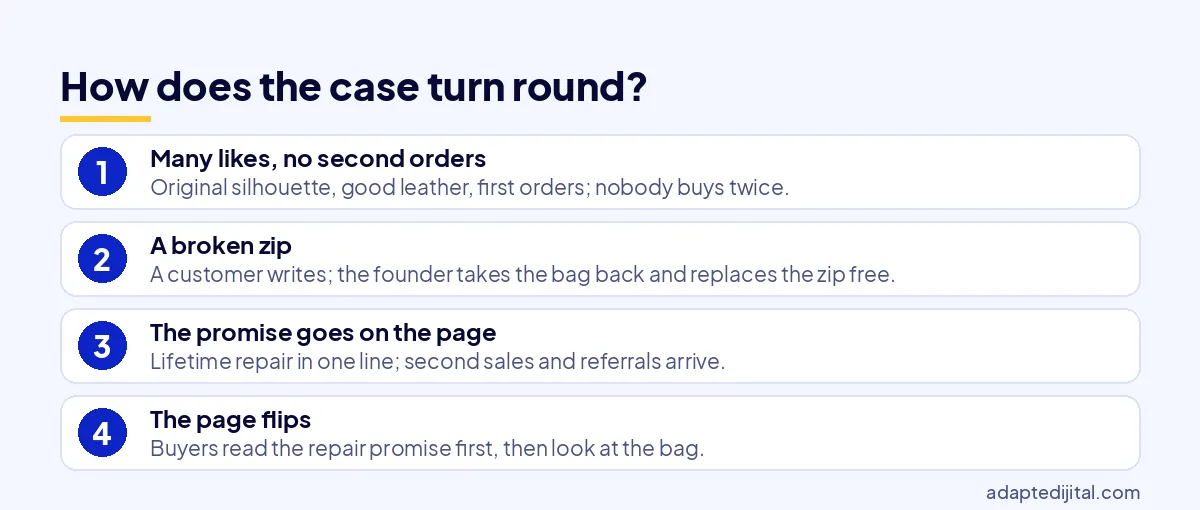
Say a leather bag brand has good photos, an original silhouette, good leather and plenty of likes; first orders come in, but nobody buys twice. As the founder considers a new model, a customer writes that her zip has broken. The founder takes the bag back, replaces the zip and charges nothing; one repair changes the brand’s whole question.
Unexpected finding
The founder adds one line to the product page: we repair this bag for life. First sales stay flat; second sales and referrals arrive, same model, same price. The brand had been selling a bag, not a relationship.
Reason one: a silhouette not everyone has
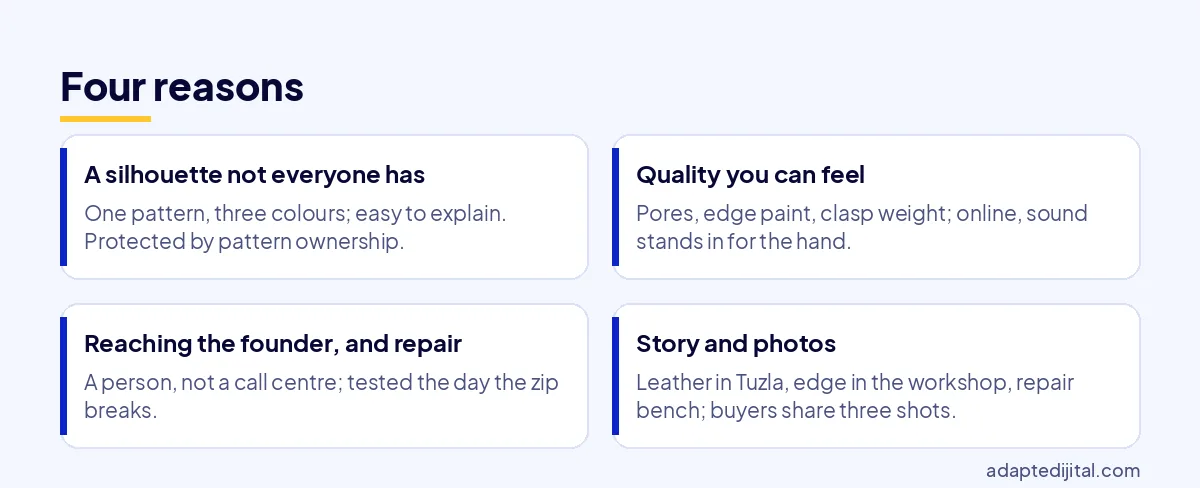
A big brand’s bag is on every street; a small brand’s silhouette gets its owner asked where she got it, and that question is what she pays for. The silhouette lives in the pattern, the brand’s most valuable asset. If the workshop reuses it, reason one falls; originality is protected by pattern ownership, not model count.
The principle for you
A capsule is built on one hero silhouette; variants are sizes and colours. We call it capsule architecture in the photo-first method.
Reason two: leather and hardware quality you can feel
The eye cannot tell faux from good leather on a screen, but the hand can at first touch: pores, weight, smell, a cool clasp, a gliding zip. Buyers feel it in a boutique and guess it online. A small brand sells high where people can feel the difference; elsewhere it sits in the same list as cheap faux leather.
Unexpected finding
Self-buyers smell the leather; gift buyers look at the box. The founder adds sound to the video: the zip’s glide, the clasp’s click.
Reason three: reaching the founder, and a repair promise
BU BÖLÜMÜN ÖZETİ
- What does the repair promise do?
- Unexpected finding
- The principle for you
This is the key observation: with a big brand the buyer reaches a call centre, with a small brand a person who repairs the bag. The promise brings second sales and referrals, not first ones, because buyers test it on the day the zip breaks. A small brand competes on reachability, not price, and wins.
What does the repair promise do?
| Promise | Tested when | Brand gains | Costs |
|---|---|---|---|
| Lifetime repair | A zip or strap breaks | Second sale, referrals | Zip and shipping |
| Care card | First rain | Fewer returns | One printed card |
| Message the founder | Before ordering | Fewer size returns | A few messages a day |
Unexpected finding
Most bags sent for repair show wear, not defects, and the founder repairs them anyway, with a new care card. Buyers share a repaired bag more than a new one.
The principle for you
Behind the one-line promise sits a written workshop agreement: spare zips in stock, a set repair time. Agree it first; clauses are in the article on choosing a workshop or contract manufacturer.
Reason four: the story and the photos
Online, the buyer sees the photo, not the bag, and looks for a story in it: who designed it, which leather, which workshop, why this silhouette. The photo is half the product and the story its caption. A small brand tells both more sincerely than a big one, because the story really belongs to one person.
What do the user, the payer and the approver look at?
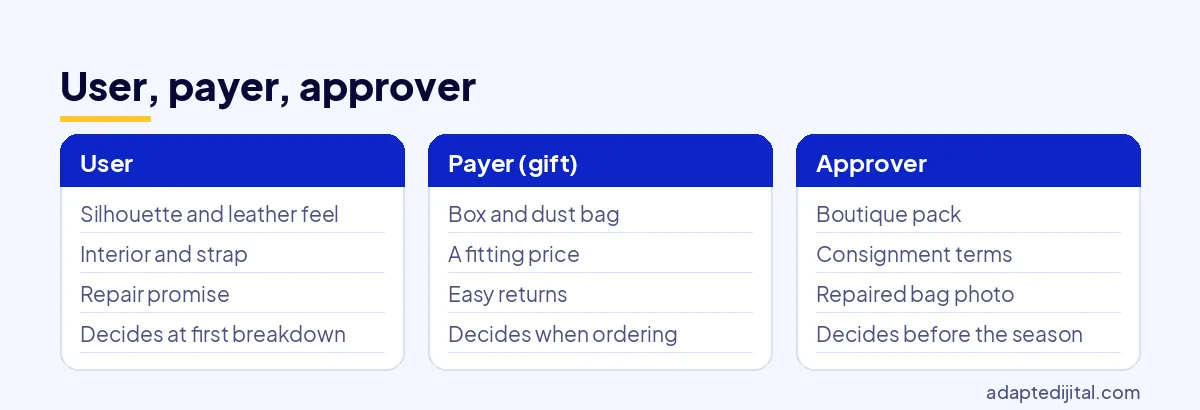
With bags, the user usually pays; gifts grow at year end and on special days. The approver is a third party: a boutique owner, an algorithm or a trusted review. All three look at the same bag from different places, so the brand needs a sentence for each; a brand with one sentence misses the first sale or the second.
Three-person table
| Who | Looks at | Decides | Brand says |
|---|---|---|---|
| User | Silhouette, leather, repair | First carry, first breakdown | One pattern, lifetime repair |
| Payer (gift) | Box, dust bag, returns | When ordering | Boxed, easy returns |
| Approver | Boutique pack, repaired bag photo | Before the season | One file, one promise |
Unexpected finding
The brand’s best-selling page is the repair service page, not the hero model. Buyers read the promise first, then look at the bag; where repair expectations are heading is in bag brands towards 2027.
One principle
People pay a small bag brand the first time for silhouette, felt quality and story, and the second time for the repair promise. A brand that says all four sells high and lasts; one that says only silhouette and photos gets likes and no second orders. The founder learns this from one broken zip.
To do today
Give your product page’s first sentence to the silhouette and its second paragraph to the repair promise. Ask your workshop whether spare zips are in stock, and learn what Leather Working Group certification means; boutique owners ask.
Next step
The overall order is in the pillar article, your stage in the hub article, the scope on the brand consultancy page; talk to a consultant.
Frequently Asked Questions
Quick Summary
- In the case, a zip replaced for free turns the brand round.
- Reasons one and two: a rare silhouette protected by pattern ownership, and quality you can feel.
- Reasons three and four: a repair promise that brings the second sale, and the story.
- User, payer and approver look at one bag from three places; the page needs three sentences.
- One principle: the first payment is for silhouette and story, the second for the repair promise.
Short Glossary
- Repair promise: a written commitment to repair a product; it brings second sales
- Comparison setting: what the buyer sees a bag next to
- Hero silhouette: the single pattern at the centre of a capsule
- Approver: a third party influencing the purchase
Next Step
To write silhouette and repair promise on one page, talk to a consultant; the scope is on the brand consultancy page. Next up: six things people get wrong about bag brands.
Updated: October 2026
Sık Sorulan Sorular
The customer shares a photo of the returned bag: you would never get this from a big brand. The founder sees that buyers want a person to reach when the bag breaks.
The brand shows two of the four causes in why a leather bag brand stalls at its first collection: no care promise, and a price compared with faux leather. The repair promise solves both.
I want something not everyone has, that does not look cheap and that I can talk about. The founder writes it in the page’s first sentence: one pattern, three colours, the same silhouette every season.
Full-grain pores, smooth edge paint, a heavy clasp. The founder’s first sample has a cheap zip that breaks; its replacement is today’s standard. The three-second test is in the genuine, faux and vegan leather article.
Buyers judge price by the comparison setting. Next to imported brands in a concept store the bag looks reasonable; in a marketplace faux leather list it looks expensive; see the own site, marketplace and boutique comparison.
The founder shows her own hands: choosing leather in Tuzla, edge paint in the workshop, the repair bench. Buyers share those three shots; where they are taken is in the Istanbul local article.
A story does not explain the price, it makes people forget it. Instagram is the window, not the till; see the digital media consulting guide.
A rare silhouette, quality they can feel, a reachable founder with a repair promise, and the story. Price is not one of them.
It lifts second sales and referrals, not first sales; buyers test it the day the zip breaks.
By choosing the setting: concept stores and your own site, not a marketplace faux leather list.