
Turkey’s Leather and Bag Industry in Numbers: Where a Bag Brand Reads the Data
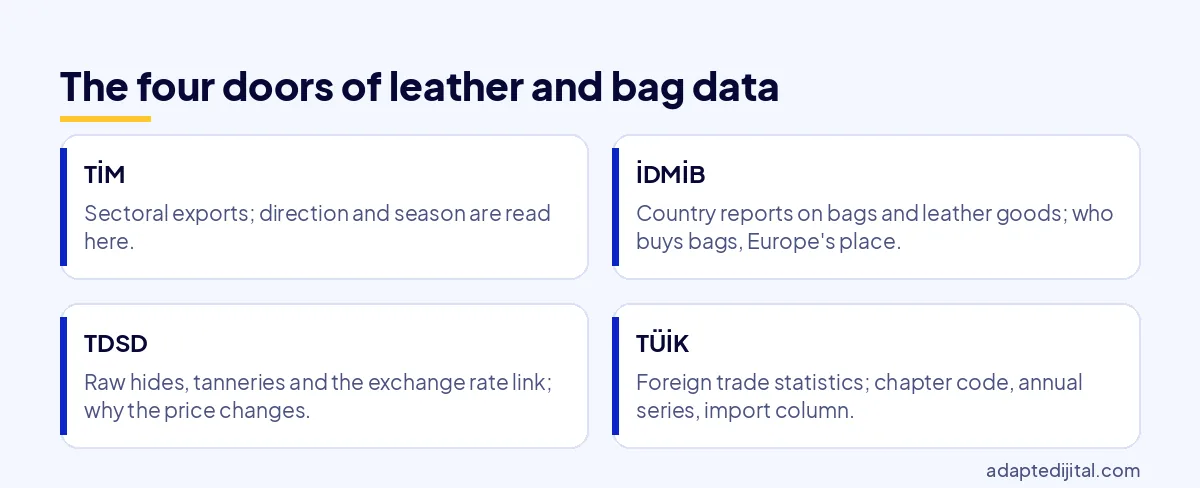
Data on Turkey’s leather and bag industry sits behind four doors: TİM (Turkish Exporters Assembly) export figures, İDMİB (Istanbul Leather and Leather Products Exporters’ Association) reports, TDSD (Turkish Leather Industrialists’ Association) notes on raw hides, and TÜİK (Turkish Statistical Institute) foreign trade statistics. For a bag brand founder the question is which table answers what, not the figure. Figures change yearly; the table’s location does not.
This article introduces the four sources, the question each answers and the four decisions a founder draws from them, ending with a data reading table: question, source, table, decision. We write no amounts; take them from the source.
Where does leather and bag data sit: TİM, İDMİB, TDSD, TÜİK?
Four sources, four angles: TİM gives the sector’s total exports and monthly course; İDMİB tracks bags and leather goods as a sub-breakdown and publishes country reports. TDSD, the industrialists’ voice, explains the link between raw hides, tanneries and exchange rates. TÜİK shows exports and imports by year under a chapter code.
Which question does TİM data answer?
BU BÖLÜMÜN ÖZETİ
- The sector row
- The monthly wave
- What not to do
TİM data answers one question: where does Turkey stand in leather and leather products, and which way is it heading? The sectoral export table shows the leather line’s share, monthly fluctuation and annual change. Read the season, not the amount: which months exports strengthen and fall. That is the first input to the production calendar.
The sector row
Leather and leather products is one sector row; bags sit inside it, not visible alone. Sector direction is read here, bag direction from the İDMİB breakdown.
The monthly wave
Strong export months coincide with European retail’s seasonal buying. Place sample and batch outside this wave and the workshop answers faster; inside it, you queue behind exporters.
What not to do
Domestic market size cannot be read from the TİM table; it shows exports, not who buys bags in Turkey. This set’s case articles cover that.
Which question does İDMİB data answer?
İDMİB data answers: who is buying bags, and which countries carry the weight? Country reports show European, neighbouring and new markets, with bags and leather goods as a separate group. The founder reads not which country to export to first, but when export becomes realistic.
Country weight
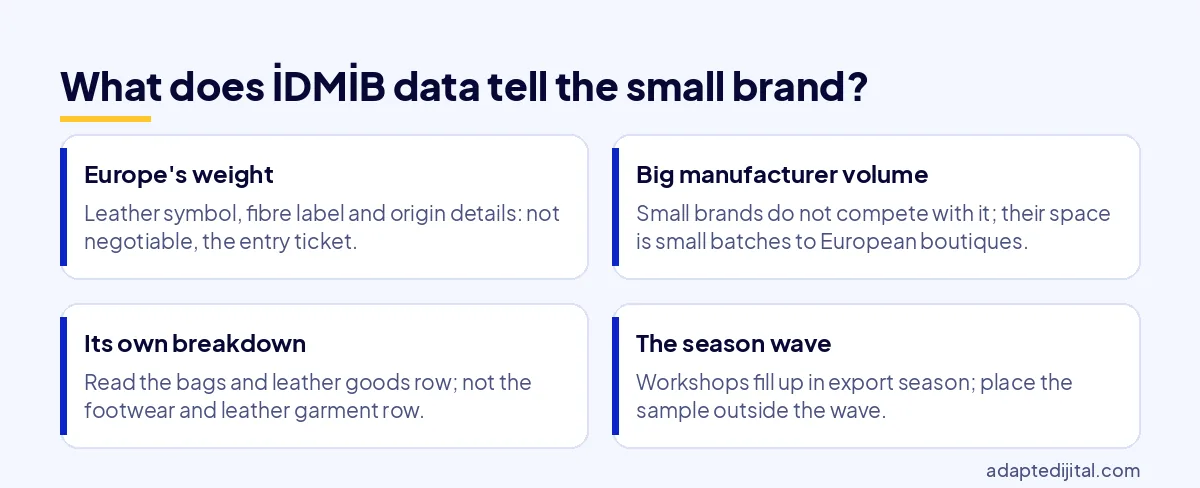
European countries stand out among the main buyers of bags and leather goods, so for a small brand the leather symbol, fibre label and origin details are not negotiable; for textile bags the rule is the EU textile labelling regulation.
Small-batch export
Behind the big export figures stand big manufacturers; the small brand’s space is small batches to European online boutiques, explained in six changes awaiting bag brands towards 2027.
Labelling and inspection, with official sources: labelling rules and inspections for bag brands.
How does TDSD data show the raw hide and exchange rate link?
BU BÖLÜMÜN ÖZETİ
- The exchange rate link
- The tannery calendar
- Certificates and the tannery
TDSD data answers the question founders look at least and feel most: why does the leather price keep changing? Its statements explain raw hide supply, tannery capacity and the exchange rate link. Read a mechanism, not an amount: imported raw hides mean prices move with the exchange rate and quotes expire fast.
The exchange rate link
Tanneries process part of their leather from imported raw hides, so prices move with the exchange rate. The consequence: a workshop’s quote carries a validity period, written into the contract.
The tannery calendar
Tanneries fill with large orders before the season; a small brand buys leather outside that calendar. Purchase threshold and price validity are laid out in the cost of starting a bag brand.
Certificates and the tannery
Leather Working Group audits tanneries; the tannery, not the brand, holds the certificate, listed on the Leather Working Group page. Ask for it and cite the tannery on your product page.
Which question does TÜİK foreign trade data answer?
BU BÖLÜMÜN ÖZETİ
- The chapter code
- The import column
- The annual comparison
TÜİK data answers two questions: what happened over the years, and are there imports? Leather goods and bags sit under their own chapter code, export and import columns side by side. Imports show where cheap bags come from; exports where domestic production goes. The gap tells the brand its price position.
The chapter code
Bags, wallets, suitcases and similar leather goods share one chapter; search that code on the TÜİK data portal. Without it the table cannot be found; note it on day one.
The import column
Turkey produces leather, yet bag imports are not zero: cheap faux leather and textile bags come in. Your marketplace rival is imported faux leather; your bag does not belong on that shelf.
The annual comparison
A five-year series gives the direction; a single year misleads. Put two years side by side and read the direction.
The data reading table: question, source, table, decision
The table below connects six founder questions to a source, a table and a decision. It holds no amounts; those come from the source itself. Fill it once, add the new figure yearly and compare direction. Memorise location, not figure.
The table
| Founder’s question | Source | Table to look at | Decision |
|---|---|---|---|
| Where does the leather sector stand? | TİM | Sectoral exports, leather products row | Compete on pattern and photography |
| Which months are strong? | TİM | Monthly export series | Sample outside the season wave |
| Who buys bags? | İDMİB | Bags and leather goods, by country | Label: European rule as standard |
| Why does the leather price change? | TDSD | Raw hide and tannery statements | Price validity in the contract |
| What happened over the years? | TÜİK | Foreign trade, chapter code, annual series | Read direction; one year misleads |
| Are there imports, from where? | TÜİK | Import column of the same table | Stay off the faux leather shelf |
How to use it
The table goes to an investor or workshop meeting as one page. The source column is never blank; unsourced figures lose trust at the first question.
Which four decisions does a bag brand draw from this data?
BU BÖLÜMÜN ÖZETİ
- Competing on pattern and photography
- Calendar and label
- Price position and contract
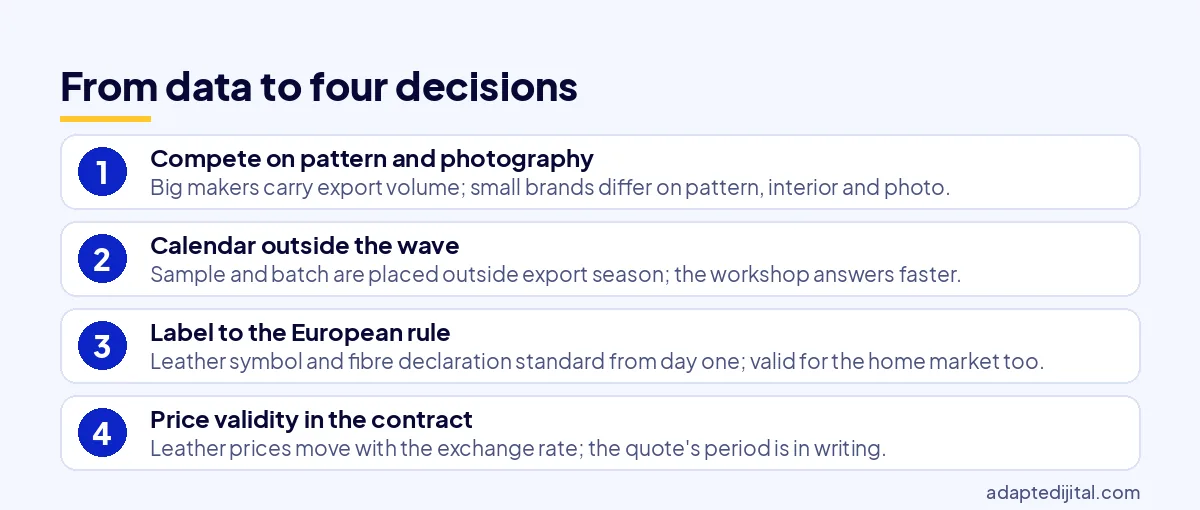
Data does not decide; it shows the direction. Four sources, four decisions: compete on pattern and photography, not in the workshop; produce outside the export wave; set label and certificate to the European rule from the start; write leather price validity into the contract. These fill the first two doors in which consulting a bag brand needs.
Competing on pattern and photography
Big manufacturers carry export volume; the small brand cannot compete in the same workshop. Differentiation lives in pattern, interior and photograph; the first budget goes there, not to leather stock.
Calendar and label
Sample and batch go outside the season wave; leather symbol and fibre declaration follow the European rule from day one. Genuine versus faux leather on the label: genuine leather, faux leather and vegan leather in bags.
Price position and contract
Sharing a marketplace shelf with imported faux leather is not the small brand’s business; a leather bag’s price is explained on its own website. Scope: the brand consultancy page; to adapt the data to your product group, use the consult your expert form. The wider picture: the starting a bag brand industry guide.
Frequently Asked Questions
Quick Summary
- Leather and bag data sits behind four doors: TİM exports, İDMİB country reports, TDSD raw hides, TÜİK foreign trade.
- TİM shows direction and season, İDMİB buyer countries, TDSD the exchange rate link, TÜİK annual series and imports.
- Read bags and leather goods in their own breakdown, not the garment or footwear rows.
- Compete on pattern and photography, not in the workshop; the label follows the European rule.
- Leather prices move with the exchange rate; price validity goes into the contract.
- The table memorises location, not amount; refresh the figure yearly.
Short Glossary
- Chapter code: the foreign trade classification that gathers bags, wallets and suitcases under one heading
- Leather goods (saraciye): the collective export-report name for bags, wallets, belts and suitcases of leather and similar materials
- Country-based product report: İDMİB’s report showing which countries a product group is sold to and with what weight
- Data reading table: a four-column worksheet connecting the founder’s question to source, table and decision
Next Step
To adapt this table to your product group, use the consult your expert form; scope on the brand consultancy page. Next: why a leather bag brand stalls at its first collection.
Updated: October 2026
Sık Sorulan Sorular
Sectoral export figures, monthly and annual, leather and leather products on its own row; source TİM export figures. Direction is read here: growing or shrinking, which months are strong.
Reports by product group and country, bags and leather goods as a separate group; source İDMİB. Which countries buy bags, and Europe’s weight, is seen here.
TDSD explains tanneries, raw hide supply and the exchange rate link; source TDSD. TÜİK lists leather goods and bags yearly under their chapter code, imports included; source TÜİK foreign trade statistics.
The data feeds the founder’s decisions in the pillar article on starting a bag brand.
TİM sectoral export tables, İDMİB country reports on bags and leather goods, TDSD raw hide statements and TÜİK foreign trade statistics under the bag chapter code.
European countries stand out in İDMİB reports, so the leather symbol, fibre label and origin details are standard for the small brand too.
Tanneries process imported raw hides and the price moves with the exchange rate; TDSD explains the link. Write the quote’s validity into the contract.