
From Architect’s Studio to Bag Brand: One Founder’s Story and Three Lessons
An architect can build a bag brand, and the architect in this story is doing it: it starts with a laptop bag she draws for her office, and today she runs a three-model capsule and a cardholder on pre-order through her own site. We give neither her name nor her office; we give the first drawing, three workshops, a zip problem, her own photos and a first shelf in Karaköy. The most surprising decision sits in the middle: she produces on pre-order instead of stock.
We use the present tense because the brand is working today. Her words are in quotation marks; the rest is observation. Three lessons close the story, for founders who are not architects.
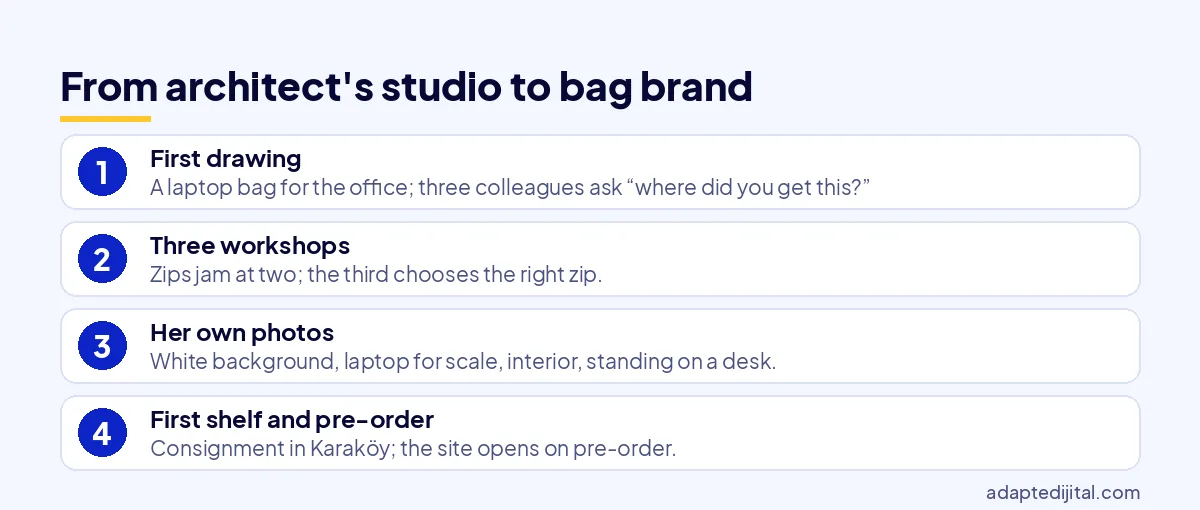
A laptop bag drawn for the office, and colleagues who ask
The founder works at an architecture practice; by day she draws façades, by evening her own laptop bag, because shop bags either will not take a drawing tube or look like office bags on a meeting table. A workshop in Zeytinburnu makes one, and she carries it to work. That month three colleagues ask: “Where did you get this?” She notes: a bag is seen first, asked about second.
The turning point
At a meeting, the client asks about the bag, not the project. She says: “They don’t ask while I carry it, they ask when I put it on the table. What sells is the moment it stands.” Why people pay a small brand is in the four reasons article.
Three workshops, one sample and a zip problem
BU BÖLÜMÜN ÖZETİ
- The founder’s words
- The clause she adds
- The quantity decision
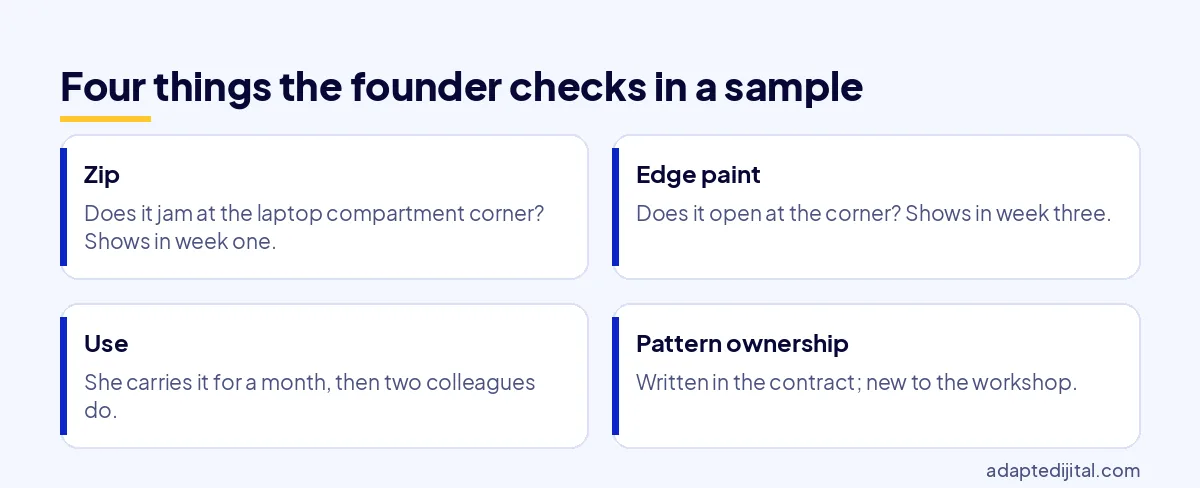
She takes one pattern file to three workshops, two in Zeytinburnu and one near Tuzla. All three get leather and stitching right; the problem is the zip. In the first two samples a thin metal zip jams at the laptop compartment corner; the third workshop buys zips from its own Tahtakale wholesaler at the quality she wants. She works with the third.
The founder’s words
“Leather is their job, zips are their job, but the choice is mine. I wouldn’t leave a building’s door handle to the contractor.” Hardware sourcing in Tahtakale and Eminönü is in starting a bag brand in Istanbul.
The clause she adds
She writes pattern ownership and price validity into the contract; the workshop has never heard of a pattern clause. “In a project, the drawing’s copyright is in the contract; so is my pattern.” See six common misconceptions.
The quantity decision
The minimum is low but unit cost high, so she cuts the laptop bag first rather than spreading quantity across three models. Thresholds are in the cost article.
She shoots her own photos: white background, scale and interior
BU BÖLÜMÜN ÖZETİ
- The founder’s words
- Three words
- The photo share of cost
Once the sample is approved she shoots it herself; as in architecture presentations, a product is approved by image, not drawing. Four angles on white, a scale shot with laptop and tube, the interior open, the bag on a shoulder and on a desk. Photos are half the bag, and she sets up that half by her office window.
The founder’s words
“We put a human figure beside a model for scale; I put a laptop beside the bag. Buyers don’t ask its size, they ask whether their laptop fits.” The photo standard is in the photo-led method article.
Three words
Page, care card and shop tag share three words: tube fits, laptop protected, stands on the desk. “In a project the drawing sheets agree; in a brand, page, card and tag agree.”
The photo share of cost
Shooting herself turns the photo threshold from money into time. When each threshold is paid is in the cost article.
First channel: a Karaköy concept store, consignment and a repair promise
She takes the first samples not to a marketplace but to a Karaköy concept store working on consignment: it pays for what sells and returns the rest. The owner pulls the zip, checks the edge paint and asks: “What happens if the zip breaks?” She answers from day one: the repair promise is on the care card, the bag comes back, the zip is replaced.
A repair promise from day one
Repair labour is in the workshop contract, and the care card gives leather type, care and repair terms together. Mandatory label lines are in labelling rules and inspections.
The decision to produce on pre-order
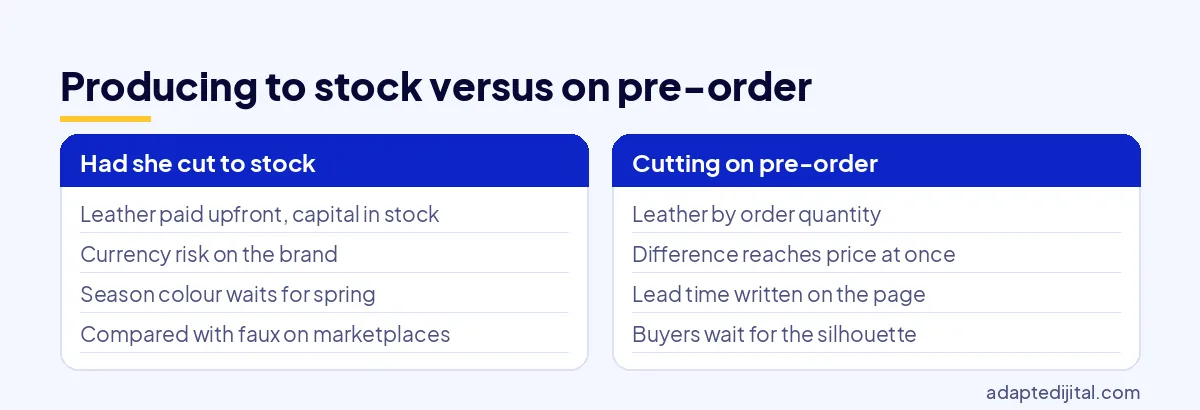
With the first shelf open, her site goes live and she makes the story’s most surprising decision: the season colour opens on pre-order, not stock. The page states the lead time, leather is bought by order quantity, and the workshop cuts once orders are in. “We don’t finish a building before it’s sold; we build on pre-sales. I don’t buy leather before orders come.”
Today
Laptop bag as hero, shoulder bag and tote as variants, cardholder as entry product; own site, one concept store, pre-order. She is still at the office: “The office teaches me delivery discipline, the brand teaches me patience with materials.”
Three lessons from the story (for non-architects)
One: a bag sells when it is seen, so photos and the standing moment come before the batch. Two: pattern ownership, zip choice and repair terms are settled in the contract and the sample, not at sale. Three: when leather prices follow the exchange rate, the first batch is cut on pre-order, lead time on the page, and buyers wait for a silhouette not everyone has.
Frequently Asked Questions
Quick Summary
- An architect has one laptop bag made; colleagues see it and ask.
- Zips jam at two of three workshops; she picks the third and writes pattern ownership into the contract.
- She shoots her own photos; three words match on page, card and tag.
- First shelf: a Karaköy concept store on consignment, repair promise from day one.
- The first batch is cut on pre-order, not stock.
Short Glossary
- Consignment: the store pays as products sell and returns the rest
- Scale photo: a photo with a known object, such as a laptop, showing real size
- Repair promise: a care-card term that broken zips or seams come back for repair
- Pre-order: cutting the batch after orders arrive, with lead time on the page
Next Step
To start your story from the first sample, write via ask an expert; scope is on the brand consultancy page. Back to the start: I want to start a bag brand.
Updated: October 2026
Sık Sorulan Sorular
She says: “For an architect a bag is a small building: structure, façade, interior. Drawing a pattern is drawing a plan, just smaller.” Why enter a sector of many workshops and few brands is in the pillar article.
She carries it for a month with laptop and tube, then two colleagues do. The zip jams in week one, edge paint opens in week three. Use testing as an acceptance criterion is in choosing a workshop.
Does the price fit the neighbouring shelf, who repairs breakages, what happens to unsold stock? The care card and consignment file answer all three; see own site, marketplace or boutique.
“On a marketplace my bag sits beside faux leather and my photo gets lost in a small square. In Karaköy the buyer handles the leather.” See the stuck leather bag brand case.
Leather prices follow the exchange rate; bought by order quantity, the difference reaches the price at once and no capital waits. She also asks the tannery for documents; see Leather Working Group.
“They wait for a silhouette not everyone has.” Lead time and cancellation terms are on the page, set up under e-commerce consultancy; see also when should a bag brand launch.
Replace her project habits with method: buyer card, three words, photo standard, care card, pre-order page. That is brand consultancy work; find your stage in the hub article.
See the bag brand sector guide and the twelve items in the checklist. For your own story, ask an expert.
Yes; this founder starts with an office laptop bag, finds the workshop with the right zip, shoots her own photos and cuts the first batch on pre-order.
Leather prices follow the exchange rate; buying by order quantity keeps capital out of stock, and buyers wait for a rare silhouette.
Plan photos before the batch, settle pattern, zips and repair in the contract, and cut on pre-order.