
Bag Brands Towards 2027: Six Changes Facing Small Brands and Today’s One Task
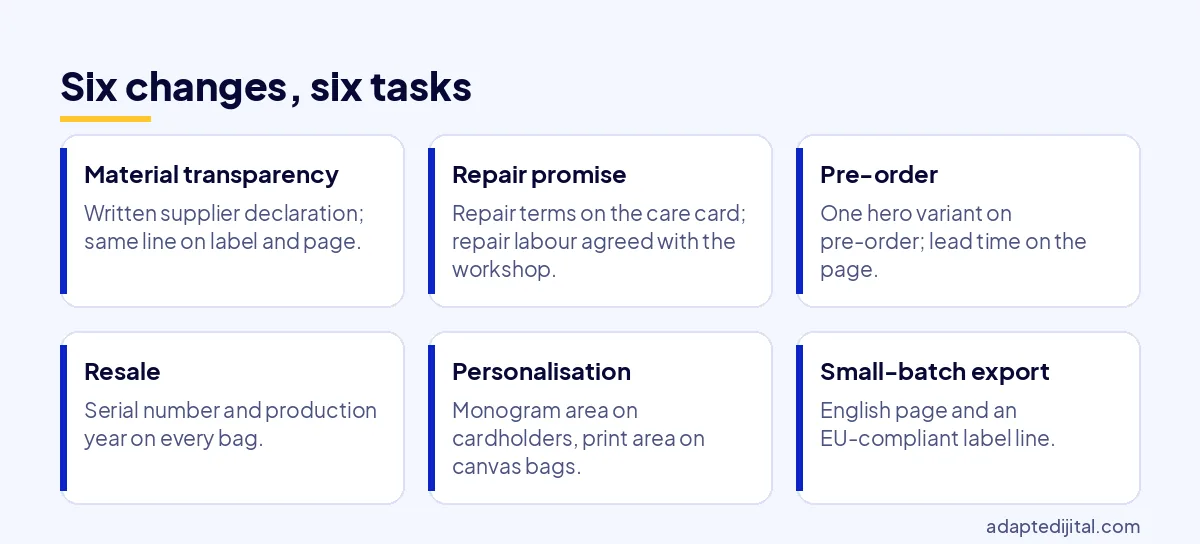
Six changes face bag brands towards 2027: material declarations become an inspected label line and vegan claims get questioned; buyers expect repair and lifetime care; small batches and pre-order replace stock; resale tests prices from outside; monograms become the gift standard; European online boutiques open to small batches. All six have started. This is preparation drawn from today’s signals, not a forecast.
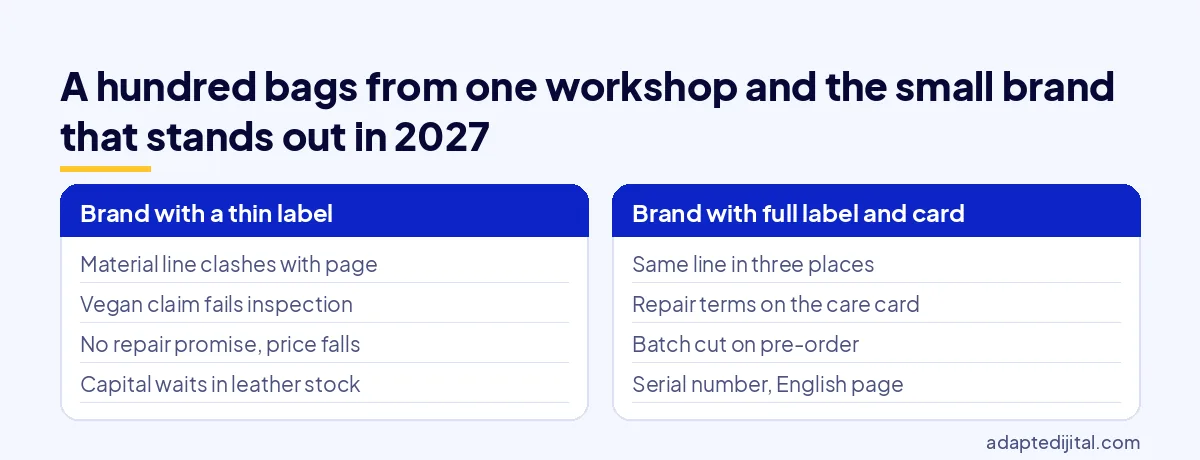
Look, all six favour the small brand that stands out from a hundred same-workshop bags through pattern, leather and story, and work against the brand with a thin label and weak photos. Each gets a signal, a consequence and one task; a table closes the article.
Change 1: material transparency and scrutiny of vegan leather
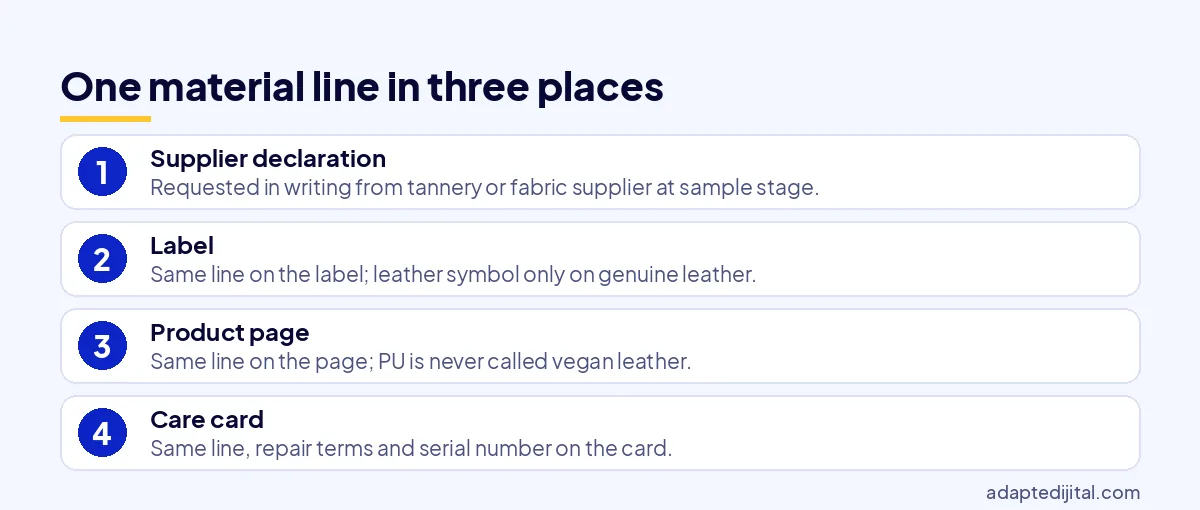
Signal: the Ministry of Trade inspects leather and textile goods through labels and content declarations, and buyers ask whether a bag is genuine, faux, or what its vegan leather is made of. Consequence: by 2027, faux goods with the leather symbol and vegan leather with no stated content will fail at inspection and at checkout. Today’s task: get each model’s material declaration in writing and use the same line on label and page.
Unexpected finding
The label is right but the page says vegan leather and the material is PU; buyers read the page, and it becomes the return reason. Supplier declaration, label and page must match; see six common misconceptions.
Change 2: the expectation of repair and lifetime care
Signal: buyers ask what happens if the zip breaks, brands sharing repair photos get comments, and boutique owners raise repair terms in consignment talks. Consequence: by 2027, a leather bag brand with no repair promise will not hold the upper-mid price band; the promise carries the price. Today’s task: write repair terms on the care card and add repair labour to the workshop contract.
The question for the workshop
Repair labour is priced separately, and a pattern registered to the brand can be repaired elsewhere; see the twelve questions in choosing a workshop.
Unexpected finding
The first repair request comes in; the founder replaces the zip and the buyer buys a second bag that week. Repair becomes the channel for a second sale.
Change 3: small batches and the pre-order model
Signal: small brands open season colours on pre-order, state lead times on the page and buy leather by order quantity; buyers wait for a silhouette not everyone owns. Consequence: with leather prices following the exchange rate, by 2027 stock will be the exception for small brands and pre-order the rule. Today’s task: open one colour variant of the hero model on pre-order, lead time on the page.
Case
An architect turns her office laptop bag into a brand and cuts the first batch on pre-order; see the architect’s studio story.
Change 4: resale prices the brand from outside
Signal: leather bags are their own category on resale platforms, buyers check what a bag will fetch later, and lasting silhouettes in good leather hold value. Consequence: by 2027, a small brand’s resale price will be the most credible proof of its own price. Today’s task: mark each bag with a serial number and production year and record both on the care card.
Unexpected finding
A bag reselling near its new price makes buyers buy new without hesitation. On resale it is compared with its own class, not faux leather; see own site, marketplace or boutique.
Change 5: printing and monograms become the gift standard
Signal: corporate buyers want logos on canvas bags, gift buyers want initials on cardholders, and hot-stamping workshops take single pieces. Consequence: by 2027, entry products without a monogram area will drop out in gift season, and canvas bags without a print area will miss corporate shortlists. Today’s task: fix the monogram area on the entry product and agree hot-stamping time with the workshop.
Print area on canvas bags
The fibre label is required whatever the print, and print time goes in the quote. The corporate calendar is in when should a bag brand launch.
Unexpected finding
Monogrammed cardholders are not returned, since initials cannot be regifted. Return terms still go on the page.
Change 6: small-batch export to European online boutiques
Signal: European online boutiques are opening to small design brands on consignment and low quantities; İDMİB (Istanbul Leather and Leather Products Exporters’ Association) publishes export market breakdowns, and small batches travel by courier. Consequence: by 2027, export will be open to small brands with EU-compliant labels and an English page. Today’s task: prepare the hero model’s English page and an EU-compliant label line.
Six changes in one table
| Change | Today’s signal | Today’s one task |
|---|---|---|
| Material transparency | Ministry inspections, buyers reading the page | Written declaration; same line on label and page |
| Repair promise | Zip questions, consignment terms | Repair on care card; repair labour in contract |
| Pre-order | Small brands stating lead times | One hero variant on pre-order |
| Resale | Own category, resale price | Serial number and production year |
| Personalisation | Buyers asking for logos and initials | Monogram area on cardholder; print area on canvas |
| Small-batch export | European boutiques opening to small brands | English page and EU-compliant label line |
All six rest on label, care card and page. See the pillar article, the hub article, the bag brand sector guide and brand consultancy.
Frequently Asked Questions
Quick Summary
- Six changes: materials, repair, pre-order, resale, personalisation, small-batch export.
- All have started and favour the small brand with its own pattern, leather and story.
- The material line matches in three places: supplier declaration, label, page.
- Repair is the channel for a second sale; resale price proves the new price.
- Monogrammed cardholders are not returned; pre-order keeps leather out of stock.
Short Glossary
- Material declaration: a supplier’s written statement of the material, repeated on label and page
- Pre-order: cutting the batch after orders arrive, with lead time on the page
- Monogram area: a zone fixed for initials or a logo
- Small-batch export: a boutique testing a model in low quantity, reordering if it sells
Next Step
To prepare for the six changes, write via ask an expert; scope is on the brand consultancy page. Next: from architect’s studio to bag brand.
Updated: October 2026
Sık Sorulan Sorular
See the Ministry of Trade announcement and labelling rules and inspections. For textile bags sold into Europe, the rule is in the EU textile labelling regulation.
A large brand re-verifies hundreds of models; a small brand confirms a three-model capsule with one call to the tannery. The three-second leather test is in genuine, faux and vegan leather.
Buyers can reach the founder and know the bag will not be binned when it breaks; a loyalty case is in why people pay a small bag brand.
The leather purchase threshold: no capital waits in stock and currency swings reach the price at once. Thresholds are in the cost article.
Lead time, scale photo, interior, cancellation and return terms. Setting it up falls under e-commerce consultancy.
It carries the ownership chain and repair record, so the brand knows each bag’s history. It goes in the lining and on the care card, not the label.
Little leather, parcel-sized, gift-priced, personal with a monogram; the capsule rule is in the photo-led method article.
Data is on the TİM and İDMİB sites; which table answers what is in the sector in numbers.
A boutique tests a model in low quantity and reorders if it sells, much like consignment in Karaköy. Ask the tannery for Leather Working Group certification; preparation falls under foreign trade consultancy.
Material transparency: supplier declaration, label and page must carry the same line, and vegan claims will be checked.
Yes; variants open on pre-order, lead time on the page, leather bought by order quantity.
Keep label, care card and page complete: declaration, repair terms, pre-order page, serial number, monogram area, English page.