
Cost of Starting a Bag Brand: Nine Items, Three Thresholds and the First Batch
Starting a bag brand has nine cost items: pattern, sample, leather, hardware, lining, workshop labour, photography, packaging with dust bag, and the site. We give no total; items move with leather type, exchange rates and quantity. What does not change: the payment order, the unit cost shares and three thresholds.
This article opens the nine items, their payment timing and the unit cost of one bag, then the three thresholds.
What are the nine cost items, and which one gets forgotten?
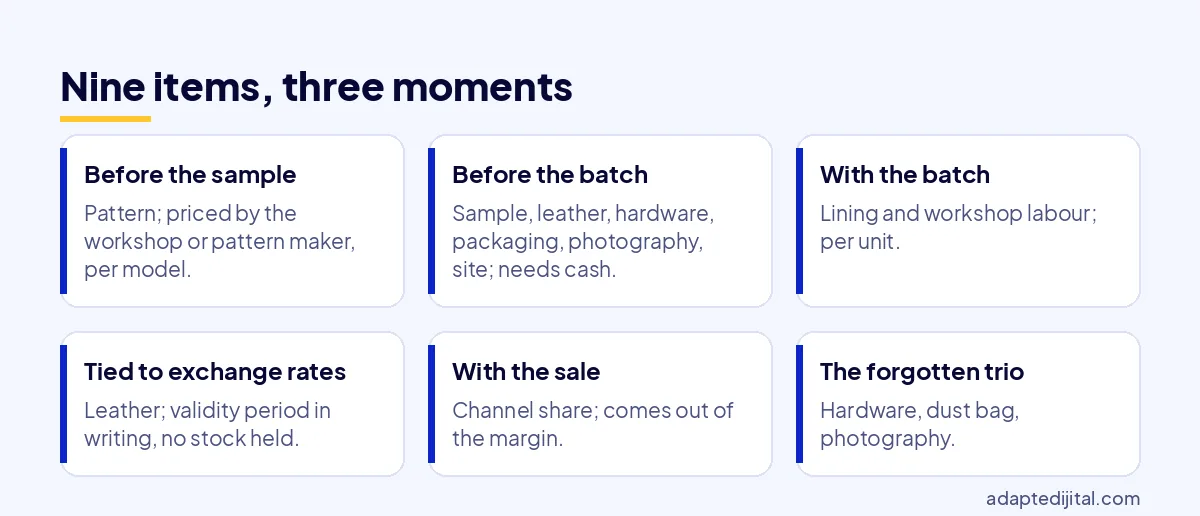
Leather and workshop labour are the items everyone counts, pattern and photography the ones everyone underrates, hardware and the dust bag the ones everyone forgets. The sample is small but compulsory; the site is the first year’s fixed cost, lining and hardware the variable cost inside every unit. Write the nine items into a table with who will price each.
The three forgotten items
Hardware, dust bag and photography never appear in the workshop’s labour quote. Hardware comes from the Tahtakale cluster; learn the terms in genuine, faux and vegan leather explained.
Who gives the price?
Nine items take prices from at least six counterparts: the workshop for pattern, sample and labour, the tannery for leather, the hardware supplier, the lining supplier, the photographer, the packaging supplier and the agency or platform for the site. Get every item in writing from its own counterpart. Threshold: an item without two quotes enters the budget as a flagged estimate.
The single-counterpart trap
A workshop may offer to handle everything. The convenience is real, but the leather price gets buried and its type cannot be checked. Ask for items separately.
When is each item paid?
The items are paid at three moments: before the sample, before the first batch, and with the sale. The order is the cash flow itself; a brand that has paid for leather and forgotten the dust bag leaves its product waiting naked on the shelf. The table arranges the nine items by timing, counterpart and type.
The table
| Item | When | Counterpart | Type |
|---|---|---|---|
| Pattern | Before sample | Workshop | One-off |
| Sample | Before batch | Workshop | One-off, deducted |
| Leather | Before batch | Tannery | Per unit, currency |
| Hardware | Before batch | Supplier | Per unit |
| Lining | With batch | Supplier | Per unit |
| Labour | On delivery | Workshop | Per unit |
| Photography | After sample | Photographer | One-off |
| Packaging | Before batch | Supplier | Per unit |
| Site | Before launch | Agency | Fixed |
How to read it
Items paid before the batch need cash; leather is the heaviest. The channel’s share comes out of the margin; see own site, marketplace or boutique.
Unit cost logic: what is inside one bag?
BU BÖLÜMÜN ÖZETİ
- The leather share
- The pattern and photography share
- The formula
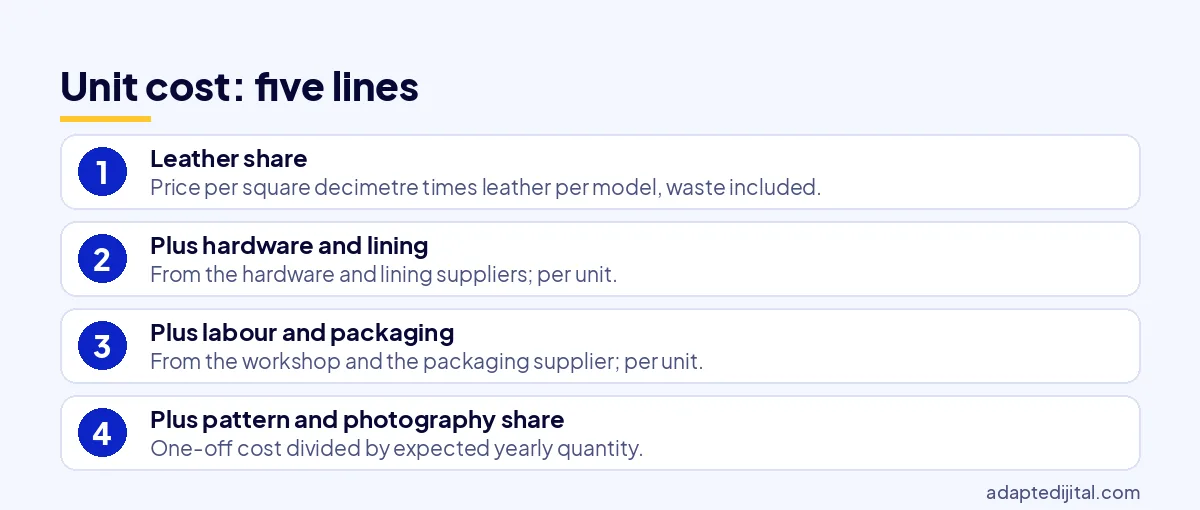
The unit cost of one bag has five parts: leather share, hardware and lining, workshop labour, packaging and dust bag, and the pattern and photography share. The first three appear on quotes; the other two do not, yet they sit inside every unit. Have the workshop calculate yield per hide with waste, and spread pattern and photography over yearly quantity.
The leather share
How the pattern sits on the hide sets the waste. A flat tote wastes little; a small handbag with many parts wastes a lot.
The pattern and photography share
One-off costs spread across units; a slow model pushes its own unit cost up.
The formula
| Line | What | Where it comes from |
|---|---|---|
| A | Leather share | Price per square decimetre times leather per model, waste included |
| B | Hardware and lining | Hardware and lining suppliers, per unit |
| C | Workshop labour | Workshop quote, per unit |
| D | Packaging and dust bag | Packaging supplier, per unit |
| E | Pattern and photography share | One-off cost divided by expected yearly quantity |
| Unit cost | A + B + C + D + E | The price is built on top of this |
How are exchange rates and the price validity period managed?
Leather prices move with exchange rates; that is why the validity period of the tannery’s and workshop’s prices goes into the contract. When you take a leather price, ask which day’s rate it rests on, have the validity written in days, and make notice of any increase a clause. Threshold: a leather price with no validity period is only an estimate.
The sector picture
Leather industry trends are reported by TDSD (Turkish Leather Industrialists’ Association). The founder’s takeaway: tie leather purchases to the batch.
How it reaches the price list
The selling price is set once a season; the first price carries a wider margin. See the industry guide to starting a bag brand.
Three thresholds: pattern-sample, leather purchase, photo-site
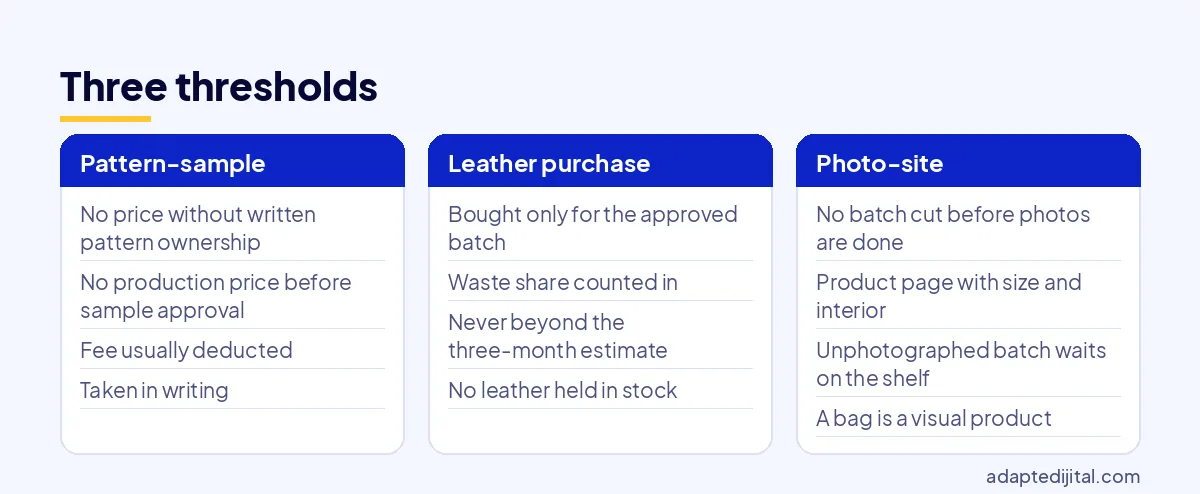
Pattern-sample: no production price is discussed until pattern ownership is in writing and the sample is approved. Leather purchase: leather is bought only for the approved batch plus waste, never beyond the three-month estimate. Photo-site: the first batch is not cut until the photo set and product page are finished; an unphotographed batch waits on the shelf.
How is the first batch sized?
BU BÖLÜMÜN ÖZETİ
- The most common mistake
- Public support
- To do today
The first batch is no larger than the three-month sales estimate and is spread depth first, variety second. Count the boutiques and channels you are talking to, put a weekly estimate against each, multiply by a quarter, and spread the result across the hero model, two derivatives and the entry product. Low workshop minimums allow depth in few models.
The most common mistake
A large batch and many models to cut the unit price: money tied up, best colour sold out. Check the 12-point checklist before a bag collection launch.
Public support
KOSGEB (Turkey’s small business development agency) support changes by period; verify on the KOSGEB site.
To do today
Open the nine-line table and note the three thresholds. See the hub article on which consulting a bag brand needs; to fill it with your quotes, consult your expert.
Frequently Asked Questions
Quick Summary
- Nine cost items, no single total.
- Forgotten: hardware, dust bag, photography.
- Paid before the sample, before the batch, with the sale.
- Unit cost has five lines.
- Leather prices need a validity period.
- Three thresholds; depth before variety.
Short Glossary
- Leather share: leather used per model, times price
- Waste: hide that cannot be cut into parts
- Pattern share: one-off costs divided per unit
- Price validity period: how long a quoted price stays fixed
Next Step
To fill in the table with your quotes, use the consult your expert form; the scope is on the brand consultancy page. Next: the 12-point checklist before a bag collection launch.
Updated: October 2026
Sık Sorulan Sorular
It looks one-off, yet each model needs its own pattern. Why a capsule is three to five models is in the pillar article on starting a bag brand.
Leather is priced in foreign currency per square decimetre, and usage per bag depends on pattern and waste. Who buys it is settled in the article on choosing a workshop or contract manufacturer.
Skip the sample and the leather, zip and price all change in the first batch. Get the fee deduction in writing.
A brand that delays photography ties up the leather money in the warehouse. Brand consultancy sets the threshold with the capsule architecture.
There is no single figure; nine items move with leather, exchange rates and quantity.
Leather, hardware and lining, labour, packaging, and the pattern and photography share.
As many as the three-month sales estimate; depth first.