
Bag Brand Launch Checklist: 12 Items to Tick Before the Collection Goes Live
Before a bag brand launches its first collection, it ticks twelve items: three for product, three for label and packaging, three digital, three for channel. If one is missing, the launch waits; the date changes, not the collection. The list is written for leather handbags and shoulder bags; for textile bags the label item changes, the order does not.
Each item gets one line, an owner and a consequence. A six-week countdown sits in the middle, a printable list at the end.
Group 1: product (three items)
BU BÖLÜMÜN ÖZETİ
- Item 1
- Item 2
- Item 3
- Common mistake
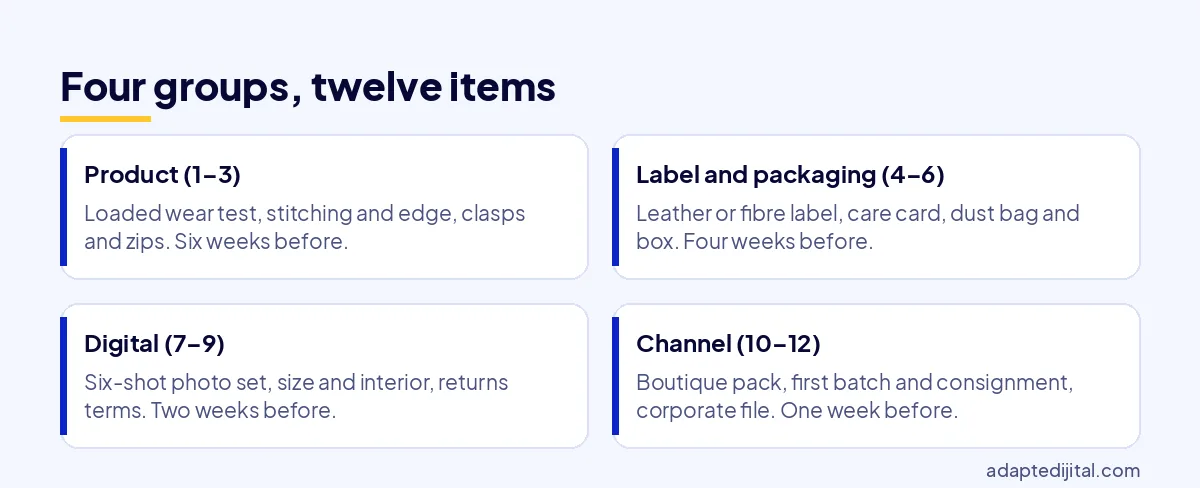
The bag has been carried for a week under real load, stitching is even, edge paint does not crack, and clasps and zips have been opened a hundred times. These items decide the owner’s first week; a snapped strap or stuck zip is invisible on a boutique shelf, but the owner never buys again. All three are settled at sample stage, not batch stage.
Item 1
The sample has been carried for a week with a real load: laptop, wallet, phone, keys. The strap seam has not stretched, the corners have not worn, the lining has not torn. Ticked by the founder and craftsman; if missing, the batch is not approved.
Item 2
Stitch length is even, no loose threads, and the edge paint does not crack when bent. On a leather bag, edge paint is the visible reason for the price. Ticked by the founder; leather and edge terms are in the genuine, faux and vegan leather article.
Item 3
Clasps, zips and rivets share one tone, zips glide, and the supplier has given a written nickel release statement. Ticked by the founder and supplier. If missing, the hardware is replaced and the batch waits.
Common mistake
Wear-testing an empty bag on a desk. A strap seam only speaks under weight on a shoulder. Acceptance criteria are in the article on choosing a workshop or contract manufacturer.
Group 2: label and packaging (three items)
BU BÖLÜMÜN ÖZETİ
- Item 4
- Item 5
- Item 6
The leather statement and symbol appear only on real leather, textile bags state fibre and percentage, and maker and origin are on the label. A care card sits inside, and the dust bag and box are branded and survive shipping. These are the first things the buyer holds; a wrong label gets printed twice, and without a dust bag a leather bag arrives in a plastic pouch.
Item 4
Genuine leather and the leather symbol appear only if the product is leather; lining and trims are stated separately. Ticked by the founder and label designer; if missing, the label is reprinted. The framework is in labelling rules and inspections; the official source is the Ministry of Trade notice on unsafe products.
Item 5
The care card covers rain, sun and storage for leather, washing for textile, plus a repair promise and contact details. The same text is on the product page. If missing, the first stained bag comes back with a review.
Item 6
The dust bag covers the whole bag, the box survives a drop, and inside is a card with your three words. If missing, the product is ready but the delivery is not; see the photo-first method.
Group 3: digital (three items)
BU BÖLÜMÜN ÖZETİ
- Item 7
- Item 8
- Item 9
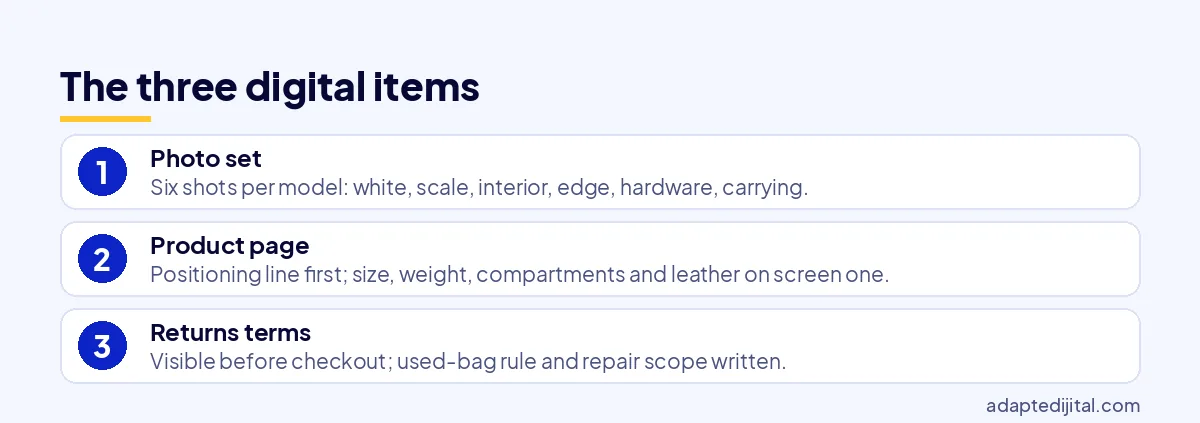
The photo set has six shots per model, the product page shows size, weight and interior on the first screen, and returns and repair terms are visible before checkout. This is what the buyer sees on a phone; a page without a scale shot causes size returns, and one without an interior shot cannot explain the price. With bags, the photo is half the product.
Item 7
Six shots per model: front on white, scale on the shoulder, interior, edge close-up, hardware close-up, a carrying scene. Same light, same order. If missing, the page does not go live; building the site is a job for website consulting.
Item 8
The product page opens with the positioning line; dimensions, empty weight, compartments, laptop fit, leather type and lining sit on the first screen. If missing, size becomes the first reason for returns.
Item 9
Returns terms appear on the product page and in the basket: the used-bag rule, return with dust bag and box, and the repair scope. If missing, the first dispute becomes a review.
Group 4: channel (three items)
BU BÖLÜMÜN ÖZETİ
- Item 10
- Item 11
- Item 12
The boutique pack is ready as one file, the first batch matches channel capacity with a written consignment promise, and a one-page corporate offer exists. These items decide whether the first shelf opens; a concept store owner cannot sell a bag without a pack, and a brand without an offer file misses year-end gift orders.
Item 10
The boutique pack holds photos, sizes, consignment terms, lead time, brand story and your three words; the shop owner sells with it. If missing, the first shelf meeting slips. Channel choice is in the own site, marketplace and boutique comparison.
Item 11
The first batch stays within a three-month forecast: depth in the hero model, few variants, and a take-back promise in the consignment agreement. If missing, stock locks up. Thresholds are in the cost article.
Item 12
The corporate offer covers canvas bag and gift set options, personalisation limits, lead time and minimum order, on one page. Corporate buyers do not wait for brands without one.
Who ticks the list, and when? A six-week countdown
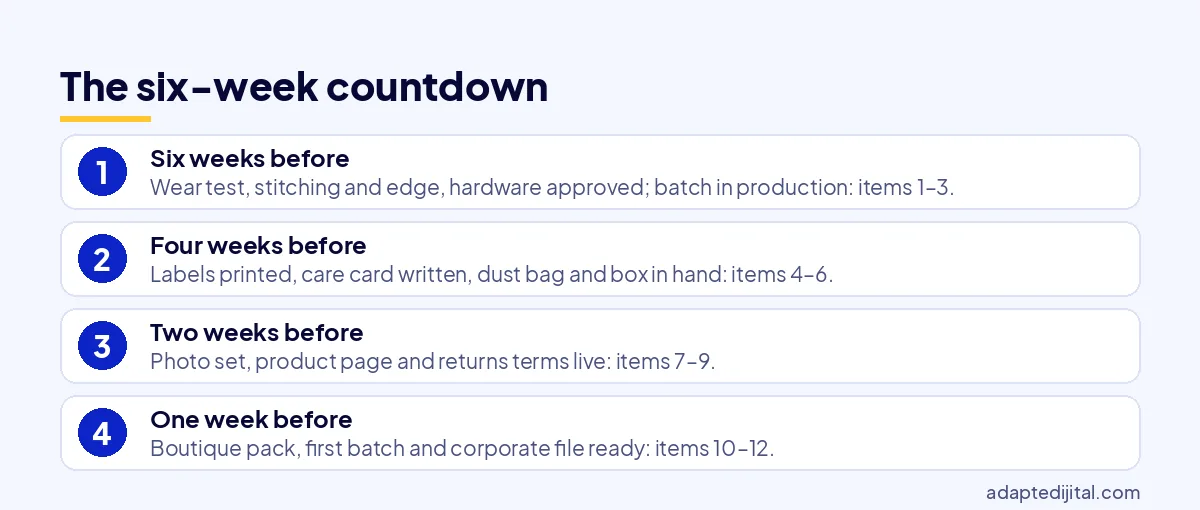
The founder ticks it and delegates it to no one; the workshop and photographer keep their own lists, but the twelve items have one owner. Product finishes six weeks before launch, label and packaging four weeks, digital two weeks, channel one week. A bag batch takes longer than a sock batch, so the countdown is longer too.
Countdown calendar
- Six weeks before: wear test, stitching and edge, hardware approved; batch in production (items 1–3)
- Four weeks before: labels printed, care card written, dust bag and box in hand (items 4–6)
- Two weeks before: photo set shot, product page and returns terms live (items 7–9)
- One week before: boutique pack, first batch and corporate offer ready (items 10–12)
Common mistake
Finishing all four groups in one week. Leather batches and box printing take weeks; a shoot takes a day, editing a week. Leave it all to the end and the launch slips a season; timing is in the article on when to launch.
The twelve items as a printable list
Print the list and write the name of whoever ticks each item, with the date. The launch date is not announced until all twelve are ticked; the workshop and boutique owner learn the date from you, and you learn it from the list. A bag brand’s first collection stands on this single page.
The list
- Week-long wear test under real load
- Even stitching, edge paint does not crack
- Clasps and zips work, nickel statement received
- Leather statement or fibre label to the rules
- Care card and repair promise inside the bag
- Branded, shipping-proof dust bag and box
- Six-shot photo set per model
- Size, weight and interior on the first screen
- Returns and repair terms visible before checkout
- Boutique pack ready as one file
- First batch within forecast, consignment written
- One-page corporate offer ready
Frequently Asked Questions
Quick Summary
- Twelve items in four groups: product, label and packaging, digital, channel.
- If one item is missing, the date changes, not the collection.
- Product finishes six weeks before, label four, digital two, channel one.
- Leather statement only on real leather, six photos per model, one boutique file.
- The most expensive mistake sits in the earliest item: a leather batch cannot be undone.
- The list has one owner: the founder.
Short Glossary
- Launch: the dated, planned moment a collection first goes on sale
- Boutique pack: one file for a concept store owner with photos, sizes, consignment terms and story
- Edge paint: the paint sealing the cut edges of leather, showing workmanship at a glance
- Countdown: a calendar working back from launch day
Next Step
To fit the list to your calendar, talk to a consultant; the scope is on the brand consultancy page. Next up: starting a bag brand in Istanbul.
Updated: October 2026
Sık Sorulan Sorular
Because a leather batch cannot be undone. A label can be reprinted and a page rewritten, but a batch with cracked edge paint is discounted or left in storage.
Fitting the list to a calendar is the work of brand consultancy; the overall order is in the pillar article, your stage in the hub article. Label rules change, so check the official source, and talk to a consultant.
A week-long loaded wear test, a stitching and edge paint check, and an open-and-close test for clasps and zips; all finish at sample stage.
The launch is postponed; the date changes, not the collection. The delay runs from a week to a season.
The founder; others keep their own lists, but the twelve items have one owner.