
When Should a Bag Brand Launch? Season, Workshop Calendar and Gift Periods
A bag brand launches in the week three calendars overlap: when the first batch leaves the workshop, when the product group enters its season, and when boutique or corporate buyers choose. Production takes ten to fourteen weeks from pattern to batch, counted back from launch. Boutiques set autumn-winter shelves in late summer; corporates settle year-end gifts in September and October. Miss the overlap and you launch with no batch, out of season, or after buyers have chosen.
The Newsroom Desk sets out each calendar, then combines them. The answer is a method, not a month, and the month differs by product group; a table and three worked examples follow.
Calendar one: production is counted back from pattern to batch
BU BÖLÜMÜN ÖZETİ
- Leather sourcing adds time
- Work that does not wait for the batch
- Label data is gathered at sample stage
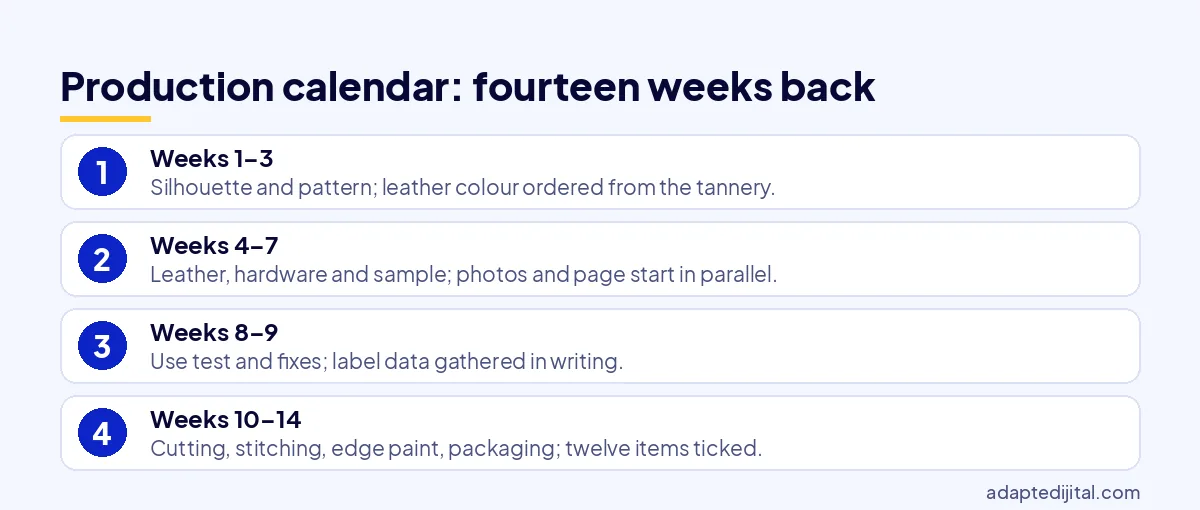
Production runs ten to fourteen weeks from pattern to first batch: two to three weeks for silhouette and pattern, three to four for leather, hardware and sample, one to two for use testing, four to five for cutting, stitching, edge paint and packaging. Pre-season rush stretches this, never shortens it. No launch date is announced before counting back.
Leather sourcing adds time
Colour and thickness are ordered from the tannery in Tuzla, and not every colour is in stock. Leather prices follow the exchange rate, so the workshop’s quote has a validity period, one of five contract clauses in choosing a workshop or contract manufacturer.
Work that does not wait for the batch
Photos, product page, care card and box start from the approved sample; only colour variants are shot later. The photo and site threshold is in the cost article, the twelve launch-week items in the launch checklist.
Label data is gathered at sample stage
Labels print with the batch, but their data is collected in writing earlier: leather type from the tannery, fibre content from the fabric supplier, nickel declaration from the hardware wholesaler. See labelling rules and inspections.
Calendar two: the season depends on the product group
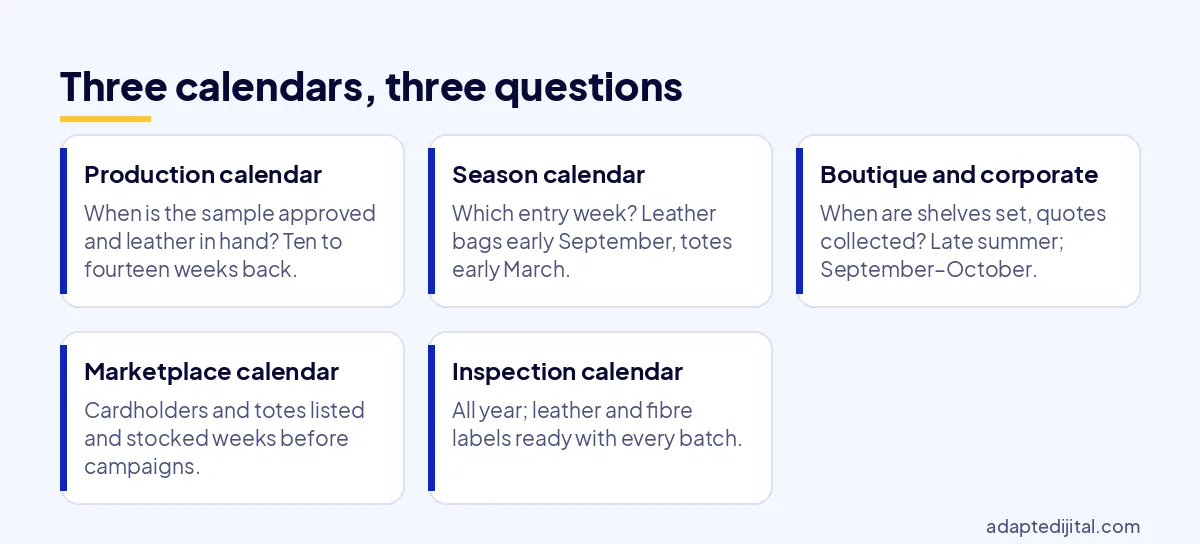
Bags follow spring-summer and autumn-winter rhythms, but a small brand’s calendar is set by product group. Leather hand and shoulder bags peak in autumn-winter and at year end; totes in spring-summer; backpacks and laptop bags at back-to-school; cardholders at Mother’s Day and year end; canvas bags at fairs and events. The season is the buyer’s calendar, not the wearer’s.
Product group, peak and entry week
The entry week is when the product must be on shelf and site before the peak; the batch must be in hand by then.
| Product group | Peak | Entry week | Main channel |
|---|---|---|---|
| Leather hand and shoulder bag | Autumn-winter; year-end gifts | Early September | Own site and boutique |
| Tote and canvas bag | Spring-summer | Early March | Own site and marketplace |
| Backpack and laptop bag | Back-to-school; September | Early August | Own site and marketplace |
| Wallet and cardholder | Mother’s Day, Valentine’s, year end | Four weeks before peak | Marketplace entry product and site |
| Canvas bag | Fairs and events; year end | Before the quote period | Corporate |
The marketplace campaign calendar
A cardholder or tote joining November sale days must be listed and stocked weeks ahead; dates come through the Trendyol seller panel. Why leather bags stay off marketplaces is in the three-channel comparison.
Calendar three: when do boutiques and corporate buyers choose?
Concept stores and independent boutiques set autumn-winter shelves in late summer and spring-summer shelves in February and March; your file must reach the owner first. Corporate buyers settle year-end gifts in September and October, approve samples in November and want delivery in early December. So a corporate batch stitched in November needs a sample approved in October.
Corporate and fair calendar
Promotional canvas bags follow the fair calendar. Corporate has no second season, only a ready quote file and a blank print area.
Three calendars stacked: how do you find the intersection week?
BU BÖLÜMÜN ÖZETİ
- Example: leather shoulder bag, site and boutique
- Example: backpack, site and marketplace
- Example: canvas bag and cardholder, corporate
Open a one-year table and mark the week the batch is in hand, the product group’s entry week, and the boutique or corporate buying week. The first week all three meet is launch week. If they never meet, production stays fixed; the season moves to the next peak or the channel shrinks. No batch is cut from an untested sample to catch a season.
Example: leather shoulder bag, site and boutique
Fourteen weeks’ production; entry early September; boutique shelves late August. The intersection is early September, so the sample is approved by mid-June and leather ordered in May.
Example: backpack, site and marketplace
Twelve weeks’ production; entry early August, plus two weeks for listing. Pattern by late April, sample approved by late May; a second batch for year end is cut in September.
Example: canvas bag and cardholder, corporate
Quote in September, sample approval in October, printing and stitching in November, delivery early December. No quote file in August means no corporate order this year; the channel changes, not the date.
What do early and late launches cost a bag brand?
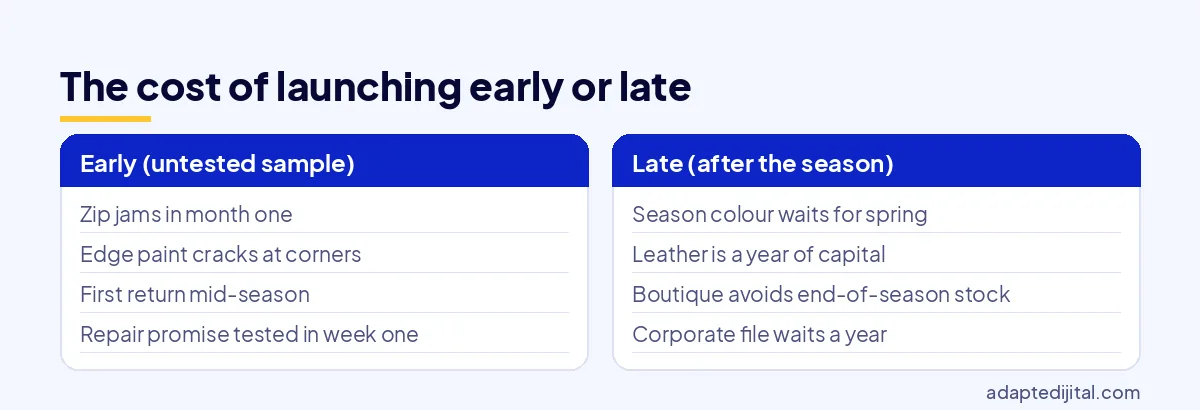
Launching early means an untested bag: the zip jams in month one, edge paint cracks, the first return lands mid-season. Launching late means a missed season; an autumn colour left until spring is a year of stock, and leather is waiting capital. The shared cost is trust: a boutique rarely takes end-of-season stock twice.
Patterns do not age, colours do
Black and brown keep; season colours lose value. Make the hero model in a permanent colour and variants in season colours, as in the method article.
Pre-order saves the calendar
Opening an approved-sample model on pre-order, lead time on the page, is the right way to enter a season without stock. A founder explains it in the architect’s studio story.
How does a bag brand build its calendar today?
BU BÖLÜMÜN ÖZETİ
- Know the inspection calendar
- Export closes earlier
- Next step
Answer three questions: when is my sample approved and leather in hand, which is my next entry week, and when do boutiques set shelves or corporates collect quotes? Put the answers in one table; where they meet is your launch date, and the twelve-item list is ticked before announcing it. Building it together is brand consultancy work.
Know the inspection calendar
The Ministry of Trade runs market surveillance all year; see the Ministry of Trade page. Leather and fibre labels must be ready with every batch.
Export closes earlier
European online boutiques choose months before the home market. Where small-batch export is heading is in bag brands towards 2027; preparation falls under foreign trade consultancy.
Next step
The overall order is in the pillar article, your stage in the hub article, the sector picture in the bag brand sector guide. For your calendar, ask an expert.
Frequently Asked Questions
Quick Summary
- Launch where production, season and buying calendars meet.
- Production takes ten to fourteen weeks; count back, never shorten.
- Season follows product group: leather bags autumn-winter, totes spring-summer, backpacks back-to-school, cardholders gift days.
- Boutiques choose in late summer and February-March; corporates in September-October.
- No intersection: change the channel or date, never cut from an untested sample.
- In waiting stock the colour ages, not the pattern.
Short Glossary
- Intersection week: the first week when batch, season entry and buying period all align
- Entry week: the week a product must be on shelf and site before its peak
- Price validity period: how long a workshop’s quote holds while leather prices move
- Shelf setting: when boutiques choose new-season products, weeks ahead of the season
Next Step
To stack the three calendars for your product group, write via ask an expert; scope is on the brand consultancy page. Next: six changes facing bag brands towards 2027.
Updated: October 2026
Sık Sorulan Sorular
At year end and Mother’s Day the gift share rises, and gift buyers see box, card and story first. Why people pay a small brand is in the four reasons article.
A month before shelves are set: capsule and scale photos, interior layout, consignment terms, repair promise, delivery time. The file opens the meeting, the bag closes it; terms are in own site, marketplace or boutique.
The approver checks print area, quantity tiers and lead time; the user checks fabric and stitching. See the buyer card in the photo-led method article and the quote file in the checklist.
Change the channel, not the date: your own site before a boutique, corporate next year. Why racing a season with twelve models stalls a founder is in the stuck leather bag brand case.
None fits all: early September for leather bags, early March for totes, early August for backpacks, four weeks before gift days for cardholders, matched to production.
Ten to fourteen weeks from pattern to first batch; leather sourcing and seasonal rush stretch it.
Boutiques in late summer and February-March; corporates in September-October, so the file is ready by late August.