
Why Does a Leather Bag Brand Stall at Its First Collection? Four Reasons from One Case
A leather bag brand stalls at its first collection not because the leather is poor but because the collection has no backbone. The bag in the basket needs few models with deep stock, photographs that carry half the product, the right comparison shelf, and a returns and care promise. Miss one and the bag gets liked while the collection does not sell.
A real brand’s first collection, no name, only observation: four reasons, what the founder sees and corrects under each, and one closing point: in leather bags, model count and sales move in opposite directions.
Say your bags are liked but the collection is not selling
Say you have an interior-architecture background, you launch twelve models, and a good Zeytinburnu workshop makes each one. Full-grain leather, even stitching, clean edge paint. Look closely: the problem is not the product. The collection maps the founder’s drawing board, not the buyer’s decision table.
What the founder sees
New models every season; each brings likes, sales stay put. Twelve models means a few pieces of each, and the most-asked-for model is out of the wanted colour. Shooting, page and stock work multiply; the till does not.
The unexpected finding
Two models bring most sales; the other ten together do not catch them. The founder sees it when she sorts the order list by model. The buyer chooses one bag, not a collection; twelve options postpone the choice.
Why people pay for a small bag brand is a separate case, in why people pay for small bag brands.
Reason one: too many models, too little depth
In leather bags the workshop minimum is low, and that convenience pushes the founder towards many models. Twelve models, one colour each, a few pieces per model: that is how the first batch spreads. The liked model sells out in a month and takes weeks to re-make; ten wait on the shelf.
The founder’s sentence
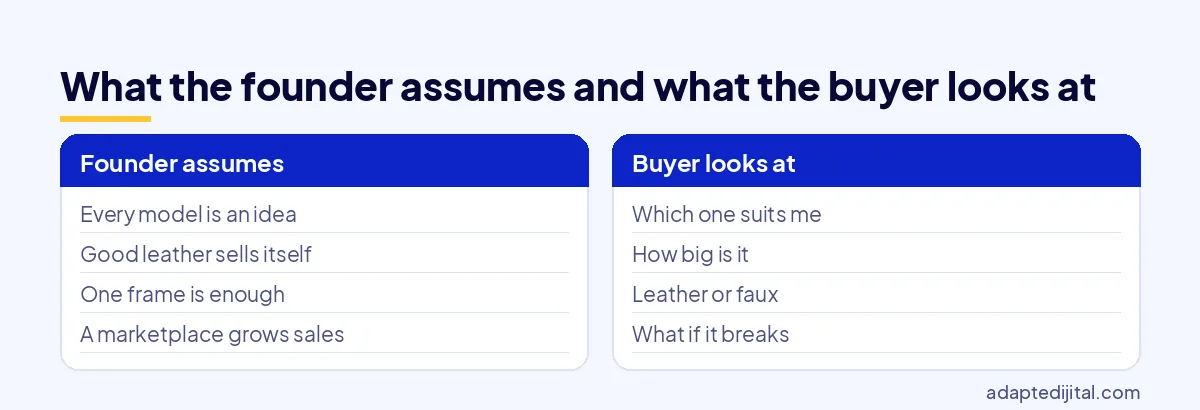
Every model is an idea and I want to show them all. That is the designer’s eye; the buyer sees only the bag that suits her. Many models feel like richness to the founder and indecision to the buyer.
The correction
Three models: a hero shoulder bag, an everyday tote and a card holder, each in two colours with enough pieces. The capsule is in the photography-first positioning method; the more-models-more-sales belief is taken apart in six things people get wrong about bag brands.
Reason two: the photograph is half the product, and that half is missing
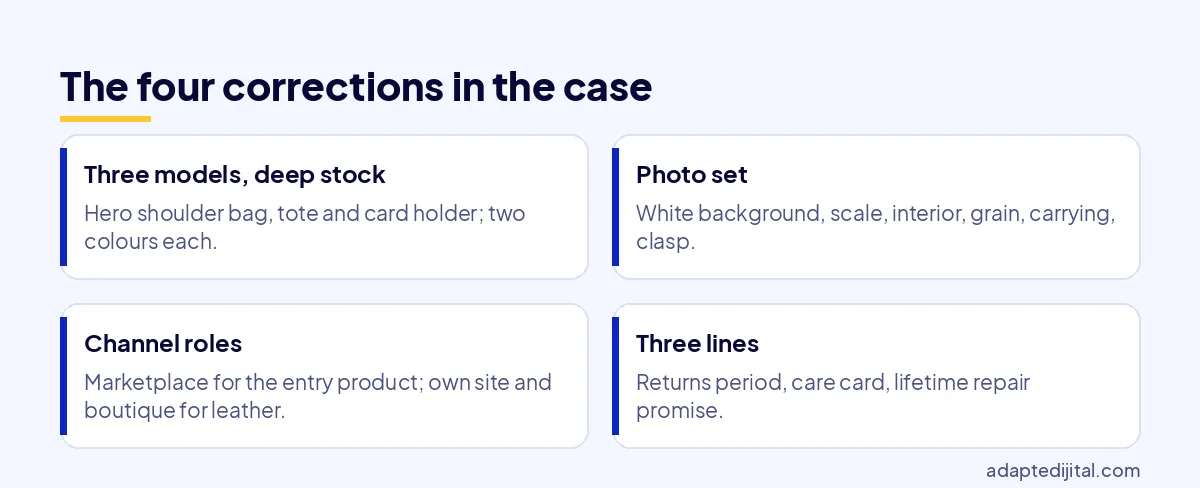
A bag is a visual product; on a screen the photograph is half of it. Here each model has one frame, a front view on white: no scale, no interior, no shoulder shot. The buyer cannot tell whether her phone fits, and she does not buy what she cannot work out.
The correction
A fixed set for every model: white background, scale shot, open interior, grain close-up, on the shoulder, edge paint and clasp close-up. It repeats on the product page and in the boutique file; the page itself belongs under website consulting.
The other side of photography
More photographs alone bring no sales; multiplying the wrong frame weighs the page down. The founder shoots ten angles and sales do not move. The frame that answers the buyer’s question changes sales, not the frame count.
Reason three: the wrong comparison shelf
BU BÖLÜMÜN ÖZETİ
- What the founder sees
- The correction
- Source
To grow, the brand opens a marketplace store; a month later the result is near zero. Look at the listing: the leather bag sits in a small tile beside faux leather, and in a tile nobody picks out leather, only price. There the bag looks expensive; the shelf sets the comparison point, not the brand.
What the founder sees
The most-clicked product is the card holder; the hero bag never surfaces. Ads go on, clicks rise, sales do not. Buyers ask in reviews whether it is real leather, because leather-look products on the same page are sold as leather.
The correction
The marketplace keeps the card holder and textile tote; leather bags move to the brand’s website and a Karaköy concept store. The store’s job becomes a first meeting through the entry product. Channels are compared in own site, marketplace or boutique for a bag brand; the marketplace side in real profit after commission on Trendyol.
Source
Seller rules sit on the Trendyol seller page; genuine versus faux leather is explained in genuine leather, faux leather and vegan leather explained.
Reason four: no returns and care promise
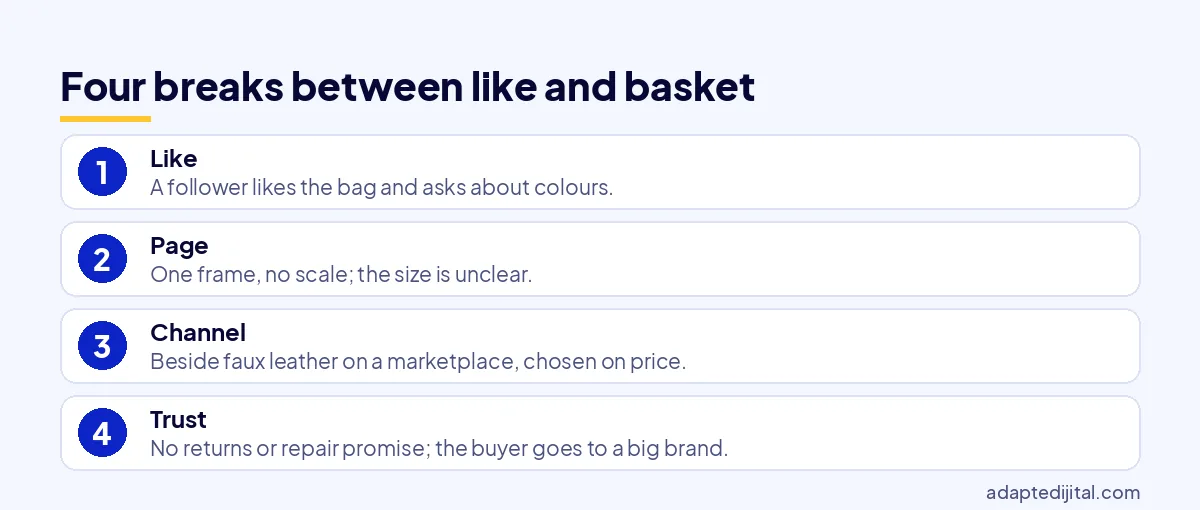
In the mid-to-upper segment the buyer pays for trust before the product. Here the page has no returns terms, no care card, no repair promise. She does not know what happens if the edge paint peels or whom to write to if the clasp breaks, so she goes to the big brand she recognises.
The correction
Three lines go onto the page: returns period, leather care card, lifetime repair promise. The same lines go onto the card in the box and into the boutique file. The loyalty a repair promise builds is in why people pay for small bag brands.
Where is the case today?
Today: three models, two colours, a card holder; own website as main channel, a consignment concept store second, the marketplace only for the card holder. Likes are unchanged; sales now move with them. Leather and workshop did not change; model count, photo set, channel roles and three lines did.
Model count and sales
In leather bags, the more models, the fewer the sales: stock spreads thin, photography multiplies, the decision gets harder. With fewer models the liked colour is in stock and the page tells one bag’s story. The inverse relationship is about attention, not product.
The cost in time
The four corrections take most of the first year; done from the start they fit one season. That is why the pillar article on starting a bag brand gives a decision order, not a drawing order.
The single observation
A leather bag brand sells on depth, not model count. Depth is four things: few models with enough stock, a photo set that carries half the product, the right comparison shelf, and a returns and repair promise, all built at the desk. With all four, three models sell; with one missing, twelve get liked.
Do this today
Sort your order list by model; if the first two carry most of the total, the rest are eating your depth. Then open your product page as a first-time visitor: scale shot, interior view, returns line?
Next step
To find your stage, the hub article on which consulting a bag brand needs; to narrow the collection together, the consult your expert form.
Frequently Asked Questions
Quick Summary
- A leather bag brand stalls for lack of a backbone, not because of the leather.
- The case: twelve models, many likes, few sales; two models carry most sales.
- Four corrections: three models, deep stock, fixed photo set, entry product only on the marketplace, returns and repair promise.
- The photograph is half the product; the frame that answers the buyer’s question changes sales.
- In leather bags, more models mean fewer sales.
Short Glossary
- Hero model: the single bag at the centre of the collection that gets most of the photography and story
- Scale shot: a photograph showing the bag’s real size against a familiar object or a body
- Comparison shelf: the shelf or listing where the buyer sees the product beside others while judging its price
- Stock depth: the pieces held in one model and colour; the opposite of variety
Next Step
To narrow your collection through the buyer’s eyes, write via the consult your expert form; scope on the brand consultancy page. Next: labelling rules and inspections for bag brands.
Updated: October 2026
Sık Sorulan Sorular
A follower likes the bag, asks about colours, tags a friend. She opens the product page, sees one photograph and a price, cannot judge the size, closes the tab. A like takes a second; a leather bag decision wants touch.
The founder holds the bag and knows its size, so she misses that the photograph does not say so. The buyer cannot touch the leather; touch comes from a scale shot, a grain close-up and a carrying shot.
The founder trusts her product; a returns line feels like weakness. The buyer reads the opposite: silence on returns means nobody stands behind the product. The small brand’s edge is reaching the founder and a repair promise; neither is on the page.
The designer draws, the workshop sews, the consultant builds the order; brand consultancy here set up capsule, photo set and channel roles independently of the workshop.
The leather is usually fine; the structure is missing: too many models with little stock, one photograph, faux leather comparison on a marketplace, no returns or repair promise.
Entry products such as card holders and textile totes, yes; mid-to-upper segment leather bags sit beside faux leather and get chosen on price. Main channels: own website and boutiques.
Few models, deep stock: one hero, one or two variants, one entry product. More models mean thinner stock, more photography and a harder decision.