
How to Start a Bag Brand in 9 Steps: From Pattern to Capsule Collection
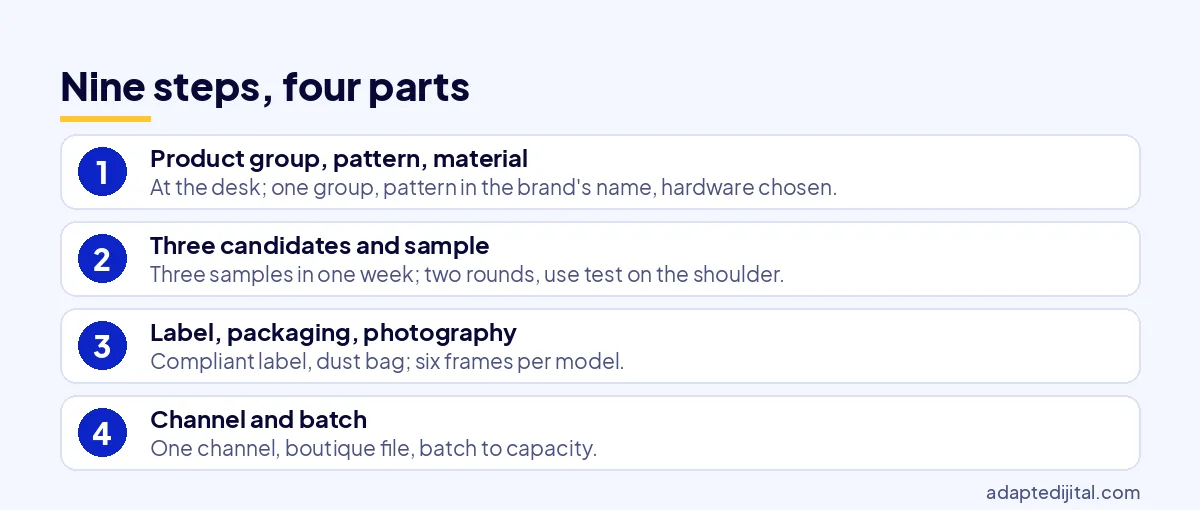
Nine steps: choose the product group, draw the silhouette and pattern, choose leather or fabric and hardware, find three workshop candidates, make and use-test a sample, prepare label and packaging, build the photo set and product page, open the first channel, produce the first batch. Pattern before leather, photograph before batch; the order does not change. Most steps happen at the desk.
At each step: what you hold at the end and which mistake is made most often. No figures, because cost depends on leather, workshop and quantity; outputs and mistakes do not change. The nine-row table is at the end.
Steps 1–2: product group, then silhouette and pattern
BU BÖLÜMÜN ÖZETİ
- 1. Choose the product group
- 2. Draw the silhouette and pattern
- Pattern ownership
The first two steps are done at the desk. One product group is chosen: leather handbags and shoulder bags, textile totes, backpacks and laptop bags, or small leather goods; silhouette and pattern are drawn for that group. Skip them and the workshop meeting is held for the wrong product.
1. Choose the product group
Output: a one-sentence product definition and a buyer card; user, payer, approver. Common mistake: launching a leather bag and a promotional cotton bag together; two groups want two channels. Framework: the pillar article on starting a bag brand.
2. Draw the silhouette and pattern
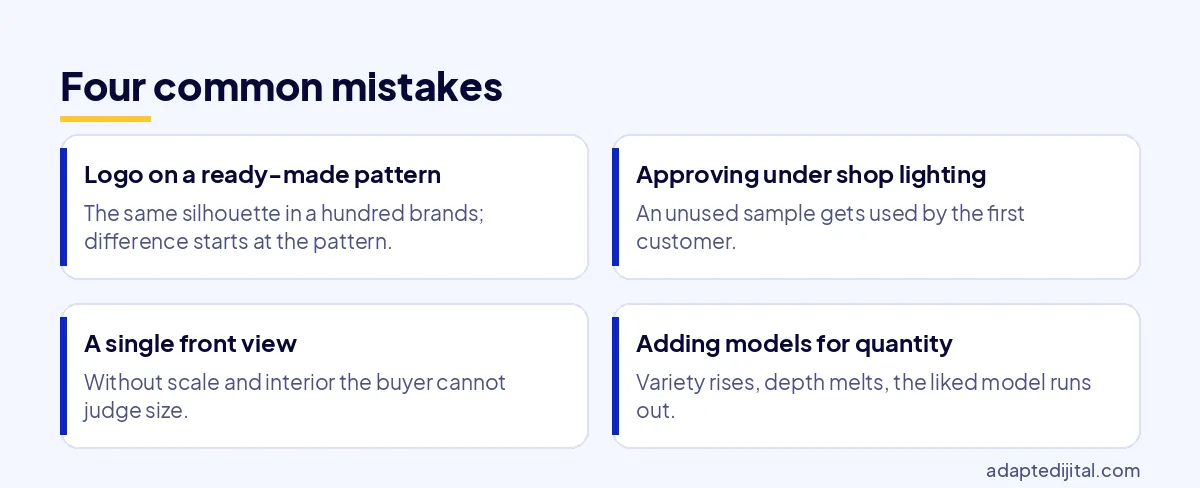
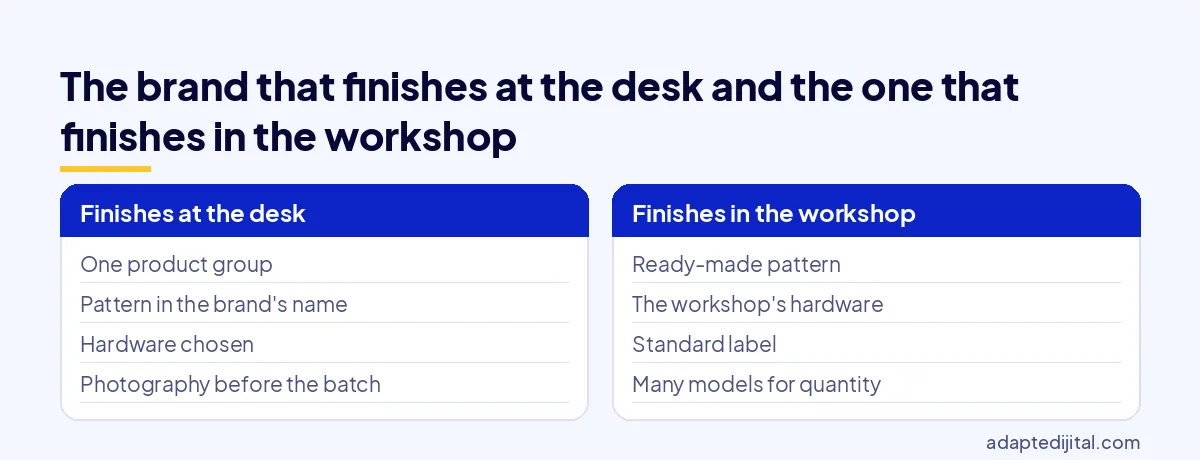
Output: technical drawing, size table and pattern file, usage rights held by the brand. Common mistake: a ready-made workshop pattern with a logo on it, the same silhouette a hundred brands carry.
Pattern ownership
The brand must own the pattern file; a pattern left at the workshop becomes another brand’s bag tomorrow. Ownership is established by contract, not by word; the pattern fee buys it.
Steps 3–4: leather, fabric and hardware, then three workshop candidates
Material is chosen before the workshop, because material determines the workshop: one that sews leather bags is expensive for canvas totes, and the reverse gives poor quality. Leather type, colour, clasps and zips are decided; then three candidates are asked for a sample in the same week. Done right, this shortens everything after.
3. Choose the leather, fabric and hardware
Output: leather type and colour card, hardware sample, supplier document list, and a note that leather prices move with exchange rates. Common mistake: hardware from the workshop’s stock; cheap hardware makes good leather look cheap.
4. Find three workshop candidates
Output: minimum quantity, pattern fee, pattern ownership, who sources the leather and the document list from each candidate, in one table. Common mistake: starting with the first workshop found. Questions: how to choose a workshop for bags.
Steps 5–6: sample and use test, then label and packaging
The sample is tested on the shoulder, not in the hand: two weeks of daily use, strap and stitching under full weight, zip opening and closing, edge paint under rubbing. The first sample is not approved; a second round is mandatory. Label after sample approval, packaging with the collection.
5. Make the sample and use-test it
Output: a signed-off sample and a written test note covering strap, zip, edge paint and whether the interior takes a phone and wallet. Common mistake: approving under shop-window lighting; the first customer then does the testing.
6. Prepare the label and packaging
Output: a label draft checked against the regulation, care card, dust bag and box design, packaging’s share of unit cost. Common mistake: the workshop’s standard label. Rules: labelling rules and inspections for bag brands.
Steps 7–8: photo set, product page and first channel
Photographs come before the first batch, because a bag sells on screen and the photograph tests what will be produced. A fixed set per model: white background, scale, interior, grain, carrying, clasp. One channel, chosen by product group: website and boutique for leather, marketplace for small leather goods and textiles, corporate proposal for cotton bags.
7. Build the photo set and product page
Output: six frames per model, size table, interior list, material declaration, care and returns terms. Common mistake: a single front view. The standard is listed in how Adapte Dijital positions a bag brand; the page falls under website consulting.
8. Open the first channel
Output: one channel, a boutique file or corporate proposal for it, consignment and returns terms. Common mistake: three channels on the same day. Comparison: own site, marketplace or boutique for a bag brand.
Step 9: the first batch
BU BÖLÜMÜN ÖZETİ
- 9. Produce the first batch
- The second-batch rule
- The calendar
The first batch is produced to channel capacity, not to a sales forecast: for one concept store and your own website, not for ten boutiques. Few models, deep stock; the capsule is three models and one entry product. The second batch follows the first channel’s turnover rate.
9. Produce the first batch
Output: a batch made to the approved sample, labels and dust bags fitted, a quality control note kept. Common mistake: adding models because the workshop minimum is low; that erodes stock depth, as the first-collection case shows.
The second-batch rule
The second batch grows on turnover, not forecast: bigger for the model that sells out fast, the same for the slow one. Cost lines and thresholds, without figures: the cost of starting a bag brand.
The calendar
Pattern to batch depends on the workshop and is counted backwards to the gift period; season and launch week: when should a bag brand launch.
The step-output-mistake table
The table shows, at a glance, the output of each step and the mistake made most often. No output means the step is not finished; a mistake made means the step repeats. Print it, take it to the workshop meeting and the hardware supplier, and tick each row for whether you hold its output.
The table
| Step | Output | Common mistake |
|---|---|---|
| 1 Product group | Definition, buyer card | Two groups at once |
| 2 Silhouette and pattern | Drawing, size table, own pattern | Logo on a ready-made pattern |
| 3 Leather, fabric, hardware | Colour card, hardware sample, documents | Hardware from workshop stock |
| 4 Three candidates | Candidate table: quantity, pattern, ownership | Starting with the first found |
| 5 Sample and test | Approved sample, written use note | Approving under shop lighting |
| 6 Label and packaging | Compliant label, care card, dust bag, box | Workshop’s standard label |
| 7 Photography and page | Six frames, sizes, interior, returns | A single front view |
| 8 First channel | One channel, boutique file or proposal | Three channels on one day |
| 9 First batch | Batch to capacity, quality note | Adding models for quantity |
Certificate and document trail
At steps three and six the tannery certificate, nickel report and dye declaration are requested in writing; tannery auditing: Leather Working Group. A certificate does not replace the label.
Nine steps on one page
Five steps at the desk, two in the workshop, two in the channel: product group, pattern, material, label and photography at the desk; sample and batch in the workshop; channel and boutique file outside. A brand that finishes in the workshop becomes one of a hundred cut from the same ready-made pattern.
Do this today
Print the nine rows and tick each for whether you hold its output. The first empty row is today’s job.
Next step
To fit the steps into your calendar, the consult your expert form; the final check: the 12-point checklist before a bag collection launch.
Frequently Asked Questions
Quick Summary
- Nine steps: product group, pattern, material and hardware, three candidates, sample, label and packaging, photography and page, channel, batch.
- The order does not change: pattern before leather, photography before the first batch.
- The pattern file in the brand’s name; ownership by contract, bought with the pattern fee.
- Two sample rounds, with a use test on the shoulder; never approved under shop lighting.
- The first batch to channel capacity; few models, deep stock.
Short Glossary
- Use test: trying a sample’s strap, stitching, zip and edge paint in daily use under full weight
- Pattern: the technical file giving the cutting dimensions of a bag’s parts and defining its silhouette
- Minimum quantity: the lowest production quantity a workshop or supplier accepts for an order
- Turnover rate: how quickly a model sells through in a channel
Next Step
To fit the nine steps into your calendar, write via the consult your expert form; scope on the brand consultancy page. Next: how Adapte Dijital positions a bag brand.
Updated: October 2026
Sık Sorulan Sorular
If the brand buys the leather, colour and quality control stay with the brand, and so does the wastage risk; if the workshop buys, the reverse. The contract states which applies.
The first round shows the pattern and the leather, the second whether the correction held. A brand that passes on one round lives the second in its first batch, where the difference costs a batch.
The brand owner; the workshop’s list is not your list. Order and calendar: brand consultancy; your stage: which consulting a bag brand needs.
Nine: product group, silhouette and pattern, leather and hardware, three workshop candidates, sample and use test, label and packaging, photography and page, first channel, first batch.
As big as the channel you open can take; few models, deep stock. The second batch follows the first channel’s turnover.
The first shows pattern and leather, the second whether the correction held; the use test is completed in the second round, on the shoulder, under full weight.