
I Want to Start a Bag Brand: Plenty of Workshops, Few Brands — Where to Begin?
The first thing to know about starting a bag brand: in Istanbul, getting a bag made is easy and building a brand is hard. Leather in Tuzla, a workshop in Zeytinburnu, hardware in Tahtakale: all found within a week, and you start with a few dozen pieces. The hard part is explaining why a buyer should pick your bag out of a hundred workshops cutting the same leather. That answer lives in pattern, leather, hardware, stitching, interior and photograph, not in the workshop.
This article gives the decision order: why bags, workshops versus brands, where you differentiate, product group, capsule, workshop and label, channels, calendar, when to bring in a consultant. Seventeen supporting articles open each step. The industry side sits in the starting a bag brand industry guide; here we are on the decision side.
I look at this as a brand consultant, not a workshop owner. A workshop talks about its leather and patterns; I ask about your buyer. The founder who grasps that early saves their first collection.
Why is a bag brand a business worth starting?
A bag is a visual product bought with the eyes, and Turkey produces both leather and craftsmanship at home. Being visual makes the photograph half the product; the leather cluster puts samples and suppliers within reach. Add per-piece workshop pricing, and a door opens for the small founder.
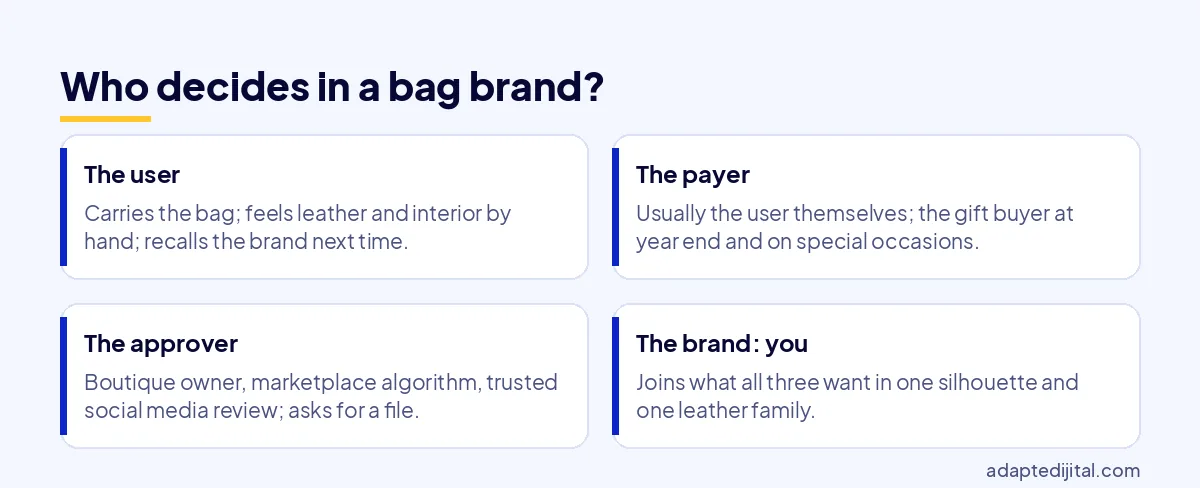
The three-part buyer chain
User, payer and approver. In bags the user usually pays too; the gift share rises at year end. The approver is a boutique owner, a marketplace algorithm or a trusted review; you cannot choose a model until you know which to convince first.
Why people pay for a small bag brand: a case in why people pay for small bag brands.
Plenty of workshops, few brands: where exactly is the problem?
The workshop does nothing special for you. The same leather, clasps and machines serve a hundred other founders. The founder prints a logo and cannot tell their bag from the neighbour’s in a shop window. Plenty of workshops is an advantage; on its own it builds no brand.
Do this
Before visiting a workshop, write one sentence: my bag differs from its rivals in these three ways. If it will not come, it is too early. Once written, the meeting shortens too.
The questions to ask a workshop: choosing a workshop or contract manufacturer for bags.
Where does a bag brand differentiate: pattern, leather, hardware, stitching, interior, photography
Differentiation happens at six points, and only some depend on the workshop. Silhouette and pattern are the founder’s; leather and colour are chosen with the tannery; hardware comes from the supplier; stitching and edge paint are the workshop’s; interior and photography are the brand’s alone. The map below sorts the six by who controls them.
The differentiation map
Six points, three hands; the hardest to copy are on the right.
| Differentiation point | Who controls it | Where it is decided | How easily copied |
|---|---|---|---|
| Silhouette and pattern | Founder | Drawing board | Hard, if you keep pattern ownership |
| Leather quality and colour | Founder and tannery | Tuzla | Medium; everyone reaches the same tannery |
| Hardware: clasps, zips | Founder and supplier | Tahtakale, Eminönü | Medium; custom hardware sets you apart |
| Stitching and edge paint | Workshop | Zeytinburnu workshop | Easy; everyone finds the same craftsman |
| Interior layout | Founder | Use testing | Hard; the buyer feels it in the hand |
| Photography and story | Founder | Studio and website | Hardest; nobody can shoot your story |
Differentiating in the wrong place
Most new brands try thicker leather and tighter stitching. These make a good bag, not a brand. We correct such misconceptions in six things people get wrong about bag brands.
Which product group do you start with: leather, textile, backpack, small leather goods?
BU BÖLÜMÜN ÖZETİ
- Leather handbags and shoulder bags
- Canvas totes and textile bags
- Backpacks and laptop bags
- Small leather goods: wallets and card holders
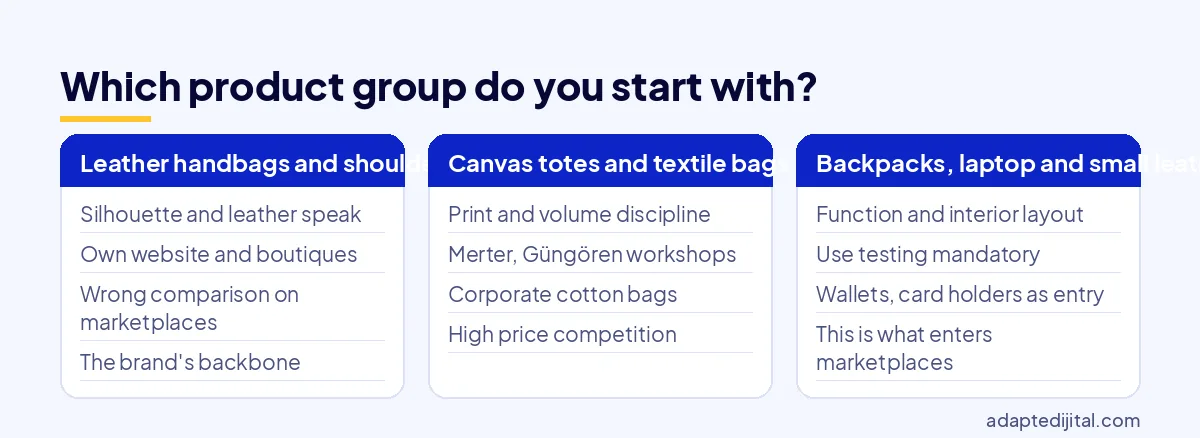
You start with one product group, chosen by the founder’s existing competence. Leather handbags call for silhouette and leather knowledge; canvas totes for print and volume; backpacks for function and interior; wallets and card holders are the low-risk entry product. Open all four at once and you finish none.
Leather handbags and shoulder bags
The backbone, and the natural door for a founder from design or interior architecture. Own website and boutiques are the main channel; on a marketplace it meets faux leather and loses.
Canvas totes and textile bags
Print, fabric and volume; Merter and Güngören workshops sew them, corporate cotton bags included. Price competition is high; differentiation is limited to print and story.
Backpacks and laptop bags
They sell function: compartments, padding, comfort. Use testing is mandatory; no product page goes up before the interior is photographed. Back-to-school and office buyers arrive on separate calendars.
Small leather goods: wallets and card holders
The entry product: the same leather at a lower price, the one item that can also enter a marketplace. It first puts the hero bag’s leather into the buyer’s hand; usually the capsule’s fourth piece.
Cost lines and thresholds, as a structure without figures: the cost of starting a bag brand.
How do you build the first model and the capsule collection: the three-to-five rule
The first collection is three to five models, not twelve: one hero, two variants, one entry product, a colour variant if needed. The smaller the capsule, the deeper each model, the tighter the stock and the more photography concentrates. Many models bring fewer photographs and less stock per model, not more sales.
Capsule architecture
The hero carries the brand’s name; the variants are size or strap versions of the same silhouette; the entry product is a wallet or card holder in the same leather. All four share one leather and hardware family; details, with the photography standard, in how Adapte Dijital positions a bag brand.
Photography before product
The photography plan is made while the model is chosen, not after: white background, scale shot, interior and carrying shot, listed for every piece. A founder who shoots her own photographs: the founder’s story from an architect’s studio to a bag brand.
Workshop and label: when, and what do you ask for?
BU BÖLÜMÜN ÖZETİ
- Three candidates, one sample
- The label rule
- What a certificate is, and is not
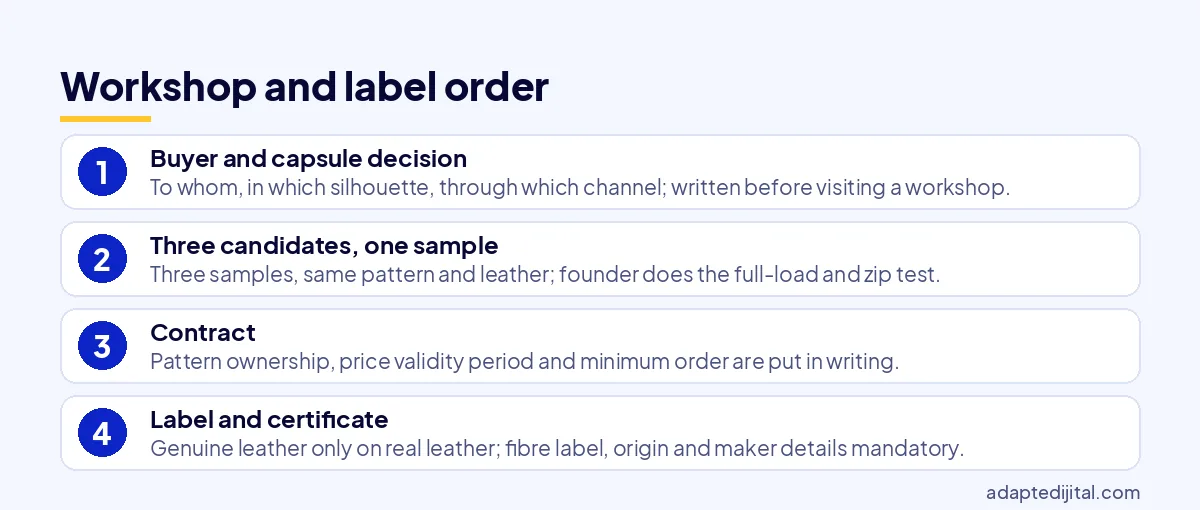
Look for a workshop after the buyer and capsule decisions: three candidates, one sample, one use test. The label is the rule, not a negotiation: genuine leather only on real leather, a fibre label on textile bags, origin and manufacturer on every product. The Ministry of Trade’s market surveillance publishes unsafe products. An unlabelled bag is a risk, not a brand.
Three candidates, one sample
Ask three workshops for a sample from the same pattern and leather. Test it yourself: carry it full, work the zip, check the edge paint at the fold. Write pattern ownership, price validity and minimum order into the contract, or your pattern appears in someone else’s window a year later.
The label rule
Genuine leather and the leather symbol require real leather; faux leather sold as leather is misleading advertising. Textile fibre labels are set by regulation in Turkey and by the textile labelling regulation in the EU. A product missing origin and manufacturer details is the first questioned in an inspection.
What a certificate is, and is not
Leather Working Group certifies tanneries and OEKO-TEX textiles; neither is issued in the brand’s name, but both are shown along the supply chain. Ask the supplier for the document before writing it on a product page. Nickel and azo dye checks: labelling rules and inspections for bag brands.
Genuine, faux and vegan leather, explained in the article on genuine, faux and vegan leather in bags.
How do you order the channels: own website, boutique, marketplace, corporate?
BU BÖLÜMÜN ÖZETİ
- Your own website
- Boutiques and concept stores
- Marketplace and corporate
Channels are ordered by product group, and the first year runs on one main channel. Leather bags start with own website and boutiques; small leather goods and textile bags enter marketplaces; corporate cotton bags are sold with a proposal file. A marketplace shelves leather next to faux leather; a boutique gives no volume.
Your own website
The main channel for leather bags: photography, story, dimensions and interior live here. The website side is covered under website consulting; here we only decide. Instagram is a shop window: discovery, not sales.
Boutiques and concept stores
Consignment, small volume, high visibility. Concept stores in Nişantaşı, Karaköy, Cihangir, Moda and Arnavutköy are a leather bag’s first window; the districts are mapped in starting a bag brand in Istanbul.
Marketplace and corporate
The marketplace is the entry door for wallets, card holders and textile bags; for leather bags the comparison is wrong. Corporate cotton bags and gift sets can close a season with one order. Six criteria: own site, marketplace or boutique.
What does the first-year calendar look like?
BU BÖLÜMÜN ÖZETİ
- The production calendar
- The season calendar
- The boutique and corporate calendar
- The pre-launch check
The first year is where three calendars meet: production, season, and the buying periods of boutiques and corporate clients. Pattern to sample to batch takes months; the year-end gift period must be ready by autumn; boutiques want the season’s collection months ahead. Overlay the three and the launch date comes from the intersection.
The production calendar
Drawing, pattern, sample, use test, correction, batch. Each step waits for the one before; a zip problem in the sample pushes the batch back a month. Count backwards from the launch date.
The season calendar
Spring-summer and autumn-winter, year-end gifts, Mother’s Day, back-to-school backpacks. Which group enters which week: when a bag brand should launch.
The boutique and corporate calendar
A boutique wants the new season’s file before the season; a company discusses year-end gifts in early autumn. If sample, photos and price list are not ready, both slip a season.
The pre-launch check
Product, label and packaging, digital, channel: twelve items in four groups, with countdown, in the 12-point checklist before a bag collection launch.
For a step-by-step build there is the guide to starting a bag brand in nine steps.
When does a bag brand need a consultant?
BU BÖLÜMÜN ÖZETİ
- The articles that follow
- Looking ahead
- If you want help
A consultant is needed before you find the workshop, not after, because every later decision is shaped by that workshop’s leather stock and habits. A brand consultant builds buyer, differentiation, capsule and channel order independently of the workshop. Today’s decision: which product group, which buyer, which channel.
The articles that follow
Which consulting at which stage: which consulting a bag brand needs; the industry’s figures, with sources: Turkey’s leather and bag industry in numbers.
Looking ahead
Material transparency, repair expectations and pre-order await the small brand; six changes awaiting bag brands towards 2027 gives one thing to do today for each. Neighbouring category: the guide to starting an underwear brand.
If you want help
To fill in the three blanks together, use the consult your expert form. Scope: the brand consultancy page; we stand beside the brand, not the workshop.
Frequently Asked Questions
Quick Summary
- In Istanbul getting a bag made is easy, building a brand is hard: plenty of workshops, few brands.
- Six differentiation points; what depends on the workshop gets copied.
- Start with one product group; sales data picks the second.
- First collection: three to five models, hero, two variants, entry product; photography planned with the model.
- Label is the rule: genuine leather only on real leather, fibre label on textiles, origin and manufacturer.
- Today’s decision: product group, buyer, channel; the workshop comes last.
Short Glossary
- Bag brand: a business that differentiates a product from the same leather and workshop as everyone else through pattern, hardware, interior and photography, sold under its own name
- Differentiation map: a table showing whether founder, workshop or supplier controls each of six points, and where the founder should spend their energy
- Capsule collection: a first collection of three to five models: one hero, two variants, one entry product, from one leather and hardware family
- Pattern ownership: the contractual right that keeps the bag’s pattern with the brand, not the workshop
Next Step
First step: the consult your expert form; the scope is on the brand consultancy page. Next comes which consulting a bag brand needs.
Updated: October 2026
Sık Sorulan Sorular
The buyer sees the bag on a screen before holding it, reading leather, stitching and silhouette from the photograph. A bag brand sells an image and a story. A good bag with weak photography loses to an ordinary one with strong photography.
Tuzla Leather Organised Industrial Zone holds the tanneries; Kazlıçeşme in Zeytinburnu the garment tradition. İDMİB data shows leather goods as one of Turkey’s established export lines. Samples will not be your problem.
Workshops charge per piece: pattern and sample are priced separately, then a few dozen pieces are sewn, a low threshold next to the hundreds textiles demand. The price: high unit cost and leather that moves with exchange rates.
Labour: cutting, sewing, edge paint, assembly. It sews your pattern and your neighbour’s. That is its job; nothing to resent, something to plan for.
That finding a workshop means building a brand. What they found is a door anyone can find; the brand is built by the pattern, leather, hardware and photography choices made after walking through it.
The workshop row is open to your rivals; pattern, interior and photography are yours alone. Give most of your budget and time to the hard rows; competing on stitching is mistaking the craftsman everyone uses for your own.
Twelve models, three colours each, two pieces per colour: nothing has enough photographs or stock, and the buyer cannot tell which bag represents the brand. The case: why a leather bag brand stalls at its first collection.
No. Per-piece workshops are easy to find in Istanbul; standing out among a hundred cutting the same leather is hard. Labelling responsibility lies with the brand.
The one closest to the founder’s competence: leather handbags for design, canvas totes for print, backpacks for function. Wallets and card holders are every group’s entry product.
Three to five: one hero, two variants, one entry product. Twelve models mean fewer photographs and less stock each; the buyer cannot find the brand’s bag.
Real leather; faux leather sold as leather is misleading advertising. Textile bags also need a fibre label; every product needs origin and manufacturer details.
With difficulty. A marketplace shelves leather next to cheap faux leather and removes the frame that explains the price; start with own website and boutiques.
Builds buyer, differentiation, capsule and channel order independently of the workshop, orders label and certificates, and picks the launch date.