
Kitchenware Brand Basics: Granite, Ceramic, Steel and Cast Iron Explained
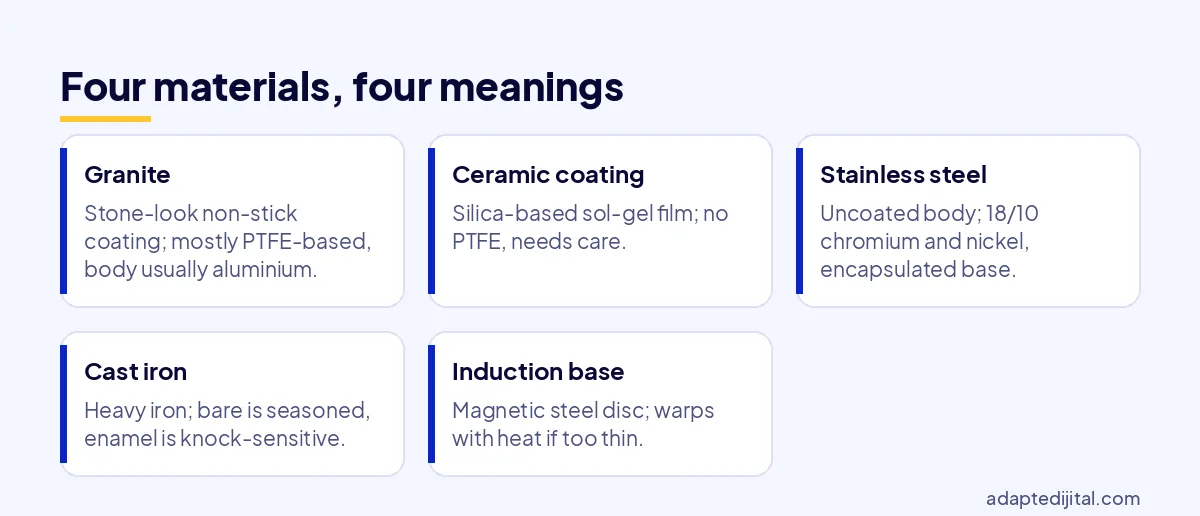
A granite pan is not stone; it is a stone-look non-stick coating, usually PTFE-based. Ceramic coating is a different, silica-based non-stick family without PTFE, stainless steel is an uncoated, long-lasting body, and cast iron is heavy iron that comes enamelled or bare. In short: the pretty name on the label describes the look, the material line describes what is inside.
A pan’s real story is in the small print on the back of the box. This article explains the four materials, the induction base and PFOA versus PTFE in plain words, then gives a 30-second pan check for any shelf.
Is a granite pan really granite?
BU BÖLÜMÜN ÖZETİ
- In plain words
- What it means for the brand
- Common confusion
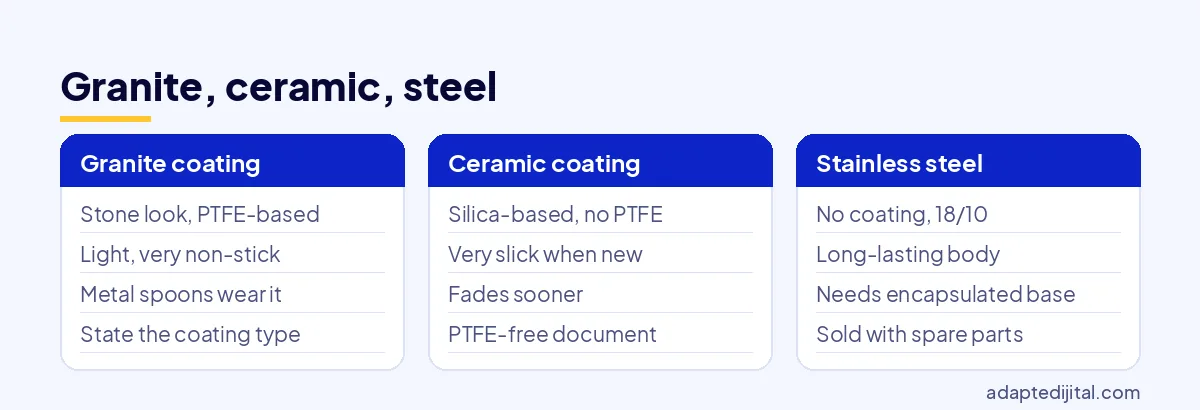
No. A granite pan usually has an aluminium body with a speckled, stone-look non-stick coating, mostly PTFE-based. The word describes the look, not the material. It is not a bad product, being light and non-stick; the problem is the impression that it is as tough as stone.
In plain words
Think of marble-pattern film on a worktop: it looks like marble until a knife reveals the chipboard. A granite coating is the same; the pattern is stone, the work is done by the non-stick layer.
What it means for the brand
Write granite-effect non-stick coating on the product page and ask the manufacturer in writing which coating it is; that question is on the list in the manufacturer selection article. Put the care line on the box; customers read it at their first complaint.
Common confusion
People assume more layers turn the pan into stone. A multi-layer coating may last longer, but high heat and metal spoons still wear it; use matters as much as layer count.
What is a ceramic coating and how does it differ from granite?
BU BÖLÜMÜN ÖZETİ
- In plain words
- What the label says
- What it means for the brand
A ceramic coating is a thin silica-based layer applied with a method called sol-gel; it contains no PTFE, so it appeals to customers looking for PTFE-free non-stick. The difference shows in use: it releases food very well when new, but its non-stick effect can fade faster than PTFE. A ceramic pot is not a ceramic coating: one is the body, the other a surface film.
In plain words
Like nail varnish: it gleams on day one and dulls a little each week under scourers. Treated well it lasts; treated roughly it tires early.
What the label says
Ceramic coating, sol-gel or PTFE-free. If it says ceramic pot, ask whether the body is ceramic or coated aluminium; they differ in care and price.
What it means for the brand
A PTFE-free claim is a promise and needs a document; keep it on file with the manufacturer’s declaration of compliance. We cover which documents are requested in the food contact material rules article.
What does 18/10 tell you about stainless steel?
18/10 describes the chromium and nickel content of stainless steel: roughly eighteen percent chromium and ten percent nickel. Chromium prevents rust, nickel adds shine and corrosion resistance. 18/10 is a good sign, but the base, wall thickness and handle fixing matter at least as much.
In plain words
Like a cake’s flour-to-sugar ratio: right ratio, wrong oven, and the cake still sinks. In steel, the oven is the base.
What it means for the brand
A steel pot’s long-life promise is sold with spare parts and a warranty; differentiation is mapped in the starting a kitchenware brand pillar article.
Cast iron: what do enamelled and bare mean?
BU BÖLÜMÜN ÖZETİ
- In plain words
- What it means for the brand
- Shipping note
Cast iron is heavy iron poured into a mould, and it holds heat for a long time. Bare cast iron is seasoned with oil, dried and oiled after washing, and rusts if neglected. Enamelled cast iron has a glass-based coating; it needs no seasoning and comes in colours, but the enamel can crack under a hard knock. Both last a lifetime, and both are heavy.
In plain words
Bare cast iron is a wooden bench: oil it yearly and it lasts generations. Enamel is a painted bench: no upkeep, but chips need care.
What it means for the brand
State the weight clearly on the page and the box. For bare cast iron, print seasoning instructions on the box; without them the first review says rusted.
Shipping note
Cast iron is heavy and enamel is fragile; packaging is built around both. How breakage enters the budget is in the cost of starting a kitchenware brand article.
Are PFOA and PTFE the same thing?
BU BÖLÜMÜN ÖZETİ
- In plain words
- Official source
- What it means for the brand
No, and this is the biggest confusion. PTFE is the non-stick coating itself; PFOA is a processing chemical once used to make PTFE and restricted today. A pan labelled PFOA-free is most likely still PTFE-coated. The label tells the truth, but customers often read it wrong.
In plain words
A sugar-free biscuit still has butter. PFOA-free is the same: that substance is absent, but the coating is still PTFE.
Official source
In Europe the scientific assessment of food contact materials is done by the EFSA food contact materials page. The lesson for a founder: whatever the claim, a document stands behind it.
What it means for the brand
If you write PFOA-free, keep its document; if you write PTFE-free, keep the document showing the coating really is ceramic. We list this confusion separately in the six myths about kitchenware brands article.
Why is the induction base the quietest line on the label?
Because customers only read it once the pan is on their hob. Induction heats only a base that holds a magnet, so aluminium pans get a steel disc and a small coil symbol. If the disc is thin or badly bonded, the base warps and the pan spins on the hob.
The magnet test
Stick a fridge magnet to the base: if it holds, it works on induction. One second closes the question behind most returns.
What it means for the brand
Test the sample base on an induction hob, at high heat, with the pan empty; if it warps, mass production does not start. The full sample test is in order in the nine-step brand guide.
The 30-second pan check
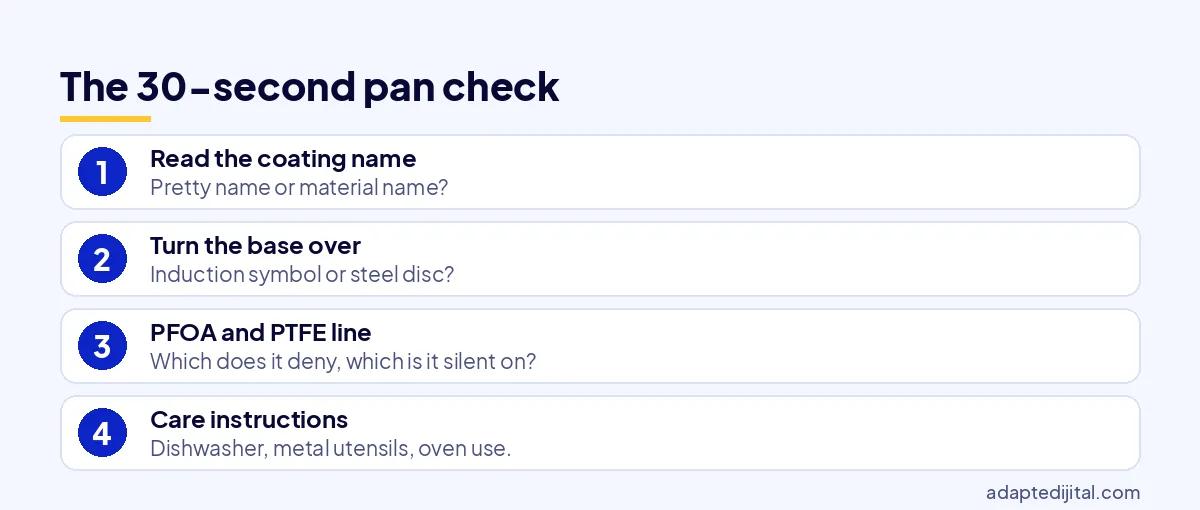
Read four lines: coating name, base mark, the PFOA and PTFE line, and care instructions. If it says granite, check the material; if it says PFOA-free, keep the PTFE question in mind; read the dishwasher line last. Nobody asks why you turned the box over.
Check: 30 seconds
- Read the coating name: granite, ceramic, steel, cast iron; is it a pretty name or a material name?
- Turn the base over: is there an induction symbol or a steel disc?
- Find the PFOA and PTFE line: which one does it deny, which one is it silent about?
- Read the care instructions: do they cover dishwasher, metal utensils and oven use?
On your own product
Run the check on your own sample first. An empty line is either a document to request or a sentence to print on the box.
Now you know
Granite is a look, ceramic coating is a PTFE-free film, 18/10 is a ratio, cast iron is heavy loyalty and the induction base is the door to return questions. PFOA-free does not mean PTFE-free. A founder who knows these words speaks the manufacturer’s language and writes the label correctly.
To do today
Run the check and the magnet test on three pans from your kitchen. Where label and pan match, that maker is a candidate.
Frequently Asked Questions
Quick Summary
- A granite pan is not stone; it is a stone-look, usually PTFE-based non-stick coating.
- Ceramic coating is silica-based and PTFE-free; its non-stick effect can fade faster.
- 18/10 is the chromium and nickel ratio of stainless steel; a good pot also needs a good base and wall thickness.
- Cast iron comes enamelled or bare; bare is seasoned, enamel is sensitive to knocks.
- PFOA-free does not mean PTFE-free; every claim needs a document.
- The 30-second check: coating name, base mark, PFOA and PTFE line, care instructions.
Short Glossary
- PTFE: the fluoropolymer behind most granite-style and similar non-stick coatings
- PFOA: a processing chemical once used to make PTFE and restricted today; its absence does not mean PTFE is absent
- Sol-gel: the method used to apply a ceramic coating as a thin silica-based film
- Encapsulated base: a base with an embedded aluminium or copper layer that spreads heat under a stainless steel pot
Next Step
To match every line on your label to the manufacturer’s language, write to us via consult your expert; the scope is on the brand consultancy page. Next up: how to choose a manufacturer for kitchenware.
Updated: October 2026
Sık Sorulan Sorular
Steel conducts heat slowly, so an aluminium or copper layer is sealed into the base. This encapsulated or sandwich base spreads heat evenly, so food does not burn in the middle.
The manufacturer supplies the coating words, the brand sets their order and tone; brand consultancy matches every label line to a document. The wider picture is in the kitchenware brand industry guide, your stage in the four gates by stage hub article, and to read your label together, consult your expert.
It is usually a PTFE-based non-stick pan covered by food contact rules; ask the manufacturer for documents behind its claims.
Ceramic is silica-based and PTFE-free; granite is stone-look and usually PTFE-based.
A chemical once used to make PTFE is absent; the coating may still be PTFE.