
Starting a Kitchenware Brand: Printing a Logo Is Easy, Standing Out Is Hard
The first thing anyone starting a kitchenware brand should know: printing a logo on a ready-made pot takes weeks, standing out takes years. The same granite-effect pot sits beside twenty brands on a marketplace, and buyers cannot tell them apart. The difference lies not in the logo but in an honest account of the coating, the base, the handle, the set design, warranty and spare parts, recipe content and packaging.
This piece gives the founder’s decision order, from why kitchenware to when to bring in a consultant; seventeen support articles open each step. The industry side sits in the kitchenware brand industry guide; here we stay on decisions.
I look at this as a brand consultant, not a manufacturer: a manufacturer talks mould and coating colour; I ask about your buyer and your promise. Founders who see this early do not leave their first batch in a warehouse.
Why is a kitchenware brand a business worth building?
BU BÖLÜMÜN ÖZETİ
- Every home, every day
- Dowry and gifts
- A production and export base
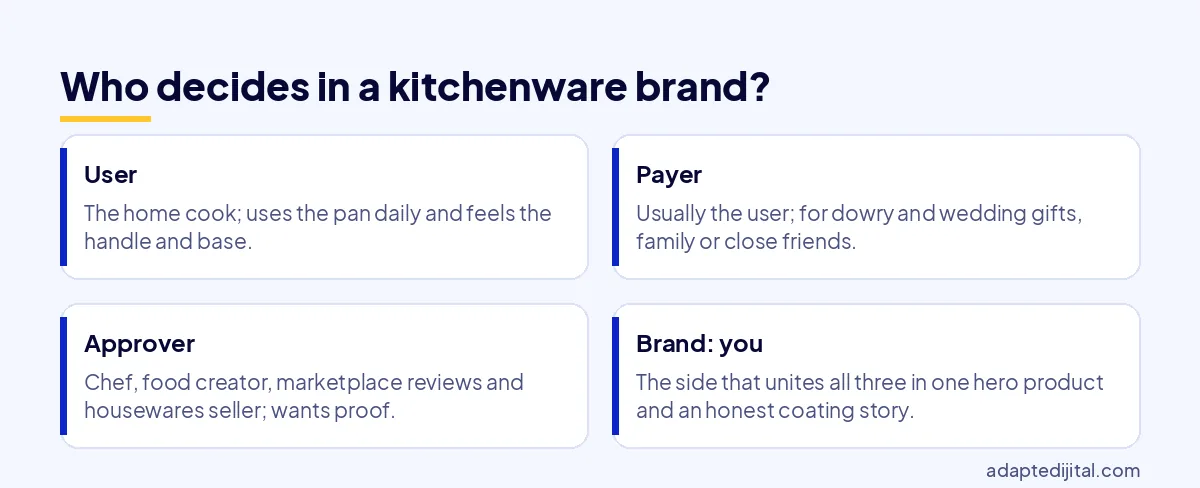
- A three-part buyer chain
Kitchenware is used every day in every home, it wears out and gets replaced, and people buy it both for themselves and as a gift. In Turkey the dowry tradition turns the kitchen set into a sales channel of its own. Production has a strong base too: pot, glass, porcelain and knife clusters are all in the country.
Every home, every day
Pots, pans, knives and storage containers wear out: coatings wear, handles loosen, lids break. Repeat purchase is the small brand’s door to a second sale.
Dowry and gifts
The dowry set is a Turkish channel of its own, and wedding and housewarming gifts share its shelf. The buyer here is often the payer, not the user, and the payer buys a careful box, a complete set and a trusted warranty.
A production and export base
Kayseri and Istanbul lead for pots and pans, the Kırklareli and Mersin line for glass, Kütahya and Bilecik for porcelain. You can read Turkey’s export picture by sector in TİM (Turkish Exporters Assembly) export data. Finding a manufacturer will not be your real problem.
A three-part buyer chain
The user cooks at home; the payer is the user or a family preparing a dowry; the approver is a chef, food creator, marketplace reviews or a housewares seller. Know which of the three to convince first before picking a product.
Why people switch to a small kitchen brand is shown through a case in why buyers move to small kitchenware brands.
Twenty brands from one mould: where exactly is the problem?
The problem is that the manufacturer makes nothing special for you. The same press mould, the same coating and the same handle serve twenty other founders. Without noticing, the founder prints a logo on the box and then cannot tell their pot apart from the neighbour’s on the marketplace. Private label ease is an advantage, but on its own it builds no part of a brand.
Do this
Before visiting a manufacturer, write this sentence: my pan differs from its rival in these three ways. If you cannot write it, it is too early to go.
Why twenty pots sold with the same photo disappear is shown in why kitchenware brands get lost on marketplaces.
Where does a kitchenware brand stand out: the differentiation map
Differentiation happens at seven points, and only some depend on the manufacturer. Honestly describing and documenting the coating is the founder’s job; the base and induction fit are chosen with the manufacturer; handle and lid ergonomics show up in use tests; set design, warranty, recipe content and packaging belong wholly to the brand.
Differentiation map
Seven points, three hands: founder, manufacturer, supplier. The points hardest to copy are in the last column.
| Point | Who controls it | Where it is decided | Copying it |
|---|---|---|---|
| Coating honesty and documents | Founder | Declaration of compliance, migration test | Hard; bare claims show |
| Base and induction fit | Founder and manufacturer | Sample and heat test | Medium; good bases are rare |
| Handle and lid ergonomics | Founder and supplier | Use test | Medium; custom handles differ |
| Body and coating colour | Manufacturer | Manufacturer catalogue | Easy; shared catalogue |
| Set design | Founder | Product plan | Hard; a set is an idea |
| Warranty and spare parts | Founder | After-sales setup | Hard; takes patience |
| Recipe content and packaging | Founder | Site, video, box | Hardest; your recipe is yours |
Standing out in the wrong place
Brighter colour and more pieces fill a window but do not make a brand. We correct myths such as granite pans being stone in six things people get wrong about kitchenware brands.
Which product group to start with: cookware, knives, storage or serveware?
BU BÖLÜMÜN ÖZETİ
- Cookware
- Knives and chopping boards
- Storage containers
- Serveware and textiles
Start with one group, chosen by the founder’s existing skill. Cookware needs material and coating knowledge; knives and chopping boards need craft and steel knowledge; storage containers need plastic and glass rules; serveware needs design and porcelain knowledge. Small electric appliances are a separate regulatory world and unsuitable as a first group. A brand that opens all four stays half-finished in all four.
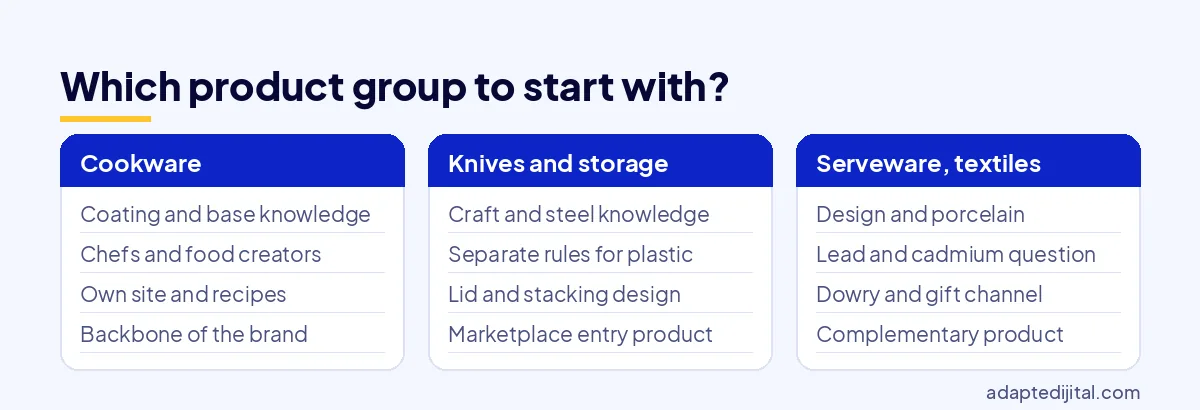
Cookware
Usually the backbone: a natural door for a chef or food creator who knows coatings and metals. We explain these coating terms plainly in granite, ceramic, steel and cast iron cookware explained.
Knives and chopping boards
These speak through craft, steel and handle material; the Yozgat Şahinkaya tradition and Istanbul workshops are the source. A chef’s approval is the strongest sales tool here.
Storage containers
Glass and plastic come with two separate rule sets; plastic has stricter migration testing and material rules. Differentiation lies in lid seals, stacking and size design.
Serveware and textiles
Porcelain and wood sell through design language; aprons and tea towels are complementary. This is the favourite group of the dowry and gift channel. With ceramics, the lead and cadmium release question is never skipped.
We lay out cost items and thresholds, as structure rather than figures, in the cost of starting a kitchenware brand.
How to design the first product and set: a hero pan and complements
The first collection is not a twenty-piece set but one hero product. The hero pan carries the brand name; two complements come from the same material and handle family; a dowry set follows only once the trio has proven itself. The fewer the pieces, the deeper each product’s testing, photos and content.
Set architecture
Hero pan; a pot and a saucepan or chopping board as complements; then the dowry set. All share one base logic and one handle language. We open this architecture, with a recipe content calendar, in how Adapte Dijital positions a kitchenware brand.
Recipes before the product
Three recipes cooked in the hero pan form the skeleton of the product page and video. Read the path of a chef who sells recipe and product together in from a chef’s kitchen to a cookware brand.
Manufacturer and documents: when to search, what to ask?
BU BÖLÜMÜN ÖZETİ
- Three candidates, one sample
- The document rule
- Claims need proof
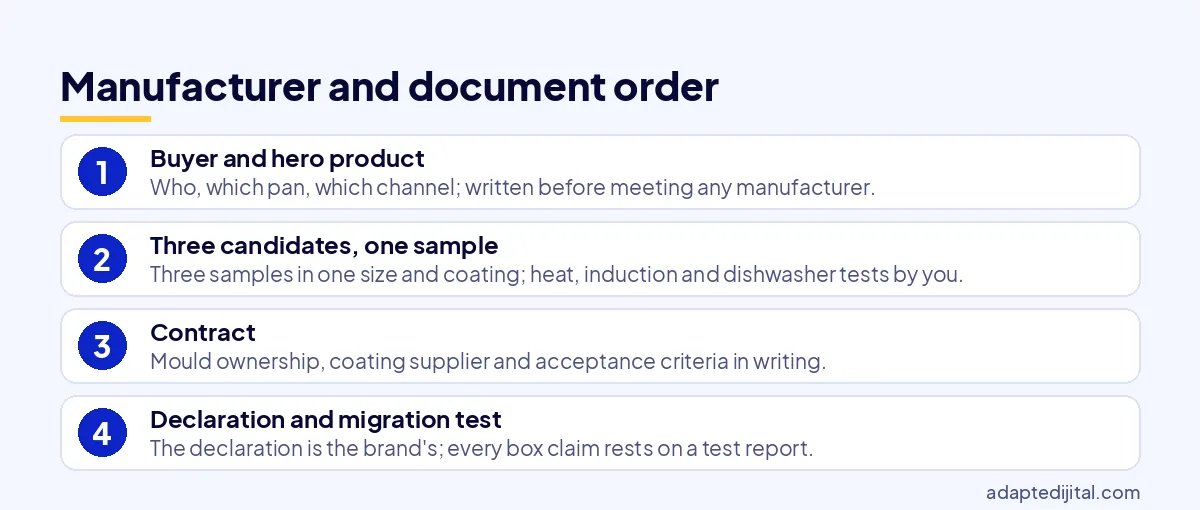
Look for a manufacturer after the buyer and hero product are decided; meet three candidates and decide on samples and use tests. Documents are not negotiable but a rule: every food contact material needs a declaration of compliance and a migration test, and that declaration is the brand’s responsibility. An undocumented pan is not a brand but a risk.
Three candidates, one sample
Ask three manufacturers for samples in the same size and coating. Run the use test yourself: high heat, sitting flat on induction, dishwasher, handle heat. Put mould ownership, the coating supplier’s name and acceptance criteria in the contract; the twelve questions are in choosing a manufacturer for kitchenware.
The document rule
In Turkey food contact materials fall under Ministry of Agriculture and Forestry regulation, and in the EU under a framework regulation. Plastics add material-specific rules; ceramics raise lead and cadmium release. We gather the documents inspectors ask for in food contact material rules.
Claims need proof
Every claim on the box rests on a document. If you write PFOA-free, you need the test report that shows it; and it does not mean PTFE-free. On product safety, follow Ministry of Trade announcements.
The nine steps from sample to first set are in order in how to start a kitchenware brand in nine steps.
How to order the channels: own site, marketplace, housewares shop, HoReCa?
BU BÖLÜMÜN ÖZETİ
- Own site
- Marketplace
- Housewares, dowry and HoReCa
Channels are ordered by product group and promise, and the first year runs on one main channel. The hero pan starts on your own site with recipe content; storage and textiles enter the marketplace as entry products; the dowry set talks in housewares and dowry shops; hotels and restaurants get a separate HoReCa offer file.
Own site
The coating document, base details, recipes and warranty are told in full here. The site side is its own world in website consulting; here we only make the decision.
Marketplace
It brings volume but drags you into price wars with same-mould rivals. Enter with a product that can bear comparison, not the hero pan. We compare four channels on six criteria in own site, marketplace or housewares shop.
Housewares, dowry and HoReCa
Housewares and dowry shops want a file: set list, documents, warranty, box. HoReCa wants durability and steady spare parts. We map the districts from Eminönü to Kadıköy in starting a kitchenware brand in Istanbul.
What does the first-year calendar of a kitchenware brand look like?
BU BÖLÜMÜN ÖZETİ
- Production calendar
- Season calendar
- Channel calendar
- Pre-launch check
The first year is where three calendars meet: production, season and channel. Going from sample to batch takes months, not weeks, because of testing and documents; dowry season leans on spring and summer weddings; housewares shops and marketplaces plan campaigns in advance. A founder who stacks the three calendars picks a launch date at their intersection, not at random.
Production calendar
Product decision, manufacturer, sample, use test, migration test and declaration, packaging, batch. If the base warps in sampling, the batch slips a month. So count back from the launch date, not forward.
Season calendar
Wedding and dowry season, the run-up to Ramadan and Eid, Mother’s Day, year end and the November sales period. We tabulate which group enters in which week in when a kitchenware brand should launch.
Channel calendar
Housewares and dowry shops order before the season; marketplaces announce campaign calendars early. If the sample, document file and photos are not ready that month, the channel slips a season.
Pre-launch check
Product, documents and packaging, digital, channel: twelve items in four groups. The list comes with a countdown in the pre-launch checklist for kitchenware.
When does a kitchenware brand need a consultant?
BU BÖLÜMÜN ÖZETİ
- What to read next
- Looking ahead
- If you want help
A consultant is needed before finding the manufacturer, not after. Once a manufacturer is found, every decision bends to their catalogue and mould. A brand consultant builds the buyer, differentiation points, set architecture and channel order independently of the manufacturer. The only decision today is this: which product group, which buyer, which channel.
What to read next
Which consulting to seek at which stage is covered through four doors in which consulting a kitchenware brand needs. Where to read sector data is sourced in Turkey’s kitchenware sector in numbers.
Looking ahead
Coating transparency, spare parts and recipe-led products are coming; six changes facing kitchenware brands towards 2027 gives today’s task for each. For document discipline, compare the cosmetics brand guide.
If you want help
To fill the three gaps together, write via the consult your expert form. The scope is on the brand consultancy page; in this work we stand with the brand, not the manufacturer.
Frequently Asked Questions
Quick Summary
- One mould yields twenty brands; a logo is easy, a kitchenware brand is hard.
- Of seven differentiation points, documents, set, warranty and recipes stay yours.
- Start with one group: cookware, knives, storage or serveware; electric appliances are not a first group.
- The first collection is one hero product and two complements; the dowry set comes later.
- The declaration of compliance and migration test are the brand’s responsibility; every claim on the box needs a document.
- Today’s only decision: which product group, which buyer, which channel; the manufacturer comes last.
Short Glossary
- Private label: a ready-made product sold under another brand’s name and packaging
- Differentiation map: a table of who controls seven differentiation points and where to spend energy
- Hero product: the single product that carries the brand name and the first sales and content; in kitchenware often a pan
- Declaration of compliance: a written statement by the party placing a food contact product on the market that it meets the relevant rules
Next Step
For those ready to fill the three gaps, the first step is the consult your expert form; the scope is on the brand consultancy page. To keep reading, next is which consulting a kitchenware brand needs.
Updated: October 2026
Sık Sorulan Sorular
The body, coating, handle and lid assembly. They print your logo and your neighbour’s. That is their job; plan around it.
Often that a private label deal means the brand is built. In fact they signed a door anyone can sign; the brand is built after it, through material, base, set and content decisions.
The manufacturer row is open to your rival. The coating document, set, warranty and recipe rows are yours alone. Put most of your budget and time into those hard rows; competing on body colour is like mistaking everyone’s catalogue for your own.
Each piece has its own size, lid and breakage risk. The buyer cannot see which piece represents the brand, and the founder cannot measure which one sells.
No. Finding a private label manufacturer is easy; the hard part is standing out among products from the same mould. Responsibility for the declaration of compliance and market surveillance lies with the brand that sells the product under its name.
The single group closest to the founder’s skill: chefs and food creators with cookware, craft-minded founders with knives, designers with serveware. Electric appliances are not a first group.
One hero product and two complements. The dowry set comes after the trio proves itself in sales; a crowded set means less care per piece.
A test report showing it. It does not mean PTFE-free; most granite-effect coatings are PTFE-based.
Yes, but not the hero product: a marketplace lines up same-mould products and strips the context that explains price. Send an entry product there instead.
Builds the buyer, differentiation points, set architecture and channel order independently of the manufacturer; orders the document process and picks the launch date where three calendars meet.