
Why Does a Kitchenware Brand Get Lost on Marketplaces? Four Causes From One Case
A kitchenware brand gets lost on a marketplace not because the pot is bad, but because nobody can tell it apart. A private-label granite-effect pot set shares its mould, coating and often its photo with rivals; seeing no difference beyond the logo, buyers look at price. A generic product, an unproven coating claim, no named contact and a single channel dissolve the brand into a price war.
This piece follows a real brand’s first year, unnamed: four causes, what the founder sees and the fix, around one observation: the same-photo problem.
Say your pot set is good but invisible in the listing
Say you are a founder with an e-commerce background. You buy a private-label granite-effect pot set from a manufacturer in İkitelli, print your logo on the box and open a marketplace store. The pot is heavy, the lid glass, the coating clean. The early problem is not the product but the listing: close to twenty brands sell the same set in the same shot.
What the founder sees
Ads bring clicks and a few sales, but the margin melts as price cuts follow price cuts. Three months on: sales, no profit, no remembered logo.
The unexpected finding
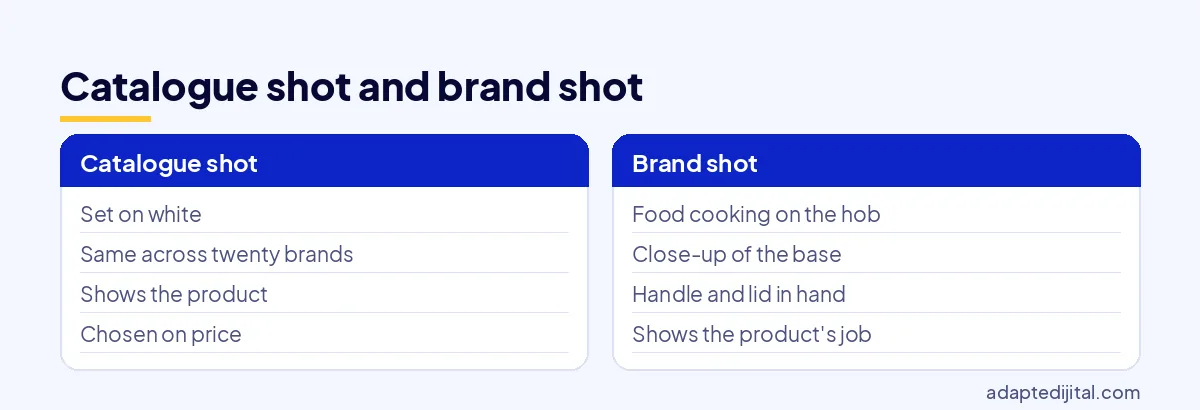
Opening rivals’ pages, the founder sees most product photos are identical, because they all come from the manufacturer’s catalogue. Buyers see one photo twenty times and rightly assume one product. We call this the same-photo problem.
Why people switch to a small kitchen brand is a separate case in our piece on why buyers switch to a small kitchen brand.
Cause one: a product that does not stand out
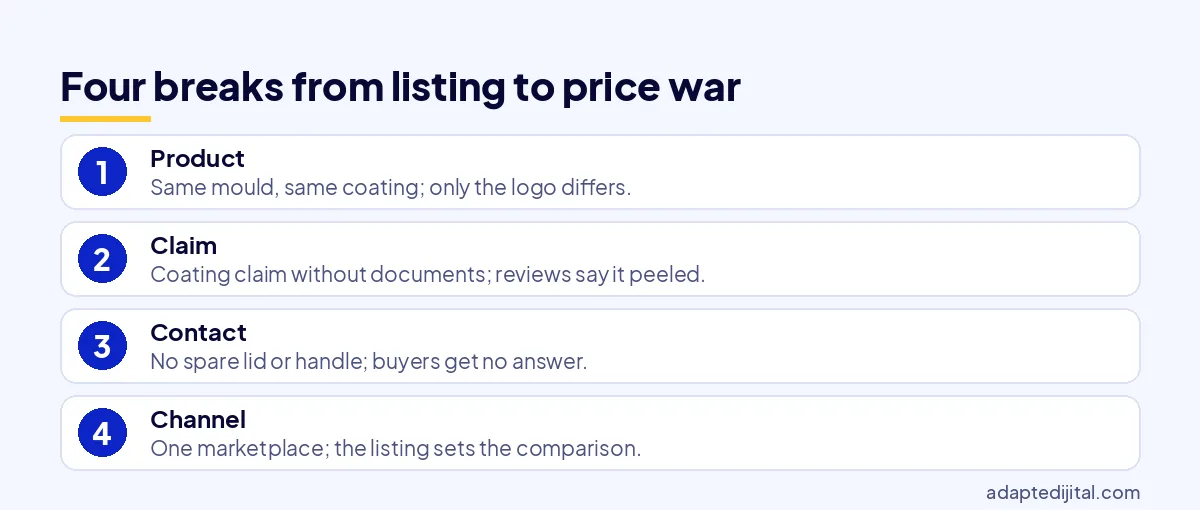
Private label is easy: a logo on a ready-made product takes a few weeks. The price of that ease is one mould going to twenty brands. Here base, handle, lid, coating and set configuration all match the competitors. The founder’s only difference is the box design, and the box is invisible in a marketplace thumbnail.
The founder’s belief
The product is good; the brand will make the difference. Half true: the brand must touch the product. A cool handle, an induction-safe base, a spare lid, a hero pan with recipes; without these, a logo is no difference.
The fix
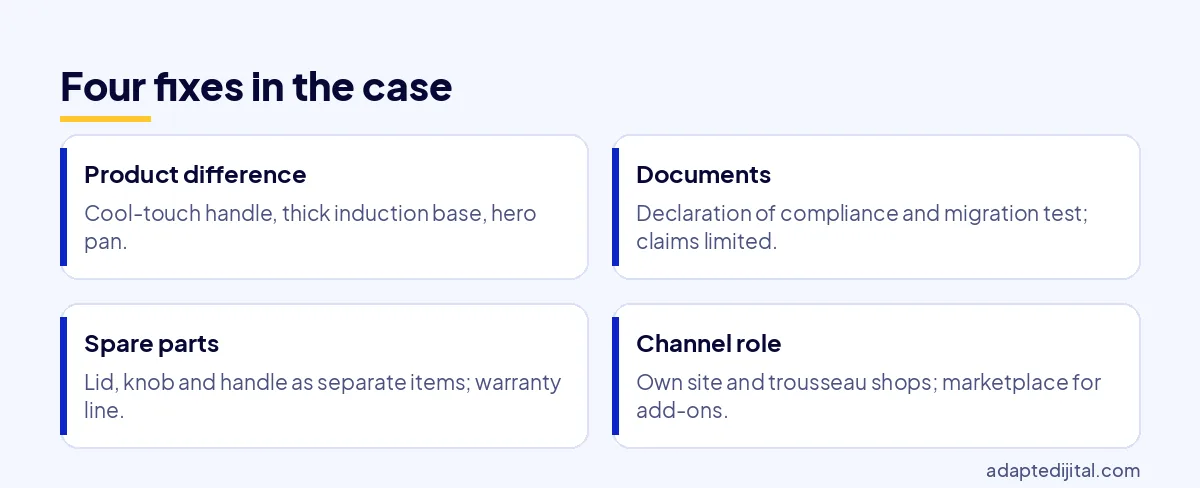
The founder picks one hero pan, adds a cool-touch handle and a thick induction-ready base. The differentiation map is in the I want to start a kitchenware brand pillar; asking a manufacturer for such changes is covered in how to choose a manufacturer for kitchen products.
Cause two: the coating claim has no proof
A few months in, reviews repeat one line: the coating came off. The page says granite coating, PFOA-free and healthy cooking, but the founder holds no document behind any of it. The buyer puts the review beside the claim and loses trust.
The fix
The founder requests the declaration of compliance and migration test report, limits claims to the documents and adds a care card to the box. The rules are in our piece on food contact material rules; the European side is on the EFSA food contact materials page.
Cause three: no warranty and no named contact
A lid knob breaks, a handle loosens; the buyer writes and gets no answer, because the founder has no spare parts and the manufacturer will not ship single pieces. A pot is used for years; buyers purchase someone to contact when it breaks, too. Without that, the next purchase goes to a big brand they know.
The fix
The next order lists lids, knobs and handles separately, and the page adds a warranty line. A buyer who gets a requested part gives the star back.
Cause four: a single channel
The brand sells only on the marketplace, so the listing’s rules decide everything: price, promotions, delivery, reviews. A marketplace gives volume, but the listing, not the brand, sets the comparison. The founder has no own site, no housewares or trousseau shop contact and no recipe content.
What the founder sees
Sales rise with promotions and fall after. The founder does not know the buyer: no email list, no repeat customers, no chef recommending the pan. Marketplace rules sit on the Trendyol seller page, and they are the platform’s rules, not the brand’s.
The fix
The marketplace stays with a new role: meeting buyers through complementary products. The hero pan moves to the own site and two trousseau shops. Channels are compared in own site, marketplace or housewares shop; marketplace setup is in real profit after commission.
What is the same-photo problem?
The same-photo problem is when brands selling a private-label product use the same manufacturer catalogue shot and cannot be told apart. Seeing one image under different logos, buyers assume one product and let price decide. The case’s clearest lesson: if the photo is not different, the product does not look different.
The observation
The week the founder’s own photos go live, clicks stay flat but time on page grows. In the new shot the pan is on the hob, food inside, handle in a hand. The catalogue shot shows the product; the new one shows its job.
A photo alone is not enough
A new photo is the first step, not the last. If the product is the same, buyers notice. A photo shows differentiation but does not create it.
Where is the case today?
Today the brand sells one hero pan and two complements: the own site is the main channel, two trousseau shops the second, the marketplace carries complements. Price is compared with the brand’s own page, not the cheapest card. The pot barely changed; handle, base, documents, spare parts, channel roles and photos did.
The time cost
The four fixes take most of the first year; done up front, they fit one season. That is why the kitchenware brand pillar gives a sequence of decisions, not products.
One observation and what to do today
A kitchenware brand stands out through a difference that touches the product, not a logo; without it, the marketplace pulls it into a price war. Before adding products, check four things: a distinctive feature, a proven coating claim, spare parts with a named contact and a second channel. Miss one and the listing swallows the brand.
Do this today
Search your marketplace category for your own product photo; if it appears under another logo, you have the same-photo problem. Then set each coating claim beside the document you hold.
Next step
To find your stage, see the hub on which consultancy a kitchenware brand needs; to choose your point of difference with us, use the consult your expert form.
Frequently Asked Questions
Quick Summary
- Kitchenware brands vanish on marketplaces because they cannot be told apart, not because the product is bad.
- Case: a private-label granite-effect pot set, about twenty look-alike rivals, a price war.
- Four causes: generic product, unproven coating claim, no warranty or contact, one channel.
- Same-photo problem: catalogue shots make brands indistinguishable except by logo.
- Fix order: product difference, documents, spare parts, second channel, then photos.
Short Glossary
- Private label: selling a manufacturer’s ready-made product under your own logo
- Hero product: the single product at the centre of the brand
- Comparison setting: the list or shelf where buyers compare products on price
- Declaration of compliance: a written statement that a food contact product meets the rules
Next Step
To find your point of difference with us, use the consult your expert form; scope is on the brand consultancy page. Next read: what food contact material rules mean for a kitchenware brand.
Updated: October 2026
Sık Sorulan Sorular
The buyer searches granite pot set and sees identical sets: same angle, colour and glass lids. Only logo and price differ, so the cheapest card wins.
Some complaints are misuse, some genuine coating faults. With no care guide and no coating data, the founder cannot tell them apart.
Granite suggests stone, so buyers expect a stone-hard surface. A granite-effect finish is usually a non-stick coating that needs care. When nobody closes that gap, reviews do; see what granite, ceramic, steel and cast iron mean in cookware.
A private-label order buys the set whole; lids, knobs and handles are not stocked separately. By the time the founder thinks of spares, the mould has moved to another brand’s order.
Three shots: food cooking on the hob, a base close-up, handle and lid in hand. None is in the catalogue. Showing product and recipe together is covered in how Adapte Dijital positions a kitchen brand.
The manufacturer makes the pot, the supplier the coating, the consultant sets the order; here brand consultancy builds the point of difference, document order and channel roles independently of the manufacturer.
Usually differentiation is missing, not quality: same mould, coating and catalogue photo. With no difference beyond the logo, buyers choose on price.
Yes, but a logo is not enough. Buyers need a tangible difference in handle, base, set, spare parts or recipes, and coating claims need documents.
Replace the catalogue shot with the product at work: food on the hob, base close-up, handle and lid in hand. A photo shows differentiation; it does not create it.