
Why Are People Switching to Small Kitchenware Brands? Four Reasons, One Cookware Case
People switch to small kitchenware brands for four reasons: trusting a brand that says plainly what is in the coating, buying the pan a trusted chef or food creator uses, being able to find a spare for a broken lid or loose handle, and giving a dowry set not everyone has. Price is not among them; the small brand costs more than the bazaar set and buyers know it.
This article follows an anonymous cookware brand that sells spare lids, in the present tense: who buys, why they pay, why they come back. The finding is unexpected; what turns the brand around is not a new set but selling a spare for a broken glass lid. Four reasons, one case, one principle at the end.
Say there is a cookware brand with no second orders
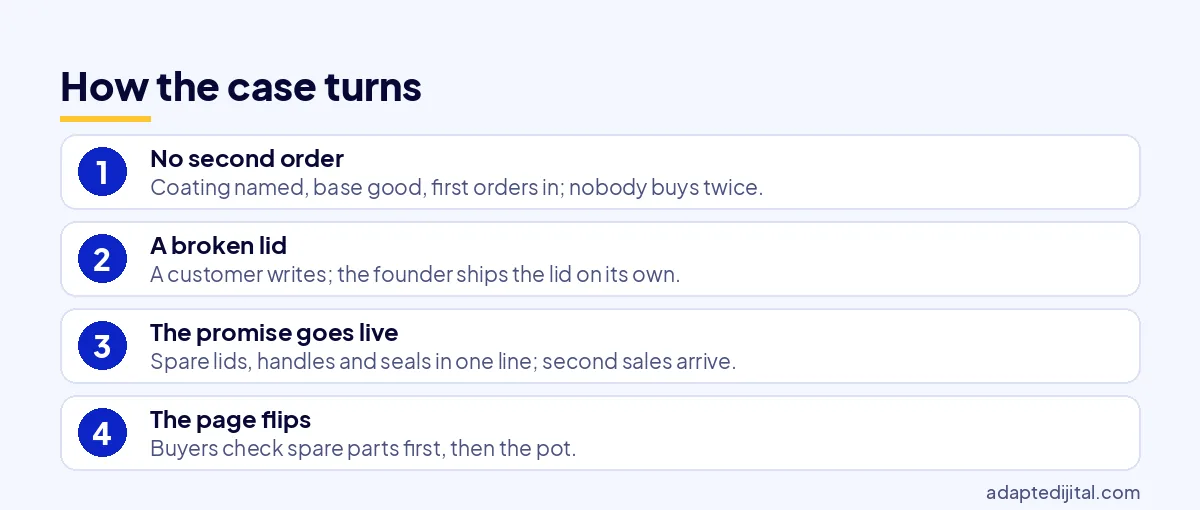
Say a cookware brand has good photos, a named coating and an induction base; first orders arrive, but nobody buys twice. As the founder sketches a new set, a customer writes: the glass lid broke, do I have to throw the pot away? The founder ships the lid on its own. One spare lid changes the brand’s whole question.
Unexpected finding
The founder adds one line to the product page: spare lids, handles and seals always on the site. First sales do not rise; second sales and referrals do. There were no second orders because the buyer was sold a pot, not a relationship.
Reason one: saying plainly what is in the coating
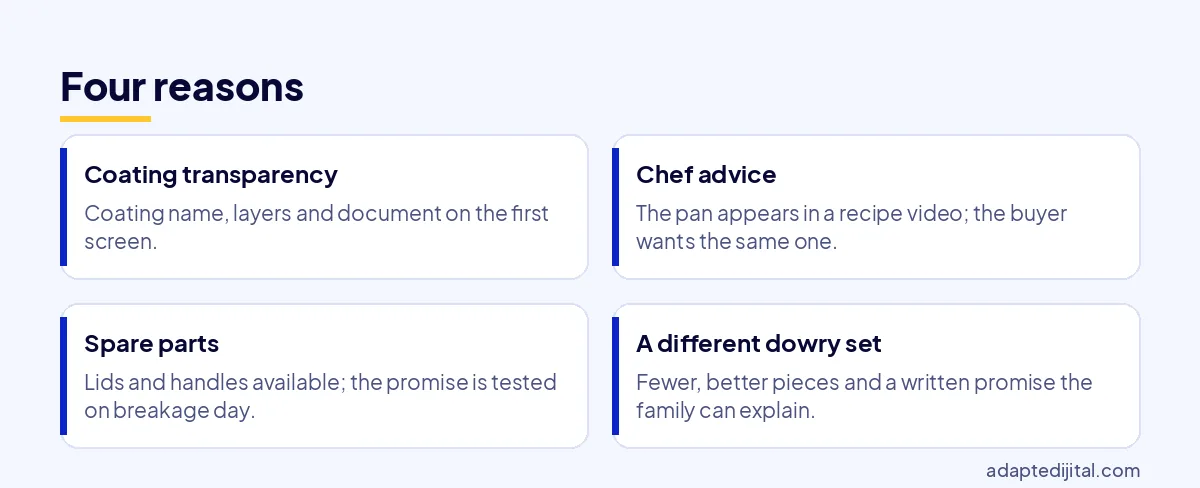
Buyers now ask one thing when choosing a pan: what is in this coating? Big brands often answer with a general line; a small brand can put the coating name, its layers and the declaration of compliance on the page. Transparency is the small brand’s cheapest way to stand out, and it works as long as the coating question is asked.
Check the source
In Europe, food contact material safety is assessed by EFSA (European Food Safety Authority); read that framework before writing any claim. What coating names mean in everyday terms is in the granite, ceramic, steel and cast iron article.
Principle for you
Write coating claims with a document behind them; no document, no claim. Unbacked lines get questioned in reviews; backed ones get repeated.
Reason two: chef and food creator recommendations
Buyers see the pan not in a shop but in a video by a chef or food creator they trust. There it is used with a recipe, nothing sticks, the handle holds, and the buyer wants the same pan. A small brand builds this more easily, because the founder can talk to the chef directly.
Unexpected finding
The most watched video is a short lid-changing clip; seeing the spare makes buying the pot easier.
Reason three: spare parts and warranty within reach
BU BÖLÜMÜN ÖZETİ
- What spare parts do
- Unexpected finding
- Principle for you
This is the case’s key observation: at a big brand the buyer reaches a call centre, at a small brand a person, and that person sends the lid. Spare parts bring not the first sale but the second, plus referrals, because the buyer tests the promise on the day the lid breaks, not the day it is made. We call this spare parts loyalty.
What spare parts do
| Promise | When the buyer tests it | What the brand gains | What it costs |
|---|---|---|---|
| Spare lid and handle | When a lid breaks or a handle loosens | Second sale, referral, shares | Small parts in stock |
| Clear warranty terms | At the first coating complaint | Better reviews, fewer returns | A review process |
| Direct message to the founder | In a pre-order question | Fewer hob and size returns | A few messages a day |
Unexpected finding
The spare parts page gets more visits than the hero pot’s page. Buyers check spares first, then the pot; backwards, but that is how sales come.
Principle for you
The promise is one line on the page, backed by a written maker agreement: lids, handles and seals in stock, mould owned by the brand. Contract clauses are in the manufacturer selection article.
Reason four: a different dowry set
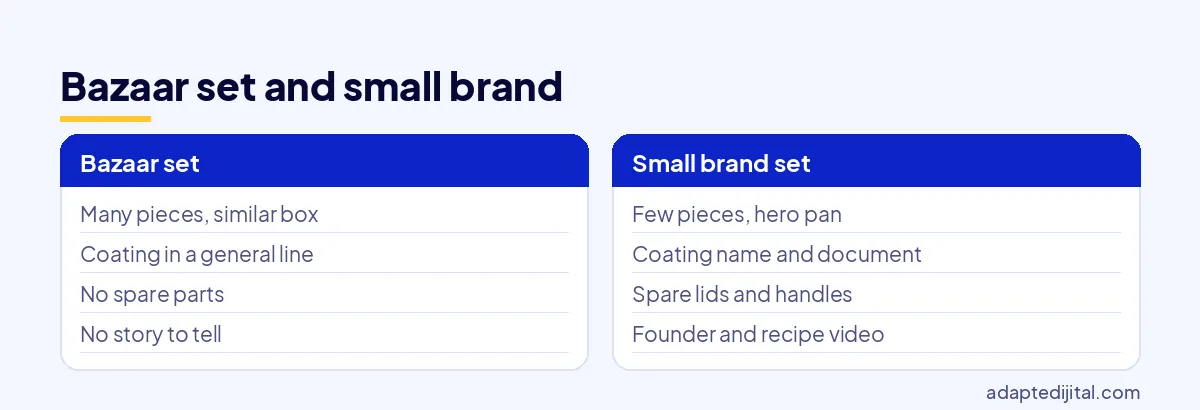
For a dowry, the family is not after the set everyone has but one they can talk about: who designed it, what it is made of, the warranty, whether spares exist. The bazaar set is crowded; a smaller, better set is easier to present as a gift. Dowry decisions are shared, and in a shared decision the explainable product wins.
What do the user, payer and approver look at?
In the kitchen the user and payer are often the same person, but in dowries and gifts they split. The approver is a third person: a chef, a marketplace review or a housewares seller. All three see the same pot from different angles and the brand must tell each a separate sentence; a brand with one sentence misses either the first sale or the second.
Three people
| Who | Looks at | Decides when | Brand says |
|---|---|---|---|
| User | Coating, base, handle, spares | First week and first breakage | Coating named, spares always there |
| Payer (dowry, gift) | Box, set contents, warranty | At the order | Few pieces, good set, written promise |
| Approver | Documents, video, reviews | When recommending or sharing | One document, one promise, one story |
Unexpected finding
The most shared photo is an old pot with its spare lid fitted. Where coating transparency and longevity expectations are heading is in the kitchenware brands towards 2027 article.
One principle
People pay a small kitchenware brand the first time for coating trust, chef advice and a different dowry set, and the second time for spare parts. A brand saying all four sells at a premium and lasts; one saying only photos and price collects likes but no second orders. The founder in the case learns this from one broken lid.
Do it today
Give your page’s first sentence to the coating and its second paragraph to spare parts. Then ask your maker whether lids and handles are in stock; if not, build stock first.
Next step
The overall order is in the pillar article, your stage in the hub article, scope on the brand consultancy page, and the first step is to talk to an expert.
Frequently Asked Questions
Quick Summary
- In the case, what turns the brand around is not a new set but a spare for a broken lid.
- Reason one is coating transparency, reason two chef and food creator recommendations.
- Reason three is spare parts, which bring the second sale and referrals; reason four is a different dowry set.
- User, payer and approver see the same pot from three angles; the page needs three sentences.
- One principle: people pay first for trust and difference, second for spare parts.
Short Glossary
- Spare parts loyalty: a buyer returning to the brand where they can find a spare lid, handle or seal
- Coating transparency: stating the coating’s name, layers and document plainly on the product page
- Hero product: the single product at the centre of the set that carries the brand, usually a pan
- Approver: a third party influencing the purchase: a chef, a review or a housewares seller
Next Step
To write the coating and spare parts promise together on one page, use the talk to an expert form; scope is on the brand consultancy page. Next up: six things people get wrong about kitchenware brands.
Updated: October 2026
Sık Sorulan Sorular
The customer posts the new lid: I did not bin the pot. The founder sees that the buyer wants not a pot but a brand they can reach when it breaks.
In year one the brand carries two of the four causes in the kitchenware brand lost on the marketplace: no warranty or named contact, and a single channel. The spare parts promise solves both at once.
A pan that does not stick, does not worry me and that I can explain. One line answers all of it: the coating name and its document, on the first screen.
The buyer watches the egg slide, not the logo. The founder shoots recipe videos and links the pan and its spare parts under each; selling recipe and product together is covered in the recipe-led positioning article.
A chef’s recommendation is a shop window, not a till; how window and site split the work is in the short video production guide.
The founder’s dowry set is the hero pan, one pot and a spare lid card with the promise printed inside. The family buys the set with the promise. Where dowry shops are is in the Istanbul local article.
The giver wants to say the pot will last for years; the spare parts promise makes that possible.
For four reasons: plain talk about the coating, chef and food creator recommendations, reachable spare parts and warranty, and a different dowry set. Price is not one of them.
It lifts the second sale and referrals rather than the first; buyers test the promise when the lid breaks and share the pot that lives on with its spare.
By being explainable: a coating document, a spare parts promise and a smaller, better set say what the crowded bazaar set cannot.