
Turkey’s Kitchenware Sector in Numbers: Where a Kitchenware Brand Finds Data

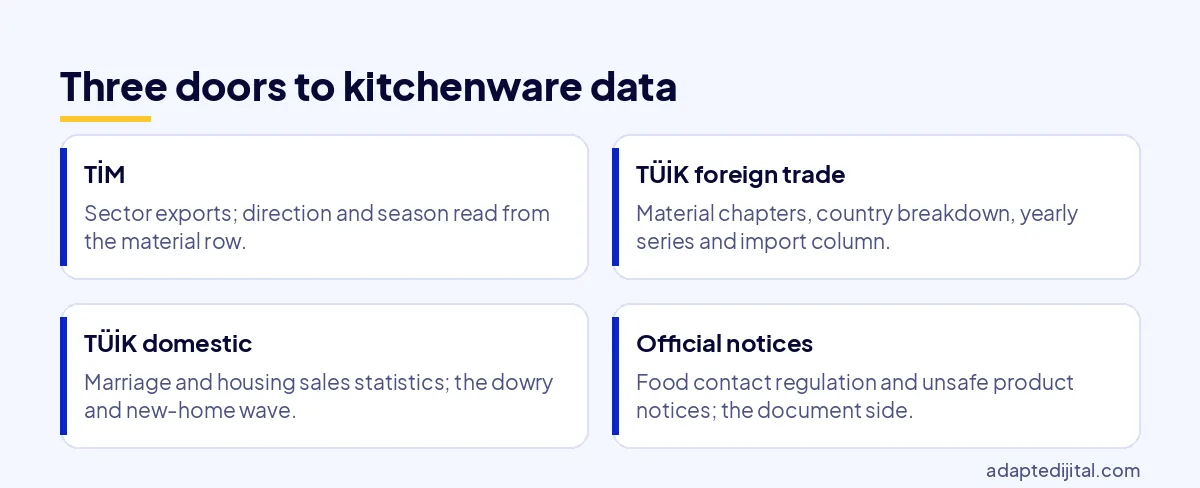
Data on Turkey’s kitchenware sector sits behind three doors: TİM (Turkish Exporters Assembly) sector export data, TÜİK (Turkish Statistical Institute) foreign trade statistics, and TÜİK’s housing and marriage statistics, which signal the domestic market. For a founder starting a kitchenware brand, the real question is not the figure but which table answers which question. Figures change every year; where the table sits does not.
Below: each source, the question it answers and the four decisions it yields. At the end is a data reading table: question, source, table, decision. We quote no amounts; the reader takes them from the source, up to date.
Where does kitchenware data sit: TİM, TÜİK and official notices?
Kitchenware does not sit in one row; it spreads by material. In TİM sector export tables, pots and pans appear under metal sectors, glass and porcelain under glass-ceramics, storage containers on the plastics side and small appliances under electrical and electronics. TÜİK foreign trade statistics list the same products by product code. Data on documents and inspection is in ministry notices.
Which question does TİM data answer for a kitchenware brand?
BU BÖLÜMÜN ÖZETİ
- The material row
- The monthly wave
- What not to do
TİM data answers one question: where does Turkey stand abroad in your material group, and which way is it heading? The sector table shows the sector’s share of the total, monthly swings and yearly change. The founder reads season and direction from it, not amounts. This is the first input to the manufacturer calendar and any export ambition.
The material row
Pots and pans, glass storage and porcelain plates sell on one shelf but are tracked in different TİM rows. We explain material differences plainly in granite, ceramic, steel and cast iron explained.
The monthly wave
Strong export months fill large manufacturers’ capacity. Time samples and first batches outside that wave and replies come faster.
What not to do
TİM tables do not give domestic market size; they show exports, not who buys pans in Turkey. The domestic signal comes in section four.
Which question does TÜİK foreign trade data answer?
BU BÖLÜMÜN ÖZETİ
- Country breakdown
- Import column
- Year-on-year
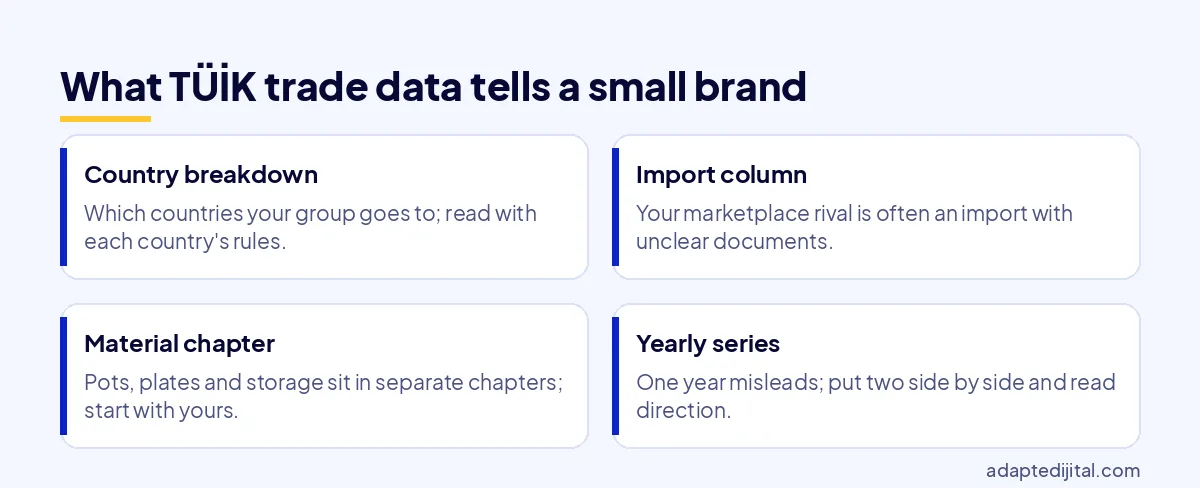
TÜİK data answers three questions: what happened over the years, which countries the product goes to, and is there import? In foreign trade statistics kitchenware spreads across material chapters: iron and steel ware, aluminium ware, ceramic and porcelain tableware, glassware, plastic household goods, cutlery. The founder reads direction from the country breakdown and rivals from the import column.
Country breakdown
The Middle East, Europe and the Caucasus are known directions for kitchenware; the TÜİK country breakdown shows which countries weigh most in your group. In Europe, food contact materials fall under the EU framework regulation 1935/2004.
Import column
Though Turkey is a strong producer, kitchenware imports are not zero; cheap pans, plastic storage and small appliances come in. The lesson: on marketplaces your comparison is often an import with unclear documents.
Year-on-year
A single year misleads; put two years side by side and read direction, not amount.
How small-batch export is changing is covered in six changes facing kitchenware brands towards 2027.
Where to read the domestic signal: dowry and housing
BU BÖLÜMÜN ÖZETİ
- Marriage statistics
- Housing sales statistics
- Marketplace signal
The domestic market has no single table; its signal is read indirectly. Kitchenware is bought with a new home and a new life, so two TÜİK series guide the founder: marriage statistics and housing sales statistics. The marriage series shows the dowry set wave; the housing series shows housewarming gifts and first kitchen purchases. Read months and direction, not figures.
Marriage statistics
The monthly spread of marriages is the dowry season calendar. Show the dowry set before weddings cluster. The season and entry-week table is in when a kitchenware brand should launch.
Housing sales statistics
New and resale home sales signal households setting up. A new home buys its first pot set, knife set and storage system together.
Marketplace signal
How crowded your group is on a marketplace shows in the seller panel’s category reports; source: Trendyol seller panel. Not official, but the fastest view of competition.
Where to read document and inspection data?
Document data is more rules than figures and sits behind three doors: Ministry of Agriculture and Forestry food contact material regulation, EU regulations and scientific opinions, and Ministry of Trade market surveillance notices. They show which documents are required and which groups inspectors target, feeding costs and the calendar.
National regulation
The regulation on food contact materials is on the Ministry of Agriculture and Forestry site. The declaration of compliance and migration test stem from it. We gather the three documents inspectors ask for in food contact material rules.
EU rules and scientific opinion
For plastics, EU regulation 10/2011 sets separate rules. Scientific opinions on coating and material safety are collected on the EFSA food contact materials page. Exporters follow both from day one.
Data reading table: question, source, table, decision
The table below links six founder questions to a source, a table to check and a resulting decision. The founder fills it once, writes the new figure into the same table each year and compares direction. Memorise where the table is, not the figure.
Table
| Founder’s question | Source | Table to check | Decision |
|---|---|---|---|
| Where does my material group stand? | TİM | Sector exports, material row | Product group: compete on documents, not catalogue |
| Which months are strong? | TİM | Monthly export series | Production: sample outside the wave |
| Which countries does it go to? | TÜİK | Foreign trade, country breakdown | Export: choose with the country’s rules |
| Are there imports, from where? | TÜİK | Import column of the same table | Price position: stand out with documents |
| When do dowry and new homes peak? | TÜİK | Marriage and housing sales statistics | Launch: before the dowry wave |
| Which documents are asked for? | Agriculture and Trade ministries | Regulation and unsafe product notices | Documents: declaration and migration test before launch |
How to use it
The table goes as one page into an investor deck or a manufacturer meeting. A founder quoting unsourced figures loses trust at the first question.
Which four decisions does a kitchenware brand draw from this data?
BU BÖLÜMÜN ÖZETİ
- Compete with documents and sets
- Calendar and documents
- Price position
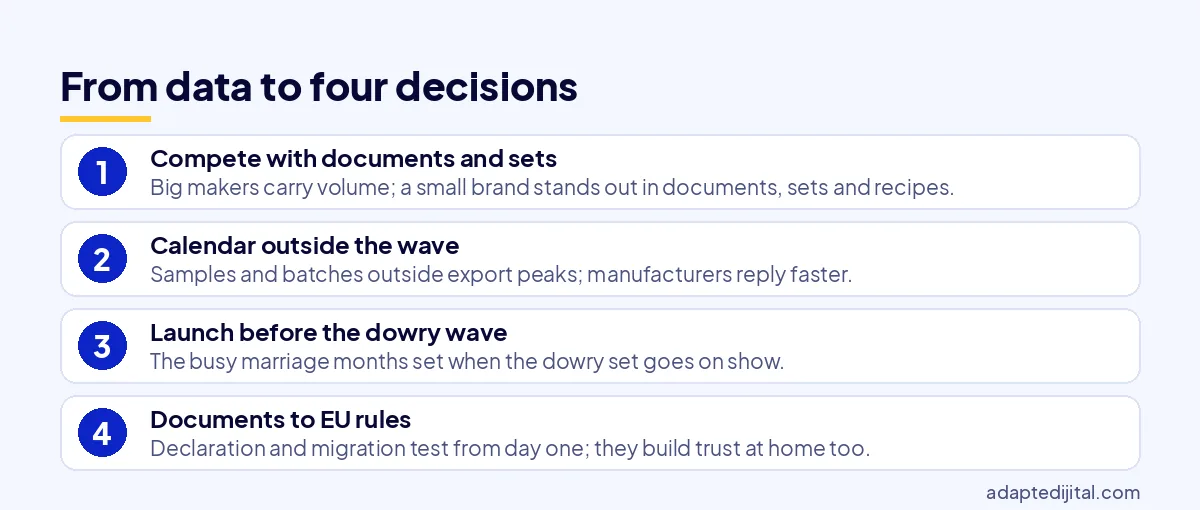
Data does not make the decision; it points its direction. Four decisions follow: compete with documents and sets, not the catalogue; time production outside the export wave; launch before the dowry and new-home wave; build documents to EU rules from the start. These four fill the first two of the four doors in which consulting a kitchenware brand needs.
Compete with documents and sets
A small brand stands out in the coating document, set design and recipe content. So the first budget goes to testing and content, not stock.
Calendar and documents
Samples and batches go outside the export wave; the launch goes ahead of the dowry wave. Ask for the declaration and migration test to EU rules from day one.
Price position
A price war on marketplaces with imports of unclear documentation is not a small brand’s game. The scope is on the brand consultancy page; to fit the data to your group, write via the consult your expert form. The wider picture is in the kitchenware brand industry guide.
Frequently Asked Questions
Quick Summary
- Kitchenware data sits in TİM sector exports, TÜİK foreign trade and TÜİK domestic series.
- Kitchenware spreads by material; the founder first finds their own material row.
- TİM shows direction and season; TÜİK shows countries, the yearly series and imports.
- Marriage and housing sales statistics signal the dowry and new-home wave.
- The document side is read from ministry regulation, EU regulations and surveillance notices.
- Memorise where the table is; refresh figures from the source each year.
Short Glossary
- Material chapter: a foreign trade classification grouping products by material, placing pots, plates and storage under different headings
- Sector export table: TİM’s monthly and yearly table of exports by sector row
- Domestic market signal: reading domestic demand indirectly from series such as marriages and housing sales
- Data reading table: a four-column worksheet linking the founder’s question to a source, a table and a decision
Next Step
To fit this table to your product group, write via the consult your expert form; the scope is on the brand consultancy page. Next up is why kitchenware brands get lost on marketplaces.
Updated: October 2026
Sık Sorulan Sorular
TİM publishes sector exports monthly and yearly. Source: TİM export data. The founder reads their material row’s direction and strong months.
TÜİK foreign trade statistics give products by code, broken down by country and year, with exports and imports side by side. Source: TÜİK data portal. The same portal carries housing sales and marriage statistics.
The Ministry of Trade periodically publishes market surveillance results and announces products found unsafe. Source: Ministry of Trade unsafe product notice. The founder reads which product groups stand out in inspections.
How data links to the founder’s decisions is set out in order in the pillar on starting a kitchenware brand.
In TİM sector export tables, in material chapters of TÜİK foreign trade statistics and, for the domestic market, in TÜİK marriage and housing sales statistics.
Because data is classified by material: pots as metal, plates as porcelain, storage as glass or plastic, small appliances as electrical goods.
There is no single official table; marriage and housing sales statistics show the direction of the dowry and new-home wave, and marketplace category reports show competitive density.