
Kitchenware Brand Launch Checklist: 12 Items Before the Set Is Ready for the Shelf
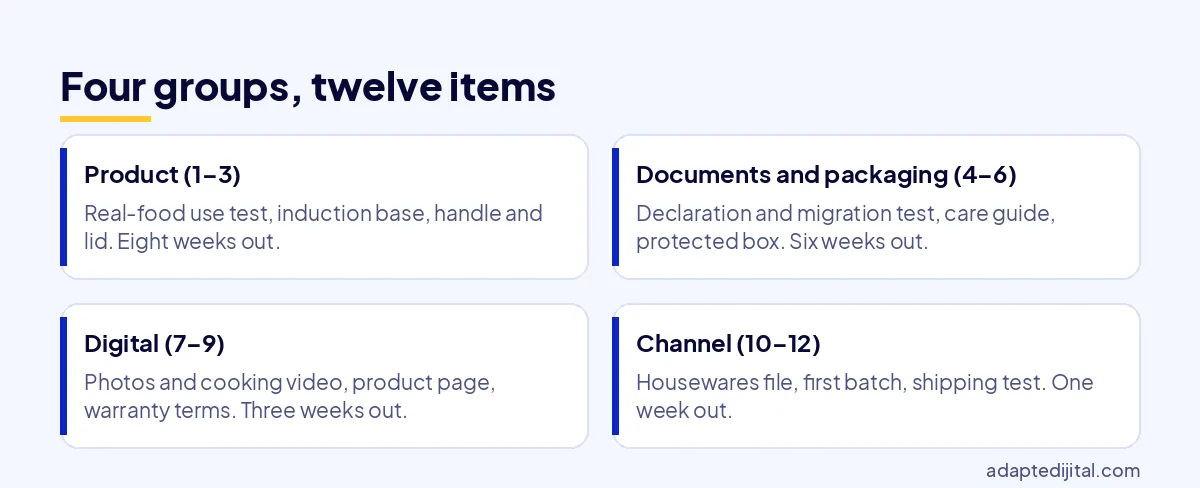
Before a kitchenware brand puts its first set on sale, it ticks twelve items: three for the product, three for documents and packaging, three digital and three for the channel. If one is missing, the launch waits; the date moves, not the set. For storage and serveware the tests change, not the order.
Each item below names who ticks it and what happens if it is missing, followed by an eight-week countdown and a printable list. Cookware touches food; a set missing its documents will not stay on the shelf.
Group 1: the product (three items)
BU BÖLÜMÜN ÖZETİ
- Item 1
- Item 2
- Item 3
- Common mistake
The use test ran in a real kitchen, the base sits flat on induction and does not warp when hot, and the handle and lid can be held while cooking. Peeling coating, a rocking base and a hot handle never show in a marketplace photo, but they show first in reviews. All three are settled at the sample stage, not the batch stage.
Item 1
Two weeks of real cooking: high-heat frying, eggs, sauces, dishwasher and hand washing. No scratches, no sticking, no discoloured rim. Ticked by the founder and a test cook; if missing, the batch is not approved.
Item 2
The base was tried on induction, gas and ceramic hobs; no bulging, warping or rocking. Ticked by the founder and the maker. If missing, base thickness or bonding changes; base and coating terms are in the granite, ceramic, steel and cast iron article.
Item 3
The handle stays cool enough to hold, the screw stays tight, the lid survives a drop. Ticked by the founder. If missing, handle material or fixing changes and the batch waits.
Common mistake
Running the use test with one dish on a new hob. Coating only tells the truth through repetition. Sample acceptance criteria and the three-candidate rule are in the manufacturer selection article.
Group 2: documents and packaging (three items)
BU BÖLÜMÜN ÖZETİ
- Item 4
- Item 5
- Item 6
The declaration of compliance is signed in the brand’s name and rests on a migration test report, the care guide is inside the box, and the packaging protects pot and lid in a courier drop. A pan without a declaration looks sellable but comes off the shelf at inspection; one without a guide comes back after the first wrong wash.
Item 4
The declaration is issued in the brand’s name, lists product group and materials, and rests on an accredited lab’s migration test report. Ceramics get a lead and cadmium line, plastics an EU 10/2011 line. Ticked by the founder; the framework is in the food contact material rules article, the official text is EU framework regulation 1935/2004.
Item 5
The care guide is ready: what to do before first use, which heat to cook on, whether metal spoons and the dishwasher are fine, how the warranty works. Same text in the box and on the page. Ticked by the founder; if missing, the first misuse becomes a coating complaint in the reviews.
Item 6
The box holds pot and lid in separate slots, glass lids and porcelain have corner protection, and a card carries the brand’s three words. The box passed a drop test. Ticked by founder and packager; if missing, the product is ready but delivery is not.
Group 3: digital (three items)
BU BÖLÜMÜN ÖZETİ
- Item 7
- Item 8
- Item 9
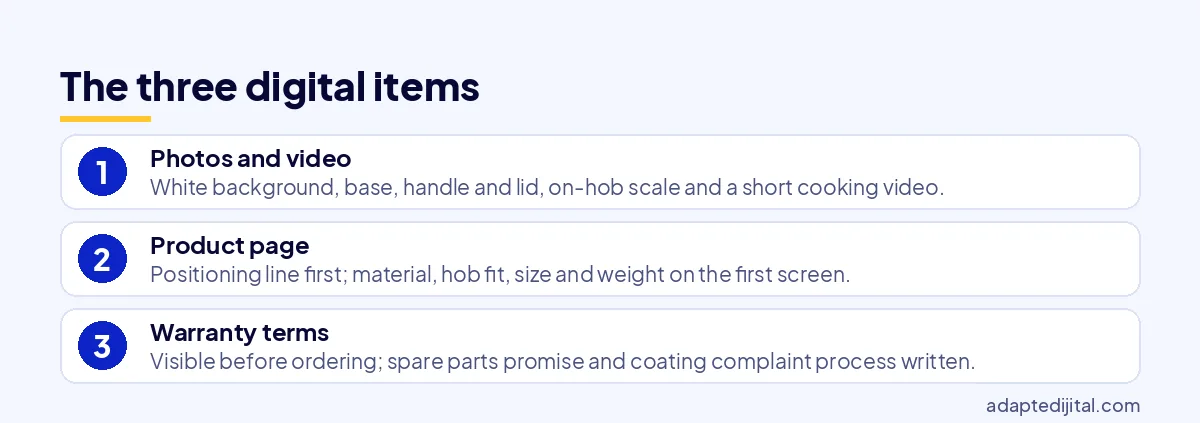
The photo and short video set is complete per product, material, base and size sit on the first screen of the product page, and warranty and return terms are visible before ordering. A pan with no base photo triggers induction returns, and one with no cooking video cannot explain its coating, because the buyer wants to see food slide.
Item 7
Per product: front on white, base, handle and lid close-ups, an on-hob scale shot and a short cooking video. Ticked by founder and photographer; if missing, the page does not go live. Building the site is a job for website consulting.
Item 8
The first sentence of the page is the positioning line; material and coating name, hob compatibility, diameter, depth, weight and dishwasher advice sit on the first screen. Ticked by founder and site owner; if missing, the first return reason is size or hob fit.
Item 9
Warranty length, scope and the spare parts promise show on the product page and in the basket; the used-pan rule and coating complaint process are written. Ticked by the founder. If missing, the first dispute becomes a review.
Group 4: the channel (three items)
BU BÖLÜMÜN ÖZETİ
- Item 10
- Item 11
- Item 12
The pitch file for housewares and dowry shops is ready as one document, the first batch matches channel capacity, and a shipping test ran with a real courier. A pot without a file cannot be explained to a shop owner, and a glass lid never shipping-tested comes back broken in week one.
Item 10
The housewares file: set photos, sizes, a summary of the declaration, warranty and spare parts promise, lead time, brand story. Ticked by the founder; channel choice is in the own site, marketplace and housewares comparison.
Item 11
The first batch does not exceed a three-month sales forecast: depth in the hero pan, few units of the rest. Bulky goods eat storage. Ticked by the founder; thresholds are in the cost article.
Item 12
Shipping test: three parcels sent to your own address and to a friend, lid, handle and coating checked, breakage and dents noted. Ticked by the founder. If missing, sales do not open until the packaging changes.
Who ticks the list, and when? An eight-week countdown
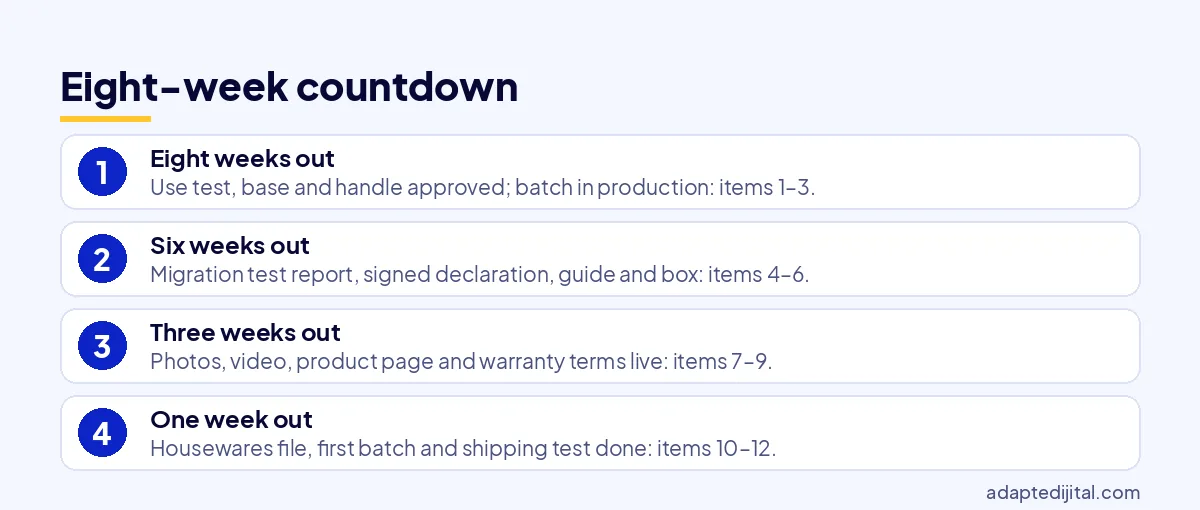
The founder ticks it and does not delegate; the maker keeps its own list and the lab issues its own report, but the twelve items have one owner. Timing: product closes eight weeks before launch, documents and packaging six weeks, digital three weeks, channel one week. Kitchenware tests are slow, so the countdown is long.
Countdown
- Eight weeks out: use test, base and handle approved; batch in production (items 1–3)
- Six weeks out: migration test report in hand, declaration signed, guide and box printed (items 4–6)
- Three weeks out: photos and video shot, product page and warranty terms live (items 7–9)
- One week out: housewares file, first batch and shipping test done (items 10–12)
Common mistake
Leaving the migration test to the last week. Lab queues and reporting take weeks; no report, no declaration, and no dowry shop takes the file. Which season to aim for is in the when-to-launch article.
The twelve items as a printable list
Print the list below and note who ticked each item and when. Announce no date before all twelve are ticked. It fits one page, and a kitchenware brand’s first set stands on that page.
List
- Use test done with real food and the dishwasher
- Base flat on induction, no warping when hot
- Handle and lid holdable while cooking
- Declaration in the brand’s name, based on a migration test report
- Care guide inside the box
- Box and corner protection passed a drop test
- Photos and cooking video complete per product
- Material, base and size on the page’s first screen
- Warranty and spare parts promise visible before ordering
- Housewares and dowry file ready as one document
- First batch within the three-month forecast
- Shipping test done, breakage noted
Frequently Asked Questions
Quick Summary
- Twelve items in four groups: product (3), documents and packaging (3), digital (3), channel (3).
- If one item is missing the launch waits; the date moves, not the set.
- Product closes eight weeks out, documents six, digital three, channel one.
- The declaration is in the brand’s name and based on a migration test report; the guide is in the box.
- The costliest mistake sits in the earliest item: a coated batch cannot be recalled.
- The list has one owner: the founder.
Short Glossary
- Launch: the dated, planned moment a set first goes on sale
- Migration test: a lab test measuring whether substances pass from a food contact material into food
- Declaration of compliance: the document in which the brand states in its own name that the product meets food contact rules
- Shipping test: a trial shipment showing whether the product arrives unbroken under real courier conditions
Next Step
To fit the twelve items to your calendar, write via the talk to an expert form; scope is on the brand consultancy page. Next up: starting a kitchenware brand in Istanbul.
Updated: October 2026
Sık Sorulan Sorular
Because a coated batch cannot be recalled. A guide can be reprinted, but a batch with warped bases is either discounted or stays in storage. The costliest mistake sits in the earliest item.
Building the list and fitting it to a calendar is the work of brand consultancy; the overall order is in the pillar article, your stage in the hub article. To fit the list to your calendar, talk to an expert.
A real-food use test, an induction base test, a handle and lid check and a migration test at an accredited lab; all four are ticked before batch approval and the declaration of compliance.
The launch waits; the date moves, not the set. A missing document can delay it by weeks, a missing product item by up to a season.
The founder; the maker, lab, photographer and site owner hold their parts, but the twelve items have one owner.