
What is the Google new business boost? Visibility that rises and falls after opening
The Google new business boost is a new business looking better than expected in search or on maps for its first weeks, then pulling back; some call it the “honeymoon effect”. Most people do not know this: Google does not accept that such a reward exists. In a 2021 statement, Google Search Advocate John Mueller says they neither push new content up nor hold it back on purpose; with few signals, they simply make assumptions.
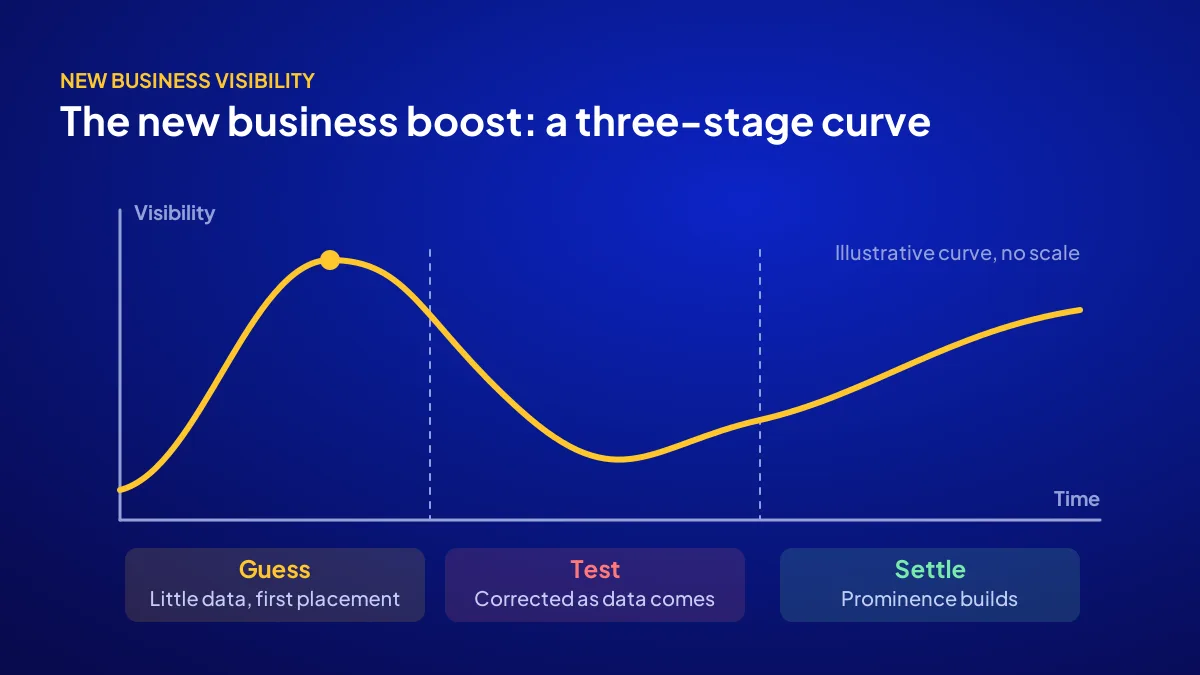
So where does the swing come from? Google has little data on a new business, so the first placement is a guess, corrected as reviews, searches and direction requests arrive. There is also an official, little-known detail: for 90 days after opening, a Google Business Profile shows a label saying you recently opened.
What exactly is the new business boost?
The new business boost is not an official Google term; it names something owners and SEO people observe. A new profile or site appears high for some searches at first, then a few weeks or months later slips into its real place. Visibility here means how many searches you appear in and at what position.
Does Google admit this effect exists?
Not as a reward. In his 2021 statement, Mueller says Google recognises and indexes new content but does not have many signals about it; the systems then guess a position, assuming it is in line with the rest of the site. If the guess is right, the position holds; if it is wrong, it is corrected. What we call the boost is the visible side of that correction.
What is the 90-day window on both sides of opening?
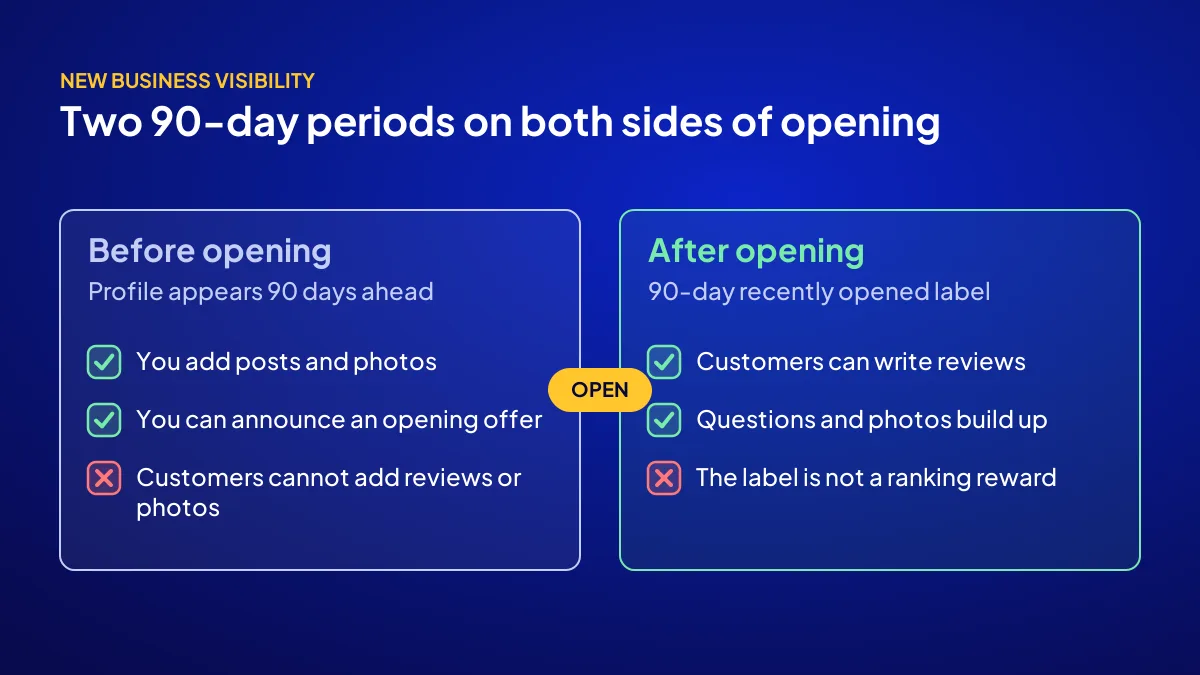
You can enter a future opening month in your Google Business Profile, up to a year ahead. According to Google’s help page, the profile starts appearing on Google 90 days before opening. For 90 days after opening, a label showing that you recently opened stays on the profile. Before opening, customers cannot write reviews, add photos or suggest edits.
The 90 days before opening
You can add posts, photos and a description, and Google suggests using them to announce the opening and share an opening day discount. Even with the shutters down, your window shows on the map. We rank which channel to open first in where a new business should appear first.
The 90 days after opening
The label tells viewers this place is new, a kind of invitation. After 90 days it comes off, and whatever the profile has built is what stays.
Why does visibility rise first and fall later?
Because the first position is a guess, and the guess is tested against data. A new business can set up relevance, meaning how well the profile matches a search, from day one, and distance is fixed anyway. But prominence, meaning how well known you are, builds up over time through reviews and sites that mention you. When the guess is pulled back, missing prominence shows and the ranking drops.
Competitors do not stand still
The old shops nearby have years of reviews and links. A new business’s drop is often not its own fault but the weight on the other side of the scale.
Separate the causes of a drop
Not every drop is the boost ending; a category change, muddled address or wrong hours can also pull a ranking down. We separate six reasons for appearing at opening and then disappearing in why a new business’s ranking dropped.
What should you do while the effect lasts?
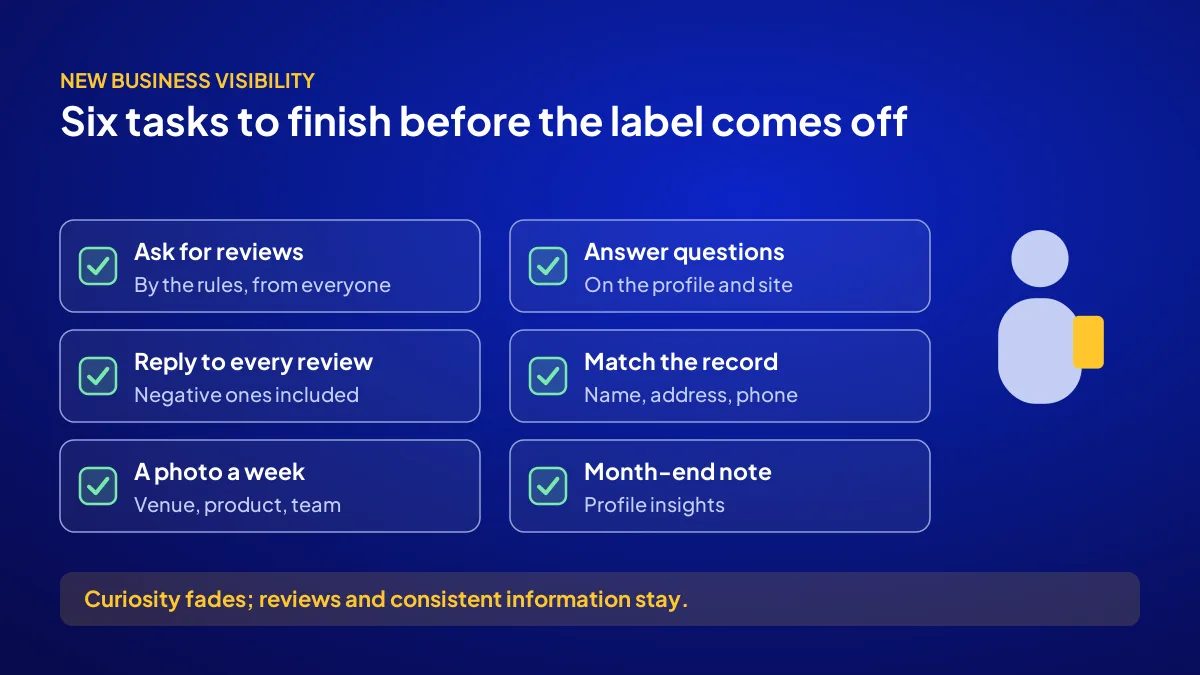
While the effect lasts, the job is to turn passing interest into a lasting trace: lookers into customers, customers into reviewers. The six tasks below belong to this period, and each stays in place after the label comes off.
- Ask first customers for reviews in a way that follows the rules.
- Reply to every review, negative ones included, briefly and politely.
- Add one real photo a week: venue, product, team.
- Fill your profile questions and your site with the most common questions.
- Keep name, address and phone identical in every listing.
- Note your profile insights at month end.
The rules for collecting reviews
Google does not allow reviews in exchange for discounts or gifts. Ask everyone equally, not just happy customers. We gather the rule-friendly ways in how a new business gets its first reviews.
What lasts after the effect ends?
When the effect ends, what came from being new goes and what you built stays. Curiosity, the label and Google’s first guess are temporary. Reviews, a consistent record, pages that answer questions and sites that mention you last.
| Temporary | Lasting |
|---|---|
| Opening curiosity | Real customer reviews |
| The 90-day recently opened label | Same name, address and phone everywhere |
| Google’s first ranking guess | Pages that answer questions |
Now you know this
The boost is not a reward but Google’s guess. There is an official 90-day window on each side of opening. A drop is usually not a penalty but prominence still building. Build your trace before the window closes.
Quick Summary
- The new business boost is not an official term but an observation.
- Google says it does not push new content on purpose; it makes assumptions.
- A profile appears 90 days before opening and shows a new label for 90 days after.
- The real cause of a drop is prominence that has not built up yet.
- While the effect lasts, build reviews, photos, answers and a clean record.
- Curiosity fades; reviews and consistent information stay.
Short Glossary
Honeymoon effect: The honeymoon effect is the informal term used to describe a new page or business looking better than expected at first and then pulling back.
Signal: A signal is any data point, such as a review, click or link, that a search engine uses when deciding about a page or business.
Sandbox: The sandbox is the name used for the claim, rejected by Google, that new sites are deliberately held back for a while.
Next Step
To build your trace while the window is open, apply to the Get Visible Online campaign and get a recipe suggestion based on your needs form.
Frequently Asked Questions
Source: Google Business Profile Help — Add a business opening date
Sık Sorulan Sorular
Think of a new neighbour on the street. In week one everyone knocks to say welcome; a month later only friends drop by. In search, too, the newcomer meets curiosity first, then earns its place.
No. The sandbox claims a new site is deliberately held back; the honeymoon claims a newcomer is deliberately pushed forward. Mueller rejects both: no penalty, no reward, only missing data.
On a new Business Profile, a new website, even a new page of an old site: anything Google has little information about. We bring together the full visibility path for a new business on maps, search and AI in the new business visibility guide.
An assumption is the most likely answer when there is no data. On day one, a teacher seats a new pupil in the front row; once marks come in, everyone moves to their own seat. Google’s guess holds until the first marks arrive.
Google publishes no fixed time. In a 2020 session, Mueller says sites 2 to 12 months old still count as very fresh and can settle within about a year. That is about websites, not a timetable for map profiles.
Google does not say so; the label is a note, not a ranking reward. According to Google, local ranking is decided by relevance, distance and prominence.
To see what changed when the effect ends, you need a starting number. We list which numbers to check in six numbers to check after month one. If you cannot run these six tasks yourself in the opening rush, the Get Visible Online campaign sets up a 3-month period at a fixed TRY 36,000 + VAT, with results reviewed together at the end of month one.
Google does not publish a fixed time. On a Business Profile, the recently opened label stays for 90 days after opening. For websites, Mueller’s observation is that fluctuations can settle within about a year.
According to Google’s statement, no. With few signals about new content, the systems make assumptions, and the guess is corrected by data.
Usually not. It is often the first guess being corrected while prominence builds. Still, check your category, address and hours.
No. During the pre-opening period, customers cannot write reviews or add photos to the profile. Plan your first reviews around opening day.
A recipe is suggested from your needs form, delivery starts with payment, and results are reviewed together at month end. The package is TRY 36,000 + VAT, fixed and upfront.
No. With the Google Ads or Meta Ads Recipe, the ad budget is paid separately to Google or Meta. The Website Recipe needs no ad budget.
Updated: October 2026