
Dentist name search: why patients type the dentist’s name, not the clinic’s
Say you’re opening your new clinic and a patient goes looking for you. Most likely they type your name, not the clinic’s. That makes the dentist name search the most valuable search for a new clinic: patients attach trust to a person, not a building, and pass on recommendations by name, as in “go to Dr Ayşe”. If searching your name brings up your old workplace or an empty page, the patient comes as far as the door and turns back.
The fix is to make your name visible as one consistent identity: a dentist profile on Google, a dentist page on your website, and the same name and title written the same way everywhere. All of this is information that Türkiye’s Regulation on Promotion and Information Activities in Health Services explicitly allows. Below, we explain why and the compliant way to do it.
Why do patients remember the dentist’s name, not the clinic’s?
The mouth is not a place people open easily. Patients give that trust to the person beside the chair, not to an institution. That is why recommendations travel by name: a neighbour doesn’t say “that clinic”, they say “Elif is very calm, go to her”. The clinic name is an address; the dentist’s name is a reference.
The unexpected finding: the sign changes, the name stays
A dentist opening their own clinic has their most loyal patients among people who know them from a previous workplace. These patients don’t know the new sign. All they know is your name.
A dentist who opens a new clinic gets searched by name by old patients
Say you’ve worked at a chain clinic for seven years and now you’re pulling up your own shutter in Beylikdüzü. Hundreds of patients are happy with you, but none of them has your new address. One day one of them has toothache and types your name, and the result in front of them decides whether they find you. The real test isn’t opening day; it is that moment of search.
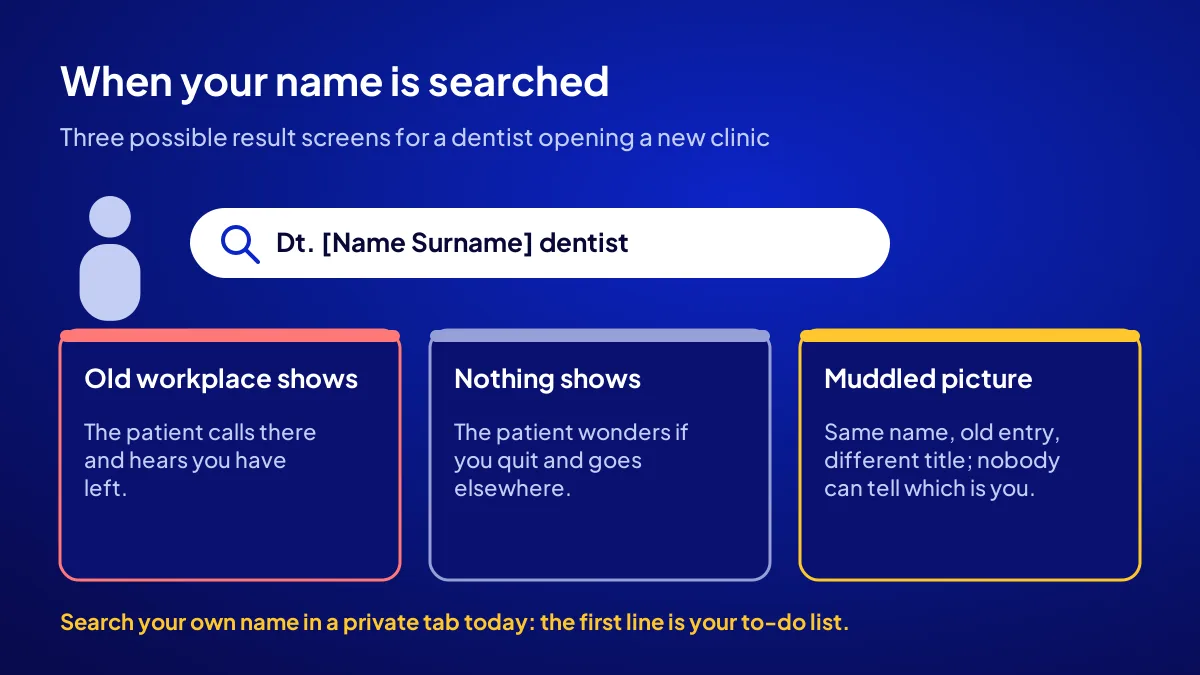
One of three results appears when your name is searched
BU BÖLÜMÜN ÖZETİ
- 1. The old workplace shows up
- 2. Nothing shows up
- 3. A muddled picture shows up
When the name of a dentist who has opened a new clinic is searched, one of three pictures usually appears: the old workplace, a blank, or a muddle. All three lose the patient, in different ways. To know which one you’re in, search your name together with “dentist” today, on your phone, in a private tab. The results screen is the first line of your to-do list.
1. The old workplace shows up
The search still shows you at your previous clinic. The patient calls there and hears you’ve left. It is the most expensive result, because the patient had already chosen you.
2. Nothing shows up
No current page about you. The patient wonders “did they quit?” and goes elsewhere.
3. A muddled picture shows up
Another dentist with the same name, an old directory entry, a title written differently. The patient can’t tell which one is you. The problem here isn’t visibility but identity consistency.
What does Google say about separate profiles for dentists?
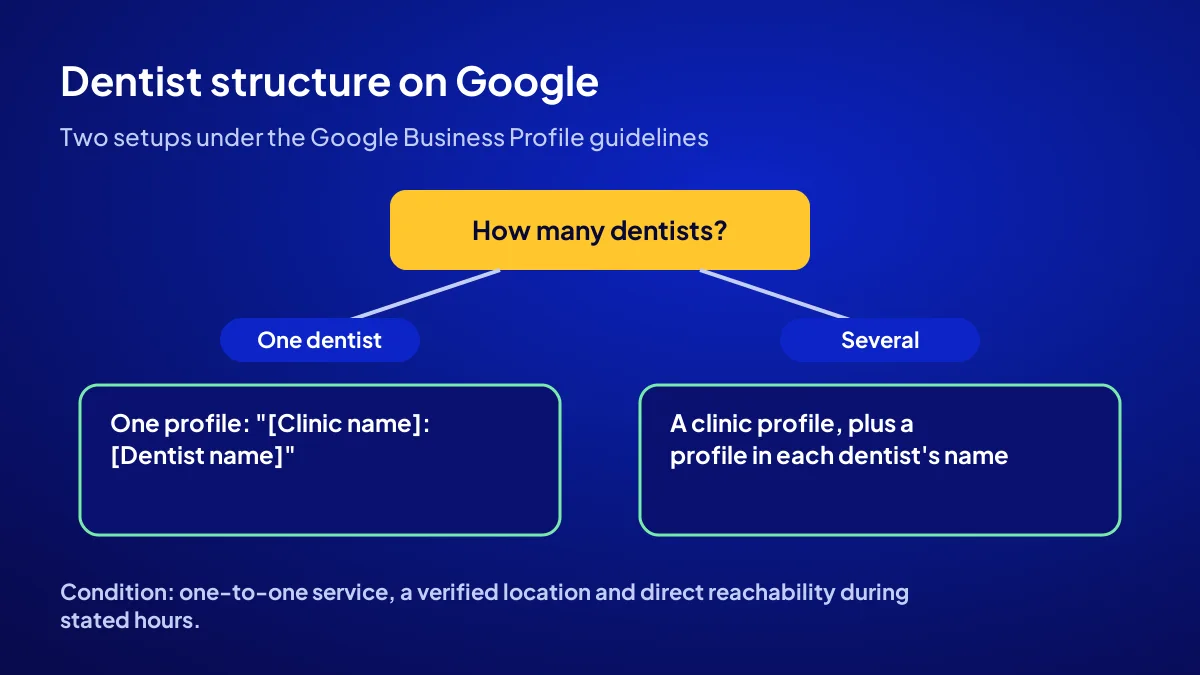
Google Business Profile guidelines treat doctors, dentists and others who serve clients one-to-one as individual practitioners. A dentist who is directly reachable at a verified location during stated hours can have their own profile. The structure changes depending on whether the clinic has one dentist or several. Setting up the right structure links your name to the clinic on the map.
| Situation | Structure Google suggests | What it means for a new clinic |
|---|---|---|
| One dentist, branded clinic | One profile: “[Clinic name]: [Dentist name]” | Name and clinic on the same card |
| Several dentists | A separate profile for the clinic, plus a profile in each dentist’s own name | Each dentist is found by name |
| Dentist’s own practice | Own profile, if serving one-to-one at a verified location during stated hours | The name goes straight onto the map |
The category and map side
Both profiles need the right primary category; the job here is linking the name to the clinic.
Within what limits can you write your title?
The title is the word next to your name that carries the most trust, and it is bound by the strictest rule. Under Article 5(1)(d) of the regulation, no specialist title based on a certificate may be written outside the main and sub-specialties set by law. In other words, use what your diploma and Ministry registration say. A course-based phrase like “implant specialist” doesn’t strengthen your name; it puts it at risk.
What happens if your name isn’t written the same way in five places?
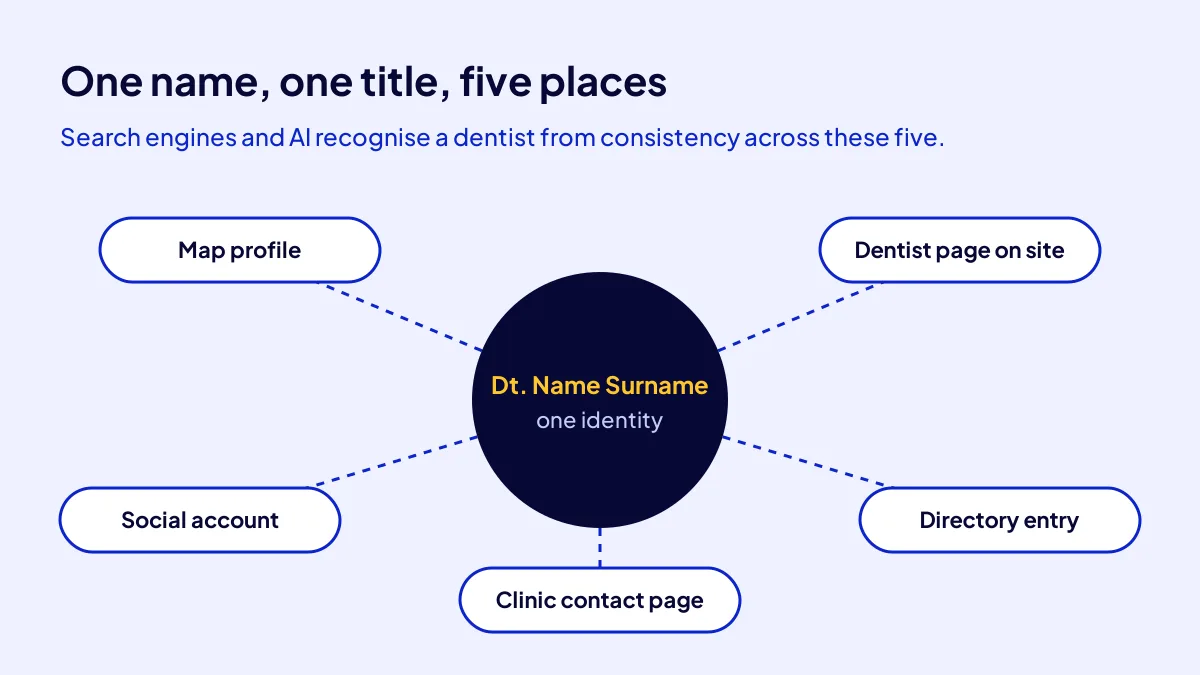
Search engines and AI assistants recognise a person from information that appears the same way in different places. If your name reads one way on the map, another on your site and a third on social media, they struggle to merge them into one dentist. The result is a muddled picture and a lost patient. The five places: the map profile, the dentist page on your site, social accounts, professional directory entries and the clinic’s contact page.
Who builds this foundation, and how?
Dentist name visibility has three layers: the map profile, the dentist and clinic pages on your site, and the structured data that links the two in the background. You can start the first two yourself. The third is technical work, and it also affects whether your name is readable in AI answers. You’ll find the full path in our new dental clinic promotion guide and the first 90 days in the new dentist practice plan.
Quick Summary
- Patients attach trust to the dentist and recommend by name.
- A dentist’s old patients search for them by name after a move.
- Messaging an old patient list is both a KVKK and a regulation problem.
- Google lets a dentist serving one-to-one have their own profile.
- Titles follow the diploma and Ministry registration; a certificate isn’t a title.
- Name and title must read the same in five places.
Short Glossary
Individual practitioner profile: An individual practitioner profile is the Google Business Profile listing used to show a one-to-one professional, such as a dentist, under their own name.
Entity: An entity is the concept used by search engines and AI to recognise a person or organisation as one distinct thing.
Structured data: Structured data is the code used to mark up dentist, clinic and address information so machines can read it.
Next Step
To make sure your clinic is found wherever your name is searched, apply for the AI SEO Campaign; a diagnosis card is prepared from your site and target questions, and setup is delivered turnkey.
Frequently Asked Questions
Sık Sorulan Sorular
The person who gets the recommendation searches the name, then finds the route on the map. If the result can’t bridge name and clinic, the recommendation stops halfway, and a dentist known around the neighbourhood becomes one nobody finds online.
No. A former workplace’s patient records belong to that institution, and health data is special-category personal data under Türkiye’s data protection law (KVKK). Article 5(1)(k) of the regulation also bans contacting people without consent by phone, SMS or email. Being findable is safer and more compliant than going after patients yourself.
Being searchable by name: the one route that stays within the rules and bothers no one.
Name, title, patient hours, clinic address and specialty. For health professionals, the regulation lists main and sub-specialties, academic titles, and when and where patients are seen. Don’t go beyond that.
Write titles such as “Dt.”, “Spec. Dt.” or “Dr. Dt.” exactly as on your diploma and registration, the same everywhere. Mixed titles create both a rule and a consistency problem.
The regulation allows Ministry-registered certificates to be used in information activities. Write course certificates not as titles but as separate training information, after checking their registration status. If unsure, ask your provincial health directorate.
A separate page for each dentist is the one address that owns your name. Name, title, specialty, patient hours and clinic details live there. Our dental clinic website pages checklist lists the pages a new clinic’s site needs.
Assistants recognise people and organisations as entities. Our piece what is an entity in SEO explains what that means. For getting ready for the time when patients ask AI for a dentist, read patients ask AI for dentists in 2027.
The AI SEO Campaign is a fixed TRY 36,000 + VAT (TRY 43,200 with 20% VAT; check the current rate on the invoice), with a 10% coupon and 12 businesses per period. It includes an AI visibility diagnosis, entity setup, structured data, 108 articles, Search Console and Bing Webmaster Tools setup, and starting and closing diagnosis cards. Delivery takes 30 days. There is no guarantee of being recommended; the readability and recognisability foundation is built and measured.
Clinic articles must stay within the preventive health information the regulation allows. Raise this when you apply.
One principle: patients search you by name; where your name is found, the clinic is found too.
Yes. Google lets a dentist who serves one-to-one and is reachable at a verified location during stated hours have their own profile. If the clinic has several dentists, the clinic gets a separate profile.
No. The regulation bans certificate-based specialist titles outside the main and sub-specialties set by law. Use your title as it appears on your diploma and Ministry registration.
No. There is no guarantee of being recommended. The campaign builds the foundation for your name and clinic to be readable and recognisable, and measures it with starting and closing diagnosis cards.
Updated: October 2026