
New dental clinic promotion: the road to the first patient within advertising rules
New dental clinic promotion in Turkey in 2026 happens between two walls: an advertising ban and the phone in the patient’s hand. The Regulation on Promotion and Information Activities in Health Services, in force since 12 November 2025, bans open or covert advertising of health services. You cannot publish prices, discounts or campaigns. Paid promotion on social media and search engines is closed as well.
What stays open is promotion and information: address, contact details, opening hours, specialties, the dentists’ titles and information that protects oral health. So the road to the first patient does not run through paying to be seen. It runs through being found when someone searches. A properly built Google Business Profile, a compliant website, one name written the same everywhere and a plain answer to the patient’s question. These four pieces are built in the first 90 days.
What is allowed and what is banned for a new dental clinic in 2026?
Saying who you are and where you are is allowed. Pushing yourself forward to lure the patient is banned. The regulation defines advertising as any activity that goes beyond the limits of promotion and information. Look, the line hides in one question: does this post give the patient information, or does it try to pull them through the door? The first is allowed, the second is not.
| Allowed promotion | Banned advertising |
|---|---|
| Address, phone, working days and hours | Fees, discounts, campaigns, promotions |
| Specialties, professional and academic titles | Using patient thanks for advertising |
| Information that protects and improves oral health | Paid, sponsored or boosted listings |
| Free listing on search engines and social media | Raffles, gifts, unsolicited calls and messages |
How does a patient find a new dentist?
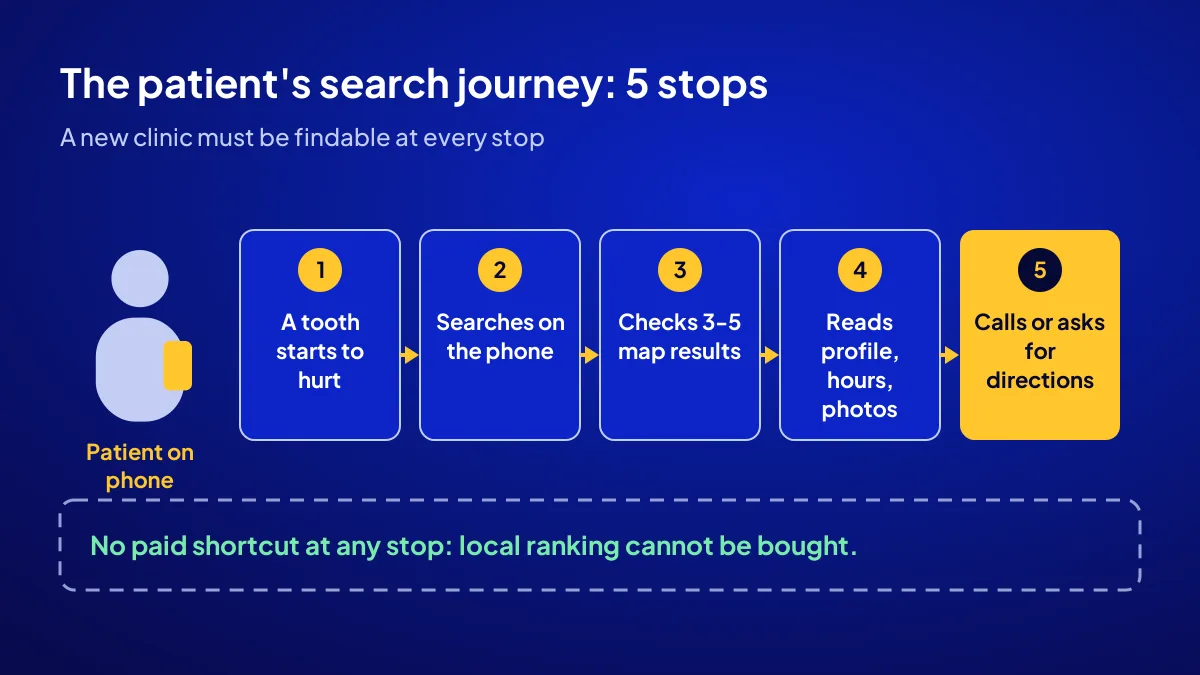
Most patients look for a dentist when a tooth hurts, on their phone and close by. They search “dentist” or their district name and look at the three to five results on the map. They read the profile, photos and reviews, then call or ask for directions. Google itself states that you cannot pay to rank higher in local results.
What are the four layers of compliant promotion?
BU BÖLÜMÜN ÖZETİ
- 1. Identity: the licensed name, the same everywhere
- 2. Map: the Google Business Profile
- 3. Website: a compliant door plate
- 4. Information: the dentist’s answer to the patient’s question
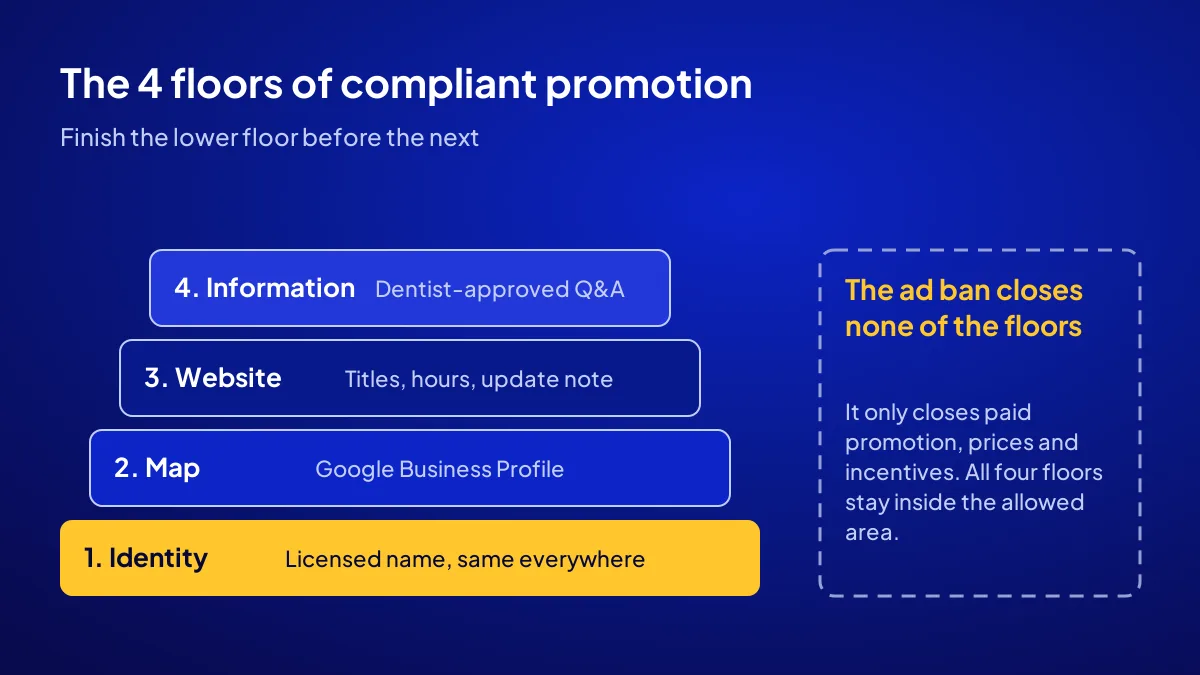
Now let me show you the system I carry in my head. Promoting a new clinic has four floors, and you do not climb to the next one before the floor below is finished. Floor one is identity, floor two the map, floor three the website, floor four information. The advertising ban closes none of these floors; it pulls the game inside them.
1. Identity: the licensed name, the same everywhere
The clinic’s name is written on the sign, the profile and the site exactly as it appears on the licence. The regulation on private oral and dental health facilities does not allow a name other than the one registered on the licence. Keeping name, address and phone identical everywhere, known as NAP consistency, lets Google recognise you as one entity.
2. Map: the Google Business Profile
The right primary category, correct hours, a verified address and photos from inside the clinic. Which category to choose and which six fields to fill are covered step by step in the right Google category for a dental clinic.
3. Website: a compliant door plate
The site is a door plate that carries the dentists, their titles, address, hours and health information in order. The regulation also asks websites to show the last update date and the editor’s contact details clearly. The pages you need are listed in nine pages every dental clinic website needs.
4. Information: the dentist’s answer to the patient’s question
A patient asks, “Does scaling damage tooth enamel?” A plain, protective answer signed by the dentist is both allowed and a source of lasting traffic. Only an authorised health professional may give health information; whoever drafts the text, the dentist does the final read.
In what order do you move before and after opening?
BU BÖLÜMÜN ÖZETİ
- Before opening: identity and map
- The first 30 days: website and first questions
- Days 31 to 90: the name and the questions build up
The order is simple: the licensed name is fixed, the profile goes up, the site goes live, then information articles start to pile up. The two weeks before opening belong to identity and the map. The first month belongs to the site and the first articles. Months two and three are when the dentist’s name and the questions grow. The day-by-day calendar is in how a new dentist practice gets known.
Before opening: identity and map
Write the licensed name, full address, landline and opening hours on one page. Do not leave verification for opening day.
The first 30 days: website and first questions
The site goes live and the first three or four information articles are added with the dentist’s approval. The opening announcement stays within the sign, a profile post and a hello visit to the shopkeepers next door. “Opening special” is the most dangerous phrase of this period.
Days 31 to 90: the name and the questions build up
As patients come, word of mouth starts and searches for the dentist’s name grow. New question-and-answer articles go up each month.
Why are being seen and being found two different things?
Here is what I noticed: a page written for a long, intent-rich question rises far faster than one aimed at a short, general word. In the Search Console data of our own site, adaptedijital.com, for 14 June to 13 September 2026, the Turkish query “diş deposu nasıl açılır” (how to open a dental supply store) has 219 impressions at an average position of 2.5 and brings 11 clicks. In the same period, “dijital ajans” (digital agency) sits at an average position of 66 with 478 impressions and zero clicks.
Being mentioned in AI answers
Patients now ask the same questions to ChatGPT or Gemini. These tools like orderly, sourced and consistent information. Entity details, structured data and question-and-answer layout help here; nobody can guarantee a mention, but readability can be built.
Which tactics should you never try?
Many moves that work for shopkeepers are grounds for a fine at a dental clinic. If a new clinic reaches for them because the till is not ringing, it may spend its first year writing defences instead of promoting itself. Strike the six tactics below off your list today.
- Announcing prices, discounts, an “opening special” or instalments.
- Paid search ads and sponsored social posts aimed at domestic patients.
- Sharing patient thanks or reviews as advertising material.
- Using before-and-after images to lure patients.
- Raffles, gifts or free check-ups as incentives.
- Bulk SMS, calls or emails to people who have not consented.
Where does the budget go, and what does TRY 36,000 buy?
A dental clinic has no ad budget line to begin with, because paid promotion to domestic patients is closed. The money goes to the identity, map and website layers. The Website Recipe in Adapte’s Get Visible Online campaign builds exactly these three floors: a mobile-friendly page, contact buttons, a Google Business Profile, basic SEO and visitor tracking. The price is TRY 36,000 + VAT, paid upfront at a fixed price, for a 3-month period.
| Item | Amount | Note |
|---|---|---|
| Website Recipe (3 months) | TRY 36,000 + VAT | Upfront, fixed price |
| Total with VAT (20%) | TRY 43,200 | Check the current rate on the invoice |
| Ad budget | TRY 0 | No ads are set up in this recipe |
A second step for the information layer
Once identity, map and site are settled, the information layer grows. Adapte’s AI SEO Campaign lists clinics among its audience; it builds readability for AI answers with 108 question-and-answer articles, entity setup and structured data. Every article with health information is approved by the dentist before it goes live.
How do you know you are moving in the first 90 days?
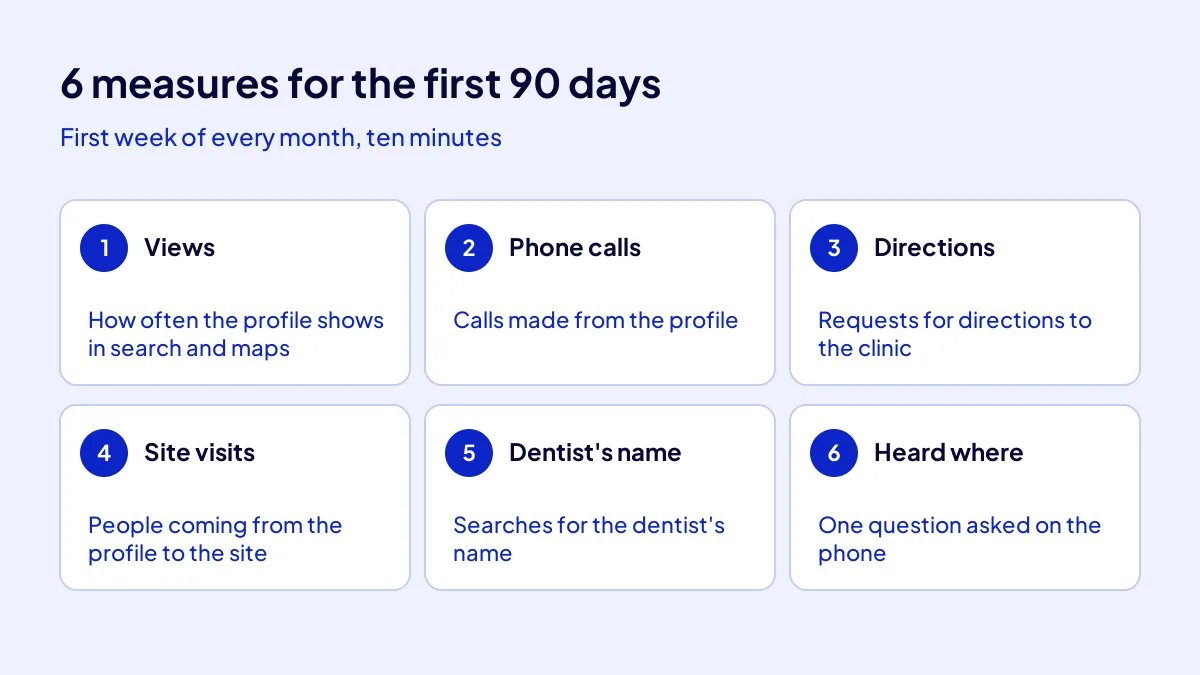
Let me ask you just one thing: when someone searches for your clinic, do they find it? The answer hides in six numbers. Check them in the first week of every month.
- How often the profile is viewed in search and on the map.
- Phone calls made from the profile.
- Direction requests.
- Website visits coming from the profile.
- Searches for the dentist’s name.
- Answers to “where did you hear about us” on the phone.
What I have seen
I have been watching how businesses look online for fifteen years and have tested more than a hundred sites and domains with my own hands. In rule-bound sectors, the winner is the one who knows the rules best and stays the most patient. Nobody visits a dentist for fun; the tooth does the convincing. You just need to be findable at that moment.
My decision sentence is this: promote your new clinic not with ads, but with an identity that is found when searched.
Quick Summary
- Open or covert advertising of health services is banned; promotion and information are allowed.
- Prices, discounts, campaigns and paid promotion are closed for domestic patients.
- Promotion is built on four floors: identity, map, website, information.
- The licensed name is written the same on the sign, profile and site.
- Dentist-approved answers to long, clear questions rise faster.
- The Website Recipe is TRY 36,000 + VAT with no ad budget line.
Short Glossary
Promotion and information: Promotion and information is the activity permitted by the regulation for a health facility to share its address, contact details, hours, specialties and protective health information.
Paid promotion: Paid promotion is the method used to make a listing more visible on a search engine or social media by paying for it.
NAP consistency: NAP consistency is the local search principle used to keep a business’s name, address and phone number identical on every platform.
Next Step
If you want to build the identity, map and website floors in one go, apply to the Get Visible Online campaign and we will set the scope of the Website Recipe together based on your needs form.
Frequently Asked Questions
Source: Google Business Profile Help — Tips to improve your local ranking on Google
Sık Sorulan Sorular
“Open Monday to Saturday, 09:00 to 19:00” is information. “Big implant deal this month” is advertising, and the banned kind. The nine-point breakdown is in what the dental clinic advertising ban covers.
The regulation lets clinics and dentists register on search engines and social media. There is one condition: the listing must not be paid, sponsored or aimed at boosting. That takes domestic search ads and sponsored posts off the table.
In every province an evaluation commission scans the internet, social media and the press. Breaches can lead to administrative fines and disciplinary action. Before opening, read the regulation, then your local chamber of dentists’ announcements.
Google looks at three things in local results: relevance, distance and prominence. Relevance is how well your profile matches the search. Distance is how close you are to the patient. Prominence is how well known you are; reviews and links feed it.
When the shutters first go up, prominence starts from zero. If the profile is incomplete, the category wrong or the name different from the sign, Google cannot match you to the search. If your business does not appear on the map at all, see business not showing on Google Maps.
The decision happens on the first scroll of the screen. If opening hours, a call button, a few plain photos of the clinic and the dentist’s title are there, the patient calls. If not, they move on to the next result and you never hear about it.
A new clinic cannot race established rivals on “dentist” right away. But it can become the local answer to questions like “what to do about toothache at night” or “at what age is a child’s first dental check”.
A team can prepare the content, but the dentist is the one giving health information. The dentist’s name and title sit under the article, it carries information rather than claims, and it has no prices or campaigns. Such an article fits the regulation’s definition of promotion and information.
Patients may leave reviews on their own. You do not run review-collecting campaigns, and you do not use reviews as advertising on your site or social media. When replying, write nothing about the patient’s treatment; a short, measured thank-you is enough.
The campaign’s other two recipes are built on paid ads. Since paid promotion to domestic patients conflicts with the regulation, we do not recommend those two recipes for a new dental clinic. Our recommendation is to start with the Website Recipe.
You fill in the needs form, Adapte suggests the right recipe, and delivery starts with payment. At the end of the first month you review the results together. If you have a coupon code, just mention it when you apply or during the call. To apply, go to the Get Visible Online campaign page.
There is no fixed day, and nobody can tell you “you will be number one on this date”. A verified, complete profile usually starts getting views in the first weeks. Question-and-answer articles work by piling up over months.
The regulation allows registration on search engines only if it is not paid, sponsored or aimed at boosting. Paid search ads aimed at domestic patients therefore conflict with the regulation. A Google Business Profile is a free listing.
No. Promotion and information may not include fees, discounts, campaigns or promotions. Announce the opening with your address, hours and dentist details.
Yes, you can open a free account and share protective health information. You should not post sponsored content, prices, patient thanks or luring images.
No. The ad budget is paid separately only in the Google Ads and Meta Ads recipes; the Website Recipe sets up no ads, so that line does not exist. The package price is TRY 36,000 + VAT, upfront and fixed.
Just mention your coupon code when you apply or during the call.
An evaluation commission in each province scans the internet, social media and the press. Breaches can lead to administrative fines and disciplinary action. When in doubt, consult the Provincial Health Directorate and your chamber of dentists.
Updated: October 2026