
New boutique promotion: 9 steps to the first customer for vintage and antique shops
New boutique promotion starts with trust, not a window photo. A selective customer first wants to know whether the piece is genuine, who runs the shop and what others say. The right order: rules and identity first, then the Google map and the phone screen, then the story of the experience. A niche boutique, vintage or antique shop that follows it finds its first customer in 9 steps.
Look, in Beşiktaş or Çankaya the customer asks the same thing: “Is this piece what they say, and can I trust this shop?” In 2026 the answer is sought in three places: the Google Business Profile, the shop’s website and an AI assistant. All three should show the same name, story and address.
Which rules come before new boutique promotion?
Two rules come first. One is what you sell: antiques and possible cultural property fall under a specific law. The other is advertising: since 1 August 2026 Turkey has stricter rules on discounts, reviews and sponsored posts. Ignore them and even a beautiful window struggles in month one.
Vintage and antique are not the same thing
In the trade, vintage usually means a second-hand piece a few decades old that reflects its era. Antique means older items, some of which may qualify as cultural property. Your customer knows the difference; the wrong word on the tag costs trust at the first question.
Ask the permit question before opening
Movable items that qualify as cultural property fall under Law No. 2863 on the Conservation of Cultural and Natural Property, and trading them may require permission from the Ministry of Culture and Tourism. Before you raise the shutter, ask the provincial culture and tourism directorate or the regional museum directorate which pieces are covered and whether you need a permit. Get it in writing.
How does a selective customer choose a boutique?
BU BÖLÜMÜN ÖZETİ
- Say you live in Moda
- Three screens on the phone
- The question asked to AI
In an affluent district customers usually choose on the phone, across three screens: the map, the profile’s photos and reviews, then the website or Instagram. Google ranks local results by relevance, distance and prominence. A new shop has few reviews, so its prominence is weak. Clarity closes that gap.
Say you live in Moda
On a Saturday afternoon you type “Kadıköy vintage lamp”. Four shops come up. One lists the lamp’s era, size and new wiring; the others show a dim photo of a shelf. You know which one you will walk to.
Three screens on the phone
The first screen is the map card, the second photos and reviews, the third the top of your website or account. On each, the customer asks one thing: will I find what I want, or walk out empty-handed? If one is empty, they move to the next card.
The question asked to AI
Selective customers now ask ChatGPT or Gemini too: “Recommend a trustworthy antique shop in Bebek.” The assistant answers from what it can read online. If your website has no page on your collection, expertise and district, your name will not be in that answer. Nobody can guarantee a recommendation, but without readable information there is no chance.
What are the 9 steps to the first customer?
BU BÖLÜMÜN ÖZETİ
- Identity: name, rules, direction
- Window: profile, piece pages, announcement
- Trust: viewing, reviews, measurement
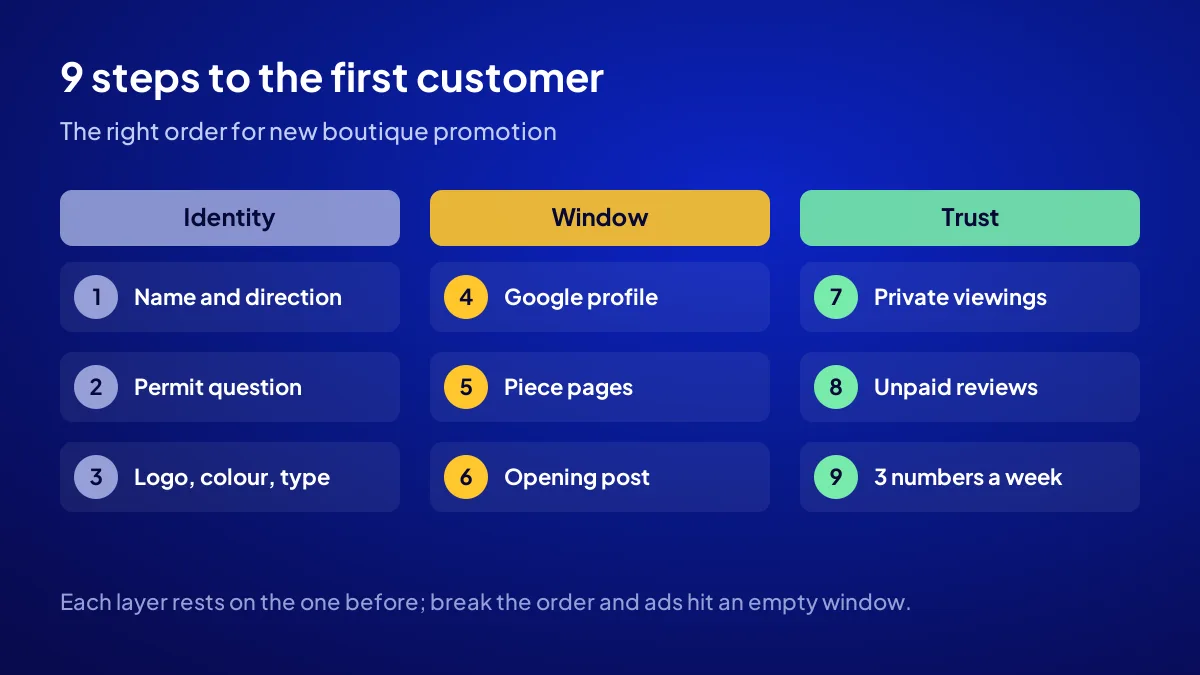
The nine steps fall into three layers: identity (name, rules, brand direction), window (map profile, piece pages, opening announcement) and trust (private viewings, first reviews, weekly measurement). Each layer rests on the one before; break the order and you wait in front of an empty window, ads or not.
Identity: name, rules, direction
Step one: write the shop’s name and a one-sentence direction, such as “Scandinavian and Italian lighting, 1950–1980.” Step two: ask in writing whether your items need a permit. Step three: fix logo, colours and typeface in one direction, so window, business card and website speak alike.
Window: profile, piece pages, announcement
Step four: prepare the Google Business Profile with the opening date; Google can show it up to 90 days before opening. We explain the right category in the boutique Google Business Profile guide. Step five: give each important piece its own web page. Step six: announce the opening with district, address, collection and hours; examples are in the boutique opening announcement guide.
Trust: viewing, reviews, measurement
Step seven: offer private viewings by appointment, so the customer can touch the piece and ask questions without a crowd. Step eight: ask buyers for a review without offering anything in return. Step nine: every Monday check three numbers: profile searches, direction requests and viewing requests.
Is experience sold with adjectives or with an ID card?
Experience is told with information, not adjectives. “Unique, rare, special” sit in every window and mean nothing to a selective customer. “1960s, walnut veneer, hinge replaced, 82 x 45 cm” persuades. The customer buys their trust in the piece’s story, and a short ID card for each piece builds it.
- Era: decade or century, marked “estimated” if unsure.
- Origin: country, workshop or maker, plus any document.
- Material: wood type, metal, fabric, glass.
- Size: centimetres, plus weight for shipping.
- Condition: signs of use, missing parts, scratches.
- Intervention: restoration, reupholstery, rewiring.
Do not hide the restoration
New wiring or replaced fabric is not a flaw; hiding it is. A customer who spots an undisclosed intervention doubts the whole shop, while a stated one shows expertise. Explaining the price is part of that honesty; see why branded products sell higher.
Why are being seen and being chosen two different jobs?
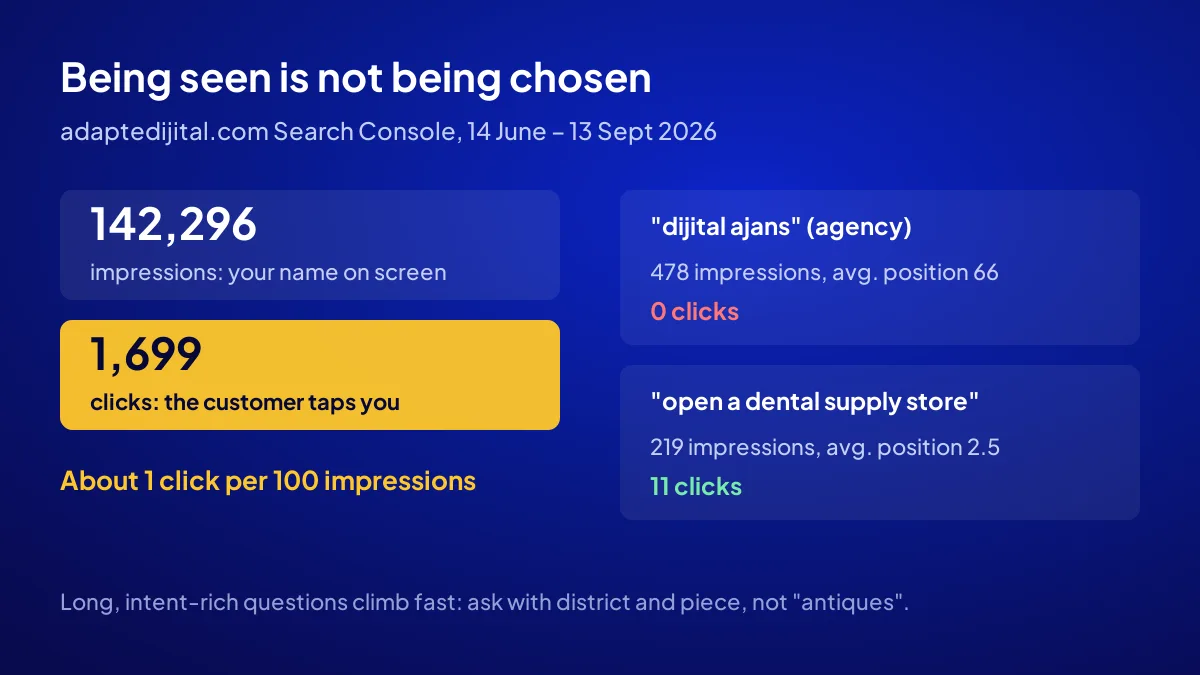
Being seen means your name appears on a screen; being chosen means the customer taps and sets off. Our own Search Console data shows the gap: between 14 June and 13 September 2026, 142,296 impressions and 1,699 clicks. Roughly one in a hundred clicks. Your new shop will meet the same gap.
Here is what I have seen
I have been watching search results for fifteen years and I keep testing more than 100 domains and sites. With a keyword domain you can reach the top within a month for a term you could not crack for years. The lesson: the right name and the right question come before a big budget.
A system idea
Every sold piece can become a Q&A article on your website. The question a customer asks you today, “How can I tell an original Thonet chair?”, someone will ask Google tomorrow.
Which tactics hurt a premium boutique?
In a selective district the most expensive mistake is looking cheap or doubtful. Endless discounts, inflated origin claims, unlabelled sponsored posts and bought reviews break trust on the first screen, and some also break the rules. The six tactics below ring the phone today and empty the till tomorrow. Try none of them.
- A firm era or famous maker on an undocumented piece.
- An inflated “old price” instead of the ten-day lowest.
- Reviews bought with money, gifts or discounts.
- Sponsored posts without the “reklam” label.
- An “antique” label on every old item.
- The district name stuffed into the business name on the map.
Brand or shop: which campaign fits you?
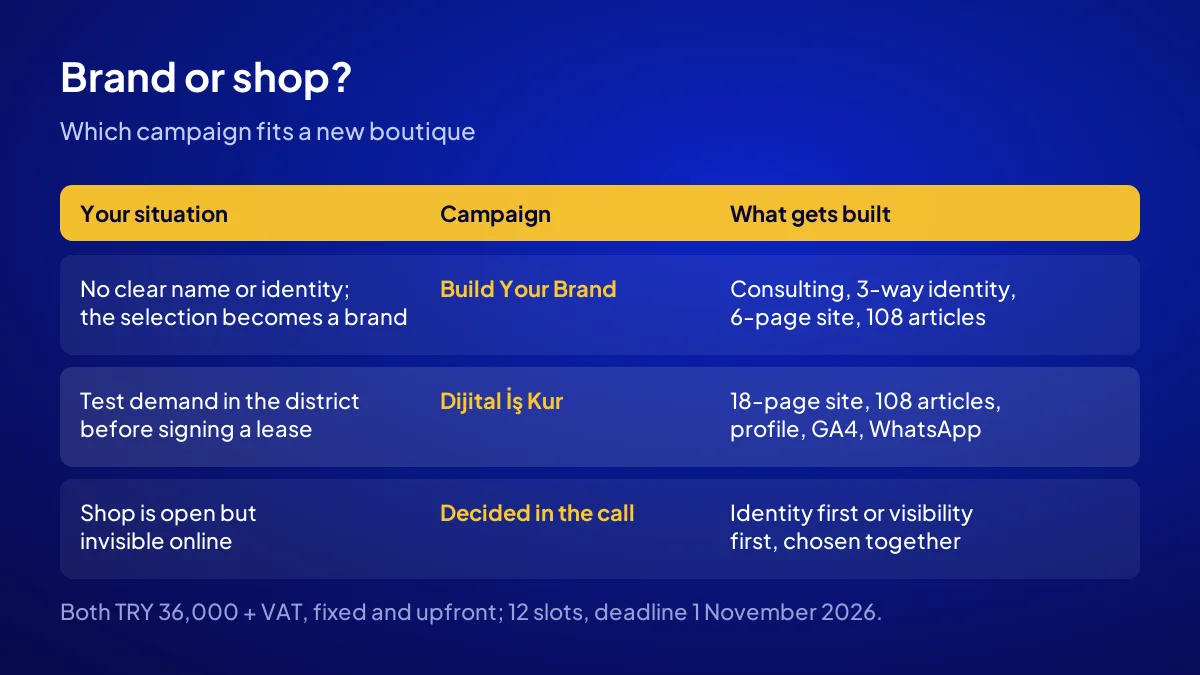
A niche boutique is a brand business: customers come for the selection and the eye behind it. So our main route is the “Senin de Dijital Markan Olsun” (Build Your Digital Brand) campaign: TRY 36,000 + VAT, fixed and paid upfront; with 20% VAT that is TRY 43,200, so check the current rate on the invoice. 10% coupon, 12 brand slots, deadline 1 November 2026.
| Your situation | Suitable campaign | What gets built |
|---|---|---|
| No clear name or identity yet; you want a brand | Build Your Digital Brand | Brand consulting, TÜRKPATENT preliminary search, digital identity in 3 directions, 6-page brand website, 108 articles, brand guideline, social media kit |
| You want to test demand before signing a lease | Start a Business Online (Dijital İş Kur) | Domain suggestion, site with 6 main + 12 sub pages, 108 articles, 3 social accounts, Google Business Profile, GA4 and Search Console, WhatsApp Business |
| The shop is open but invisible online | Suggested in the needs call | Identity first or visibility first, decided together |
What do you check at the end of the first 90 days?
Look at three numbers: profile searches and direction requests, viewing requests and sales. The first two come from the profile’s performance screen, the third from your till. A twelve-week table shows a direction; decide by that, not by the mood of one quiet Tuesday.
Weekly plan
To plan the 90 days after opening week by week, continue with the new boutique first customer plan. It shows in detail the order in which trust is built.
Let me ask you one thing
If a customer looks you up tonight, will they see the era and size of your best piece on the first screen? If not, the first step is clear: build your name and story online, then open the window.
Quick Summary
- For antiques, ask the permit question in writing before opening.
- Since 1 August 2026, rules on discounts, reviews and sponsored posts are stricter.
- Customers decide on the phone across three screens.
- The nine steps fall into three layers: identity, window, trust.
- Experience is told with a six-field piece ID card, not adjectives.
- On day 90, check three numbers: searches, viewing requests, sales.
Short Glossary
Provenance: Provenance is the record of origin used to show where a piece comes from and whose hands it passed through.
Primary category: Primary category is the main classification used in a Google Business Profile to say in one phrase what the business is.
Availability check: Availability check is the preliminary search used to see in advance whether a brand name may clash with similar marks at registration.
Next Step
To build your shop’s name, identity and website online before opening, apply to the Build Your Digital Brand campaign. Fill in the form and mention your coupon code in the call.
Frequently Asked Questions
Sık Sorulan Sorular
According to the Ministry of Trade, the amendment in Official Gazette No. 33297 of 1 July 2026 has been in force since 1 August 2026. The pre-discount price is the lowest price of the last ten days. Posts made for a benefit must carry the label “reklam” (advertisement) or “tanıtım” (promotion). Reviews from people whose purchase cannot be verified may not be published.
Six fields are enough: era, origin, material, size, condition and any intervention. Keep it identical on the tag, the piece page and the invoice. We look at what the customer is really buying in what boutique customers want.
Shoot in daylight on a plain background from at least four angles: front, side, detail and flaw. A flaw photo does not lower sales; it lowers returns. Shoot the interior in morning and evening light, so customers see both the piece and the feel of the room.
For “dijital ajans” (digital agency) we appear 478 times at an average position of 66, with zero clicks. For “diş deposu nasıl açılır” (how to open a dental supply store) we average position 2.5 with 219 impressions and 11 clicks. Long, intent-rich questions climb fast. For a boutique: stand out not on “antiques” but on “restored Thonet chair in Bakırköy”.
Reviews are a new shop’s slowest-growing capital. Ask politely after the sale and give nothing in return. If a customer sends a photo of the piece in their home, share it with permission; a piece in a real living room says more than a long description.
A competitor bending the rules gives you no right to do the same. A shop that shouts “last day” every week raises doubt in Sarıyer and Mavişehir alike. Keep telling the story of your pieces.
Consulting defines positioning, audience and brand voice. A TÜRKPATENT preliminary search and availability check follow; this is not a legal opinion. Three directions are offered for logo, colour and typeface, and the chosen one is finalised. Included: the domain in your name, one year of hosting, a 6-page site, 108 AI SEO-ready articles in 6 keyword groups, a digital business card and a handover video.
If you have not signed a lease yet, the Dijital İş Kur campaign costs the same, TRY 36,000 + VAT. Its aim is to open online before you open the door: see who searches in the district, then raise the shutter. It also has 12 slots; the application deadline is 1 November 2026 and the delivery schedule is given in writing.
Fill in the form and mention any coupon code in the application or the call. Consulting starts with payment; if you have no name, one is suggested. Then the identity, website and 108 articles are built. Details are on the Build Your Digital Brand campaign page.
Profile searches often stir in the first weeks; piece pages and Q&A articles build up over months. So do not say “it isn’t working” in month one. An antique shop is a shop of patience anyway; a century-old console loses nothing by waiting three months for its owner. Neither do you.
Trading items that qualify as cultural property falls under Law No. 2863 and may need permission from the Ministry of Culture and Tourism. Ask the provincial culture and tourism directorate before opening.
Under the amendment announced by the Ministry of Trade, the pre-discount price is the lowest price applied in the last ten days before the discount starts. Do not show a higher figure on the tag.
Yes. Google can show a profile up to 90 days before the opening date entered. Prepare the profile once the opening month is certain.
TRY 36,000 + VAT, fixed and paid upfront; with 20% VAT that is TRY 43,200 (check the current rate on the invoice). A 10% coupon applies; mention the code when you apply.
Yes. A name is suggested during consulting and checked with a TÜRKPATENT preliminary search, which is not a legal opinion. A trademark filing is a separate offer with a trademark attorney.
The domain is registered in the customer’s name. One year of hosting is included; renewing hosting in the second year is up to the customer.
Updated: October 2026