
Boutique promotion methods compared: maps, website, social media and AI side by side
Boutique promotion methods come down to four routes: the Google Maps business profile, your website, social media such as Instagram, and AI answers. Weighed on six criteria, the winner for a newly opened niche boutique, vintage or antique shop is the “map + website” pair. Instagram becomes the shop window, and AI answers feed on what the site builds up.
Order matters, because the four do different jobs: the map shows the way, the site carries trust, Instagram sparks curiosity, and AI answers arrive last but stay longest.
Which 6 criteria weigh the four methods?
We use six criteria: time to first result, cost type, accumulation, ability to carry a piece’s story, trust signal and measurability. Price alone is not one: a cheap method that does not accumulate is paid from scratch every month, while one that accumulates gets cheaper over time. For selective clients, story and trust weigh as much as price.
Why accumulation matters so much
Accumulation asks whether today’s effort still brings customers tomorrow. An Instagram post lasts a few days in the feed; a collection page can be found for years. What keeps working after the shutters come down accumulates.
Why story is a separate criterion
A vintage or antique client asks about a piece’s period, size, condition and origin. A channel that cannot carry this information in an orderly way loses half the sale. In a niche boutique, the designer’s name and the material play the same role.
How do the four methods look in one table?
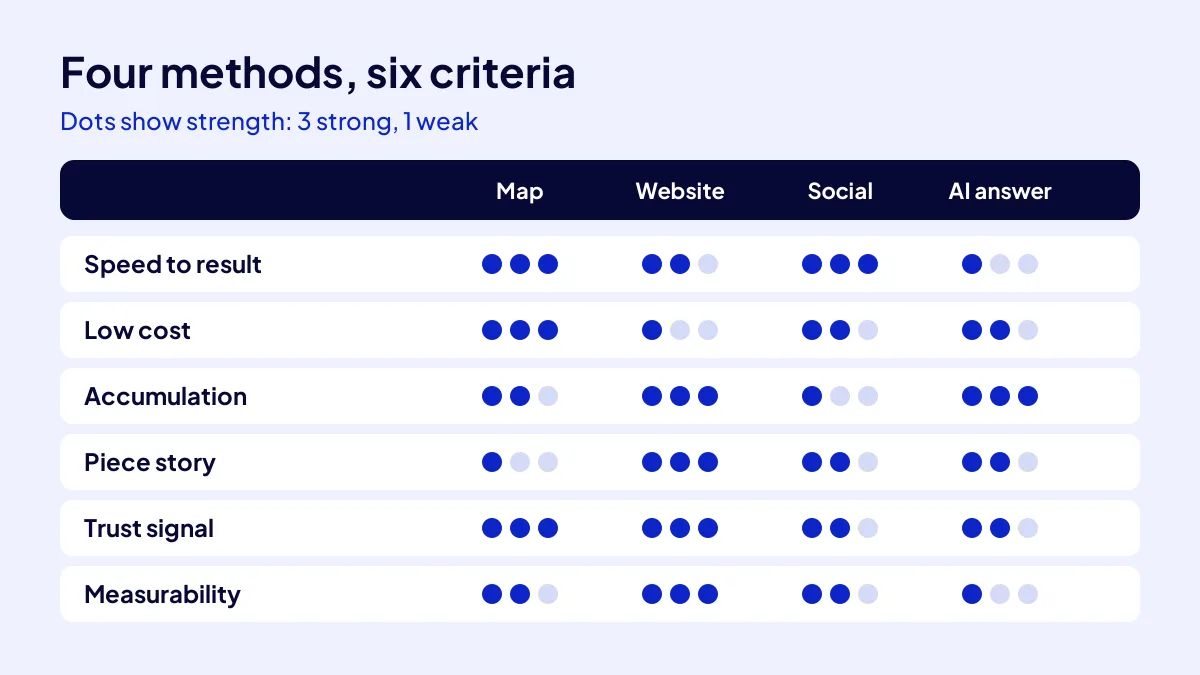
No method leads on all six criteria. The map is fast and trusted but storyless; the site carries story and trust but starts slowly. Instagram is fast but does not accumulate; AI answers are slowest and depend on the site. The last row says who each suits.
| Criterion | Map (Business Profile) | Website | Social media | AI answer |
|---|---|---|---|---|
| Time to first result | Short after verification | Within months | Within days | Longest |
| Cost type | Free, takes effort | Setup + yearly hosting | Free, constant effort | No separate fee, depends on site |
| Accumulation | Medium | High | Low | High |
| Piece story | Weak | Strong | Medium | As much as it takes from the site |
| Trust signal | Reviews, address, hours | Returns, shipping, condition note | Visual consistency | Being mentioned elsewhere |
| Measurability | Profile performance | GA4, Search Console | In-app insights | Limited |
| Who it fits | Everyone, day one | Any shop with a story | Shops rich in visual products | Those who build the site and wait |
The first lesson from the table
The two high-accumulation methods, the site and AI answers, feed from the same source. A shop that skips the site leaves the AI column empty too.
In what order does a selective client use the four methods?
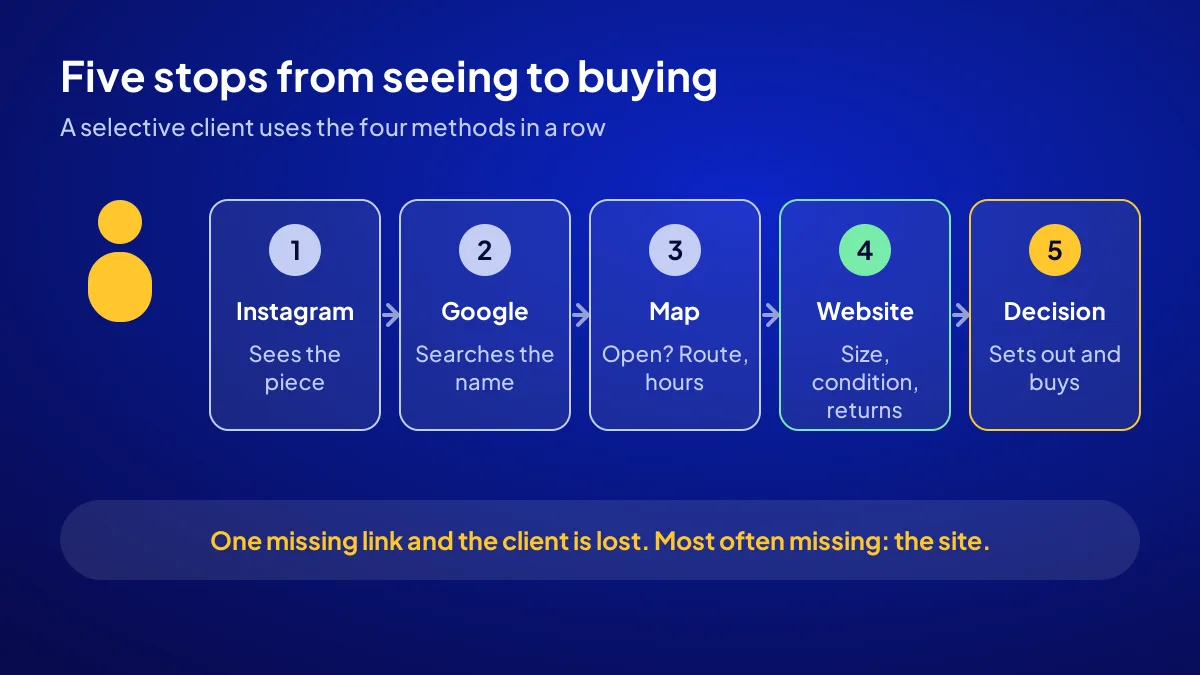
A selective client uses all four in a row. Say someone in Bakırköy sees a vintage dress on Instagram, searches the shop’s name, checks the map for hours and reads size and returns on the site, often deciding there. One missing link and the client is lost.
Instagram’s real job
Instagram is the shop window: it sparks curiosity and shows the shop’s taste. Closing the sale needs orderly answers on size, price, condition and returns, a gap we covered in why Instagram is not enough on its own.
The map’s limit
The map gives the address, hours, reviews and directions. But it has no room to explain which period an antique console belongs to. A client who arrives from the map looks for the story somewhere else.
Which method carries trust in vintage and antiques?
The website carries trust best, because permanent, orderly information lives there: condition note, period, size, returns and shipping, in the same format for every piece. A selective client notices that consistency. Map reviews support trust but cannot show on their own that a piece is genuine.
Why a condition note sells
A condition note honestly states a piece’s flaws: “small stain on the left sleeve,” “drawer handle replaced.” A shop that names the flaw up front lowers the risk of returns and complaints. The client also knows there will be no surprises.
An extra trust question for antiques
Trading antiques or items that may count as cultural property follows special rules in Türkiye. Before selling, ask the Ministry of Culture and Tourism or your regional museum directorate whether you need a permit, and state it on the site if you have one.
What does showing up in AI answers depend on?
According to Google, no additional requirements or special optimizations are needed to appear in AI Overviews or AI Mode. A page needs to be indexed and eligible to show with a snippet in regular Search. So the fuel for the AI column is a well-built site that answers real questions; nobody can guarantee a recommendation.
Who needs which: three shops, three starting orders
BU BÖLÜMÜN ÖZETİ
- A vintage clothing shop in Kadıköy
- Antique objects and furniture in Sarıyer
- A niche design boutique in Mavişehir
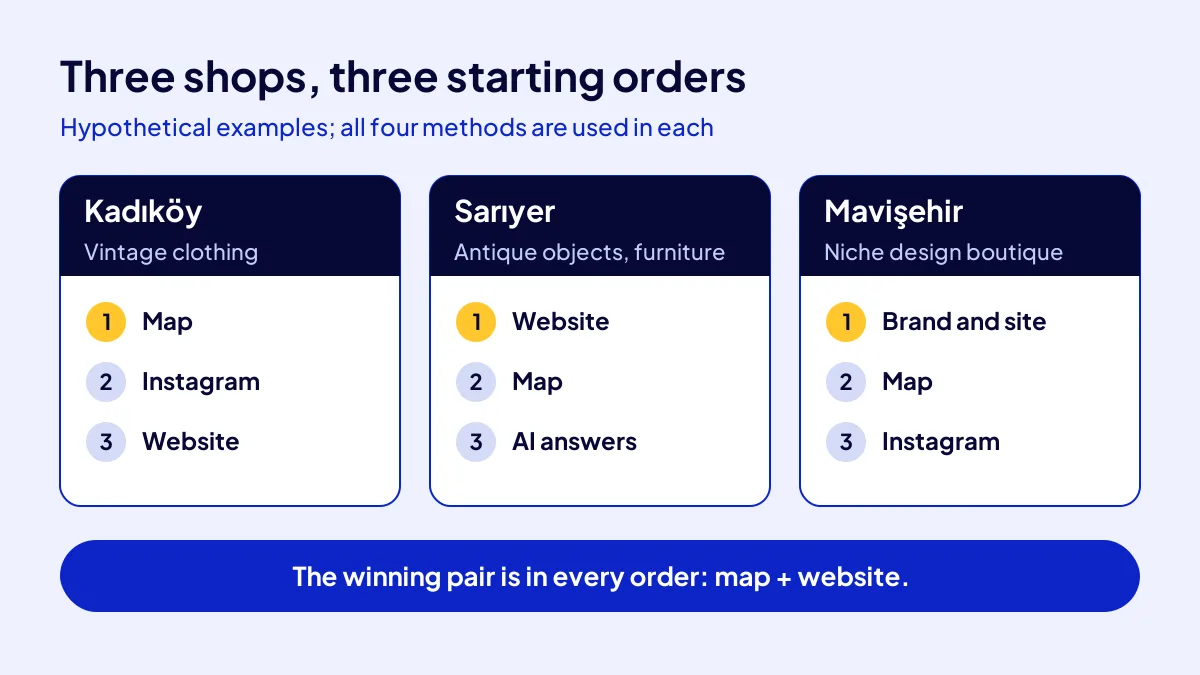
The starting order depends on what the shop sells and how the client arrives. The three shops below are hypothetical; each uses all four methods, and what changes is which gets effort first.
A vintage clothing shop in Kadıköy
The product is visual and turns over fast. Order: map, Instagram, site. The site gathers each week’s new arrivals on a category page.
Antique objects and furniture in Sarıyer
Pieces are expensive and decisions are slow. Order: site, map, AI answers. Instagram shares only selected pieces; the story lives on the site.
A niche design boutique in Mavişehir
Clients look for the designer and the brand. Order: brand identity and site, map, Instagram. If the brand name is inconsistent, all four scatter.
Which one wins, and why?
The winner is the “map + website” pair: the map shows the way and signals trust, while the site carries the story, accumulates and fuels AI answers. Instagram is the window that feeds the pair. A shop leaning on one channel sees the till stop when that channel goes quiet.
The general channel question
We covered which business needs which channel in general terms in which channel do I need. The boutique’s full promotion plan is in the new niche boutique promotion guide, and the first three months are in the first 90 days plan.
Building the pair with the brand
In a niche boutique, site and map grow stronger with a consistent brand. The Build Your Digital Brand campaign sets up brand consulting, a TÜRKPATENT preliminary search (not a legal opinion), logo, colours and typeface, a domain with a 6-page brand site and 108 AI SEO-ready articles for TRY 36,000 + VAT, fixed. Places are limited to 12 brands; the deadline is 1 November 2026. Details are on the campaign page.
Quick Summary
- Four methods: map, website, social media, AI answers.
- Six criteria: time, cost type, accumulation, story, trust, measurement.
- The winning pair is map + website; Instagram becomes the window.
- AI answers need no extra requirement; an indexed, well-built site is the condition.
- In vintage and antiques, the condition note and the site carry trust.
- The starting order depends on what the shop sells.
Short Glossary
Accumulation: Accumulation is the criterion used to describe whether a promotion effort still brings customers months later.
Condition note: A condition note is the description used to state a vintage or antique piece’s flaws and repairs openly before the sale.
Snippet: A snippet is the term used for the short text shown under a page title in search results.
Next Step
To set up the map and the site together with a consistent brand, apply to the Build Your Digital Brand campaign. Fill in the form and add the coupon code; consulting starts with payment.
Frequently Asked Questions
Source: Google Search Central — AI features and your website
Sık Sorulan Sorular
Ads are not a method; they are an accelerator for one of these four channels. We worked out how much to set aside, line by line, in the niche boutique marketing budget article.
In most newly opened shops, the missing link is the website. A client coming from Instagram searches your name, finds only the map, and the question goes unanswered.
Pages that answer the client’s questions plainly: “where to buy a vintage jacket in Kadıköy,” “how to tell an antique console’s period.” If those questions find orderly answers on the site, AI systems can read them too.
It cannot be set up on its own. Expecting AI mentions before the site builds up is like expecting customers at empty shelves.
For most boutiques, the first job is the Google Business Profile and the website. The map shows the way on day one; the site carries the story and trust. Instagram is added as the window that brings clients to the pair.
No. According to Google, there is no extra requirement to appear in AI Overviews; the page must be indexed and eligible for a snippet. Nobody can guarantee a recommendation or a mention.
No. The package is TRY 36,000 + VAT, fixed; with 20 percent VAT that is TRY 43,200 (check the current rate on the invoice). Google and Meta ads are a separately priced add-on. A 10 percent coupon applies; mention the code when you apply.
Updated: October 2026