
Finding customers for a new deli: 9 thresholds from tasting plate to regular basket
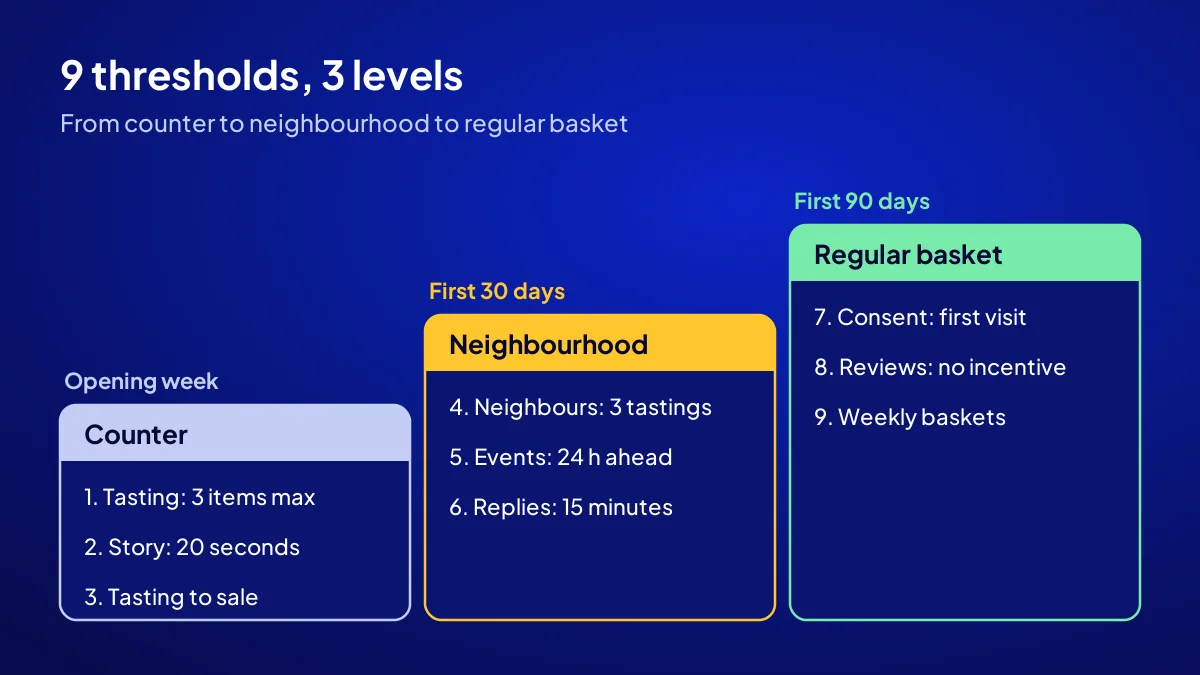
Finding customers for a new deli takes 9 steps in three places: 3 at the counter, 3 in the neighbourhood and 3 in the regular basket. Each step has a threshold: items on a tasting plate, reply time, weekly regular baskets. A shop that measures them weekly gathers first customers without burning an ad budget.
In a gourmet deli the first sale happens through tasting. A selective customer will not buy an expensive aged kashar untasted. So one sum sits at the centre: how many tastings must become sales for the plate to pay for itself. Know it in your opening week.
Why does finding deli customers start at the counter?
Because in Bakırköy as in Çankaya, the first visitor to a gourmet deli tastes first, buys second and returns last. The order follows that: first sale at the counter, recognition in the neighbourhood, then the regular basket. Make sure the counter sells before you bring people to it.
Three groups, nine thresholds
Counter: tasting and story. Neighbourhood: partners and orders. Basket: consent, reviews, return visits.
Which 3 thresholds build the first sale at the counter?
BU BÖLÜMÜN ÖZETİ
- 1. Tasting plate: 3 items at most
- 2. Story: 20 seconds per item
- 3. Tasting to sale: count daily
At the counter you measure items per tasting plate, seconds per introduction and how many of 10 tastings become sales. None needs a budget, only routine. The third shows whether tasting earns money.
1. Tasting plate: 3 items at most
Offer no more than 3 items per tasting: one cheese, one cured meat, one meze. More confuses the palate. Keep each portion toothpick-sized.
2. Story: 20 seconds per item
Three facts are enough: where it comes from, how long it aged, what it goes with. A story longer than 20 seconds sends the next person in the queue out the door.
3. Tasting to sale: count daily
A sheet on the counter with two columns: tasting given, sale made. Write the rate down before you pull the shutter in the evening.
Which 3 thresholds matter in the neighbourhood?
BU BÖLÜMÜN ÖZETİ
- 4. Neighbours: 3 joint tastings in 30 days
- 5. Event orders: 24 hours ahead
- 6. Message reply: 15 minutes
The neighbourhood group is the work of the first 30 days. You hold joint tastings with neighbours, set a pre-order rule for events and reply fast. Selective customers often hear about a new deli from a shopkeeper they trust. How you appear on the map is covered in deli Google Business Profile.
4. Neighbours: 3 joint tastings in 30 days
A bakery, wine shop, florist or boutique café. Sourdough with cheese is a natural pair.
5. Event orders: 24 hours ahead
Take meze platter orders for dinners and office meetings at least 24 hours ahead. Offer platters in three sizes by guest count.
6. Message reply: 15 minutes
Reply within 15 minutes in opening hours. “A platter for 8 tonight?” goes elsewhere if the answer is slow.
Which 3 thresholds turn customers into regular baskets?
A regular basket is the same customer on the same day each week, and it is what keeps a deli’s till turning. Here you ask for consent, request reviews honestly and count weekly regulars, all within 90 days of the first sale.
7. Consent question: at every first purchase
Ask “shall we tell you when the new cheese batch arrives” and record the answer. Campaign messages need prior consent, managed through Turkey’s Message Management System (İYS).
8. Review request: no incentive, everyone
Ask every customer for a review, but offer no discount, treat or gift in return. Google calls that fake engagement, and asking only happy-looking customers is also banned. Why reviews matter is explained in why Google reviews matter.
How does a tasting plate pay for itself?
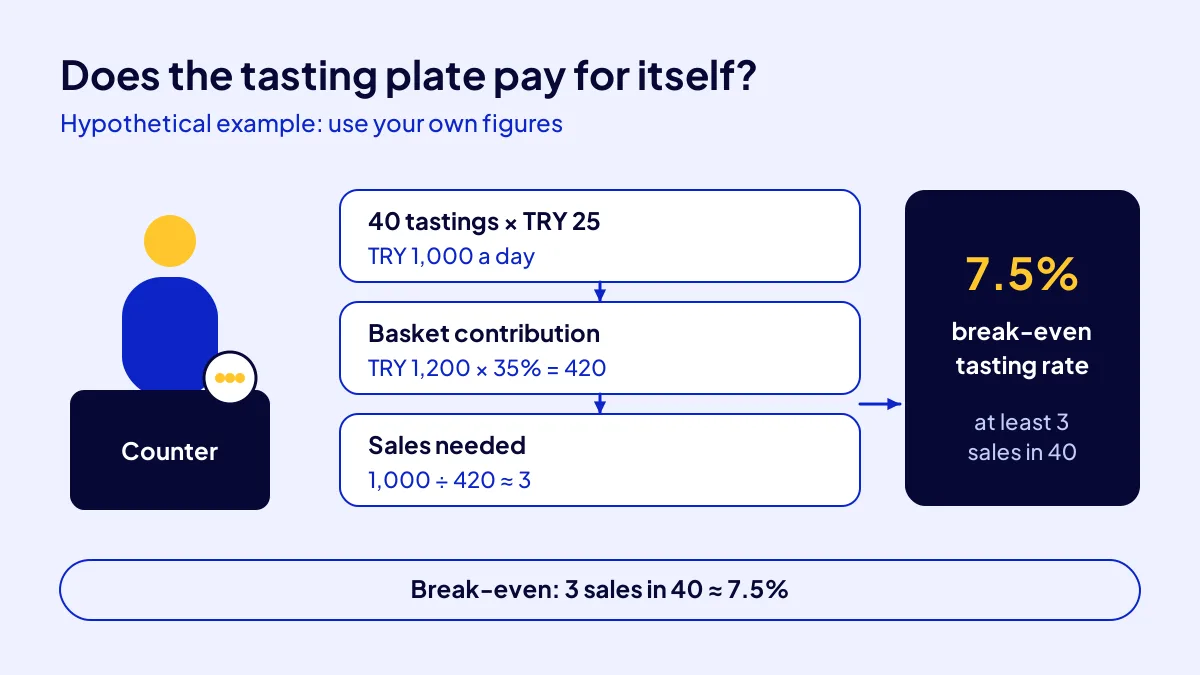
Tasting is a cost of sale. Find the daily tasting cost, the contribution per basket and the sales needed to cover tasting, then divide by daily tastings: that is the break-even tasting rate. Figures are hypothetical; use your own.
| Line | Hypothetical example | Your figure |
|---|---|---|
| Cost per tasting (3 small portions) | TRY 25 | …… |
| Tastings per day | 40 | …… |
| Daily tasting cost (25 × 40) | TRY 1,000 | …… |
| Average basket | TRY 1,200 | …… |
| Contribution per basket (after product cost, 35%) | TRY 420 | …… |
| Sales covering tasting (1,000 ÷ 420) | about 3 | …… |
| Break-even tasting rate (3 ÷ 40) | about 7.5% | …… |
| Today’s tasting-to-sale rate | …… | …… |
Which shortcuts burn a new deli?
Some shortcuts fill the shop in week one and empty the till afterwards. Selective customers spot them and leave quietly; lost trust costs more than a lost basket.
- Offering discounts, treats or gifts in exchange for reviews.
- Sending campaign texts or emails to people who have not consented.
- Giving everyone a taste of everything without measuring.
Most common mistake: turning opening day into “free meze day”. The crowd does not return at shelf price. Run a measured daily tasting instead.
Getting set up with a ready recipe
To appear in “deli” and “meze” searches, the Get Visible Online campaign offers three recipes; the Website Recipe sets up profile and mobile page, the Google Ads Recipe search campaigns and conversion tracking. TRY 36,000 + VAT, fixed and paid upfront, for 3 months; ad spend is not included. Details on the campaign page.
How do you fill in the weekly 9-threshold template?
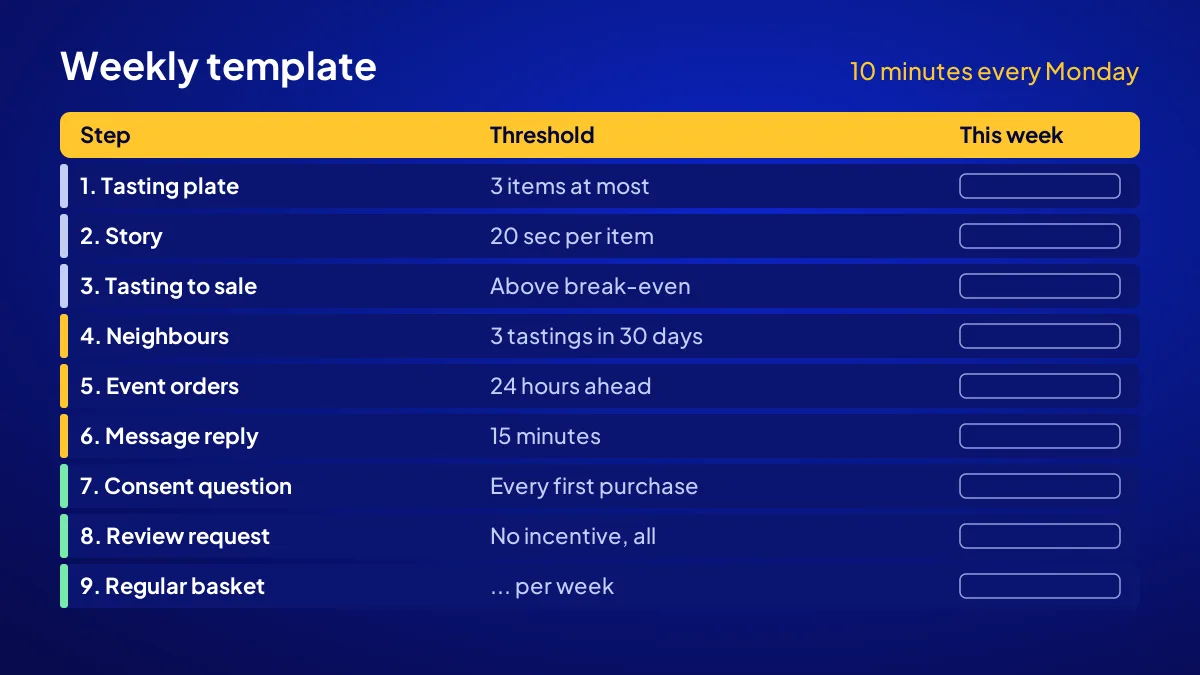
Spend 10 minutes every Monday before opening. The row below threshold is the week’s single job. The full framework is in the new deli promotion guide, the order of the first three months in the first 90 days plan.
| Step | Threshold | This week |
|---|---|---|
| 1. Tasting plate | 3 items at most | …… |
| 2. Story | 20 seconds per item | …… |
| 3. Tasting to sale | Above break-even rate | …… |
| 4. Neighbours | 3 joint tastings in 30 days | …… |
| 5. Event orders | 24 hours ahead | …… |
| 6. Message reply | 15 minutes | …… |
| 7. Consent question | Every first purchase | …… |
| 8. Review request | No incentive, everyone | …… |
| 9. Regular basket | …… per week | …… |
Monday, 10 minutes
Copy last week’s tasting sheet, reply times and order book into the template.
Month-end comparison
Put four weeks side by side. A row below threshold two weeks running is next month’s main job.
Quick Summary
- Finding customers means 9 thresholds in three groups: counter, neighbourhood, regular basket.
- A tasting plate holds 3 items at most, with 20 seconds of story each.
- Break-even tasting rate: daily tasting cost ÷ basket contribution ÷ daily tastings.
- Hold 3 joint tastings with neighbours in the first 30 days.
- Get consent before campaign messages; ask for reviews without incentives.
- Fill in the template every Monday in 10 minutes.
Short Glossary
Break-even tasting rate: The break-even tasting rate is the share of tastings that must become sales for tasting costs to be covered.
Basket contribution: Basket contribution is the amount left from a purchase after product cost, used to cover fixed costs.
Fake engagement: Fake engagement is the Google policy term used for reviews obtained through incentives or not based on real experience.
Next Step
To carry your counter into the neighbourhood and into search, apply to the Get Visible Online campaign. Fill in the needs form and get the recipe that fits your deli.
Frequently Asked Questions
Source: Google Maps contribution policy — Fake engagement
Sık Sorulan Sorular
The one number you check each week: hit or missed. These are starting suggestions; adjust after four weeks.
Count customers who come on the same day every week. Weekend breakfast basket pre-orders until Thursday make it visible.
Note: since an amendment published on 1 July 2026, posts made in return for a benefit, such as a free platter, must carry an advertising or promotion label.
In the example, if fewer than 3 of 40 tastings become sales, tasting does not pay. With 8 sales from 40, it is the cheapest way the shop finds customers.
Many tastings, few sales: go back to steps 1 and 2. Sales but small baskets: suggest honey or crackers with the cheese. Few tastings: the problem is the neighbourhood, so move to step 4.
The line-by-line split is in deli marketing budget.
Through 9 thresholds in three groups: counter (tasting, story, tasting-to-sale rate), neighbourhood (joint tastings, event orders, fast replies) and regular basket (consent, reviews, weekly regulars).
No. Google treats incentives for reviews as fake engagement. Asking every customer without an incentive is allowed.
No. TRY 36,000 + VAT (TRY 43,200 at 20%; check the current rate on your invoice). Ad spend is paid to the platform separately.
Updated: October 2026