
Deli promotion methods compared: maps, website, social media and AI answers
Deli promotion methods for a new gourmet deli and meze shop come down to five paths: the Google Maps profile, the website, Instagram, AI answers and an opt-in WhatsApp order list. Weighed on six criteria, the first 90 days are won by the “maps + website” pair. Maps catch the person looking for cheese nearby right now; the website tells the Saturday host the price, the ordering route and where the produce comes from.
Instagram dresses the window but collects orders in a scatter. AI answers build slowly. The WhatsApp list is the cheapest repeat channel, but it only works after a customer has come once. Criteria first, then the table, then who needs what.
Which 6 criteria weigh deli promotion methods?
A meze shop’s criteria differ from an ordinary shop’s. The customer pays for a plate of meze, a wedge of aged cheese or an evening table; that is a decision of taste and trust. So tasting trust and claim risk sit next to cost and speed. The general logic of picking channels is in our guide which channel do I need; here are only this trade’s criteria:
- Tasting trust: can it show flavour, freshness and origin?
- First-month effect: does it bring people in within 30 days?
- Accumulation: what is left when effort or money stops?
- Table orders: does it collect weekend and party orders neatly?
- Repeat purchases: does it bring the weekly customer back?
- Claim risk: how likely is it to break labelling or ad rules?
What does the side-by-side table show?
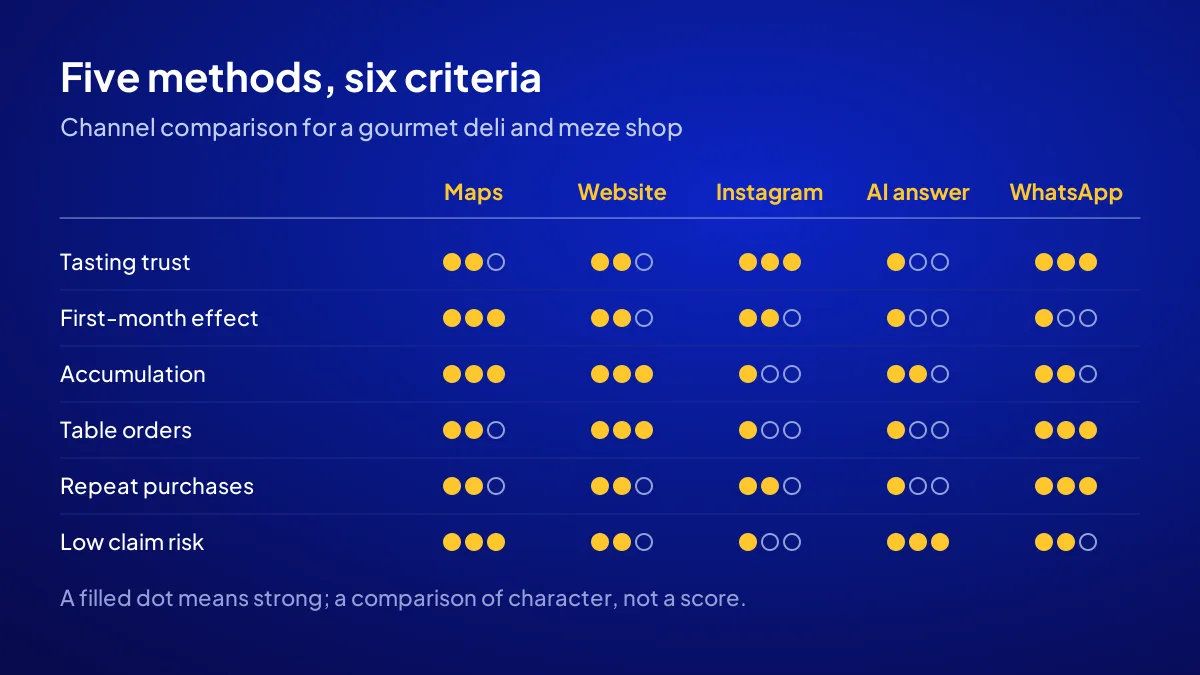
The table compares character, not figures, because budgets differ from shop to shop. Read it column by column. You will see which channel builds up and which stops when you stop. The money behind each channel is worked out in our deli advertising budget article.
| Criterion | Maps profile | Website | AI answer | WhatsApp list | |
|---|---|---|---|---|---|
| Tasting trust | Photos and reviews | Origin, menu | Strong visually | Indirect | Personal, strong |
| First-month effect | Fast | Medium | Medium | Slow | None until customers exist |
| Accumulation | Grows with reviews | Grows with pages | Lost in the feed | Builds | List grows |
| Table orders | Calls and directions | Form and order page | Scattered in DMs | Points elsewhere | Direct |
| Repeat purchases | Medium | Medium | Medium | Weak | Strong |
| Claim risk | Low | Controlled | High | Low | Medium |
| Cost type | One-off setup | Setup + yearly | Constant effort | Accumulated content | Consent and order |
Where do maps and a website part ways?
At two different moments. Someone heading home who types “deli near me” looks at the map and goes to the closest shop with the most reviews. Someone hosting twelve people on Saturday wants the menu, portions and ordering route, and only a website can explain that. The order of the first three months is in the first 90 days plan.
Maps: the instant decision
The profile is set up once and grows with reviews and photos. It brings customers fastest in month one.
Website: the planned order
Party platters, cheese baskets, a weekend meze set. With price ranges and delivery times on the page, phone orders stay short.
Do Instagram and a WhatsApp list do the same job?
No. Instagram gathers new eyes; the WhatsApp list calls back the customer who already came. One is a window, the other a ledger. Why Instagram is not enough on its own is in is Instagram enough. The list is built only from people who clearly opted in.
Instagram’s strength
Pastırma being sliced, olive oil being poured, a platter coming together. Images whet the appetite and get the neighbourhood talking.
The list’s strength
“Fresh lakerda arrived this Friday”, sent to twenty people who opted in, often clears the counter that day. Ask for consent at the first purchase.
When does an AI answer mention a meze shop?
Slowly, but it builds. Google’s developer page says there are no additional requirements or special optimisations to appear in AI Overviews or AI Mode; the page needs to be indexed and eligible to show in Search with a snippet. The same basics apply: correct information, clean pages, a consistent profile. AI Mode launched in Turkey on 18 February 2026.
Which words and images carry risk in posts?
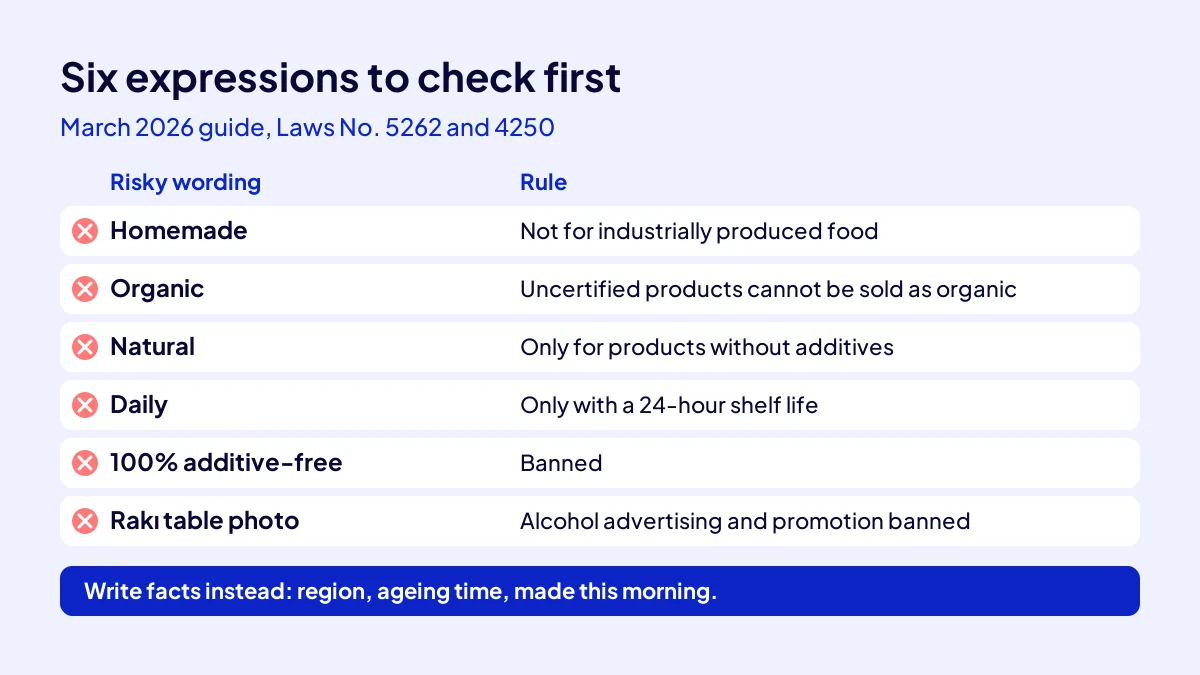
Six expressions need care in food. The Ministry of Agriculture and Forestry updated its labelling guide in March 2026, and news reports describe new limits on some words. Organic claims fall under Law No. 5262. Alcohol promotion is a separate ban. Check this list before you post.
- “Ev yapımı” (homemade): not for industrially produced food.
- “Organic”: uncertified products cannot be sold as organic.
- “Natural”: only for products without additives.
- “Daily”: only for products with a 24-hour shelf life.
- “100% additive-free”, “completely additive-free”: banned.
- A rakı table photo: Article 6 of Law No. 4250 bans any advertising and promotion of alcohol.
What to write instead
Concrete facts instead of risky adjectives: the cheese’s region, its ageing time, the meze made that morning. Concrete facts follow the rules and taste better on screen too.
If you are unsure
Rules vary by product type. Ask the provincial or district agriculture directorate, where your food business registration certificate also comes from.
Who needs what, and which pair wins?
BU BÖLÜMÜN ÖZETİ
- Main-street shop: Moda, Bağdat Avenue
- Side street, order-led: Etiler, Gaziosmanpaşa
- Seasonal shop: Alaçatı, Ilıca
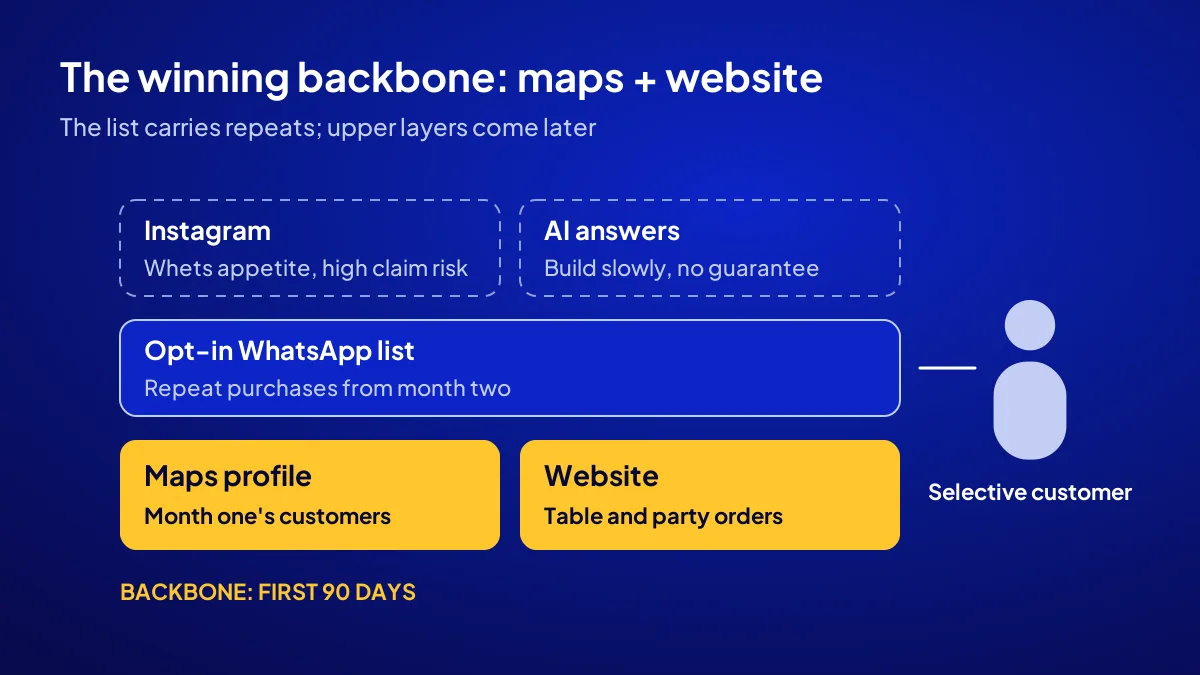
The winner is “maps + website”: maps bring month one’s customers, the website collects table orders and keeps claims in checked copy. From month two the WhatsApp list carries repeat purchases. Instagram and AI answers sit on top of this backbone. The order shifts slightly with location.
Main-street shop: Moda, Bağdat Avenue
With strong foot traffic, maps first, then Instagram. Add the website’s order page in month two.
Side street, order-led: Etiler, Gaziosmanpaşa
Website and maps together, then the WhatsApp list straight away. Table orders are this shop’s real business.
Seasonal shop: Alaçatı, Ilıca
Have profile and website ready before the season; summer crowds come from the map. The overall plan is in the new deli promotion guide. To set up maps and website with a ready recipe, the Website Recipe in the Get Visible Online campaign covers profile, mobile page and basic SEO; TRY 36,000 + VAT, upfront and fixed.
Quick Summary
- The “maps + website” pair wins the first 90 days.
- Maps catch the instant decision; the website catches the planned table.
- The WhatsApp list is the strongest repeat channel, built on consent.
- Instagram whets the appetite but carries the highest claim risk.
- AI answers need no extra requirements; they build slowly.
- Watch “homemade”, “organic”, “natural” and alcohol images.
Short Glossary
Tasting trust: Tasting trust is the criterion used to describe the signals that make a customer believe in flavour and freshness before buying.
Claim risk: Claim risk is the criterion used to weigh how likely a post or ad wording is to break food or advertising rules.
AI Mode: AI Mode is the Google Search view used to give AI-compiled answers with links to a question.
Next Step
To build the maps and website backbone at a fixed price, apply for the Get Visible Online campaign. Fill in the needs form and get the recipe that fits your meze shop.
Frequently Asked Questions
Source: Google Search Central — AI features and your website
Sık Sorulan Sorular
For a selective customer, a deli is a matter of the palate before price. They want to see the counter, the cut and the packaging first. A channel that cannot show this brings people to the door but not inside.
Food is a trade where words are regulated. A single word like “homemade” or “organic” can put a post or ad at risk. The faster and freer a channel publishes, the higher the risk.
The shutter goes up every morning, but effort does not always go to the same place. A channel that accumulates keeps working in a busy week. An Instagram post is forgotten in three days; likes come in, the till does not turn.
Instagram produces new text and images every day, so a non-compliant word slips through there most easily. Website copy is written once, checked and left in place.
A page answering long questions like “a place in Moda taking weekend meze orders” is written today and may start being cited within months. There is no guarantee.
It brings no customers in month one. Grow it third, once maps and website are settled.
Not one channel but a pair: the Google Maps profile and the website. Maps bring month one’s customers; the website collects weekend and party orders. From month two an opt-in WhatsApp list carries repeat purchases.
Be careful. After the March 2026 guide update, “ev yapımı” (homemade) cannot be used for industrially produced food. Write concrete facts instead: that the meze was made this morning, where the ingredients come from.
One of three: Website, Google Ads or Meta Ads Recipe. After the needs form, Adapte suggests the right one; the price is TRY 36,000 + VAT, upfront and fixed. Ad spend is not included.
Updated: October 2026