
People who opened their own deli: 6 starts from cheesemonger to chef and year-one lessons
People who open their own deli come from six roads: the counter-trained cheesemonger, the restaurant meze chef, the ex-manager leaving an office tower, the retired couple, the family bringing Aegean produce to the city and the gourmet chain franchisee. Each has a different strength. Where they struggle in year one is surprisingly the same: they do not write their story down.
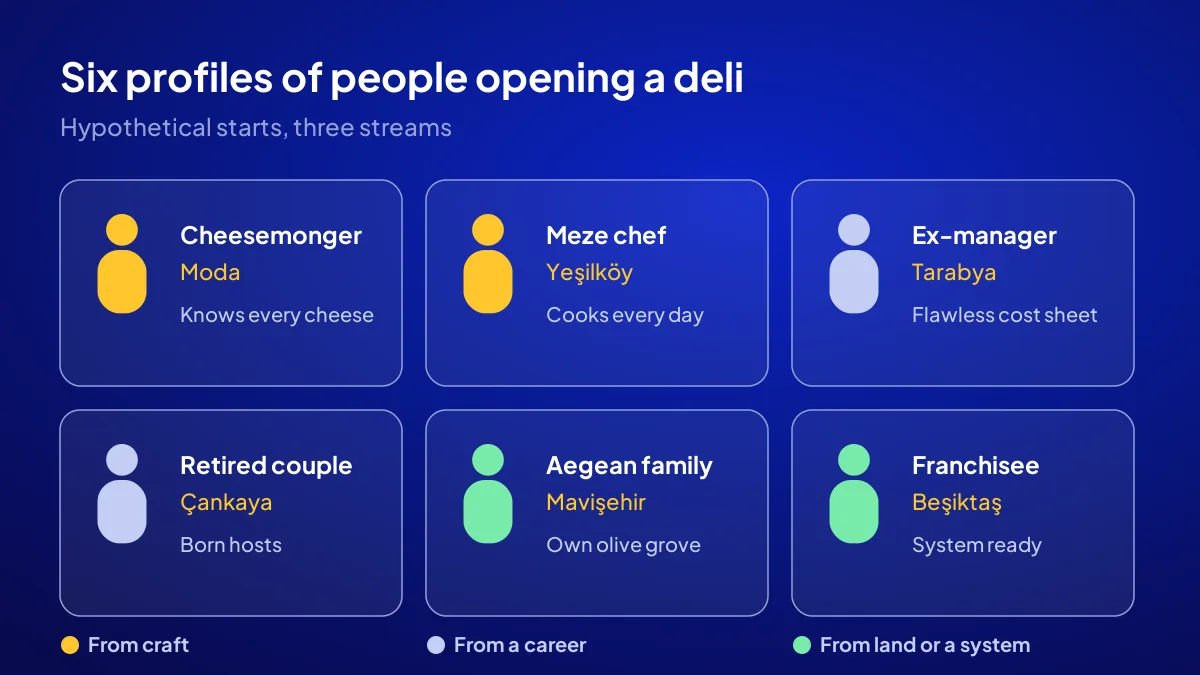
The six profiles below are hypothetical scenes, each showing a type of start rather than a person. Whichever you recognise yourself in, its year-one gap and first digital step are meant for you. Registration and labelling rules vary by profile too.
Which roads lead people to open their own deli?
BU BÖLÜMÜN ÖZETİ
- From craft
- From a career
- From the land and from a system
The roads gather into three streams: craft, career, and the land or a ready-made system. Craft brings product knowledge, career brings planning and hospitality, and the land or a system brings something ready on day one. The stream largely decides where year one will limp.
From craft
The cheesemonger and the meze chef, whose eyes light up when they talk about the product.
From a career
The ex-manager and the retired couple, who plan well and host well but build suppliers later.
From the land and from a system
The Aegean family with the product ready and the franchisee with the system ready.
What do counter-trained owners skip in year one?
Counter-trained owners know the product better than anyone, but they carry that knowledge in speech. The neighbourhood knows them by word of mouth; online they have no name. The skipped task of year one is to write down, once, the story they tell at the counter every day.
The cheesemonger in Moda
After twenty years at another man’s counter, he opens his own shutter in Moda. He knows by heart how long each kashar has aged and which village it came from. Old customers find him; a newcomer searching “good cheese shop in Moda” sees other names. The till turns over, but it does not grow.
The meze chef in Yeşilköy
After fifteen years plating meze in restaurant kitchens, she opens a small meze shop in Yeşilköy with six dishes on the counter every day. Because she produces, registration and labelling matter more to her; she wants to write “homemade” on the menu and must check the rule first.
How does year one go for those who come from a career?
Career-changers understand order and hospitality; where they struggle is product language. One describes everything in numbers; the other hesitates to talk about price. A selective client wants to see both flavour and price clearly. For both, the year-one task is to write the product in the client’s language.
The ex-manager in Tarabya
After twelve years in finance, he opens an elegant deli in Tarabya. His cost sheet is flawless. His product page, though, shows only weight and price, with nothing on taste, origin or pairing. The page gives clients no appetite.
The retired couple in Çankaya
Long-time hosts, they open a small shop in Çankaya. Their gift baskets are loved, but they avoid social media and feel awkward listing prices. Clients who phone come in; those too shy to ask do not.
Where do owners from the land or a system struggle?
Those with a ready product or system start fastest, but face an identity problem. The Aegean family tends to call its produce “village-made” or “organic”. The franchisee loses its own district behind the chain’s name. For both, the year-one task is to write their own name, in a way that fits the rules.
The Aegean family in Mavişehir
With the family grove near Ayvalık, the daughter opens a Mavişehir shop selling olive oil, thyme and sun-dried tomatoes. She considers labelling them “organic” without certification. That word is for certified products; naming the grove’s location and harvest month fits the rules and is more convincing.
The chain franchisee in Beşiktaş
He takes a chain franchise with products and packaging ready. Online, the chain’s main site shows up; his branch does not. A client searching in Beşiktaş cannot find the branch’s hours, delivery streets or its own profile.
Why does year one knot in the same place for all six?
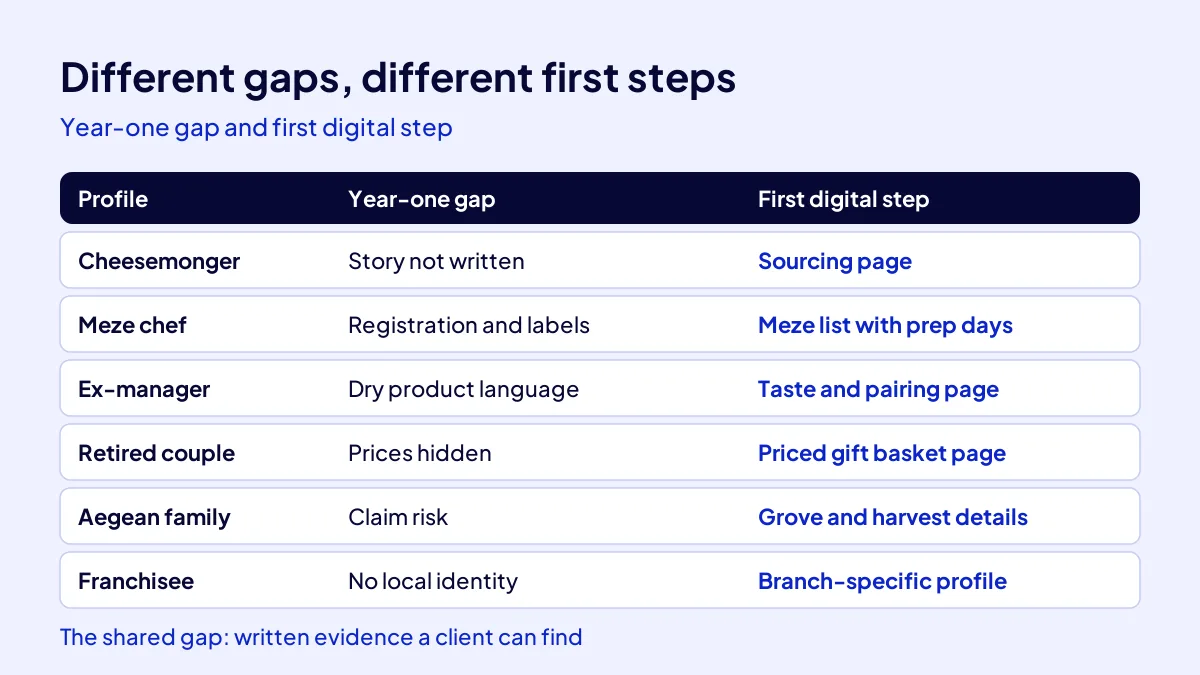
The knot sits in one place: there is no written evidence about the business that a client can find. The cheesemonger speaks, the manager counts, the couple phones, the franchisee leans on the chain. A selective client reads first; finding nothing, they go elsewhere.
| Profile | District | Strength | Year-one gap | First digital step |
|---|---|---|---|---|
| Cheesemonger | Moda | Product and supply knowledge | Story not written | Sourcing page |
| Meze chef | Yeşilköy | Daily production | Registration and label wording | Meze list with prep days |
| Ex-manager | Tarabya | Cost and planning | Dry product language | Product page on taste and pairing |
| Retired couple | Çankaya | Hospitality | Prices hidden | Priced gift basket page |
| Aegean family | Mavişehir | Own produce | Claim risk | Grove and harvest details |
| Franchisee | Beşiktaş | Ready system | No local identity | Branch-specific profile |
The shared lesson
Whichever row you see yourself in, the step in the last column is your first job. What clients really expect from a deli is in what deli clients really buy, and why they stay away is in why clients don’t come to a new deli.
How do registration and labelling rules affect each profile?
BU BÖLÜMÜN ÖZETİ
- Those who sell
- Those who produce
- Those who make claims
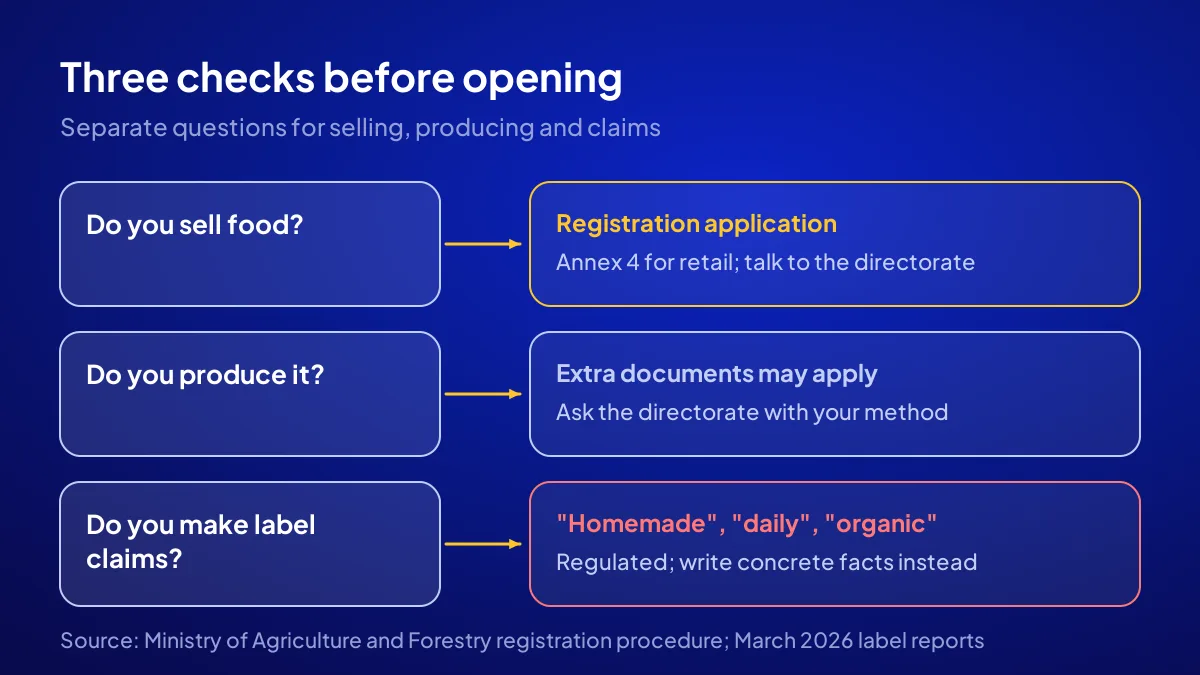
Businesses selling food fall under the Ministry of Agriculture and Forestry’s registration or approval scope. Per the ministry’s registration procedure page, retail, storage and mass catering businesses submit a Business Registration Certificate application and declaration (Annex 4). Food producers may need extra documents depending on the activity. The chef’s load differs from the franchisee’s.
Those who sell
Four of the six mostly sit on the retail side. Discuss the application with your Provincial Directorate of Agriculture and Forestry before opening.
Those who produce
For the chef and the family packing produce, requirements depend on the activity; ask the provincial directorate which documents apply.
Those who make claims
According to news reports from March 2026, the ministry’s labelling guide was updated: industrial products cannot be called “homemade”, and “daily” is limited to products with a 24-hour shelf life. “Organic” is for certified products. If unsure of a word, give concrete information instead.
Why should the year-one name grow into a brand?
Most of the six eventually ask: can the shop’s name also be a product name on the shelf? The family’s olive oil, the chef’s signature meze and the couple’s gift basket all need a name. Chosen well in year one, that name moves onto the bottle, the jar and the basket in year two.
Name and availability
Before choosing a name, check whether someone else uses it. Why branded products sell at higher prices is covered in why branded products sell higher.
A digital identity in one go
The Your Own Digital Brand campaign also covers product brands such as food: brand consulting, a TÜRKPATENT preliminary search and availability check (not a legal opinion), logo and colours, a domain, a six-page brand website and 108 articles. Fixed TRY 36,000 + VAT; 12 brand slots, deadline 1 November 2026. Details are on the campaign page.
The full opening plan is in the new deli promotion guide, and the order of the first three months in the first 90 days plan. Whatever your road, your counter story becomes yours the day it is written.
Quick Summary
- Deli owners come from six roads; their year-one gaps overlap.
- The shared gap: written evidence about the business that clients can find.
- Each profile’s first digital step is to write its own strength down.
- Retail food businesses submit a registration application and declaration.
- Producers should check extra requirements with the directorate.
- “Homemade”, “daily” and “organic” are regulated claims.
Short Glossary
Business Registration Certificate: The Business Registration Certificate is the document used to show that a food-selling or storing business is registered with the ministry.
Availability check: An availability check is the preliminary search used to see whether a chosen name is already registered or applied for.
Sourcing page: A sourcing page is the website page used to tell clients which region and producer each product comes from.
Next Step
To turn your shop’s name into a product brand, apply for the Your Own Digital Brand campaign. Just mention the 10% coupon code on the form.
Frequently Asked Questions
Source: Ministry of Agriculture and Forestry — Food business registration procedure and required documents
Sık Sorulan Sorular
Under the Ministry of Agriculture and Forestry’s procedure, retail food businesses submit a Business Registration Certificate application and declaration (Annex 4). If you produce food yourself, more documents may be needed; check with your Provincial Directorate of Agriculture and Forestry.
According to news reports on the March 2026 labelling guide update, industrial products cannot be called “homemade”. Even if you cook in your own kitchen, ask the provincial directorate first; writing the preparation day instead is a safe route.
Yes. The Your Own Digital Brand campaign includes a TÜRKPATENT preliminary search and availability check; it is not a legal opinion. A trademark application is handled separately with a trademark attorney under a custom offer.
Updated: October 2026