
Deli local search in Beşiktaş, Kadıköy, Çankaya and Mavişehir: the neighbourhood names
Someone living in Kadıköy often does not type “Kadıköy deli”; they type “Moda cheese shop” or “Cadde meze”. In Ankara, “GOP deli” or “Tunalı meze” is more likely than “Çankaya deli”. Deli local search runs on neighbourhood, street and local nickname more than on district name. A new gourmet deli and meze shop enters these searches when those names appear where it lives online: its profile, its website and its reviews.
So local visibility is not an advertising job; it is a dictionary job. First write down what your customers call their area, then put those names in the right places. Below: a dictionary for six areas, how the map decides, and six signals to measure.
What words does someone searching for a local deli type?
BU BÖLÜMÜN ÖZETİ
- District: “Beşiktaş deli”
- Neighbourhood and street: “Bebek meze”, “Cadde cheese”
- “Near me”: the unnamed district
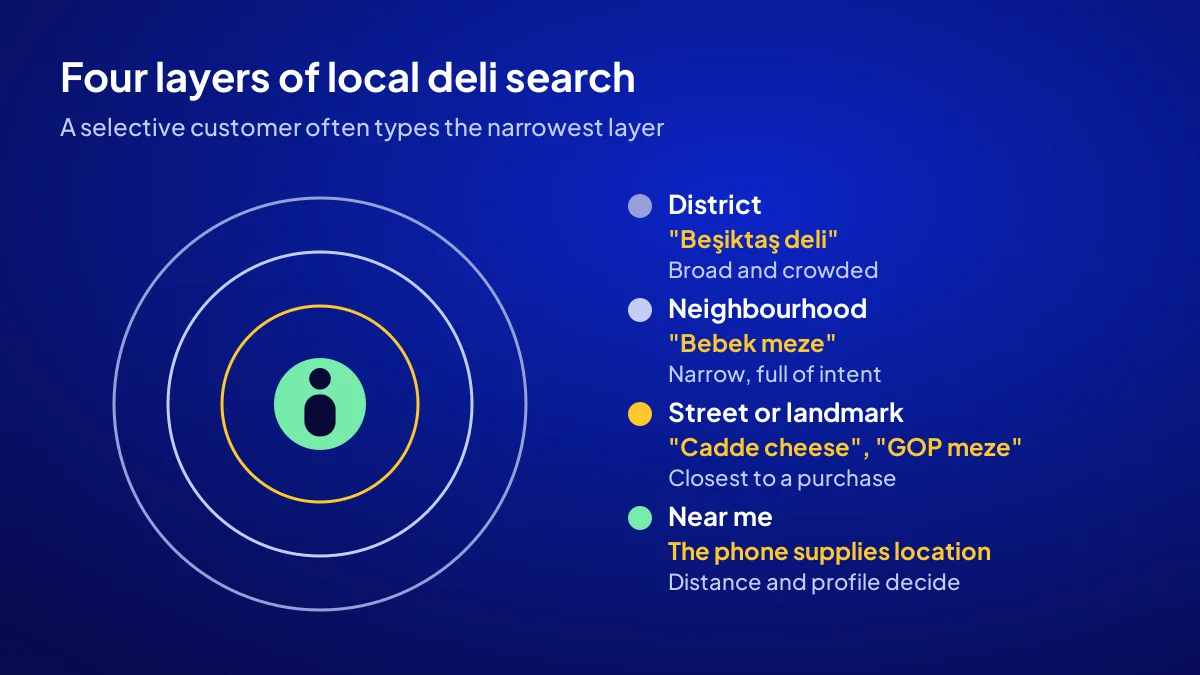
There are four layers: district, neighbourhood, street or landmark, and “near me”. Our observation is that a selective customer often types the narrowest layer, because they want a shop within walking distance. District names are broad and crowded; neighbourhood and street names are narrow but full of intent. The general logic of near-me searches is in showing up in near me searches.
District: “Beşiktaş deli”
Broad and crowded. A new shop struggles to stand out here in its first months.
Neighbourhood and street: “Bebek meze”, “Cadde cheese”
Narrow but close to a purchase. This is the layer a new shop can actually win.
“Near me”: the unnamed district
The customer types no place name; the phone supplies the location. Here map distance and a complete profile decide.
Why does a district dictionary matter more than the district name?
Because people call their areas by their own names, not official ones. Bağdat Avenue is “Cadde”, Gaziosmanpaşa in Ankara is “GOP”, the main street in Bahçelievler is “7th Avenue”. If your profile and website show only the official address, your chances of matching the customer’s own word drop. Build the dictionary by asking your customers.
Which names stand out in the six areas?
The table below is an observation list, not search volume data. For each area it shows neighbourhood, street and nickname names a customer may use, and how they can appear on a website. Complete it with the dictionary you collect at your own till. There are no population or income figures here; we do not print unsourced numbers.
| District | Neighbourhoods and streets | Local nickname or landmark | Sample website sentence |
|---|---|---|---|
| Beşiktaş | Bebek, Etiler, Arnavutköy, Akatlar | Bebek shore | “Weekend meze delivery to Bebek and Etiler” |
| Sarıyer | İstinye, Yeniköy, Tarabya, Zekeriyaköy | Bosphorus line | “Table orders from Yeniköy to Tarabya” |
| Kadıköy | Moda, Caddebostan, Fenerbahçe, Suadiye | Cadde, Kadıköy Market | “Five minutes from Cadde, Moda’s cheese shop” |
| Bakırköy | Yeşilköy, Florya, Ataköy | Yeşilköy shore | “Party platters for Yeşilköy and Florya” |
| Çankaya (Ankara) | Gaziosmanpaşa, Kavaklıdere, Bahçelievler | GOP, Tunalı, 7th Avenue | “Evening meze orders for GOP and Tunalı” |
| İzmir | Mavişehir, Bostanlı (Karşıyaka); Alaçatı, Ilıca (Çeşme) | Alaçatı market | “Every day in Mavişehir, in season in Alaçatı” |
If you cannot change distance on the map, what can you change?
BU BÖLÜMÜN ÖZETİ
- Relevance: the right category and description
- Prominence: reviews and local mentions
- Distance: where the shutter is
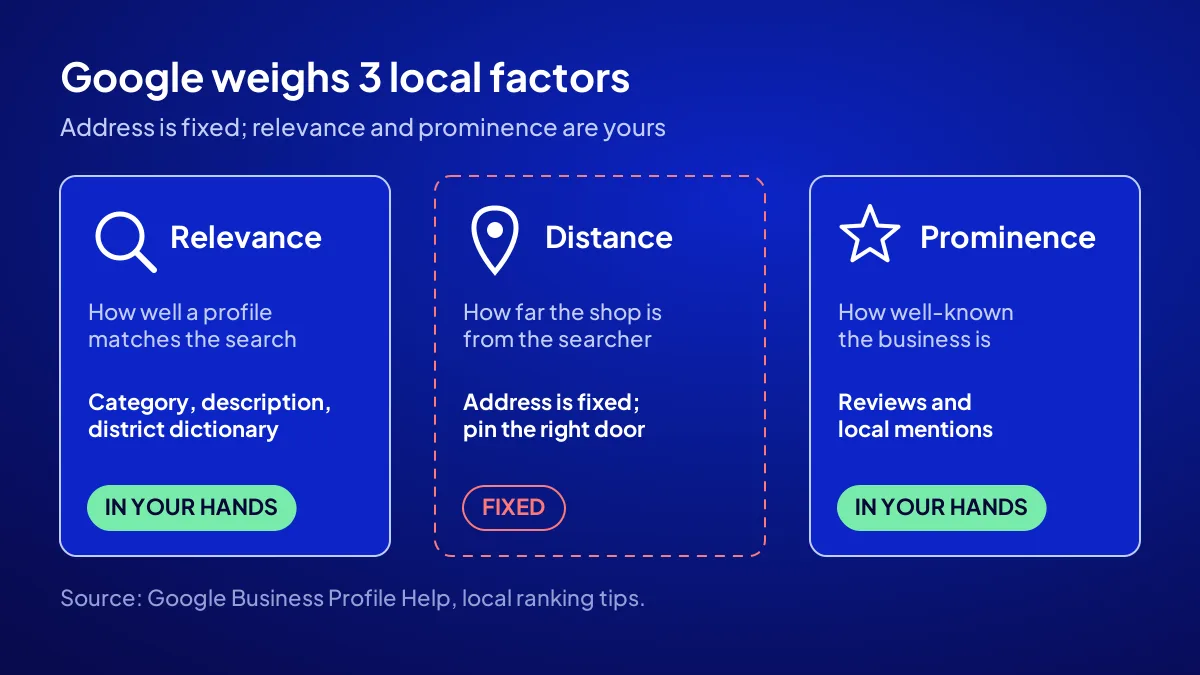
Relevance and prominence. According to Google’s help page, local results are ranked on three factors: relevance, how well a profile matches the search; distance, how far the business is from the searcher; and prominence, how well-known the business is. Your address is fixed. How complete your profile is and how many reviews it earns are up to you.
Relevance: the right category and description
Category and description meet the word the customer types. The right category is covered in deli Google Business Profile.
Prominence: reviews and local mentions
Review count and local recognition grow with time. Do not offer discounts for reviews; since July 2026, reviews whose purchase cannot be verified may not be published.
Distance: where the shutter is
You cannot change it, but you can mark it correctly. Put the pin right at your door; a wrong pin sends customers to the next street.
Where does local information go on the website?
Three places: the contact page, the order page and the “about” text. The contact page gives address, directions and walking time. The order page lists the neighbourhoods you deliver to. The about text tells the shop’s tie to the area. Which pages you need is in the deli website checklist.
The directions sentence
“Walk up from Moda Pier” works better than an address line. Describe the way to your door with a landmark.
Product and place in one sentence
“A cheese platter delivered to Etiler on Friday evening” carries both product and place. Check rule-bound adjectives like “homemade” or “organic” before using them.
How does visibility differ in Çeşme and Mavişehir?
Mavişehir is a year-round residential area; the customer is the same every week and repeat purchases decide. Çeşme, Alaçatı and Ilıca breathe with the season; summer visitors do not know the area and look at the map on their phone. The same shop needs two kinds of visibility in two places.
Mavişehir: year-round loyalty
Profile and an opt-in order list come first. Once a customer finds you, they stop searching and send a message.
Çeşme: preparing before the season
Have the profile, photos and opening hours up to date before the season opens. List off-season hours too; a customer sent to a closed shop does not look again.
Which 6 signals measure local visibility?
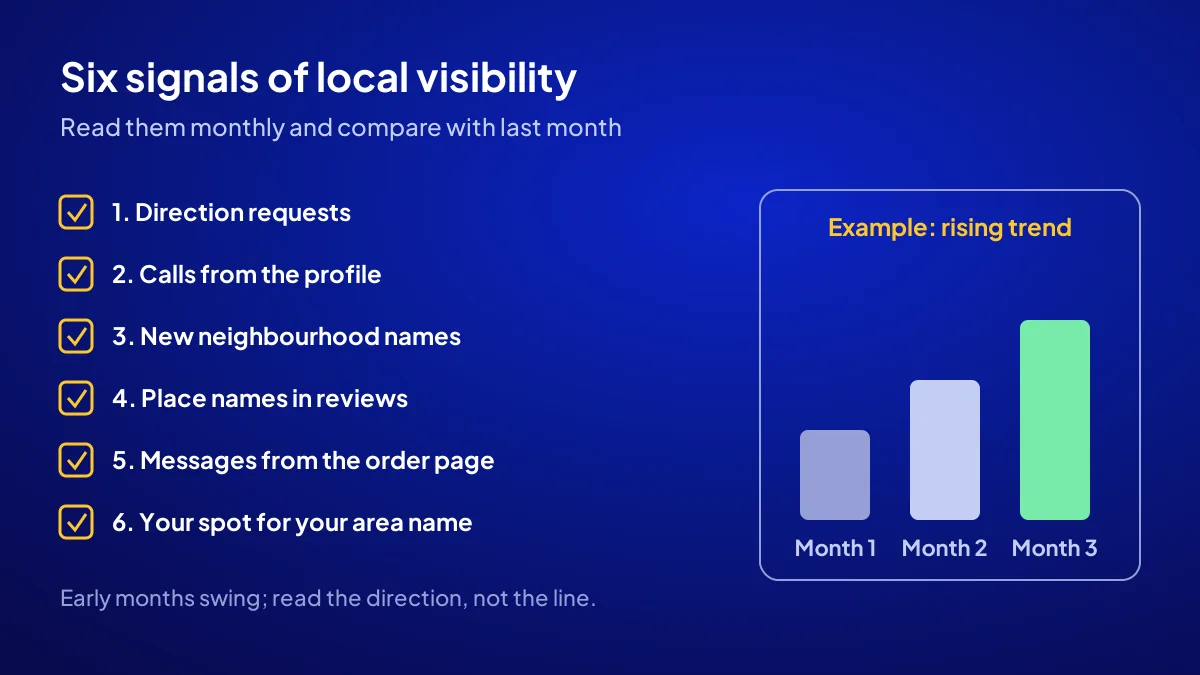
Read six signals once a month. Write them in a notebook or table and compare with the previous month. Irregular numbers in the first months are normal; the direction matters. The overall plan is in the new deli promotion guide, the order of the first three months in the first 90 days plan.
- Direction requests from the profile.
- Calls from the profile.
- New neighbourhood names in the “where do you live” answers.
- Place names mentioned in reviews.
- Messages from the order page.
- Where you appear when you search your own neighbourhood name on a phone.
Getting the setup done with a ready recipe
To set up profile, mobile page and basic SEO in one go, the Website Recipe can be chosen in the Get Visible Online campaign; TRY 36,000 + VAT, upfront and fixed, for 3 months.
When nobody walks in
If direction requests come in but the till is not turning, the problem may be the window or the price, not visibility. The signals help you tell them apart.
Quick Summary
- Local search runs on neighbourhood, street and nickname more than district.
- Build your district dictionary by asking customers at the till.
- Put the dictionary into profile, contact and order pages in natural sentences.
- Google ranks local results on relevance, distance and prominence; all but distance are yours.
- Loyalty wins in Mavişehir, pre-season preparation in Çeşme.
- Read six signals once a month.
Short Glossary
District dictionary: A district dictionary is the list used to collect the neighbourhood, street and nickname names customers give an area.
Prominence: Prominence is the factor Google uses in local results to weigh how well-known a business is.
Direction request: A direction request is the metric used to track how many people take a map route from a business profile.
Next Step
To be found by neighbourhood name, apply for the Get Visible Online campaign. Fill in the needs form and get the recipe that fits your deli.
Frequently Asked Questions
Source: Google Business Profile Help — Tips to improve your local ranking on Google
Sık Sorulan Sorular
For the first two weeks, ask customers at the till where they live and write the answer down word for word. Do they say “Caddebostan” or “Cadde”? That list is your district dictionary.
Into the business description, the contact and order pages, and product descriptions, in natural sentences. Do not stuff keywords; readers notice, and so do search engines.
Pick your own row and the neighbouring row you deliver to. Write the sample sentence to match your reality; if you do not deliver, do not say “delivery”.
Only those you really serve. Copying the same text with a new place name does not work, and readers do not trust such pages.
Often the name the customer types does not match the name you wrote. The customer types “Cadde” or “GOP”, while the profile shows only the official address. Build your district dictionary and use it in natural sentences on profile and website.
According to Google’s help page, on three factors: relevance, distance and prominence. You cannot change distance; a complete profile, the right category and reviews affect relevance and prominence. There is no ranking guarantee.
It is a 3-month period; the price is TRY 36,000 + VAT, upfront and fixed. Ad spend is not included. Results are reviewed together at the end of month one.
Updated: October 2026