
Deli AI visibility in 2027: how your meze shop gets named when clients ask an assistant
Say someone is hosting six people on Saturday night and types into their phone: “Is there a deli in Kadıköy that makes a good cheese and meze platter?” In the AI era, a deli gets chosen through a sentence like that. The assistant splits the question into parts, looks for written evidence online for each part and builds its answer from that evidence. Whether your name comes up depends on that evidence being written about you, clearly and consistently.
Toward 2027 this path is widening: Google’s AI Mode and AI Overviews launched in Turkish in Turkey on 18 February 2026. Google says there are no additional requirements to appear in these features. So a new meze shop does not need a secret setting. It needs its profile, its pages and its sourcing details written plainly enough for an assistant to read.
What sentence does a gourmet client bring to an AI assistant?
A gourmet client does not type a keyword; they describe a situation: guests, evening, district and taste, all in one sentence. The word “deli” is a small piece of it. The real decision rests on details: platter size, timing, sourcing and delivery. To be part of the answer, those details have to exist in writing.
From search box to conversation
Clients who used to type “deli Kadıköy” now explain the whole need and expect a short list.
Details decide
“Good cheese” is not enough. Aged kashar or Ezine? How many does a platter serve, how far ahead do you order? The assistant looks wherever those answers are written.
How does an assistant break a dinner question apart?
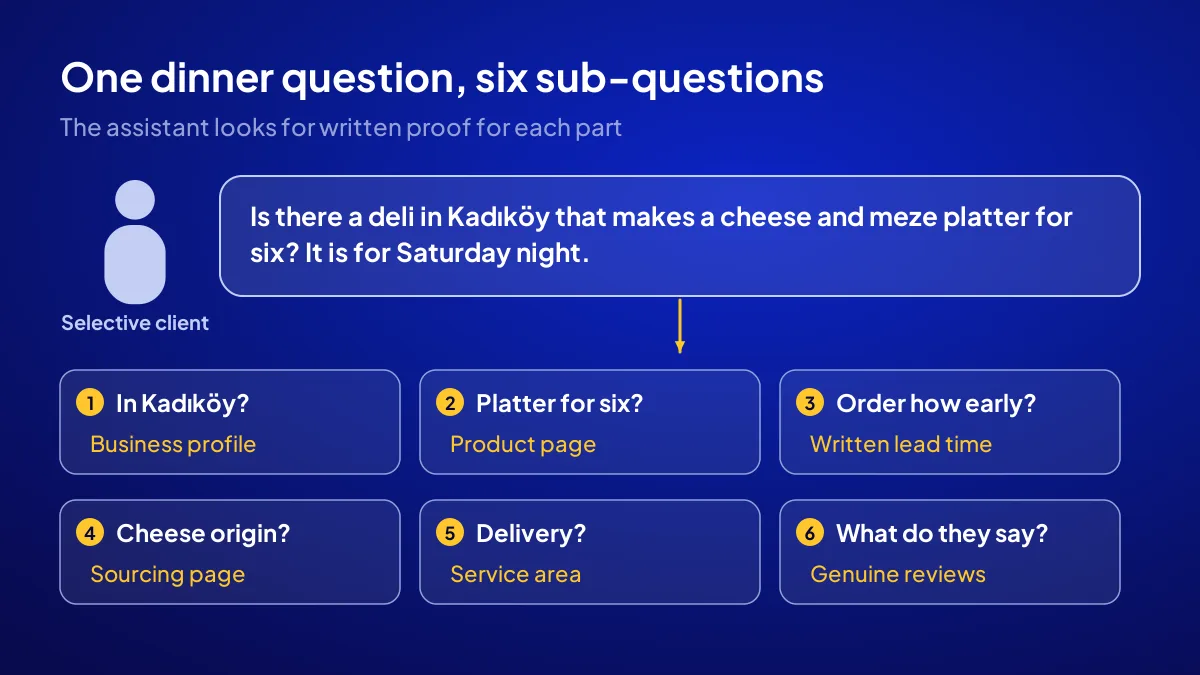
Google describes this in its own documentation as query fan-out: the system runs multiple related searches across subtopics and data sources. A dinner question turns into six small questions. Each answer sits in a different place. Wherever the evidence is missing, your name drops out of the answer.
| Sub-question | Evidence the assistant looks for | Where it lives |
|---|---|---|
| Is there such a place in Kadıköy? | Address, category, opening hours | Google Business Profile |
| Do they make a platter for six? | Platter sizes, guest counts | Product or service page |
| How far ahead should I order? | Written preparation time | Order page, profile description |
| Where do the cheeses come from? | Region, producer, ageing time | Sourcing page |
| Do they deliver? | Districts served | Service area in the profile |
| What do customers say? | Genuine reviews | Profile reviews |
A missing row, a missing name
If one row is empty, the assistant fills the gap from another business’s page, often with that business’s name.
The profile is the first door
The first two rows rely on your profile. For the right category and complete fields, see the deli Google Business Profile guide.
Which habit is settling in toward 2027?
The habit is this: the client consults an assistant before deciding, then checks the map or the website. That is expected to become even more ordinary in 2027. What stays the same is the need for evidence: your address, your pages and your reviews. That is good news for a new meze shop: the rules call for order, not tricks.
Questions are getting longer
Long questions favour the business whose details are written down; generic promotional copy stays weak.
Confirmation still ends on the map
Clients still check location, hours and photos. The assistant opens the door; the open shutter brings them in.
Say you just opened in Moda: how does the first season go?
BU BÖLÜMÜN ÖZETİ
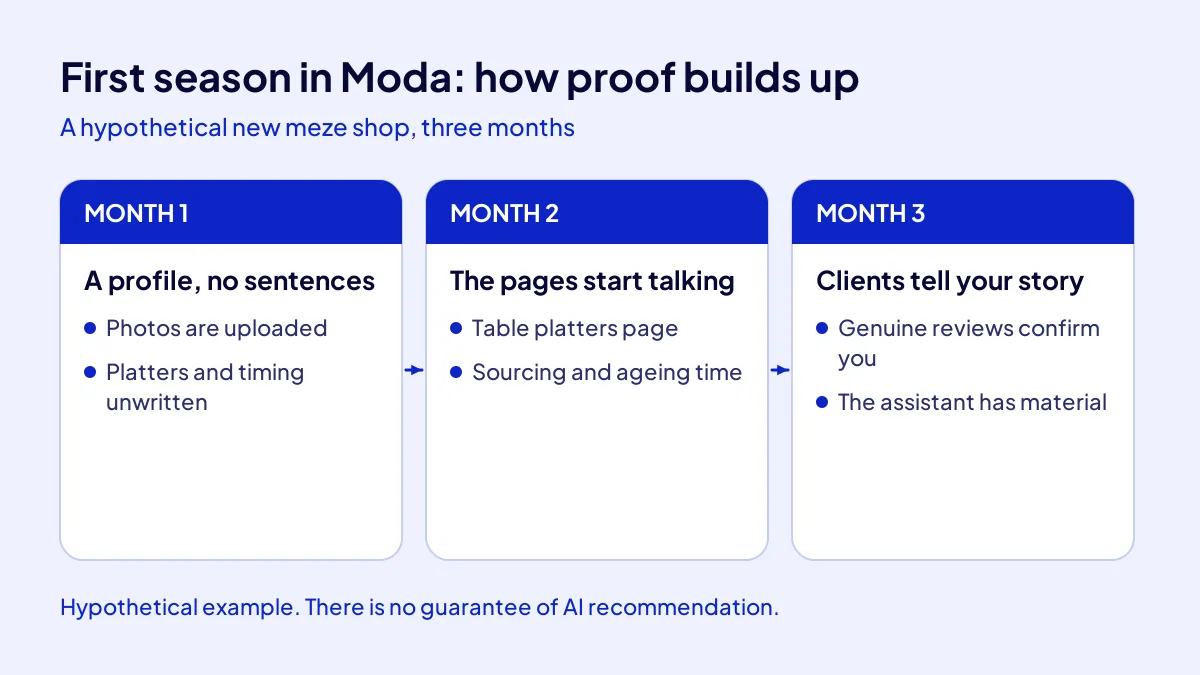
- Month one: a profile, no sentences
- Month two: the pages start talking
- Month three: clients tell your story
A hypothetical scene: you open on a side street in Moda. The counter holds Ezine cheese, a sürk from Antakya, Ayvalık olive oil and six mezes prepared that day. The product is good and the window is beautiful, yet in the first weeks nobody walks in, because not a single line about you exists online.
Month one: a profile, no sentences
Your profile is live with photos, but platter sizes, order times and sourcing are written nowhere. The assistant knows you as “a deli”, not as “the place that makes a meze platter for six”.
Month two: the pages start talking
You add a “table platters” page and a “where our cheeses come from” page, with each cheese’s region, ageing time and best pairing. Now most sub-questions in the table have an answer on your site.
Month three: clients tell your story
A review reads: “I ordered twenty-four hours ahead and the platter was ready on the minute.” That sentence confirms the one you wrote. There is still no guarantee of being recommended, but the assistant now has enough material to mention you.
Why does a window display not make it into the answer?
The unexpected finding: the deli’s strongest asset, its display, is the assistant’s weakest evidence. An assistant cannot look at a photo of a cheese board and work out “serves six, order a day ahead”. Information that is not written down does not reach the answer. A beautiful Instagram post sparks desire; a written line drives the decision.
A sentence under every photo
Write the product name, region and serving size under each post. The image stays; its evidence value rises.
A social account alone is just a window
We cover the gap between display and decision in is Instagram enough for a new deli; here we only look at the assistant’s side.
Why does label wording carry into the assistant’s answer?
An assistant repeats what you write. If your page carries a non-compliant claim, that claim multiplies in answers. According to news reports from March 2026, Turkey’s Ministry of Agriculture and Forestry updated its labelling guide: industrial products cannot be called “homemade”, and “daily” is limited to products with a 24-hour shelf life. “Organic” is reserved for certified products.
Choose the precise word
Instead of “homemade”, write which day and in which kitchen the meze is made. Concrete detail stays within the rules and is better evidence for an assistant.
When unsure, ask
If you produce in your own kitchen, registration and labelling requirements may change. Check your product copy with your Provincial Directorate of Agriculture and Forestry before publishing it.
Which six texts should you write this season?
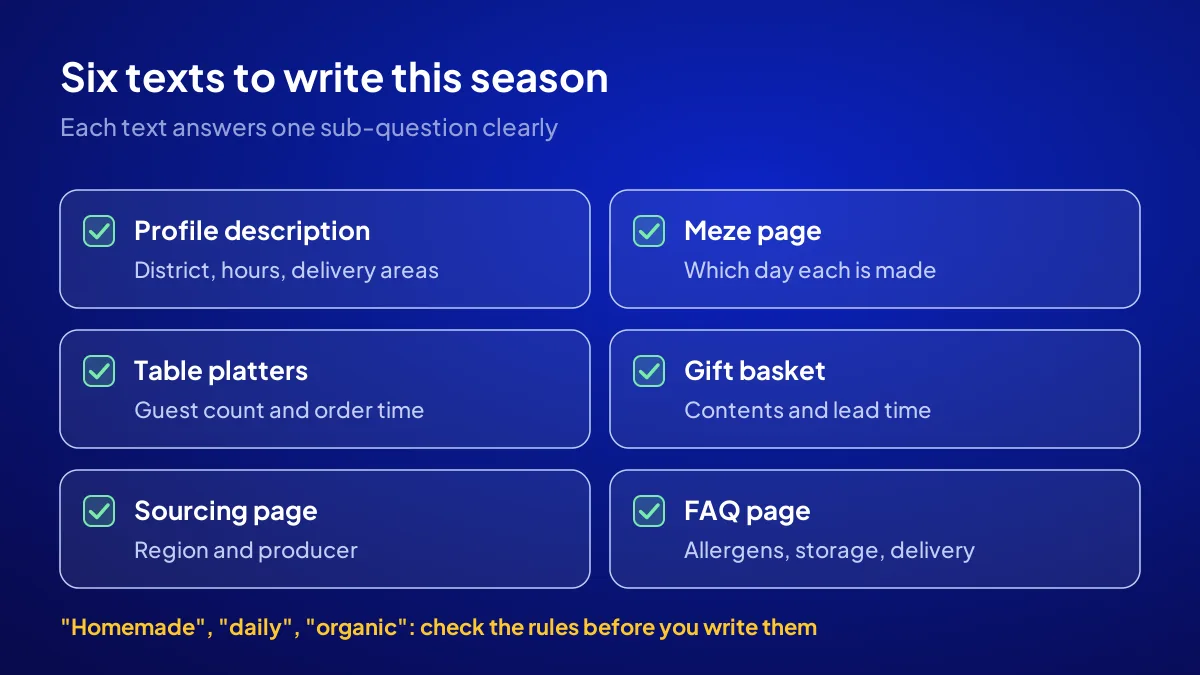
The six texts answer the six sub-questions in the table. Each is a short, plain page that answers a single question clearly. Once all six exist, the assistant no longer needs to borrow pieces from another business to mention you.
- Profile description: district, category, hours and delivery districts.
- Table platters page: platters by guest count and order time.
- Sourcing page: region and producer for each cheese and olive oil.
- Meze page: which meze is prepared on which day.
- Gift basket page: content options and preparation time.
- FAQ page: allergens, storage and delivery answers.
Connecting the six texts to a system
To meet the growing range of questions, the Your Own Digital Brand campaign sets up 108 AI SEO-ready articles across 6 keyword groups along with a brand website, for a fixed TRY 36,000 + VAT, with 12 brand slots and a deadline of 1 November 2026. Details are on the campaign page.
The bigger picture
The full promotion plan is in the new deli promotion guide, and the order of the first three months in the first 90 days plan. The general logic of how assistants recommend a brand is in how to get recommended by assistants.
One principle: the assistant does not taste you, it reads you. Write the line it will read today.
Quick Summary
- A gourmet client describes a dinner situation to the assistant, not a keyword.
- The assistant splits the question and looks for written evidence for each part.
- Google says there are no extra requirements to appear in its AI features.
- Display photos do not reach the answer; platters, timing and sourcing must be written.
- Claims such as “homemade”, “daily” and “organic” are regulated.
- Six short pages answer the six sub-questions.
Short Glossary
Query fan-out: Query fan-out is the method used in AI search to split one question into subtopics and run a separate search for each.
Sourcing details: Sourcing details are the descriptions used to show clients which region and producer a product comes from.
AI Mode: AI Mode is the Google search view used to get an AI answer supported by links.
Next Step
To build your meze shop on a brand website assistants can read, apply for the Your Own Digital Brand campaign. Just mention the 10% coupon code when you apply.
Frequently Asked Questions
Source: Google Search Central — AI features and your website
Sık Sorulan Sorular
It can, but there is no guarantee. The assistant builds its answer from written evidence online. If your profile, pages and reviews cover the parts of the question, the chance of your name appearing rises.
Google says there are no additional requirements to appear in AI Overviews and AI Mode. The basic condition is that your page is indexed in Google and clearly written.
It includes 108 AI SEO-ready articles across 6 keyword groups, plus brand consulting, a digital identity, a domain and a six-page brand website, for a fixed TRY 36,000 + VAT.
Updated: October 2026