
ChatGPT vs Gemini vs Perplexity citations: how three assistants show their sources
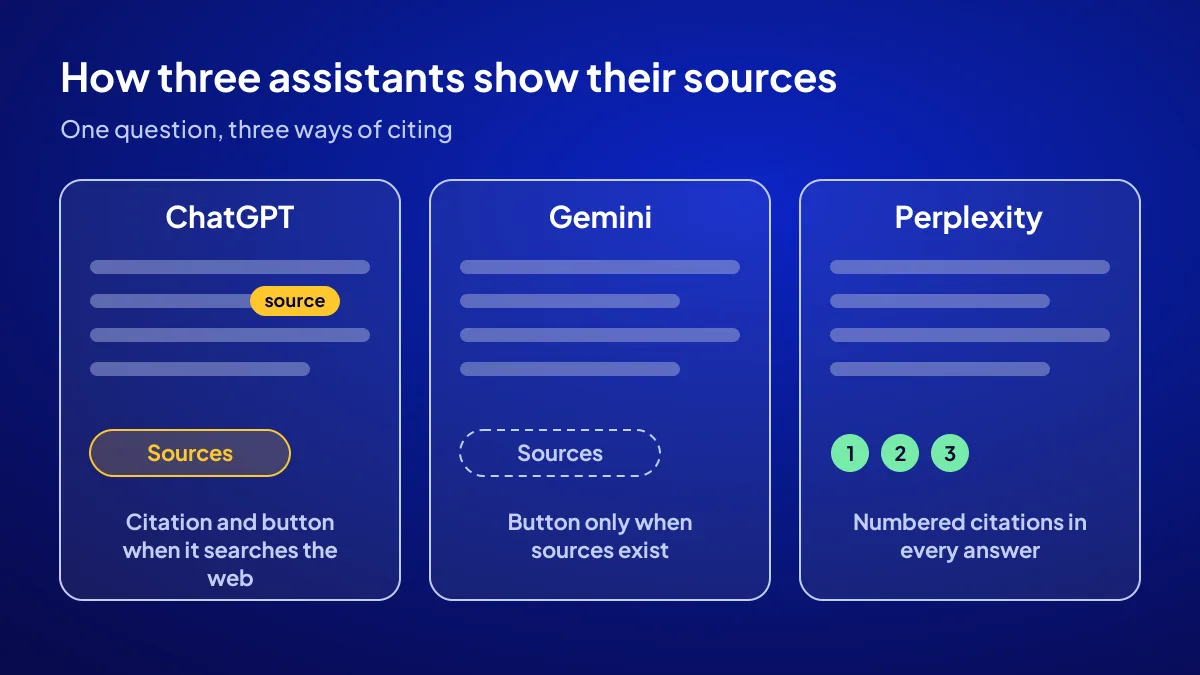
The citation differences between ChatGPT, Gemini and Perplexity come down to three things: how often they show a source, how they show it, and which door they use to reach your site. Perplexity puts numbered sources in every answer. ChatGPT adds citations when it searches the web and lists them under a “Sources” button. Gemini shows sources when they are available; its own help page says plainly that not every answer has them.
The practical point for a business is simple. To be cited by any of them, your site must be readable and must answer the question clearly. The difference is where the door sits. You allow OAI-SearchBot for ChatGPT and PerplexityBot for Perplexity; for Google’s AI answers, a page only needs to be indexed and eligible for a snippet. None of them guarantees a citation.
Which four criteria does this comparison use?
Four: how the source appears, whether it appears in every answer, which crawler visits your site, and what measurement the site owner gets. Together they answer an owner’s three questions: will customers see me, what do I need to set, and where do I track the result. User numbers are left out, because they do not tell you what to do with your site.
How does the source appear in the answer?
BU BÖLÜMÜN ÖZETİ
- ChatGPT: sources when it searches
- Gemini: a button when there is a source
- Perplexity: citation is the backbone
All three link to their sources, but placement and frequency differ. According to Perplexity’s help page, each answer includes numbered citations linking to the original sources. ChatGPT adds citations to answers that use web search. In Gemini, when sources are available, a “Sources” button appears at the bottom of the answer or inline.
ChatGPT: sources when it searches
OpenAI’s help page says ChatGPT may search the web automatically when a question benefits from current information, and sometimes partners with other search providers. The “Sources” button lists cited sources alongside other relevant links.
Gemini: a button when there is a source
Google’s Gemini help page is direct: not all responses include related links or sources. When an answer quotes a long passage directly from a web page, that page is listed in the sources.
Perplexity: citation is the backbone
Perplexity interprets the question, searches the web in real time and compiles what it finds into one answer. A numbered citation is part of every answer.
Which crawler visits your site, and what do you need to set?
BU BÖLÜMÜN ÖZETİ
- OpenAI’s three crawlers
- Perplexity’s two crawlers
- The Google side
ChatGPT search uses OAI-SearchBot and Perplexity search uses PerplexityBot; both need permission in your robots.txt file. Google’s AI Overviews and AI Mode have no extra requirement or special setting: the page needs to be indexed and snippet-eligible. These settings are free, but one wrong line hides all your work.
OpenAI’s three crawlers
OAI-SearchBot is for search. GPTBot collects content for model training, and blocking it does not block search visibility. ChatGPT-User opens a page when a user asks and does not crawl automatically. OpenAI says robots.txt changes take about 24 hours to reach its search systems.
Perplexity’s two crawlers
PerplexityBot crawls to surface and link websites in search results, and Perplexity says it is not used for training foundation models. Perplexity-User opens a page in response to a user’s question and may link it in the answer.
The Google side
Google’s AI features guide says AI Overviews and AI Mode may use query fan-out, running several related searches, so a wider set of links can appear than in classic search. The Google-Extended setting governs use of content for training and grounding in Google’s other AI systems.
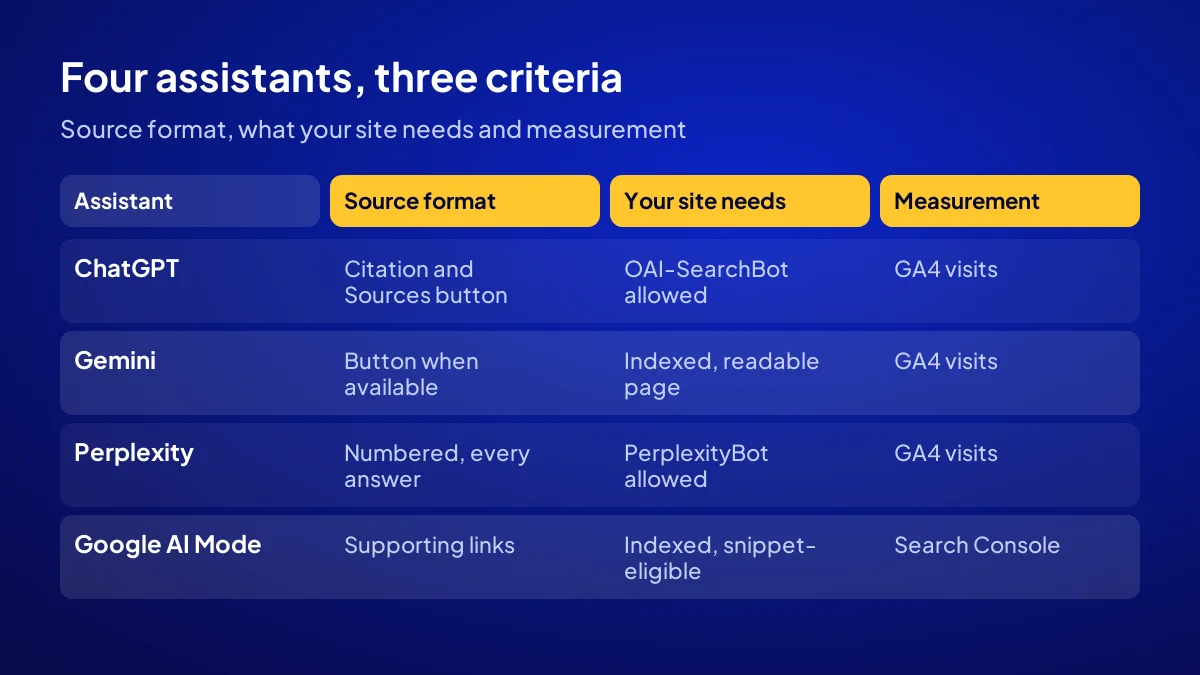
What do the four criteria look like in one table?
The table sums up the work on your side. Rows are assistants, columns are criteria. Google’s AI Overviews and AI Mode have been live in Turkey since 18 February 2026, so they sit in a fourth row. The measurement column rests on the official help pages we reviewed.
| Assistant | How the source appears | In every answer? | Needed on your site | Measurement for owners |
|---|---|---|---|---|
| ChatGPT | Inline citation, Sources button | In answers that use web search | OAI-SearchBot allowed | Click-through visits in GA4 |
| Gemini | Sources button, at the bottom or inline | No, only when available | Indexed, readable page; a Google-Extended decision | Click-through visits in GA4 |
| Perplexity | Numbered citation | Yes | PerplexityBot allowed | Click-through visits in GA4 |
| Google AI Overviews and AI Mode | Supporting links | When the feature shows | Indexed, snippet-eligible page | Search Console Performance report, Web type |
What the table does not show
It does not show which assistant has more users or sends more clicks. Figures on which kinds of sites get cited are in AI citations in numbers.
Which business should look at which assistant first?
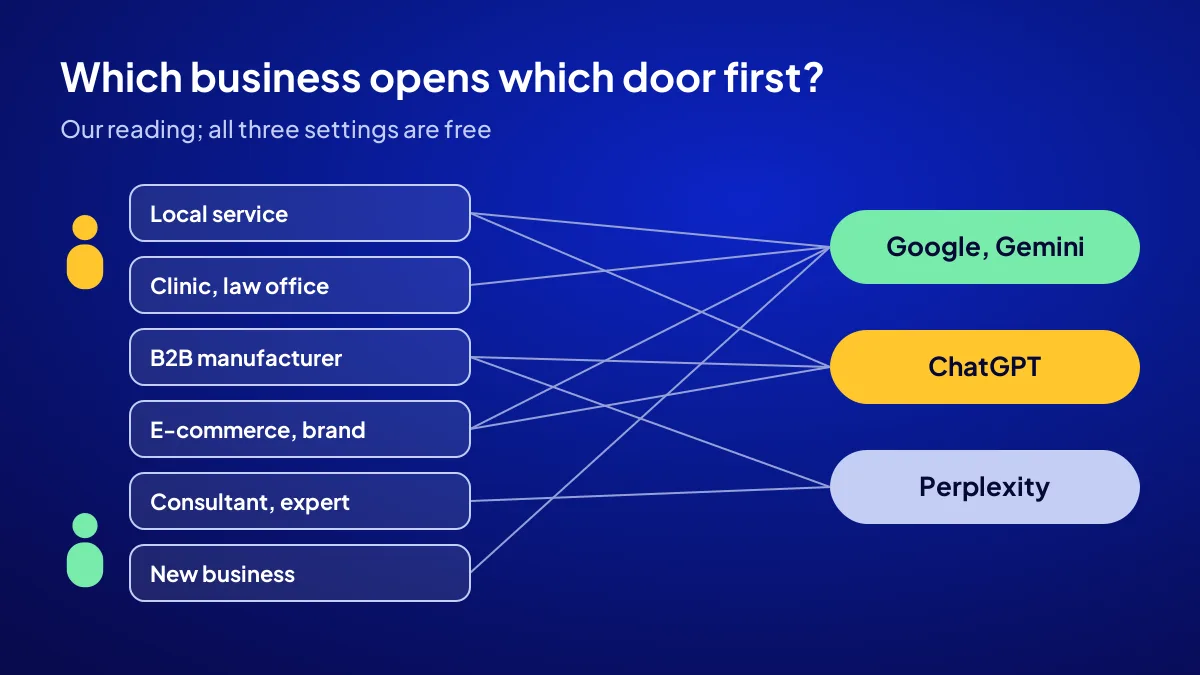
Start with where your customer asks, then set up that door. The matching below is our reading, not a fixed rule. Because every setting in the table is free, opening all three doors makes sense for most businesses; the order only decides where effort goes first.
- Neighbourhood services, hair salons, dry cleaners: Google first, then ChatGPT; both can return local results
- Clinics and law offices: Google and Gemini first; check your professional rules and the advertising regulation first
- B2B manufacturers: Perplexity and ChatGPT first; buyers research by comparison
- E-commerce and brands: ChatGPT and Google first; product questions are asked in both
- Consultants and experts: Perplexity first; signed, sourced articles stand out in a numbered list
- Newly opened businesses: Google first; a page that is not indexed passes no door
Say you run an architecture office in Çankaya
A client asks Perplexity what to look for in architects who restore old buildings in Ankara. Numbered sources line up under the answer. If you have a page on the order of restoration permits, it can be a candidate for that list; if not, the client walks past your door.
Test how you appear today
See where you stand before changing settings. How to ask three assistants the same question and record the result is in how does my brand appear in AI.
What work is common to all three?
BU BÖLÜMÜN ÖZETİ
- Interfaces keep changing
- Building the common work in one package
- Order for a shop, office or clinic
A page that answers the question in its first paragraph. Assistants differ, but they look for similar things when they pick a source: readable text, a clear author and a direct answer. Crawler permission opens the door; content decides what is on the shelf.
Interfaces keep changing
How assistants show sources changes from month to month. We follow the latest ChatGPT changes in ChatGPT citations: the latest.
Building the common work in one package
Adapte’s AI SEO campaign builds this common work: AI crawler settings, structured data, 108 articles in 6 question groups, Bing Webmaster Tools and Search Console setup. The package is a fixed TRY 36,000 + VAT, delivery takes 30 days, and no citation is guaranteed.
Order for a shop, office or clinic
Which step comes first for your type of premises is in how to get my business place cited by ChatGPT.
Quick Summary
- Perplexity shows numbered sources in every answer.
- ChatGPT cites and shows a Sources button when it searches the web.
- Gemini does not cite in every answer; a button appears when sources exist.
- ChatGPT needs OAI-SearchBot allowed, Perplexity needs PerplexityBot.
- The clearest owner report is in Google Search Console.
- No assistant guarantees a citation.
Short Glossary
Numbered citation: A numbered citation is a sequenced link used to show which source a piece of information in an answer comes from.
Query fan-out: Query fan-out is the method an AI system uses to split one question into several related searches to gather sources.
PerplexityBot: PerplexityBot is the crawler Perplexity uses to surface and link websites in its search results.
Next Step
If you want all three doors opened at once, build it in one package. Apply for the AI SEO campaign and get your starting diagnosis card.
Frequently Asked Questions
Source: Perplexity Help Center — How does Perplexity work?
Sık Sorulan Sorular
Being recommended means the assistant offers you as advice. Being cited means it bases part of its answer on your page. This comparison looks at the second.
Page owners, not consumers. We are not asking which assistant is smarter, only how you get through each door. The general signals AI weighs are in how to get my website cited by ChatGPT.
From a site owner’s view, Perplexity is the most transparent: numbered sources in every answer and a clear crawler rule. Google wins on measurement, because it gives owners a report. ChatGPT sits between them: it cites and its setting is clear, but the help pages we reviewed describe no owner report that counts citations.
Perplexity shows numbered sources in every answer. ChatGPT uses citations and a Sources button in answers that use web search. Gemini shows a Sources button only when sources are available.
Crawler permissions are separate: OAI-SearchBot for ChatGPT, PerplexityBot for Perplexity. The content side is shared; a page that answers the question clearly in its first paragraph works for all three.
No. There is no guarantee of being recommended or cited. Readability and recognisability infrastructure is built and measured with starting and closing diagnosis cards.
Updated: October 2026