
Why isn’t my product cited by ChatGPT? Six gaps on the product page to close
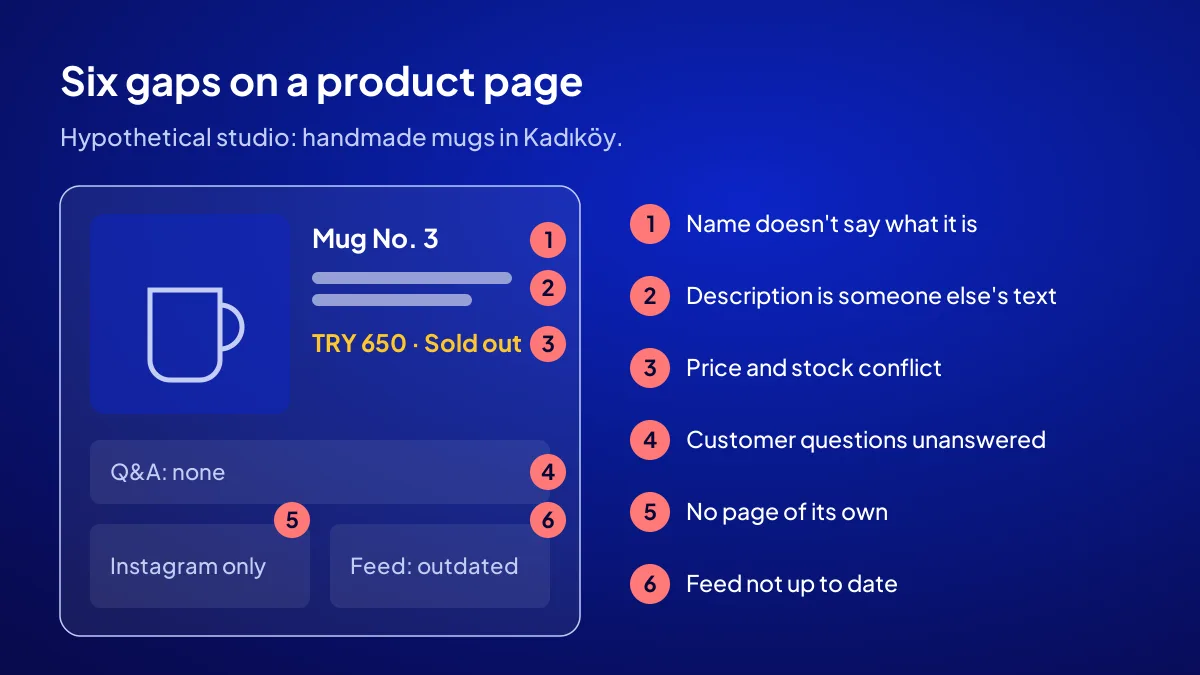
If you are searching for how to get your product cited by ChatGPT, start with why it is not cited yet. The cause is usually one of six gaps on the product page: the name does not say what it is, the description is someone else’s text, price and stock disagree, customer questions go unanswered, the product has no page of its own, or the product feed is out of date. Closing them raises the odds; there is still no guarantee.
Say you run a ceramics studio in Kadıköy making handmade mugs and plates. Your own site lists 40 products with careful photos. A customer asks ChatGPT for “handmade, dishwasher-safe ceramic mugs in Istanbul”. Other brands appear in the answer, you do not. Yet your mug is exactly that.
When does a product page become a source for AI?
When AI writes about a product, it reads the page itself, the structured data on it and, where there is one, the product feed. Google advises keeping Merchant Center and Business Profile details current and making sure structured data matches the visible text. The plainer the page, the better its chance of being the source.
The surprise: ChatGPT’s shopping shelf is not in Turkey yet
According to OpenAI’s merchant page, shopping in ChatGPT is currently live only for users in the U.S., with more regions to follow over time. For a studio selling in Turkey, that means the real foundation today is your product page and the pages that describe it.
Being cited is not the same as being sold
A citation means being named as a source under the answer. Even if AI does not recommend your mug, it may quote your page to answer “is it dishwasher-safe”. The business-wide roadmap is in how to get my business place cited by ChatGPT.
Gap 1: Does the product name say what it is?
On the studio’s site, the product is called “Mug No. 3”. At the counter that works; AI, which is not holding the mug, looks for product type, material and a distinguishing feature in the name. “Handmade stoneware ceramic mug, 350 ml, dishwasher-safe” answers three sub-questions at once.
Use the customer’s words
A customer may not say “stoneware”; they say “ceramic mug”. Build the name from their words and leave the technical term for the description.
Name the variants
If the mug comes in three colours, show the colour in the product or variant name. AI reads the difference between “blue” and “navy” from text, not from the photo.
Gap 2: Whose text is the description?
Many product pages carry a one-line description or a copy of the supplier’s text. Google’s helpful content guidance asks whether content provides original information. A description that sits word for word on a hundred other sites tells AI nothing new. The studio’s description can carry something no one else has: how the piece is made.
Size, material, care
Volume, weight, glaze type, microwave and dishwasher details belong in the first lines. If the answer is not written down, both customers and AI look for it at another counter.
The studio’s original detail
“Each mug is shaped by hand and fired twice, so no two are identical” is the signature of your work. The same logic for articles is in why my articles are not cited.
Gap 3: Do price, stock and structured data say the same thing?
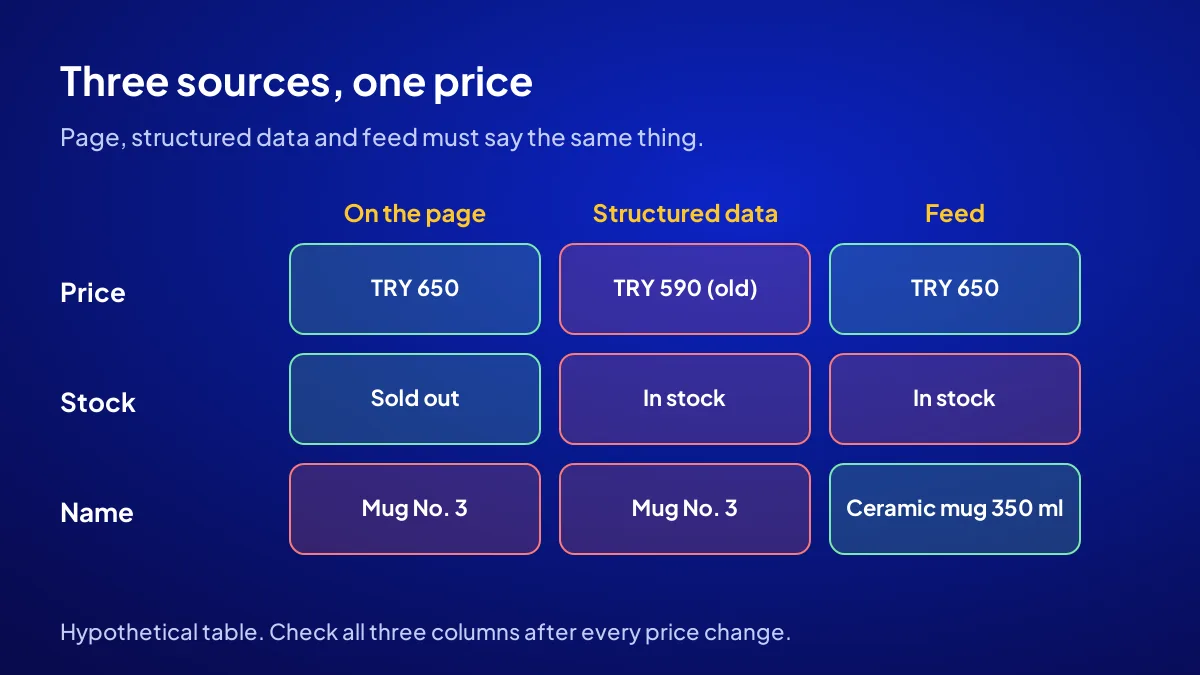
The page says TRY 650, the structured data still says TRY 590. Stock shows sold out, the feed says available. To AI, that conflict signals unreliability. Google explicitly asks for structured data to match the visible text, and its product markup separates pages where you sell directly from pages where you do not.
| Detail | On the page | Structured data | Product feed |
|---|---|---|---|
| Price | TRY 650 | TRY 590 (old) | TRY 650 |
| Stock | Sold out | In stock | In stock |
| Name | Mug No. 3 | Mug No. 3 | Ceramic mug 350 ml |
The table is hypothetical, but familiar
The rows are built for the studio example. Such conflicts tend to appear when a sale ends or stock is updated by hand, so check all three columns after every price change.
Why structured data is its own topic
Why AI confuses you without structured data is covered in why structured data matters.
Gap 4: Are customer questions answered on the page?
A product page should be the counter conversation in writing. If “is there gift wrap, what if it breaks, how many days to deliver” sit at the bottom with short answers, AI can quote them. Without them, the answer comes from another seller’s page.
Which questions to write
- Dishwasher and microwave use
- Delivery time and breakage-proof packing
- Return and exchange terms
Reviews and the legal line
Genuine reviews strengthen a page. In Turkey, the Commercial Advertising regulation amendment in force since 1 July 2026 bans publishing consumer reviews whose purchase cannot be verified. Collect reviews only from customers who ordered.
Gaps 5 and 6: Does the product have its own page and a current feed?
If a product lives only in an Instagram post or only on a marketplace, no product page speaks for you. Once it has its own page, the feed comes next. Google says providing both structured data on the page and a Merchant Center feed maximises eligibility for its experiences.
An Instagram shop window is not enough
Instagram is a lovely window, but it does not hold price, size and return terms on an orderly page. Customers ask in DMs and the till stays quiet, because the answer is not on a public page. How channels behave differently in AI is shown in ChatGPT, Gemini and Perplexity compared.
What is known about feeds
OpenAI says catalogues connect to ChatGPT through feeds, via SFTP, APIs or major commerce platforms, and that Shopify and Etsy catalogues are already integrated. It also says it is moving away from a standalone Instant Checkout, with purchases completed on merchants’ own sites. That makes your own product page matter more.
In what order should you close the six gaps?
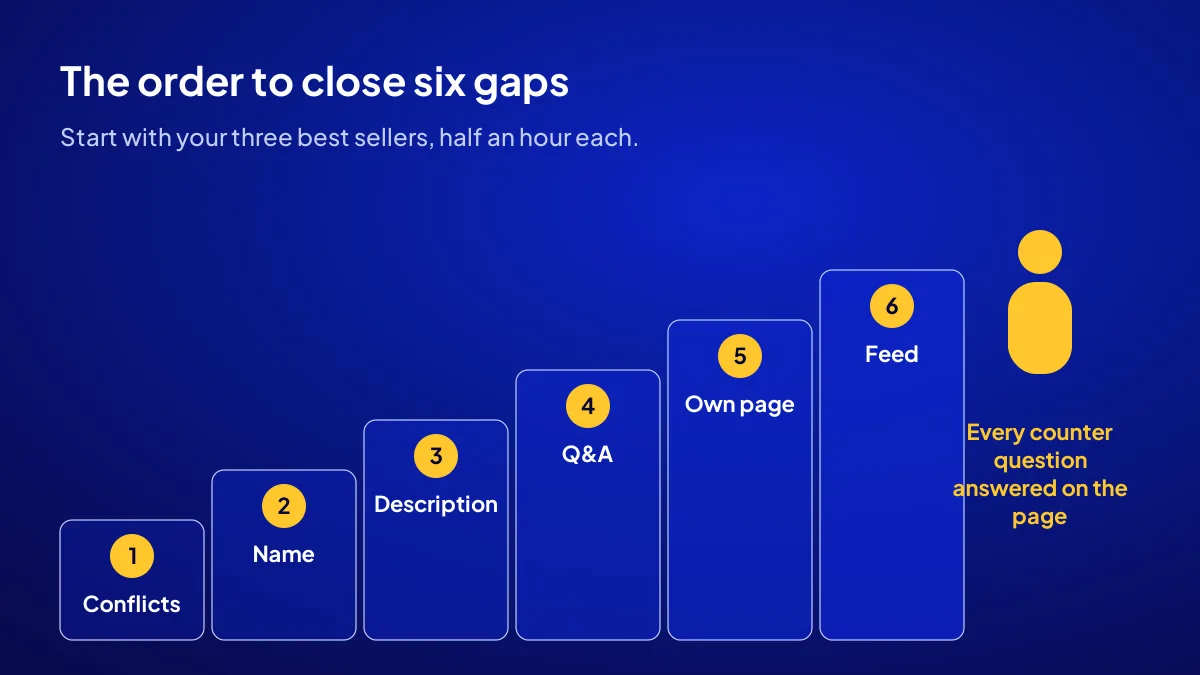
Start with your three best sellers, not all 40 at once. The order removes the most conflict with the least effort. For the studio it takes about half an hour per product; then you copy the pattern to the rest.
- Remove price and stock conflicts; page, structured data and feed must agree.
- Rewrite the product name in the customer’s words.
- Put size, material and care in the first line of the description.
- Add three short Q&As at the bottom of the page.
- Give Instagram-only products their own page.
- Check the feed after every price change.
If you want to build it together
Adapte’s AI SEO campaign sets up structured data, adds Q&A blocks to existing product pages and writes 108 articles across 6 question groups. It covers e-commerce sites and brands. Fixed TRY 36,000 + VAT, 30 days, 12 businesses per round, no recommendation guarantee. The whole-site view is in how to get my website cited by ChatGPT.
One principle
The Kadıköy studio’s lesson: if a product page does not answer every counter question in writing, AI takes the answer from someone else’s counter.
Quick Summary
- An uncited product usually has one of six page gaps.
- ChatGPT shopping is live only in the U.S. for now; in Turkey the product page is the foundation.
- The name should state product type and key feature in the customer’s words.
- Price, stock and name must match across page, structured data and feed.
- Reviews without a verifiable purchase cannot be published.
- No citation guarantee exists.
Short Glossary
Product feed: A product feed is the data file a store uses to pass product names, prices and stock to platforms on a regular basis.
Structured data: Structured data is the markup used so search engines and AI can read page information in machine-readable form.
Merchant Center: Merchant Center is the seller tool used to send product data and feeds to Google.
Next Step
Check your three best sellers against the six gaps today; to build structured data, Q&A blocks and the content family together, apply for the AI SEO campaign and mention your coupon code when you apply.
Frequently Asked Questions
Source: OpenAI — Power product discovery in ChatGPT (merchants)
Sık Sorulan Sorular
According to OpenAI’s merchant page, shopping in ChatGPT is currently live for U.S. users and will expand to more regions over time. In Turkey, your product page is the main foundation.
Google says no special schema.org markup is needed for its AI features. Existing product structured data should still match the visible page.
Then no product page speaks for you; the page AI can rely on is the marketplace’s.
No. The regulation amendment in force since 1 July 2026 bans publishing consumer reviews whose purchase cannot be verified.
Yes. It covers e-commerce sites and brands; no recommendation guarantee is given.
Fixed TRY 36,000 + VAT, or TRY 43,200 at 20 percent VAT; check the current rate on the invoice. Delivery in 30 days, 12 businesses per round, 10 percent off with a coupon.
Updated: October 2026